This was a cheap acquisition. It's ok but won't reach infinity on both my adapters.
It does have discolouration behind (or inside) the front element.
Here are some poor attempts to capture it (most visible below the word 'Elmar')
It has a slight green/brown tinge to it and looks a little like condensation/oil.
There's little hope of getting it looked at here for any price that would make it worthwhile.
I just wondered what it was - and if I can get at it to try removing it? Is the back of the front element accessible in this lens? Anything I can do about the infinity problem?
Thanks.
martindesu wrote:
...is there a consensus on *the* Leica-R lenses worth having in one's collection?
"Consensus" might be a bit strong. The top R lenses are good enough that whether they are better than other top lenses is mostly a matter of taste. Most R lenses have been surpassed from a technical standpoint, though their handling, durability, and relatively low cost make them desirable for what they do offer. Personally, the stand-out feature of most of these lenses is that they address my pet peeve, longitudinal CA.
A typical can't-really-argue-against-but-for-cost kit might consist of the latest 19/2.8, 28/2.8, 50/1.4, 90/2 or 100/2.8, and 180/2.8. Anything APO, as those last three are, plus a few more telephotos (which aren't my area of expertise).
A set of lenses that might be better for storytelling than pristine documentary would be the earlier versions of all those lenses. Additionally, the 35/2.8, 50/2, 60/2.8, and 90/2.8 lenses all offer good value, at least as far as Leica goes. This isn't comprehensive, just from the top of my head.
JonPB wrote:
A typical can't-really-argue-against-but-for-cost kit might consist of the latest 19/2.8, 28/2.8, 50/1.4, 90/2 or 100/2.8, and 180/2.8. Anything APO, as those last three are, plus a few more telephotos (which aren't my area of expertise).
I consider the inclusion of the 180/2.8 APO vs the 180/2 APO situational due to handling issues. While the 180/2.8 is far lighter, it isn't light enough to hang from a lens mount unsupported, making its lack of a tripod collar a frustrating disadvantage.
For handheld shooters, the 180/2.8 may still be preferable. Unlike the 180/2, the 180/2.8 is light enough that most can probably support it manually (ie without a monopod).
For tripod shooting, however, the 180/2.8 requires something like this which, although cool, is much more cumbersome than the excellent, low-profile tripod collar built right into the 180/2.
Mescalamba wrote:
Your Vario 21-35 is one of those pretty good too. Just regular Speedbooster?
Regular Speed Booster (from Metabones, not a knock-off). I'm curious about the Ultra, but I haven't seen reviews of it...at all. Hmm. Maybe I should email them. :-) Anyhow, most of the shots I post here are on Flickr at full resolution (sometimes cropped, but rarely downsized), if anyone's curious to see the pixels my kit produces.
Oh, and, Lee's right--different lenses have their quirks. I'm mostly a wide-angle guy, though, so my choices are far more limited than in the realm of excellent telephotos. But I suppose it is safe to say that it doesn't make sense to buy any of these lenses, or anything else alt in this price range, without investigating it first.
Elmarit-R 35 (III), Speed Booster, NEX-7. I think the lens was around f/4 (aka 25mm f/2.8). I don't know how the field curvature seen here relates to the Speed Booster, but this is the first time I've seen it so strongly; note the upper left and bottom right corners.
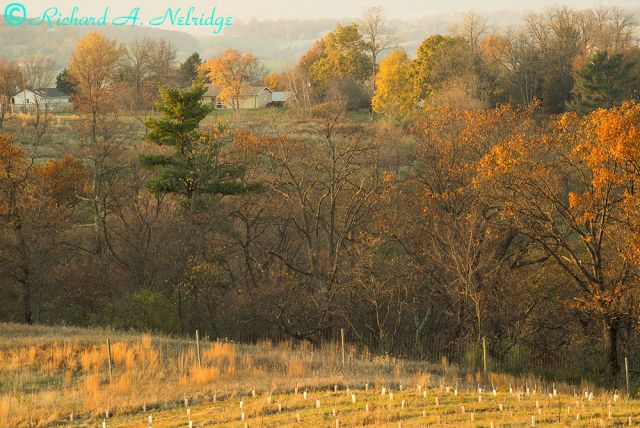
Here are some images cross posted in the Sony A7/A7r/A7s image thread taken last evening in Magic Hour and around sunset at the Trexler Nature Preserve, Schnecksville, PA with my tripod mounted Leica R 280mm f4 Apo Telyt lens and my A7r camera. All images shot at f8 for DOF and processed in LR5.6.