Samuli Vahonen
Offline
• • • •
Upload & Sell: Off
|
 p.188 #20 · ZE/ZF/ZM Images (Official Thread!) p.188 #20 · ZE/ZF/ZM Images (Official Thread!) | |
Peixe wrote:
I finally sold my ef 24-70mm f/2.8L lens and I am tempted to get the Zeiss 1.4/50mm planar.
Quick question on this lens...
based on some reviews, is that you need to use Live View to really focus correctly? Is that a true statement? I have the first generation of Canon 5D and that is not an option.
Peixe, it all depends on your requirements and how you use images. I you don't print (or just print 15x10/6"x4") and don't enlarge your images on your screen and have pretty small screen on your computer you may never see any issues. There are also people who don't anyway see any issues, e.g. post photos to forums which obviously are mis-focused and can be seen even on the 700-1000px wide thumbnail.
Without live view biggest problem is that 5D/5DmkII tolerances are quite loose and based on my experience of 7 different bodies of 5D and 5DmkII all except one would need shimming for accurate focusing. Once you get your body shimmed so that Ee-S screen is perfectly showing focal plane issues caused by lens start to become important. If you use the standard screen then any tolerances etc. won't matter since the standard screen on 5D and 5DmkII shows depth of field equivalent of about f/5.6.
What comes to Zeiss 1.4/50 planar there are two main issues which will give headache when manually focusing:
- Focus shift - when you focus with full aperture and take picture with closed aperture focus shifts towards infinity. Focus shift is larger on short distances and disappears on large distances (hard to say at which distance, maybe 15 meters/45 feet). General guideline to mitigate focus shift is to focus at shooting aperture or if shooting aperture is smaller than f/2.8 then focus with f/2.8 - e.g. when shooting with f/2.2 focus with f/2.2, but when shooting with f/5.6 then focus with f/2.8. Also it's possible to mitigate focus shift just by estimating how much the focus will shift and focus to some object a little closer to camera than the intended focus plane, but in order to do this one needs to know the focus shift behavior very well and have very good estimation skills. Some people will claim that stopping down to f/5.6-8 will take care of the focus shift, this again comes question how you use your images - even on A4 size printout I can clearly see where the actual focus plane has been when shooting image, this is because sharpness inside depth of field (DOF) is not homogeneous but instead peaks in middle or thereabouts of the DOF.
- Aberrations - the viewfinder image (as well as live view image) is low on contrast and has some sort of "haze" on top of it making it hard to focus at full aperture. Aberrations are worse on close focusing distances, but also picture quality is low (unless you want to shoot wide open close ups for the funky bokeh) so mitigating focus shift will help the viewfinder image as well. Focus shifting on this lens is actually caused by uncorrected spherical aberrations, when closing down they get corrected but as side effect focus plane shifts.
In practice mitigate focus shift requires focusing by pressing the DOF button at the same time. Also if you shoot at f/5.6 you need first to focus with f/2.8, I have used method in which I focus by using Av-mode and then take the actual shot in M-mode, and due to this I don't need to adjust the aperture back and forth.
However since you have 5Dmk1 I would recommend Contax Planar T* 1.4/50 or 1.7/50, due to them having manual aperture ring. They can be adapted by using C/Y -> EOS adapter. According to some 1.4 planar is slightly sharper, thou I don't see big differences. Benefits of f/1.7 version is that aperture is quite round until f/2.2 (between f/2 and f/2.8, there is no click but this is the "optimum aperture" of this lens) where it tends to be more clearly hexaconal shaped in 1.4 version, from f/4 both are hopelessly hexaconal. Drawbacks of Contax versions are a little different colors compared to ZEs, closed down aperture shape is hexaconal and issues caused by using lens with adapter (tolerances e.g. sample variance on Canon 5D is so bad that same lens can hit mirror in one camera but not in another, no EXIF/wrong aperture recorded). One option of course is to use ZF version of lens adapted, but I don't recommend that since it's really difficult to learn manual focusing fast when some of your lenses require you to turn clockwise and some anti-clockwise for infinity.
Gary, I liked the 2nd last one. The only one which sky isn't blown, which I think is the reason why in some of the images sky looks weird since it's just 1/2-1 stop more than sensor can take and blue channel clips, and on the clouds all channels clip. Some of the images maybe could be recovered if you shoot them as RAW and have RAW program, which allows to recover highlights, e.g. in Apple Aperture the slider is name "Recovery". Compositionally I liked the 1st ZF35 image, but the sky is way too much blown out.
rsolti13, last one is great, thou tilting horizont is a little distracting but if you would straighten it then the pier would look tilted. You need thick fog for this pier to hide the tilting horizon 
Akul, I agree that wide range of subjects (like in Alternative image thread) makes this much more interesting that watching just landscapes or portraits for example. I find this thread often giving some inspiration, challenge and causing me thinking "hmm, I have never considered this lens to be used like this, let's try it"
----------
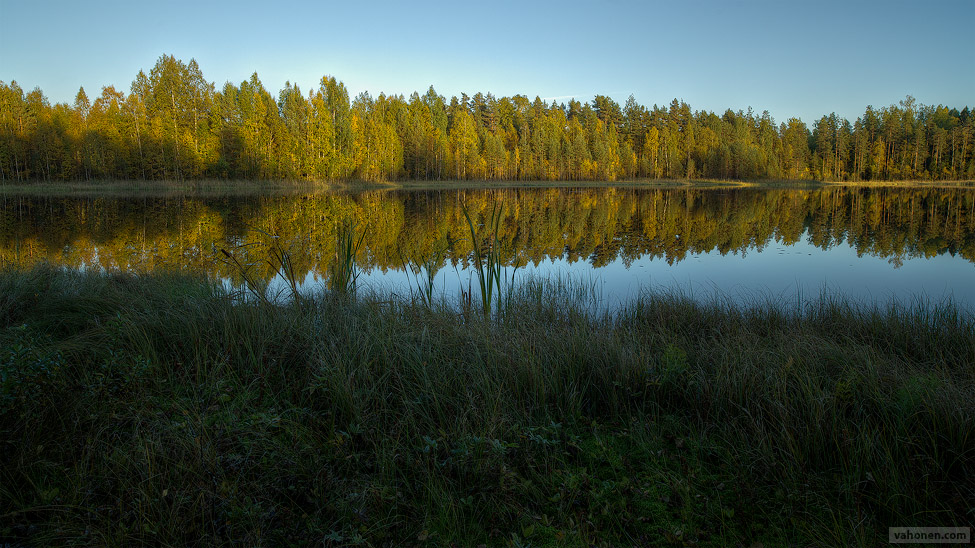
Kortejärvi 15 - Carl Zeiss Distagon T* 2.8/21 @ f/9, HDR, ISO 100
Samuli
|


 ).
).
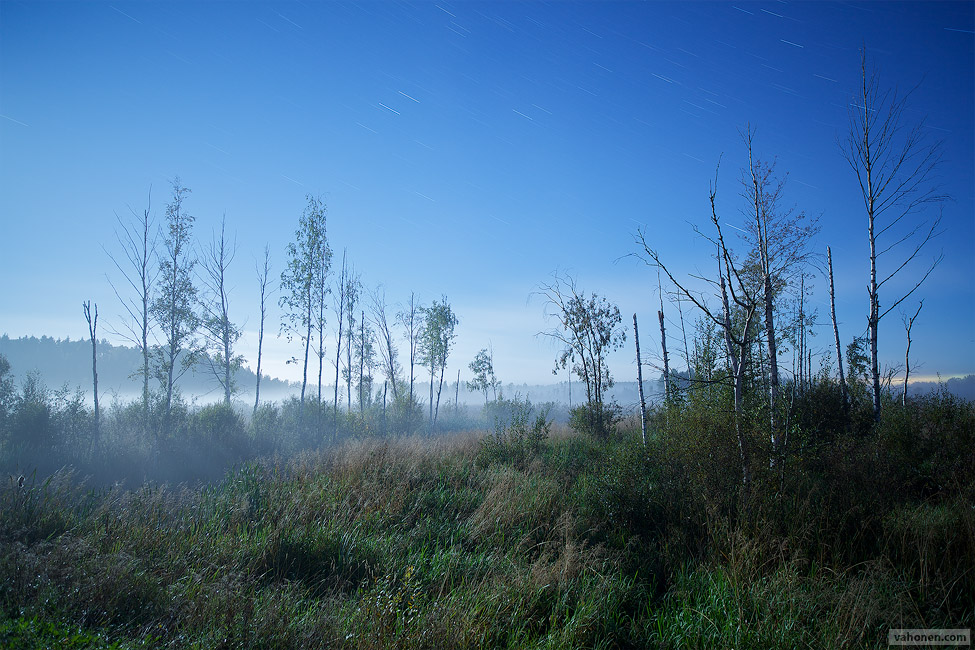

 Anyway, here are two that I shot a while ago and that I have at least not been explicitly forbidden from posting