kiddik wrote:
Or, you could see if there are any Icelanders that could take you out to a weekend phototrip, spending both nights in Reykjavik. There is an unbelievable amount of good places in short distance of the capital, it would be no problem to "wow" you for 2 days or less. Bobu's method is definitely the best though, if you have the resources. Or if you lack resources, but have ambition - you could do what all the germans do - bicycle around the country!
PS. I'm an Icelander and I'd be happy to tour anyone interested in a visit, for a day or two. It's always fun and enlightening spending time with other photographers
wayne seltzer wrote:
Why not shoot longer at f5.6 or f8 and get more DOF?
The foreground grass is blurry and there isn't enough of it for my tastes.
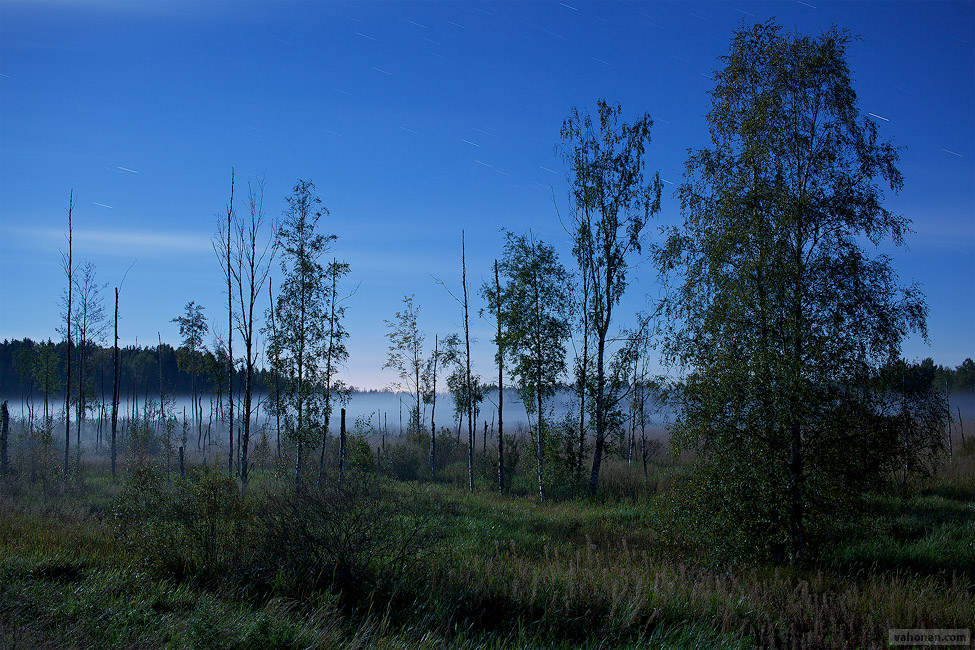
Hi Wayne! The fog disappeared on longer exposures, it looked much better on ISO 800 & 15s but the noise was awful. Neither live view or viewfinder didn't even show the foreground grass, both were more or less black, kind of hoped the sky and stars to reflect from water. It was so dark that I had to focus by illuminating the tree on right with 700 lumen flashlight then using live view to focus. However when I did finally did see the blurry grass on back of camera, I immediately liked it due to dynamic it creates (all sharp landscapes mostly look boring to me, but I'm sure my preference here doesn't represent opinion of the masses). Other thing is when shooting with only one camera body 16min (f/5.6) or 32min (f/8) exposures get REALLY boring to wait and the mandatory dark frame doubles the exposure time.
Mast3rChi3f, nice colors on #2
Paul, thanks! Waiting for winter so we can see the your "puffy 3D winter jackets" with 100ZE as well, I think they are "ultimate 3D subject" or atleast close to it
Luka, thanks!
------
Start to run out of images soon... Lempäälä by night 02 - Carl Zeiss Distagon T* 2/35 @ f/4, 260s, ISO 100 (much thicker fog which tolerated f/4)
Hi Wayne! The fog disappeared on longer exposures, it looked much better on ISO 800 & 15s but the noise was awful. Neither live view or viewfinder didn't even show the foreground grass, both were more or less black, kind of hoped the sky and stars to reflect from water. It was so dark that I had to focus by illuminating the tree on right with 700 lumen flashlight then using live view to focus. However when I did finally did see the blurry grass on back of camera, I immediately liked it due to dynamic it creates (all sharp landscapes mostly look boring to me, but I'm sure my preference here doesn't represent opinion of the masses). Other thing is when shooting with only one camera body 16min (f/5.6) or 32min (f/8) exposures get REALLY boring to wait and the mandatory dark frame doubles the exposure time.
Mast3rChi3f, nice colors on #2
Paul, thanks! Waiting for winter so we can see the your "puffy 3D winter jackets" with 100ZE as well, I think they are "ultimate 3D subject" or atleast close to it
Luka, thanks!
------
Start to run out of images soon... Lempäälä by night 02 - Carl Zeiss Distagon T* 2/35 @ f/4, 260s, ISO 100 (much thicker fog which tolerated f/4)
I just participated in a Night Photography workshop the last 3 nights with the full moon.
For focusing you either have to use the DOF markings on the lens and/or take a test shot with iso 6400 so that it completes quicker and you can check your composition and focusing.
I setup a moon rise shot with my 24/1.4 wide open in the available light after sunset.
I used the ZE 21 for most of my shots and my longest exposures were at f11 iso 200 about 9-10 minutes plus another 9-10 min for the shots I used the long exposure NR on. Depends also if you want to expose fully to the right or not too. Most of my shots were at f8 iso 200 at around 5 or 6 minutes.
wayne seltzer wrote:
Nice fog in this shot, great shot!
I just participated in a Night Photography workshop the last 3 nights with the full moon.
For focusing you either have to use the DOF markings on the lens and/or take a test shot with iso 6400 so that it completes quicker and you can check your composition and focusing.
I setup a moon rise shot with my 24/1.4 wide open in the available light after sunset.
I used the ZE 21 for most of my shots and my longest exposures were at f11 iso 200 about 9-10 minutes plus another 9-10 min for the shots I used the long exposure NR on. Depends also if you want to expose fully to the right or not too. Most of my shots were at f8 iso 200 at around 5 or 6 minutes. ...Show more →
Thanks Wayne! I don't find the DOF markings useful on modern 20+Mpix cameras. With film I used them, but for me they are useless for everything else than ultrawide webthumbnail shooting. ISO 6400 method does work to some extend but at least of 5DmkII the image displayed is the small JPG thumbnail attached to RAW image, and I have hard time seeing from large JPG artifacts which is sharp and which is not. And from experience I know that I forgot the camera to shoot JPG if I used it for test shot I still hate myself shooting this and few other "first of 21ZE" as JPG. All this (and led flashlight development) has lead me to prefer flashlight and liveview for focusing in the dark if feasible. For astrology (why not star trails) the live view has made shooting much easier, making it possible to focus accurately with large apertures.
denoir wrote:
Nice star trails Samuli.
Thanks, I think they are a little on short side for star trail photo...
rexx714 - Very nice usage of color in composition
--------
While Wayne mentioned checking composition composition and focus with ISO 6400 exposure I checked if I have left any ISO 6400 photos to card, and luckily found one (I always delete this kind of setup photos). It's amazing how good ISO 6400 is with dark frame subtraction. Major difference is smaller dynamic range and vignetting (f/2 vs f/4), otherwise the ISO 6400 looks very good, I even made A4 size test print and at this size the noise doesn't bother viewer. I think the reason why colors appear more vivid on ISO 6400 is because the fog on foreground wasn't bothering ISO 6400 shot as much as ISO 100 shot. Links: 5DmkII ISO 6400 f/2 2s 5DmkII ISO 100 260s f/4
Luka, Samuli, Rexx, Robert, Boris, spectacular, splendid shots. If you all did not post so puch quantity and quality, I'd be able to make more meaningful comments than just lavish praise. Oh well....
Samuli Vahonen wrote:
Thanks Wayne! I don't find the DOF markings useful on modern 20+Mpix cameras. With film I used them, but for me they are useless for everything else than ultrawide webthumbnail shooting. ISO 6400 method does work to some extend but at least of 5DmkII the image displayed is the small JPG thumbnail attached to RAW image, and I have hard time seeing from large JPG artifacts which is sharp and which is not. And from experience I know that I forgot the camera to shoot JPG if I used it for test shot I still hate myself shootingthis and few other "first of 21ZE" as JPG. All this (and led flashlight development) has lead me to prefer flashlight and liveview for focusing in the dark if feasible. For astrology (why not star trails) the live view has made shooting much easier, making it possible to focus accurately with large apertures.
Thanks, I think they are a little on short side for star trail photo...
rexx714 - Very nice usage of color in composition
--------
While Wayne mentioned checking composition composition and focus with ISO 6400 exposure I checked if I have left any ISO 6400 photos to card, and luckily found one (I always delete this kind of setup photos). It's amazing how good ISO 6400 is with dark frame subtraction. Major difference is smaller dynamic range and vignetting (f/2 vs f/4), otherwise the ISO 6400 looks very good, I even made A4 size test print and at this size the noise doesn't bother viewer. I think the reason why colors appear more vivid on ISO 6400 is because the fog on foreground wasn't bothering ISO 6400 shot as much as ISO 100 shot. Links: 5DmkII ISO 6400 f/2 2s 5DmkII ISO 100 260s f/4
Samuli,
Usually shooting in the dark of night, the LED flashlights are still not bright enough to produce a bright enough image in Liveview to check focusing. Though the flashlights can help in illuminating objects (which are close enough) close to the edges of the frame to check composition looking through the viewfinder.
BTW, when you mention "black frame subtraction" are you referring to the in the camera Long Exposure Noise Reduction?
philber wrote:
Luka, Samuli, Rexx, Robert, Boris, spectacular, splendid shots. If you all did not post so puch quantity and quality, I'd be able to make more meaningful comments than just lavish praise. Oh well....
Boris, really great viewpoint for waterfall. The 2nd geysir photo looks interesting, the dark sky against the geysir and mind gets buzzled by the polarizer causing horizon to be much brighter than the top of the sky.
wayne seltzer wrote:
Samuli,
Usually shooting in the dark of night, the LED flashlights are still not bright enough to produce a bright enough image in Liveview to check focusing. Though the flashlights can help in illuminating objects (which are close enough) close to the edges of the frame to check composition looking through the viewfinder.
BTW, when you mention "black frame subtraction" are you referring to the in the camera Long Exposure Noise Reduction?
Wayne, by recent development on led flashlights I did mean that the 700-2000L models have become available and having decent price, for year flashlights have been 25-50 lumens, for these AAA-battery powered I have found hard to use for focusing (the high power ones have 1-3 PCS of "18650"-type of battery/-ies. When 700L led is combined with good "lens" it's about same brightness as car headlight, which has been bright enough for live view focusing of subjects within 25 meter (75 feet range). Bigger problem than reach has been that fog between flashlight and target becomes illuminated making it hard to see the focusing target.
Hmm, "long exposure noise reduction" can mean whatever, for example active cooling of the sensor (used in astrophotography). I refer to camera feature, in which camera takes exposure and then other exposure of same length, and then subtracts the black/dark frame values from normal frame (based on theory that hot pixels/noise is on same pixels). On canons this is activated by using shutter speed longer than 1s or 1.3s depending on model. And this feature can be disabled from custom functions, I wish there would be setting for enabling it for shorter exposures as well, too lazy to do it in PhotoShop...
rji2goleez wrote:
Luka - I just love the last two, especially the black and white. That's the look I was expecting these zeiss lens' to achieve. Very nice.
+1




 I still hate myself shooting


