I decided to build my own ring flash because I didn't want to spend $200 on a RayFlash or even $50 for the Coco. Not to mention they are designed to fit the 580ex flash and I have the 430ex. The build below is my second version, here is the first version made out of pie pans.
So here's how I built my latest version:
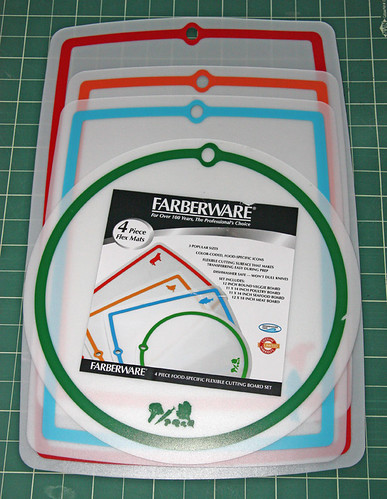
Step 1: I bought this cutting board 4 piece set at Walmart for $6 and the 3-pack set for $5. The reason I choose the 4 piece set is they are flexible, easy to cut with scissors and they are translucent so the light can shine through it..
Step 2: I drew up this template which got me started (it's not complete). I had to cut out some pieces later. Mainly 4 more rectangles like the bottom shape.
Step 3: I transfered the template to the the cutting boards and cut them out.
Step 4: Next I lined the insides with aluminum foil tape.
Step 5: Next I folded in all the tabs.
Step 6: I applied the foil tape to one side of the rectangle cutting board and a strip of double sided duck tape to the back (cut into thirds).
Step 7: Installing the inner reflective ring to the inner tabs.
Step 8: Installing the outer reflective ring with double sided duct tape sticking to the tabs. These pieces are not shown on my template from step 2.
Step 9: Installed doubled sided duct tape to the top.
Step 10: I forgot to take a picture of the front piece being installed but the tabs just bend down to stick to the tape.
Step 11: Added the beauty rings to cover up all the tabs.
Step 12: I masked off the front ring where the light shines through and painted the rest with black spray paint.
That's it. Well, I plan on adding a Velcro strap at the top that will go around the flash to hold it on.
Here are some sample shots with it:
I'm a little pissed at myself, I missed measured the height of this unit so my camera lens does not sit centered within the ring. So watch out for this when you're building yours.
because the lens is not centered I'm getting a stronger shadow cast on the right side (holding the camera in portrait orientation).
Nicely done. DIY in addition to saving money its a great way to figure out how things actually work. It hangs nicely off the flash, albeit off-centered, in landscape mode but looks like it would sag in portrait mode. When doing V2 you might want to incorporate foam blocks or some other spacer between the ring and the lens hood for support.
The simplest way to test power loss without a hand held flash meter would be to take a piece if white paper towel as highlight proxy and with bare flash in M mode and adjust aperture until you put the paper just at the point of clipping in the playback. That's your baseline. Then put the ring diffuser on and see how many stops you must open the lens to put the paper towel back to the point of clipping again.
Since the foil is very reflective I doubt you will see a difference you can measure, but you could measure it the same way.
mattr762 wrote:
cgardner,
Does it matter what distance from the camera I do this test at?
Not for comparison, just keep the distance the same for both. However if you shoot with the target 10ft away at ISO 100 and then multiply the f/stop needed for correctly exposed highlights by 10 you'll know the guide number in feet. Per the specs a 580ex has a GN of 190 at full power, 105mm zoom. That translates to f/19 at 10ft at ISO 100.
My guess is that the loss will be in the range of about 3 stops. Since the channel is reflective much of the loss will be the result of the light having to pass through the front diffuser layer.
One of the things I discovered experimenting with my DIY diffusers was that putting a diffusion layer in front didn't significantly change the diffusion characteristics but cut output by 1/2 (1 stop). I decide that the marginal difference wasn't worth the cost in light output and complexity of construction and deployment.
I see as similar situation with your ring flash but for a different reason. We add diffusion to soften shadows but in the case of a ring light there are no visible shadows to make fuzzy and soft. Given the way you designed it with a bounce chamber on top to redirect the light evenly around the ring I suspect you could remove the front diffusion panel completely, gain a stop of light and not see any difference in the character of the lighting on the faces. The diffusion surface is so small it won't make much difference unless you are very close to the subject.
I recently completed a new DIY diffuser for using my 580ex for macro. My design goal for it was to create the same natural downward angle of light I get with fill on a bracket for full scale shooting, using a second 580ex on a stand as rim light: https://www.fredmiranda.com/forum/topic/846847/
Chuck,
Actually with this design, the front diffuser is a must. Without it the light won't shine all the way around the ring causing the bottom to be darker. My first two prototypes were open faced and would not give out an even spill of light. As soon as I put the diffuser on the face, BINGO! it worked. The diffuser allows the light to bounce and reflect inside and carry the light all the way around the ring. I scratched my head for many days trying to figure out why the first two didn't work properly until I taped a piece of paper over it to shoot through.
If it is bouncing that much light back into the box the transmission loss is probably over a stop. A simple way to test that would be to put a piece of it directly over the flash head and see how much the output drops.
I know others have said it, but this is really excellent work here. Im really impressed with your design and its build. Have you thought of selling the PDF when you get it all sussed out? Think it would be a great little product and you could sell it for people to download from your site.
Any time I see someone with precision craft skills, I get a warm fuzzy feeling. I love making things out of paper, and the geometric aspects to the construction really appeals to me. Now I want to make one for myself
Second to the last photo is great BTW! Fun and expressive!
shatterkiss wrote:
Did you consider using an actual mirror panel instead of foil tape for the 45-deg angled panel to increase the ring's efficiency?
Shatterkiss,
I did a test and it looks like it would be better to use a mirror. I'm no expert, does this look like one stop to you? I drew some guide lines on the levels to show the difference. All camera settings are apples to apples here. Sorry I didn't worry about WB or brightening it up any. This is not being shot through my ring flash, it's simply holding up a mirror/silver tape to the flash at a 45 degree angle.
Chuck,
This one is for you. I felt it more apples to apple to compare my ring flash to another light diffuser I use (Demb's Flit-it w/diffuser). On this test I tried to make the levels match exactly so the Flit-it is F/4 and my ring flash is F/2.8. These were shot at 8ft away. I did test it with bare 430ex flash and to match the same levels below the camera was set to F/16! So it looks like I'm losing TONS of light.




 ! may i ask what is the light loss of your adapter?


