To me: DOF is one of the classic art 3D cues. Any of the classic art 3D cues will enhance the effect. If image contains "just" classic art 3D cues, to me it doesn't give 3D-ish look/feeling/what-ever-this-is-called but it gives cues to brains and I can imagine 3D image but I don't see it.
Interesting reading for people who have not read the 2007 3D thread: https://www.fredmiranda.com/forum/topic/530337/0
Specially the "polarized light/weird edges on the edge of object" is quite interesting and may be important to understand, specially when thinking DOF's role in 3D. This is explained/demonstrated by brainiac in page 3 and also page 17. Unfortunately we have lost many images in this old thread but quite many of the very important illustration photos are still in the 2007 thread.
Bifurcator wrote:
Well, I think most people still really think that the basis for "3D" is DOF.
carstenw wrote:
Many of us are repeatedly saying that this is exactly what we do *not* think, yet you keep coming to this conclusion
I'm not coming to that conclusion myself (since page 7 or something). I'm saying that most of the people NOT IN THIS THREAD still think so. See the difference?
--
And RustyPlug, you can just bite me. You crave a fight for some reason. It's all on you. Fight with yourself! Leave me out of it please.
Yes, I recall those comments... His close-up 35mm Distagon portrait of a man has this dark edge on the edge of his chin. When I look directly at that line, I find it actually detracts from the 3D look, but I have been mulling it over for quite some time now, and it is quite possible that Richard is right that a lens which renders that way enhances 3D, even if that one line doesn't do it for me. I wonder how the characteristic which causes that line to appear affects the rest of the image?
I wish I had a Canon 5D2 and a 100 Planar, so I could do some tests. Now, some people who know me well might be falling off their chairs at hearing me make such a statement, since I generally detest Canons, and their rendering, but for the purposes of testing where 3D comes from, it would be very handy to have this combo.
[Edit: on second thought, I already have a 100 Planar... almost. I have the Hasselblad (Zeiss) 110mm f/2 FE, and could use this with an adapter on my Contax 139Q. I would have to develop some film, but I am doing that at the moment anyway, so it would be no big deal. Does anyone know where I could get a Hasselblad-Contax adapter? I see two on eBay, but the prices are way out of the experimental range.]
Great read! Samuli, nice find. It was fun to go back and see a lot of the same kind of ideas being offered around. I admit to skipping a lot, but the stereogram images certainly are 3D, and the included discussion about the circumference of a baby's head was surreal.
Here's a wonderfully 3D image, linked to in the thread, that was posted on DPReview, and if you follow the bread crumbs, you'll find that it was taken with (egads!) a 17-40 on a 5D.
Bifurcator wrote:
Well, I think most people still really think that the basis for "3D" is DOF.
carstenw wrote:
Many of us are repeatedly saying that this is exactly what we do *not* think, yet you keep coming to this conclusion
Bifurcator wrote:
I'm not coming to that conclusion myself (since page 7 or something). I'm saying that most of the people NOT IN THIS THREAD still think so. See the difference?
And you can find a lot of people in various places and forums that think that climate change is a hoax. That doesn't make them right. See the similarity?
Bifurcator wrote:
And RustyPlug, you can just bite me. You crave a fight for some reason. It's all on you. Fight with yourself!
Bifurgator, considering your own very provocative writing style and attitude of not listening neither understanding other writers and being not able to provide anything more than talk and some example pictures not relevant/not working for majority to this discussion you should really be prepared to take heaploads of crap...
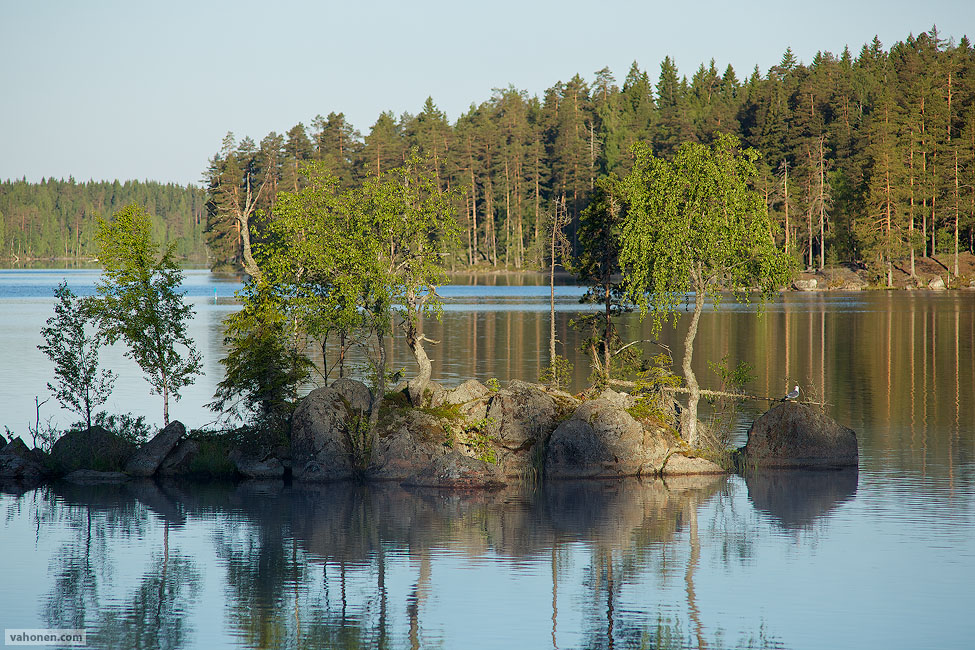
Since I would be shamed to post just useless talk, which is even off-topic, I'll post one picture from my archives. I did try to find image in which narrow DOF provides something to this 3D-ish feeling/look - comments welcome.
Contax Tele-Tessar T* 3.4/200 @ f/5.6 (based on sunny 16, I didn't write this down), 1/400s, ISO 100:
Personally I feel this image short times 3D-ish feeling/looking, then illusion disapperar and the small island may just seem cardboard island floating in the lake. Part of it working is visual illusion since one of the background trees is in shade of another and gives appearance of "drop shadow" effect
StevenPA wrote:
Great read! Samuli, nice find. It was fun to go back and see a lot of the same kind of ideas being offered around. I admit to skipping a lot, but the stereogram images certainly are 3D, and the included discussion about the circumference of a baby's head was surreal.
Here's a wonderfully 3D image, linked to in the thread, that was posted on DPReview, and if you follow the bread crumbs, you'll find that it was taken with (egads!) a 17-40 on a 5D.
Bifurcator wrote:
Well, I think most people still really think that the basis for "3D" is DOF.
carstenw wrote:
Many of us are repeatedly saying that this is exactly what we do *not* think, yet you keep coming to this conclusion
Bifurcator wrote:
I'm not coming to that conclusion myself (since page 7 or something). I'm saying that most of the people NOT IN THIS THREAD still think so. See the difference?
Lotusm50 wrote:
And you can find a lot of people in various places and forums that think that climate change is a hoax. That doesn't make them right. See the similarity?
I don't really see the similarity myself no. One is using a term everyone understands , is established and agreed on, or not. The other is being well informed about a planetary condition and government organizations or not. BTW, I'm convinced it's a hoax myself.
And I didn't mean to bring this all up again. RustyPlug acted surprised when he met with the reality of someone not getting the usage of the illusive "3D" term. I was just pointing out that this should be expected is all.
Somewhat "3D-ish" to me without lens brilliance, DOF blur, or fine textures.
I am wondering what effect size has on the ability of an image to carry 3D. Is anyone willing to post links to larger images, perhaps 1200 pixels on the long edge or so?
I'll oblige. You'll have to forgive the image if it is (completely) lacking in 3D. I took it with the OM 21/3.5 and the large version is a quicky processing job.
feel free to disagree and be honest about your opinion, you shouldn't have to defend yourself. Ignoring posts that you can't make sense of should indeed work
@steven:
Your fountain shot works much better without a frame! something to look out for perhaps
biotar,
Thanks, but "making sense" and being ridiculous, belligerent, or combative are slightly different things.
Steven,
I don't think those completely lack "3D". They just aren't subject specific 3D where only one subject, focus point, or object is affected by it. I get a sense of 3D (three dimensional volume) from these in a slightly different way than those but it's still there - fairly strongly too. The large ones seem more-so than the small ones -in producing the sense of volume and space.
Samuli Vahonen wrote:
That is a good question. I would have suspected moose but there were no animal footprints in snow. So it must be something smaller like some worms eating the three inside, which kind would make sense based on the small network of grooves seen on the wood. It's really annoying that when person is ~15 year old nothing could interest less than biology and history classes, except for that they are good for sleeping...when person turn 30 both seem interesting but since person has been using these classes for sleeping, person doesn't have any base knowledge about subject... [this happened to me and many of my friends as well] ...Show more →
I read this and then forgot to reply. I'm not sure if this is the work only of worms, unless those Finnish worms are strong enough to rip the bark off of trees. Maybe the bark was pulled off by something that wanted to eat the worms?
StevenPA wrote:
Maybe the bark was pulled off by something that wanted to eat the worms?
Indeed. Exactly what I thought when I saw it. Probably squirrels.
"In winter, much of their diet is made up of hibernating insects
and their larvae found under the bark of trees; also the juicy buds of
trees." (Squirrels)
Jan 23, 2010 at 08:38 AM
Steve Spencer Offline • • • • • • • Upload & Sell: On
Toothwalker wrote:
It is certainly an entertaining thread, but it gives rise to confusion more than that it answers questions. It is impossible to get a clear picture of the topic when the '3D' perception appears to be highly subjective and key terms ill-defined.
My brain tells me that there are depth cues in some images in this thread; some of these have a blurred background and some have not. The lens may play a role, because ultimately it must be a matter of contrast (in the all-sharp images anyway). Contrast in the broad sense of the word.
I am a loyal Zeiss user, and have been for 20 years, but I don't think that Zeiss holds the secret to a mystical lens quality that enhances depth perception, '3D' experience, or whatever it is called. My guess is that the microcontrast or resolution of the lens is relatively unimportant, since the discussion here is based on significantly downsampled images. Hence we are left with the macrocontrast (brilliance), where the lens plays a role, and all kinds of post-processing that determine the rendering of details and edges in these downsampled images.
Peer-reviewed papers such as these could be relevant, but I can't be sure as I don't have access. If someone else here does, I am interested ...
I couldn't get the articles that toothwalker suggested in pdf and I am too lazy to scan them, but here are links to a couple of related articles. The first makes a pretty straightforward case that contrast is a very strong depth cue (i.e., creates a 3D appearance), which is probably what is most relevant to the current discussion as this is probably what the lens provides. The second article is a classic reviewing a large number of depth cues and explaining their theoretical rationale.
Steven, I meant more that it would be interesting to see a shot which displayed some 3D in a larger form. In your first shot, I don't expect the larger format to rescue the 3D-ness. In the second shot, there is just a hint in the part of the robe coming over her arm, and in the larger shot, there is a touch more, I think. Hard to say. It might be easier to see the difference if the larger shot was twice as large in each dimension (which probably rather means that the smaller shot should be a bit smaller).
I do get the sense that a larger image might contain 3D more easily though. That would also have helped the Ansel Adams prints mentioned earlier. I have his calendars perhaps 8 years back, and I see no 3D in them, but I have never seen a full-sized Ansel Adams print.