Bifurcator wrote:
Well, I think most people still really think that the basis for "3D" is DOF.
carstenw wrote:
Many of us are repeatedly saying that this is exactly what we do *not* think, yet you keep coming to this conclusion
Bifurcator wrote:
I'm not coming to that conclusion myself (since page 7 or something). I'm saying that most of the people NOT IN THIS THREAD still think so. See the difference?
Lotusm50 wrote:
And you can find a lot of people in various places and forums that think that climate change is a hoax. That doesn't make them right. See the similarity?
Bifurcator wrote:
I don't really see the similarity myself no. One is using a term everyone understands , is established and agreed on, or not. The other is being well informed about a planetary condition and government organizations or not. BTW, I'm convinced it's a hoax myself.
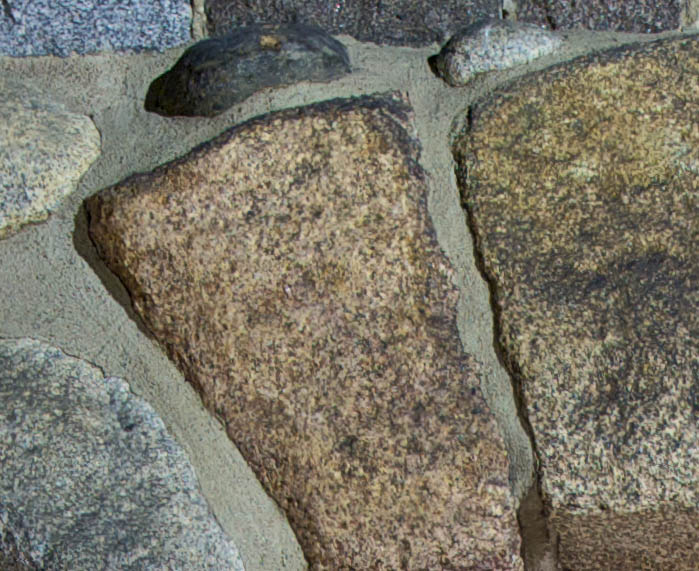
Carsten, I'm not sure which kind of example you need so I created 600px and 1200px versions of image I have shown here earlier. Seeing 3D-ish look in large size depends also what kind of texture you have in image, depending on texture size it depends does it work well or not. Open images to tabs, links below: 600px 975px 1200px
cogitech wrote:
Indeed. Exactly what I thought when I saw it. Probably squirrels.
"In winter, much of their diet is made up of hibernating insects
and their larvae found under the bark of trees; also the juicy buds of
trees." (Squirrels)
Ok squirrel is plausible since it could not have been any other "big" animal since snow was pristine with no footprints, just pieces of bark.
Samuli, that is a pretty decent example. I also don't know exactly what I am looking for, but as with art, I'll know it when I see it
This particular shot is a little over-sharpened, I think. When I look closely at the texture of any of the stones, I get the sense that from pixel to pixel there is no transition, just a jump, i.e. no feeling of continuity. Probably this is as much a problem of (relatively low-res) monitors, which just can't lump the pixels close enough together to give this transition. This is one of the great strengths of film over pixels, btw, since each piece of film grain overlaps with the next, giving beautiful transition.
Anyway, apart from this pixel-level issue, I still feel that the larger version comes much closer to showing real 3D. The small version (600) look like a postcard, small and perfect but without much depth. With the large version, I get much more of a feeling of being able to walk in (depth) and touch objects (texture) and feel their shape (3D).
I think it should be possible to make other examples, but in general, I am looking for a shot where the small and large versions show a difference in the amount of depth/texture/3D in them. My theory is that larger sizes show it more readily, and that would explain why those who shoot LF are generally more convinced that the 3D feel exists.
It would also be interesting to see if one of Richard's portraits would lose some 3D when scaled down. Richard, are you up to it: 600 and 1200 pixel version of our favorite ruddy daytime party guest?
carstenw wrote:
Samuli, that is a pretty decent example. I also don't know exactly what I am looking for, but as with art, I'll know it when I see it
This particular shot is a little over-sharpened, I think. When I look closely at the texture of any of the stones, I get the sense that from pixel to pixel there is no transition, just a jump, i.e. no feeling of continuity. Probably this is as much a problem of (relatively low-res) monitors, which just can't lump the pixels close enough together to give this transition. This is one of the great strengths of film over pixels, btw, since each piece of film grain overlaps with the next, giving beautiful transition....Show more →
This is problem with this kind of natural rocks (similar problems in the Leica & Norway & red cottage/hotel image we tried to make 3D with photoshop). They don't never look good on pixel level, no matter what size. However printing somehow smoothens the pixel level detail and it looks not harsh like in screen. Even 100% unsharpened crop (below) looks harsh, so this must be some sort of digital error when photographing analog subject with endless amount of detail
carstenw wrote:
It would also be interesting to see if one of Richard's portraits would lose some 3D when scaled down. Richard, are you up to it: 600 and 1200 pixel version of our favorite ruddy daytime party guest?
This would be interesting to see.
That old 3D thread was pretty funny, by the way. There were probably 10 people who agreed with the definition of 3D, but perhaps 8 of those consistently posted questions with no 3D as their examples
StevenPA loaned me his earlier shot to play with ... the Oly 21mm 3.5
I'm not sure how this came out, as I tried some different things, but thought I 'd share it for feedback prior to going back to the drawing board for round two.
Would you tell us what gear was used for this image?
Bifurcator wrote:
I don't really see the similarity myself no. One is using a term everyone understands , is established and agreed on, or not. The other is being well informed about a planetary condition and government organizations or not. BTW, I'm convinced it's a hoax myself.
And I didn't mean to bring this all up again. RustyPlug acted surprised when he met with the reality of someone not getting the usage of the illusive "3D" term. I was just pointing out that this should be expected is all.
Steve Spencer wrote:
I couldn't get the articles that toothwalker suggested in pdf and I am too lazy to scan them, but here are links to a couple of related articles. The first makes a pretty straightforward case that contrast is a very strong depth cue (i.e., creates a 3D appearance), which is probably what is most relevant to the current discussion as this is probably what the lens provides. The second article is a classic reviewing a large number of depth cues and explaining their theoretical rationale.
Steve, many thanks. I agree that the first paper makes a straightforward case, but I haven't recognized any '3D' due to aerial perspective in this thread. The second paper looks thoroughly enjoyable, but is a bit too long to read from a computer screen. I will print it first.
StevenPA wrote:
I'll oblige. You'll have to forgive the image if it is (completely) lacking in 3D. I took it with the OM 21/3.5 and the large version is a quicky processing job.
The monitor on which the image is being viewed plays a critical role. Unless all of you have the same monitor, it's difficult to reach any conclusion.
For myself, I can only constantly see "3Dness" from slides (from good lenses of any brand) using a good loupe on a lightbox. DOF has nothing to do with "3Dness" but a lens must be sharp enough.
I couldn't see any "3Dness" at all on my LCD monitors. I can only see the "pop" on monitor but "pop" is not "3Dness".
AhamB wrote:
Wonderful, but I don't like the impossibly blue sky.
I'd try developing it with two different WB's and then merge in PS.
I like your shots with the distagon 28 even more.
Thanks, AhamB. It just goes to show that truth can be stranger than fiction as I did nothing to manipulate the sky. This was a family trip to Rome, and when I was asked if there was any place in particular that I wanted to see, I said I didn't care as long as I was in a nice place at 6pm every day to get a good twilight shot. EXIF data tells me that I took a lot of pics from 6pm to 7pm.
carstenw wrote:
Samuli, that is a pretty decent example. I also don't know exactly what I am looking for, but as with art, I'll know it when I see it
This particular shot is a little over-sharpened, I think.
Interesting. I think the sharpening treatment is right on the money. Less would be fine but perhaps not optimal, and any more would introduce haloing and other nasty artifacts. I think that's part of the fine balance necessary to create the effect we are talking about ("3D") in web images.
When I look closely at the texture of any of the stones, I get the sense that from pixel to pixel there is no transition, just a jump, i.e. no feeling of continuity. Probably this is as much a problem of (relatively low-res) monitors, which just can't lump the pixels close enough together to give this transition.
I see the same thing, more or less. I wonder if you feel that these little "jumps" (what I called "per-pixel clarity" in the 2007 3D thread, like one could reach in an pluck out an individual pixel with ease) help or hinder 3D in web images as a result of the texture they introduce. In other words, maybe "no feeling of continuity" can be an advantage at times.
Paul Yi wrote:
I remember that blue sky....
I think it may have to do with the surrounding lights....
Here you can see that blue sky at the corner....
CY 35-70
Right on, Paul! During my trip, that blue sky happened every day regardless of location. Kind of overcast and even a bit rainy on some days. Overall I was happy with the weather.
There seems to be some jpeg compression in your image. Would be possible to see it saved at 100% quality?
I'm sure this doesn't exhibit the essence of 3D'ness everyone is trying to quantify, but for some reason this unremarkable picture seems to draw me down the path. I know it's my imagination.....




 http://www.imaging-resource.com/PRODS/A2/A2A5.HTM
