This kind of exemplifies why I'm objecting to the term as used like this.
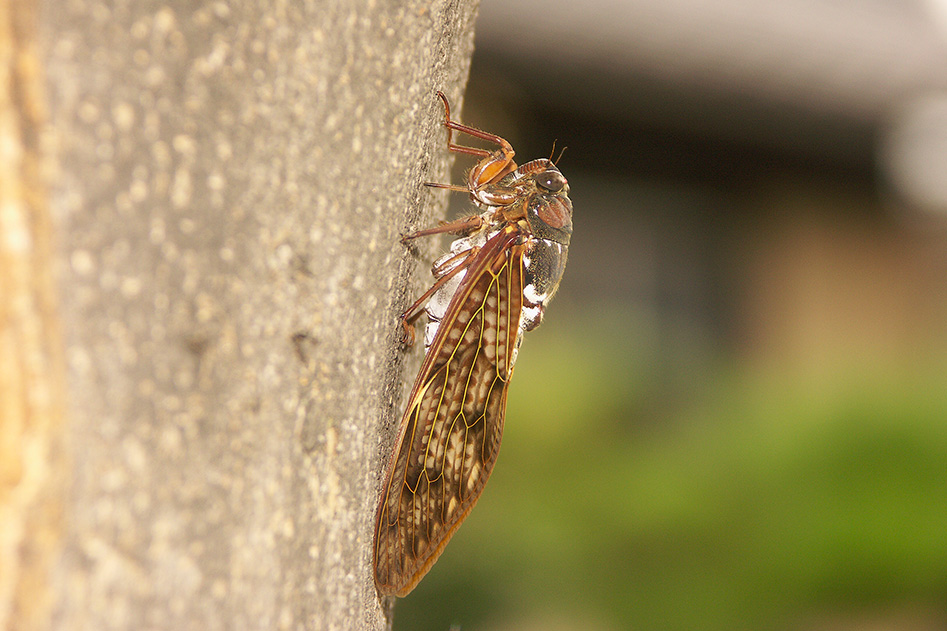
I doubt that an 85mm f/1.2 lens exists that can't produce this effect at that focal point when set to f1.6 (as was used and done here) in that scene. It's the fact that's it's an 85mm f/1.2 lens focused at that distance and set to f/1.6 that makes that image look that way - well and the fast shutter to freeze it up nice and solid. It's called properly (or cunningly) used DOF and I suppose the resolving power of the lens adds or subtracts some ultra-minute aspects of it. To me DOF is DOF though and I don't need a secondarily made up term - especially when it infringes on understanding.
BTW, RustyBug, it's those very "movie & entertainment industry uses" and drawing techniques that you mention of which I'm speaking when I say "3D" already has a defined life of it's own so to speak.
Yeah, yeah, it's a microscopically small niggle to haggle and I'm only really seeking to be understood about it - not to force others to hold the same proclivities as I.
Equipment Make: Canon
Camera Model: Canon EOS-1Ds Mark III
Maximum Lens Aperture: f/1.2
Image-Specific Properties:
Horizontal Resolution: 300 dpi
Vertical Resolution: 300 dpi
Image Created: 2008-12-03 21:49:01
Exposure Time: 1/2500 sec
F-Number: f/1.6
ISO Speed Rating: 400
Lens Aperture: f/1.6
Exposure Bias: 0 EV
Flash: No Flash
Focal Length: 85.00 mm
I guess I'm really just noticing and baulking at the change from educated remarks like: "Wow, nice use of DOF", "Excellent DOF effects!", etc. over to the more uninformed "That's very 3D" or "This is about as 3D as it gets." if you follow me.
I mostly agree with you. I've noticed that images that most demonstrate this effect not only have narrow DOF but an out of focus range both in front and behind the focus point. Some lenses are better at it than others, Zeiss most notably, but others are capable of it as well and this is a good example.
It's a cool effect and definitely gets your attention but I think it's a mistake to get so caught up in trying to get a 3D look that you miss the point of getting a good image composition.
Of course, having agreed with you, I also have to admit that what got me into alt lenses to begin with were Paul Yi's images from his Planar 100mm when he was selling it on B&S. They were as 3D as any I've seen and I was hooked. Guess who bought the lens?
I'm not saying it's absolutely necessary just that it enhances the effect. I see some 3D in your image but it would be stronger if at least the background was more out of focus. Actually, this is one of the few images I've seen that seemed to have any appreciable 3D when almost all of it was inside DOF.
Actually, I am not sure that I agree with your argument about fore-and-aft out-of-focus helping generate a "3D" effect, because Zeiss lenses, considered as a whole the most "3D-prone", are also lenses that tend to blur the background less than other lenses. This is purely inuitive of course, rather than scientific, and I would love to learn more...
Bifurcator wrote:
I guess I'm really just noticing and baulking at the change from educated remarks like: "Wow, nice use of DOF", "Excellent DOF effects!", etc. over to the more uninformed "That's very 3D" or "This is about as 3D as it gets." if you follow me.
I don't agree with the implication of this statement. A "nice use of DOF" is not the same thing as an image having good 3-dimensional qualities. DOF and 3-D are quite separate effects/results. You can have excellent 3-D qualities with a lot of DOF, as well as with small DOF. This was established earlier in this thread. 3-D qualities are independent of DOF.
Lotusm50 wrote:
I don't agree with the implication of this statement. A "nice use of DOF" is not the same thing as an image having good 3-dimensional qualities.
OK, I'll take the challenge. Define the specific properties that make this magical "3D" effect without using the term DOF or any of it's definitions.
Good luck with that.
Remember, I did specify "proper" or "cunning" use of DOF. Not just simply DOF in any old range. But I will go further in saying that you can't have one without the other in any regard at all.
one from me just for fun
You can't have DOF at all without some kind of 3D-ish feeling. How apparent it is to a person and how much it "pops out" depends on the viewers' willingness and ability to put themselves in that "state" along with the amount and placement of the DOF itself. And I assume you will naturally agree that you can't have a "3d-ish" effect without DOF. There see, interdependence.
Bifurcator wrote:
OK, I'll take the challenge. Define the specific properties that make this magical "3D" effect without using the term DOF or any of it's definitions.
Good luck with that.
What "specific properties" do you need? Either an image gives you the appearance of dimensionality, form and volume or it doesn't. Why do I need DOF to describe the 3-dimensional qualities in an image?? All DOF has to do with is the appearance of being in focus. That's it. It has nothing to do with how an captured image gives the appearance of tangible, 3-dimensional sculptural form.
Bifurcator wrote:
You can't have DOF at all without some kind of 3D-ish feeling. How apparent it is to a person and how mush it "pops out" depends on the viewers' willingness and ability to put themselves in that "state". And I assume you will naturally agree that you can't have a "3d-ish" effect without DOF. There see, interdependence.
Huh? We've seen examples with shallow DOF that have no 3D appearance and examples with deep DOF that have a lot of 3D appearance. Whether something "pops out" through the use of shallow DOF doesn't mean it has 3D. Even with shallow DOF it can look like a cardboard cut-out popping in front of a blurred background without any 3-D qualities at all. The amount of the image/subject in focus (or DOF) is irrelevant.
By the way, in the image you added to your post I don't see much 3D quality in it at all. Sure the subject is separated from the background through shallow DOF, but it just looks flat. It clear to me that you are confusing "depth separation" with "3-dimensional" form. They are different. This confusion was also dispensed with earlier in the thread.
I said patiently (that's the non-rude kind) not impatiently - which is the rude kind. it's meant like "I'm looking forward to it...".
And this makes my point perfectly. There is not a single image in this thread that doesn't contain and rely on DOF to create the affect.
Huh? We've seen examples with shallow DOF that have no 3D appearance and examples with deep DOF that have a lot of 3D appearance. Whether something "pops out" through the use of shallow DOF doesn't mean it has 3D. Even with shallow DOF it can look like a cardboard cut-out popping in front of a blurred background without any 3-D qualities at all. The amount of the image/subject in focus (or DOF) is irrelevant.
OK, show me. I don't agree. Every image here critically depends on both the depth and the placement of the DOF range(s).
By the way, in the image you added to your post I don't see much 3D quality in it at all. Sure the subject is separated from the background through shallow DOF, but it just looks flat. It clear to me that you are confusing "depth separation" with "3-dimensional" form. They are different. This confusion was also dispensed with earlier in the thread.
Again, this is a subjective anomaly. If you want to see it you will if you don't or can't then you wont. How "strong" the 3D-ish look is to you may also depend on other attributes like color contrast, correlation between recognizable object sizes and etc. but if there's no DOF there's no 3D-ish look.
Bifurcator -- Like I said, go review the thread. There is evidence of everything I've said. It has nothing to do with "wanting" to see it or not. That is insulting. I am quite capable of looking at an image objectively and dispassionately and assess its qualities.
I still think you are confusing 2 different qualities, or you just don't get it. 3D has nothing to do with depth separation in an image, and has nothing to do with either the "placement" or amount of DOF. You've given me NO evidence that it does, and the collection of images in this thread proves that it doesn't.
If you can't or won't see this, I won't waste my time trying to explain it to you any longer. You've got your mind made up and stuck in a preconceived notion and can't see past it. Good luck.
Oh, and tapping your finger at someone, "patiently" or otherwise (it is implicitly an impatient act), is rude.
I took the tapping more as a friendly 'gauntlet thrown' in its presented context ...
although I could see it being misinterpreted (easy to do in text only form).
I realize there is some background blurring that would suggest DOF is present (duh) ...
but it is NOT the DOF that is creating the '3D-ish illusion' of form around the pin / latch on the scissors.
Bifurcator wrote:
OK, show me. I don't agree. Every image here critically depends on both the depth and the placement of the DOF range(s).
Since not my own images I'll just link to page where there are two images which are '3d' but have everything sharp: https://www.fredmiranda.com/forum/topic/785634/1
- cogitech's classic castle shot at writing #4
- bobring's cityscape with some tables & chairs in front area of picture at writing #21
I didn't find many of my own, which would not have used DOF as part of '3d', and don't have really good examples. I have shoot past years mainly with normal lens and short tele lenses, and I'm trying to leard wide angle lenses and large DOF.
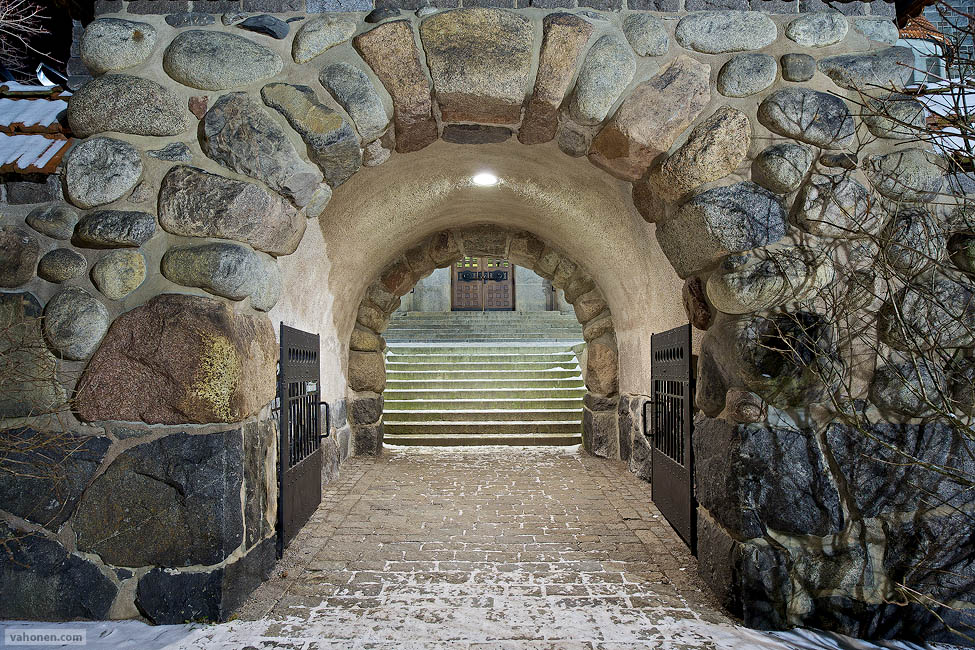
"The Tampereen Tuomiokirkko (cathedral) 1" (Carl Zeiss Distagon T* 2.8/21 ZE @ f/5.6, 5s)