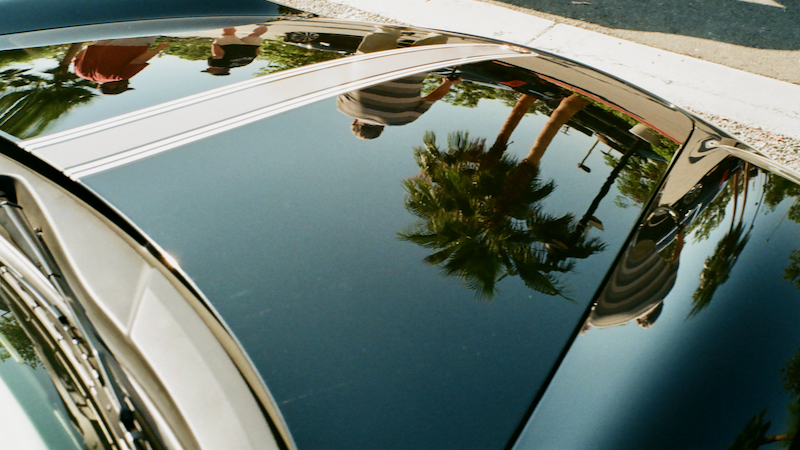
Thought I was pretty cool for finding the palm trees reflecting off the hood of this 911 at a local Cars and Coffee meetup. Leica MP, 35 Summicron IV, ColorPlus 200
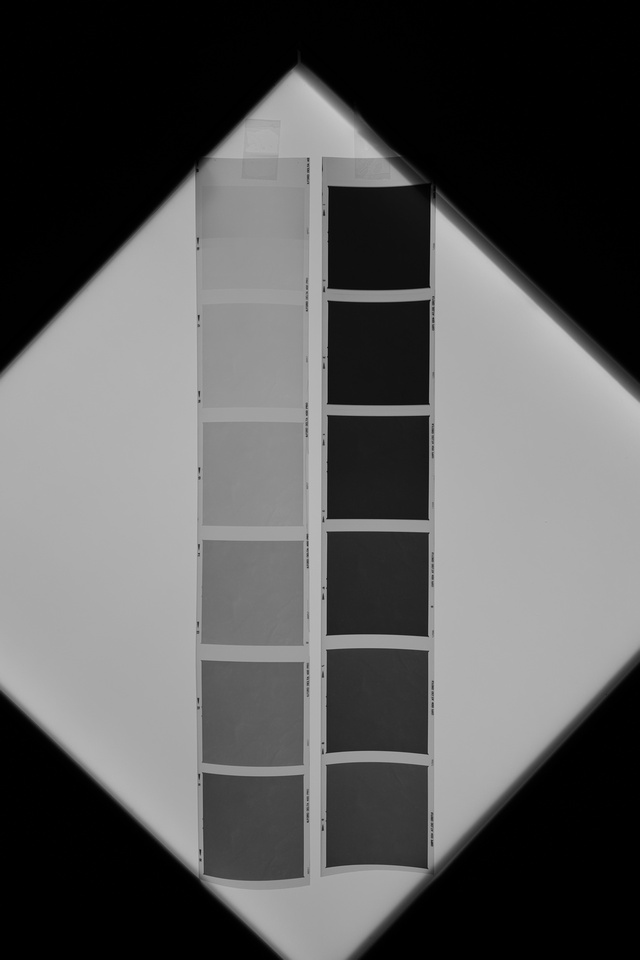
After I finished reading "Beyond the Zone System", I promised myself I would try to be more systematic with film. And since my development recipe is so off from what is recommended*, I figured I really had to do this. So here is a digital monochrome image of my first set of test exposures. Delta 400, metered at ISO200, exposed from -6 to +5, developed in DD-X (1:9) for 8'10" (= recommended time + 70% [for change in concentration] - 20% [for constant agitation]), with constant agitation in a Simma "Sine Wave" roller.
Raw Data:
-6: no data, issue with exposure, still investigating
-5: -0.6 eV from background light
-4: -0.9
-3: -1.3
-2: -1.7
-1: -2.1
0: -2.3
+1: -2.7
+2: -3.1
+3: -3.3
+4: -3.7
+5: -3.9
It is not obvious in the image, but the +5 exposure is still plenty transparent, so I will redo this up to ~+8 in the future, in addition to figuring out why the -6 shot is messed up. I thought it was a light leak, but a new back still shows this defect, though at a different shutter speed and at a different location on the negative. Today I replaced the battery, so hopefully that solves it.
*I do photolithography for work, and in my world you either do constant agitation or zero agitation while developing photoresist. Zero agitation will mess up the contrast of film, so I settled on constant agitation. To keep the development times reasonable (and for economical reasons) I use 1:9 rather than 1:4.
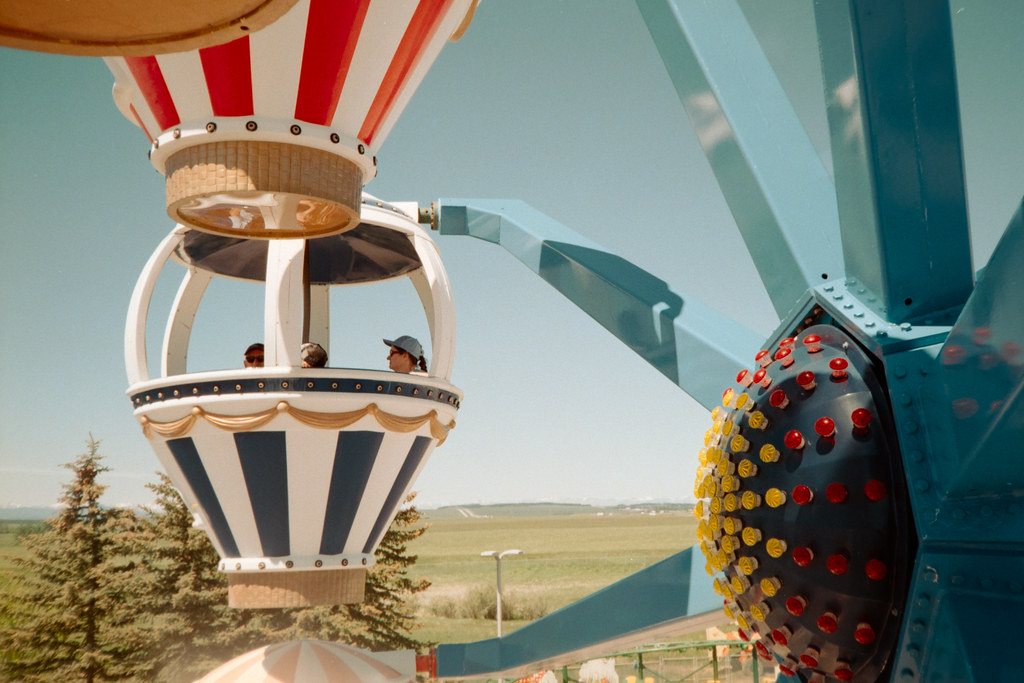
nice use of a half frame camera and beautiful color from ProImage 100!
theHUN wrote:
After I finished reading "Beyond the Zone System", I promised myself I would try to be more systematic with film. And since my development recipe is so off from what is recommended*, I figured I really had to do this. So here is a digital monochrome image of my first set of test exposures. Delta 400, metered at ISO200, exposed from -6 to +5, developed in DD-X (1:9) for 8'10" (= recommended time + 70% [for change in concentration] - 20% [for constant agitation]), with constant agitation in a Simma "Sine Wave" roller.
Raw Data:
-6: no data, issue with exposure, still investigating
-5: -0.6 eV from background light
-4: -0.9
-3: -1.3
-2: -1.7
-1: -2.1
0: -2.3
+1: -2.7
+2: -3.1
+3: -3.3
+4: -3.7
+5: -3.9
It is not obvious in the image, but the +5 exposure is still plenty transparent, so I will redo this up to ~+8 in the future, in addition to figuring out why the -6 shot is messed up. I thought it was a light leak, but a new back still shows this defect, though at a different shutter speed and at a different location on the negative. Today I replaced the battery, so hopefully that solves it.
*I do photolithography for work, and in my world you either do constant agitation or zero agitation while developing photoresist. Zero agitation will mess up the contrast of film, so I settled on constant agitation. To keep the development times reasonable (and for economical reasons) I use 1:9 rather than 1:4....Show more →
I assume -6 is top left and +5 is top right?
wouldn't the -6 still have some data as the square frame is still visible?
taemo wrote:
I assume -6 is top left and +5 is top right?
wouldn't the -6 still have some data as the square frame is still visible?
Correct. There are certainly data, but with the additional lines (stray light, shutter issue) I didn't want to contaminate an otherwise clean data set. I'll have to reshoot it anyway, so I will get the data then.
It is my understanding that the Zone system was adapted by photographers to deal with the limitations of film+paper combinations in darkroom days. The objective was to control the contrast of the scene (given\fixed at the time of exposure) via adjusting the contrast of film\negative (variable: exposure time + development) to match it to the contrast of photo paper (fixed). In other words, by expanding or contracting the contrast of the negative, the objective was to "fit" the contrast of the scene into the predefined contrast of the paper and have the print looking in a certain way, "pre visualized" by the photographer.
From my experience, the "hybrid" method of image production (images captured on film but final presentation is done with application of digital processing) has much fewer restrictions and limitations compared to traditional darkroom method. In particular, modern scanners are capable of extraction details from film with densities exceeding 4.0 and many are capable of seeing into up to 5.0. From my recollection, max densities of B&W negatives rarely approach 2.0. Hence, scanners or digital cameras do not have issues with extracting details from most dense areas of B&W negatives (and color negatives for that matter too) no matter how bright the highlights of the scene were. As such, all the contrast manipulation can, and in most cases, should be done on digital data due to offered by it convenience and flexibility.
In my opinion, with a hybrid method of image production, the benefits of the Zone system are not worth the efforts.
With a hybrid method there are 2 things that really matter :
* Proper exposure - to prevent loss of shadow details (expose for the shadows and let the highlights fall where they may)
* Proper development - to prevent detail loss due to under or over development. "Normal" development usually takes care of both extremes.
The hardcore darkroom printers may argue that it is important to control the highlight development via "+" and "-" development, but in my opinion, with hybrid method there is no obvious proof of benefits from doing so.