"Other than a flatbed scanner, what's a good scanner for 120 (and smaller) size film? "
Well, you know that my answer is going to be a good drum scanner, but that's beyond the reach of most folks, if not to buy, certainly to get fixed. The scanner that seems to get mentioned a lot now is the Plustek. They have a model that can do from 35mm to 120.
The attached is a straight 8-bit jpg copy of a 600dpi TIF scan using my Epson V700 Photo flatbed scanner, using Better Scanning film holders and Anti Newton Ring glass cover-plates.
Too late now to do any others, as I find that it's so long between my scanning sessions that I have to re-learn some of the options/settings!
lenticular11 wrote:
The attached is a straight 8-bit jpg copy of a 600dpi TIF scan using my Epson V700 Photo flatbed scanner, using Better Scanning film holders and Anti Newton Ring glass cover-plates.
Too late now to do any others, as I find that it's so long between my scanning sessions that I have to re-learn some of the options/settings!
I have not heard of those accessories. What do they do? I would be OK with results like yours.
I would love a drum scanner. What wears out on them that is expensive to fix?
Price is higher than your flatbeds but dang, the convenience factor along with the baked in color profiles (c-41 that is). Still cheaper than a new FF DSLR (or about the same depending on what you get).
or....get a pakon f135+ or f135 for 35mm and a flatbed for your 120 film. Pakon's are reasonable price and super fast for scanning. Has Kodak's baked in profiles for c41 film.
Price is higher than your flatbeds but dang, the convenience factor along with the baked in color profiles (c-41 that is). Still cheaper than a new FF DSLR (or about the same depending on what you get).
or....get a pakon f135+ or f135 for 35mm and a flatbed for your 120 film. Pakon's are reasonable price and super fast for scanning. Has Kodak's baked in profiles for c41 film.
I have an excellent 35mm scanner that I was thinking of selling for something that can scan both.
kwoodard wrote:
I have not heard of those accessories. What do they do? I would be OK with results like yours.
I would love a drum scanner. What wears out on them that is expensive to fix?
I would love a drum scanner however I can't see me buying one given the small market here in Australia and the likely costs versus those Jon Buffington's links have shown. A drum scanner would give better dynamic range than that available from a flatbed scanner. Having said that I seem to get reasonable results from the Epson.
The Better Scanning holders and ANR glass strips were things I bought from another FMer here. Better Scanning has a great website and here's a link to the section on scanning with Epson V-series flatbed scanners.
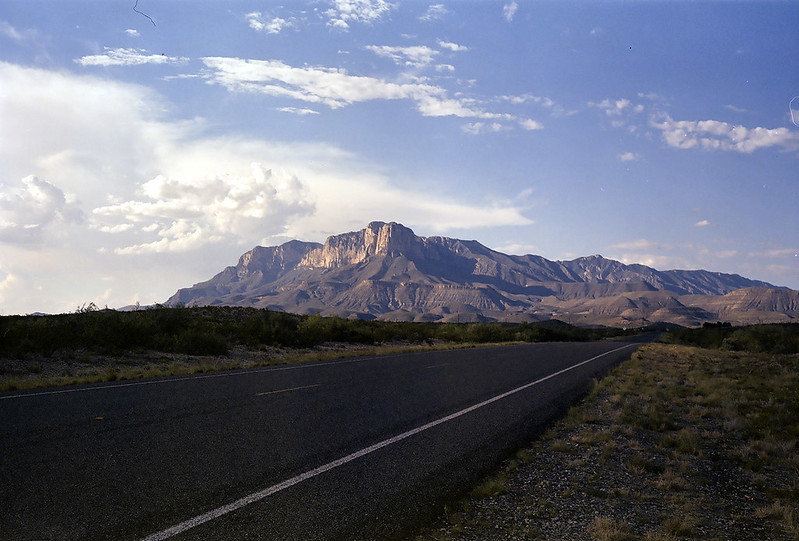
Couple shots from a quick 'scouting' trip out to Van Horn TX. Will go back in early November to catch the fall color in McKittrick Canyon of Guadalupe Mtns. NP. First shot is the Kodak Medalist II with expired Portra 400, second is the Chamonix 4X5 field camera with Portra 160. Both Epson V700 scans.
You can see El Capitan from a long way off coming up from Van Horn.
Kenny, I am impressed with that lens on the medalist. Please share you work this fall of the Guadalupe Mtns. On my short list of NP's to visit. I absolutely love far west Tx and would like to venture past the Big Bend Region.
Thanks, Jon. If I ever get my Medalist I back from Ken Ruth, I'll take two to Guadalupe NP, one loaded with color and one with B&W.
Love your B&W shots of Memphis. Brought a nostalgic smile to my face...went to electronics school at NAS Millington many moons ago. Used to go to a place called People's Billiards downtown Memphis. <sigh>
Kenny
ps Just turn almost due north from Big Bend and drive a 'little ways' (TX tongue-in-cheek) and you'll hit the Guadalupe Mtns.
Developed my fist color film using the C-41 process at 39 deg C. Kodak Ektar 100, negatives photographed with Sony A7R and Sigma 105/2.8 EF macro lens to digitize. Colors came out great! PP in PS: channel inversion, levels adjustment, saturation changes. I will do direct prints of some of these negatives using my color head enlarger with RA-4 processing (works fine so far after learning a few tricks here).
All taken with Canon EOS-Rebel X and Canon 50/1.2 L EF lens
You must be very pleased with your first home-processed C-41 film! I haven't built up the courage to do that yet myself.
Here are some more Fuji RVP50 slides shot with my P67 II camera. Scanned using Epson V700 and then imported into LR as 16-bit TIFs. Each scan adjusted to give full-range (within the obvious limitations of the scanner) and then similar PP done in LR. Minimal or no colour attribute or clarity adjustments.
I absolutely love the results from P67 lenses which are still some of the best cost-quality buys around IMHO.
Martin, great work! Especially like the Indian. Gotta love and $8 body with 1.3k in lens Have that same plastic rebel body and it is quite competent. Congrats on the c41, it isn't hard at all once you get used to it.
Lenticular, really like your work. Don't be scared of c41, eazy peazy
Jon Buffington wrote:
Martin, great work! Especially like the Indian. Gotta love and $8 body with 1.3k in lens Have that same plastic rebel body and it is quite competent. Congrats on the c41, it isn't hard at all once you get used to it.
Lenticular, really like your work. Don't be scared of c41, eazy peazy
Hi Jon, you are right, other than for the temperature consistency the C-41 process is easy. Now my bathtub found another purpose, too (meaning to keep a water bath at about 39 deg C in it) . I bought the camera some time end of the 80s. I only had to clean the shutter after it got stuck a bit. And the 50/1.2 is a keeper lens for me - not the sharpest wide open, but it has the smoothest bokeh of all my 50 mm lenses.