theHUN wrote:
I hang it in the shower with a 100 g weight hanging from the bottom of the roll. A water distiller is creating a warm and humid environment. This method consistently gives flat negatives for FP4 and HP5, slight curling for Acros, and comically massive curling for Rollei IR400.
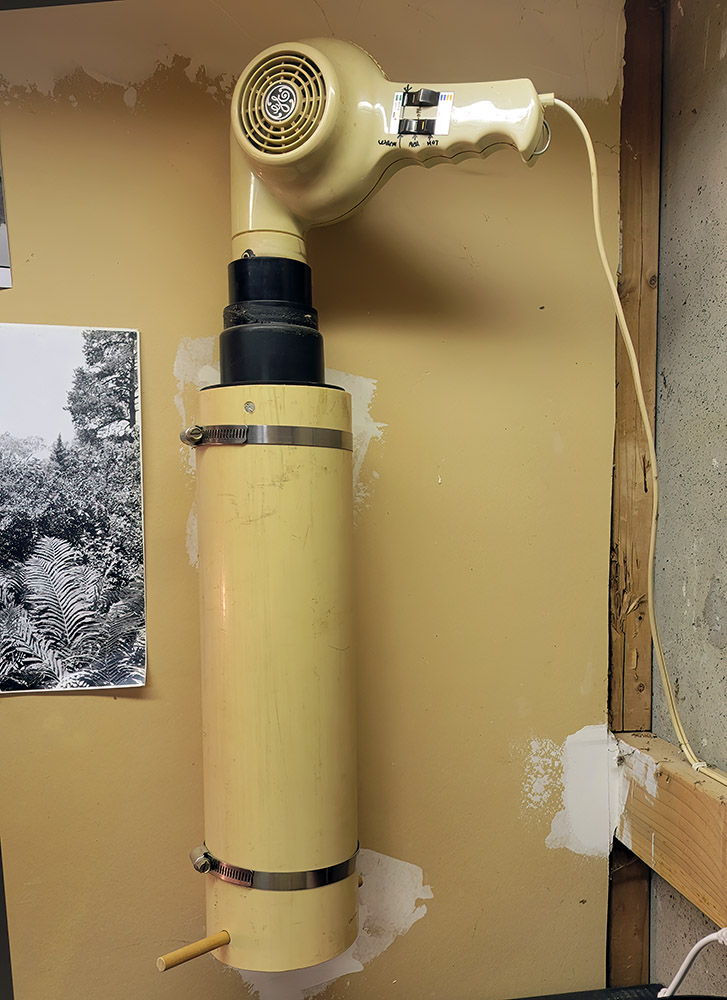
I own some of those weighted clips, but I never use them anymore. My theory is that they create tension in the emulsion that cause curling. About 35 years ago I began this method for super flat film. I use super light weight stainless steel clips.. After photo-flo and one squeegee wipe I hang for about 8-10 minutes. I remove the bottom clip and reverse roll the film back onto a dry stainless reel emulsion side out (opposite from development.) I made a dryer out of a hair blow dry hair dryer, and shop vac reducer, and a 4.5" PVC pipe about 18 inches long. One removable crosswise doll rod to keep it in the pipe, and mounted it to the wall. The drier is set to the lowest heat setting, and slowest FPS air flow. (it feels slightly warm). After 5-10 minutes I remove the reel and lay it on a piece of plywood to slow the return to room temp. Another ten minutes I take it off the reel and lay the film on edge on a formica counter in approximately a 10 inch circle. (This is to straighten the inner most end of the film) By the time I scan or cut strips the film lies perfectly flat. No cupping, and only occasionally the inner most end retains a bit of longitudinal curl that the archive sheet and being nested in a book finish off. Like I said - It's a thory, but the above works for me.
EDIT: in case someone wants to make a quick film dryer. 35 years and still ticking after thousands of rolls
James Markus wrote:
I own some of those weighted clips, but I never use them anymore. My theory is that they create tension in the emulsion that cause curling. About 35 years ago I began this method for super flat film. I use super light weight stainless steel clips.. After photo-flo and one squeegee wipe I hang for about 8-10 minutes. I remove the bottom clip and reverse roll the film back onto a dry stainless reel emulsion side out (opposite from development.) I made a dryer out of a hair blow dry hair dryer, and shop vac reducer, and a 4.5" PVC pipe about 18 inches long. One removable crosswise doll rod to keep it in the pipe, and mounted it to the wall. The drier is set to the lowest heat setting, and slowest FPS air flow. (it feels slightly warm). After 5-10 minutes I remove the reel and lay it on a piece of plywood to slow the return to room temp. Another ten minutes I take it off the reel and lay the film on edge on a formica counter in approximately a 10 inch circle. (This is to straighten the inner most end of the film) By the time I scan or cut strips the film lies perfectly flat. No cupping, and only occasionally the inner most end retains a bit of longitudinal curl that the archive sheet and being nested in a book finish off. Like I said - It's a thory, but the above works for me.
theHUN wrote:
I hang it in the shower with a 100 g weight hanging from the bottom of the roll. A water distiller is creating a warm and humid environment. This method consistently gives flat negatives for FP4 and HP5, slight curling for Acros, and comically massive curling for Rollei IR400.
I've had some bad curling with the Rollei films as well, especially the RPX ones. But the most impossible curling I've ever encountered was with Foma Ortho 400 in 120 (apparently it's less curly in 35mm; I have my first roll of it in a 35mm camera now and we'll see).
Once it was dry and I took off the weighted clip on the bottom, it curled in a tight spiral right up to the top clip, kind of like those gift-wrap ribbons that you curl with a pair of scissors or your fingernail. It took me a long time to scan it because it was almost impossible to get the negatives into the film holder. I have another roll of it in 120 and for that one I think I'll cut the negatives and clamp them in a blank book (acid-free paper) for a week before I try to scan.
James Markus wrote:
Brad, Love that first one. I'm pretty sure those "rods" are actually hollow tubes that are suppose to rotate as the film rolls over them. I've run into hollow straw like aluminum rollers that are corroded on their steel axles. It can be as simple as using dissimilar metals to cause that kind of corrosion.
I think you're right about that. They do rotate. Oddly enough I read in one review of this camera that it's made of aluminum and bakelite, but I don't believe it as the metal is very thin and I can't imagine aluminum being this stiff at that thickness. It feels more like steel to me. But the rods are probably aluminum.
I carefully covered them with electrician's tape cut to size and I think that'll cure the scratching, but I always worry that tape will eventually unstick and get caught in the film, fouling it. If I could find a way to get the rollers out of the camera without damaging it, I could put a short plastic tube over each one. But the camera appears to be assembled by a machine that stamped out the pieces, or else everything is welded together. There are no visible screws anywhere.
James Markus wrote:
Can I interest you in some free weighted film clips then?
I have way too many as it is already. But reading your post with a fresh set of eyes, I should at least try "reverse roll the film back onto a dry stainless reel emulsion side out (opposite from development.)" on a test roll of the worst curl offender in my inventory.
bjhurley wrote:
Gorgeous image and I'm jealous of your Makina! That's my dream camera but I can't bring myself to shell out so much money for it.
Thanks. It's a camera I have been curious about. I bought it and compared it to my Mamiya 7II. The Mamiya is easier to use, but very uninspiring and pretty boring. The Makina is fun! I ended up selling my Mamiya kit and bought a Makina 670 and W67 with quite a bit of money left over. I guess all that really says though is how expensive the Mamiya is. I sent both to be CLA'd a few weeks ago and am excited to get them back.
theHUN wrote:
I should at least try "reverse roll the film back onto a dry stainless reel emulsion side out (opposite from development.)" on a test roll of the worst curl offender in my inventory.
Hey all. I was looking around for some new / diffferent film to try, specifically for the Holga. Shooting TMax 100 seems to underexpose just a bit using the "Cloudy" (f8) aperture setting. But I think TMax 400 in medium-bright NYC sunlight might overexpose, even when using the smaller "Sunlight" (f11) aperture setting. Iso 200 seems like a good compromise.
So I started looking for an iso 200 B/W film. I also wouldn't mind something more "interesting" than TMax. I know the Fomapan / Arista Edu films are popular, but I've read they are extremely thin, curly and hard to deal with?
I found a film on B&H called Catlabs 320. From some reviews I found, it looks like it is best shot at 200, is naturally contrasty, and "dries very, very flat", which fits all my criteria. Plus it's an affordable $6.95 a roll. (120)
One review also said it is actually Kodak Double X and Catlabs just re-branded it. I also found a reviewer who said that even though Cinestill doesn't list this film as compatible, it does work fine with DF96.
Anyway, I searched this forum and found a couple of shots Oldwino posted, but I was wondering if anyone else has any experience with this film! Thanks!
Activatedfx wrote:
Hey all. I was looking around for some new / diffferent film to try, specifically for the Holga. Shooting TMax 100 seems to underexpose just a bit using the "Cloudy" (f8) aperture setting. But I think TMax 400 in medium-bright NYC sunlight might overexpose, even when using the smaller "Sunlight" (f11) aperture setting. Iso 200 seems like a good compromise.
So I started looking for an iso 200 B/W film. I also wouldn't mind something more "interesting" than TMax. I know the Fomapan / Arista Edu films are popular, but I've read they are extremely thin, curly and hard to deal with?
I found a film on B&H called Catlabs 320. From some reviews I found, it looks like it is best shot at 200, is naturally contrasty, and "dries very, very flat", which fits all my criteria. Plus it's an affordable $6.95 a roll. (120)
One review also said it is actually Kodak Double X and Catlabs just re-branded it. I also found a reviewer who said that even though Cinestill doesn't list this film as compatible, it does work fine with DF96.
Anyway, I searched this forum and found a couple of shots Oldwino posted, but I was wondering if anyone else has any experience with this film! Thanks!...Show more →
Use ISO 400 film in the Holga. I find it works best - in any condition.
bjhurley wrote:
I think you're right about that. They do rotate. Oddly enough I read in one review of this camera that it's made of aluminum and bakelite, but I don't believe it as the metal is very thin and I can't imagine aluminum being this stiff at that thickness. It feels more like steel to me. But the rods are probably aluminum.
I carefully covered them with electrician's tape cut to size and I think that'll cure the scratching, but I always worry that tape will eventually unstick and get caught in the film, fouling it. If I could find a way to get the rollers out of the camera without damaging it, I could put a short plastic tube over each one. But the camera appears to be assembled by a machine that stamped out the pieces, or else everything is welded together. There are no visible screws anywhere....Show more →
I use Scotch tape (sellotape) not electrician's tape. It is much thinner, slicker so film slides over it easier, and much less prone to get sticky/unravel.






 I sent both to be CLA'd a few weeks ago and am excited to get them back.
