Bryan, Great captures by the way. It is always nice to get wind of a special train and get the opportunity to see it. We ocassionally get that here with one of the ATSF steamers puffing through SO Cal. Too bad you could not get back to Chicago and find where the train was parked and get more shots.
And, yes, I bet that train is REALLY cool. I am sure that is is probably like the American Orient Express in that thing with all the beauty and exemplary service. It has to be a UP showpiece.
who me wrote:
Bryan, Great captures by the way. It is always nice to get wind of a special train and get the opportunity to see it. We ocassionally get that here with one of the ATSF steamers puffing through SO Cal. Too bad you could not get back to Chicago and find where the train was parked and get more shots.
And, yes, I bet that train is REALLY cool. I am sure that is is probably like the American Orient Express in that thing with all the beauty and exemplary service. It has to be a UP showpiece.
Thanks...
The Centennial that came by the Park yesterday was pulling Union Pacific passenger cars filled with Union Pacific Senior Executives on the way to Chicago from Omaha. How can a company plane stack up to your own company train with a giant locomotive? Well, it doesn’t. l.
I heard it was just stopping in Chicago and then heading to New Orleans so, if you live on the route go to the UP blog at yahoo groups and see if it is coming near you. It's worth the effort.
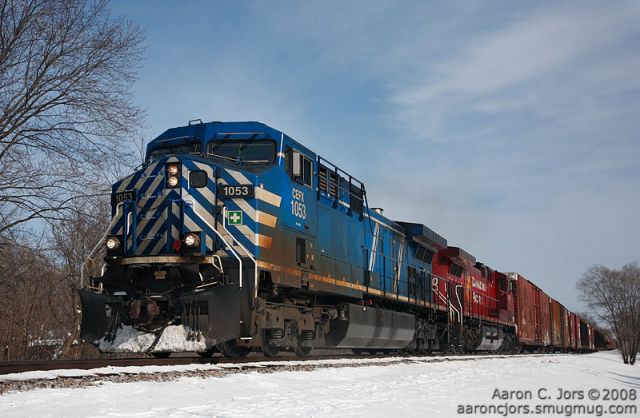
Haven't posted much lately--here or anywhere. Never seems to be enough time. Anyway, here's a couple from this afternoon--first sunny day we've had in a while. There's a place I like to walk sometimes where I can catch both birds and trains, depending on what's happening. I was stalking some ducks when this first train appeared and since I had the Bigma on the camera I decided to use it. Temp was only 7-8 C so I was surprised to see as much heat haze as there is. Train was over a half mile away when I took the shot...
I had just got the 580s and PWs set up and didn't really have time to fire off some test shots to see if the lights were angled correctly. It was just hit or miss and guessing at the intended ratio/power settings in manual mode. Looks like it could be dialed back a bit.
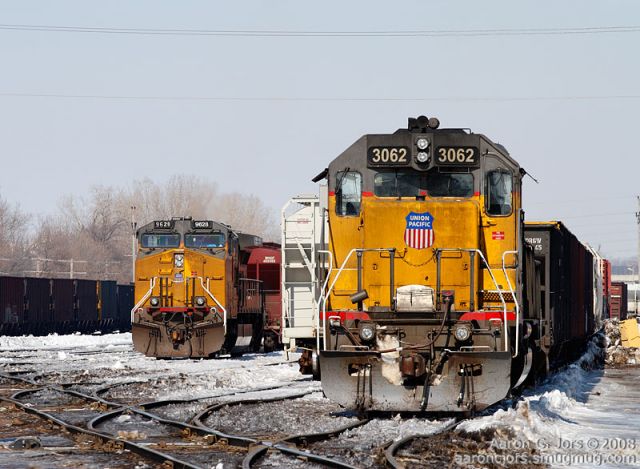
Anyone know why railroads run the last diesel in the group backwards? Or like above, butt to butt...
Also, we have a major ATSF line by our house. Some trains have 4 diesels up front and other trains run 2 in front and 2 pushing. Anyone know why they do this? I can under stand the additional pushers on large grades for additional motive power going up and additional braking/charging the air system going down but why the 2 and 2 configuration and not just 4 and 0 on the flats.
Diesel locomotives run equally well in both directions, but crews prefer to run them looking forward Having units back-to-back eliminates turning them at terminals to put a cab forward.
The 2+2 (or 3+1 or 1+2 or whatever) configuration is a relatively new practice where the engineer in the lead consist controls the mid-train or rear units by radio - they're called Distributed Power Units (DPU's). By distributing all that tractive effort essentially throughout the train, train-handling is improved and less strain is imposed on couplers, etc. Works well for on the level and on grades. DPU's have eliminated many (but not all) former pusher ("helper") grades where manned units were placed in or behind the train.
Ron
Ron, thanks for the explaination. Your first sentence makes a lot of sense to me. The DPU stuff is kind of what I figured. And with todays technology, I figured things were remote controlled.
Have you seen the articles and news spots 1-2 years ago about some Railroads experimenting with essentially RC switching engines? rom what I remember, RR's liked them because they could reduce the manpower needed (engineer and ground person linking and unlinking cars being the same person) but the safety issue of an operator being on the ground and not in an engine was a big issue.
Ron, thanks for the explaination. Your first sentence makes a lot of sense to me. The DPU stuff is kind of what I figured. And with todays technology, I figured things were remote controlled.
Have you seen the articles and news spots 1-2 years ago about some Railroads experimenting with essentially RC switching engines? rom what I remember, RR's liked them because they could reduce the manpower needed (engineer and ground person linking and unlinking cars being the same person) but the safety issue of an operator being on the ground and not in an engine was a big issue.
This is a shot I took 2 weeks ago in the Dominican Republic. Its a full scale train yard, but did some PP using a technique someone posted here a month or two ago to get the miniaturized effect.
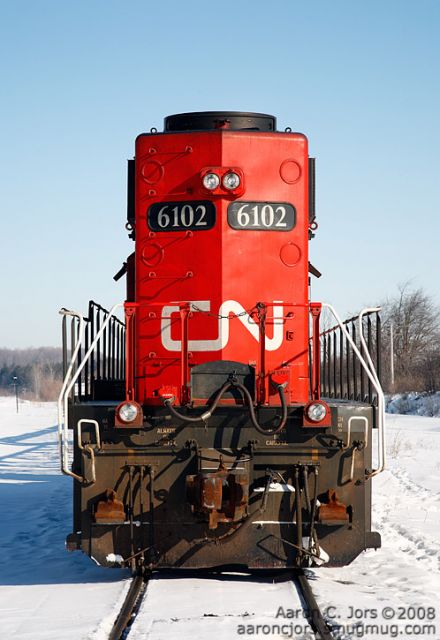
Remote control of yard engines in switching operations is past the experimental stage now. It's pretty much proven technology. American roads would like to use it more but there are a lot of union issues to resolve. I believe Wisconsin Central started to introduce it but were forced to stop by court action. Canadian railroads--CN in particular--make much greater use of the technology.


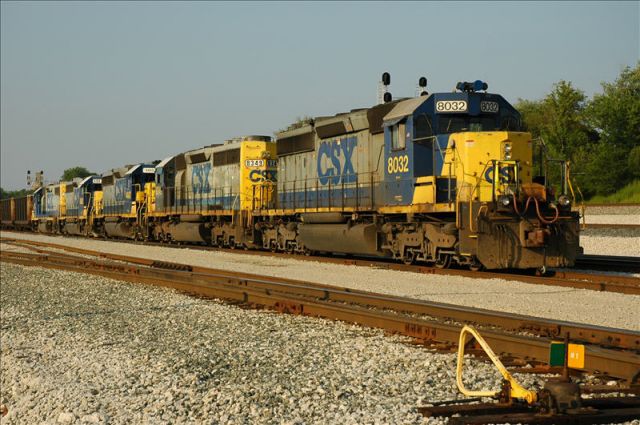
 Having units back-to-back eliminates turning them at terminals to put a cab forward.