JWilsonphoto
Offline
• • • • • • •
Upload & Sell: On
|
We all know how much time is involved now that our passion has turned digital. When I shoot film now, I feel like I'm stepping back into the dark ages. I keep looking for the preview to pop up on the ground glass of my Sinar 4x5, then I have to take it to the lab and wait 3 to 4 hours for the sheet sto come out of processing. My work flow with 4x5 is to shoot a test sheet for each composition, number it, shoot three or four sheets at several bracketed exposures, then have the test sheets processed for a guide.... and then make corrections on the final sheets according to what I saw on the tests. This whole process takes at least a day, several personal trips to the lab, or $100 in couriers, depending upon my shooting schedule. Add the cost factor, $4 for each Polaroid test, $2 per sheet of chrome and $2 per for processing, I generally ran up a 4 to 5 hundred dollar film and processing bill on each assignment. Multiply that times 250 or so assignments annually and it gets scary. Shooting digital does take time in post, but I know I have the shot before I leave the location, something I am moderately sure of (fingers crossed) when I'm shooting film. Now I am confident, have everything backed up to several drives and DVD's before I leave the site. On top of that, if I'm not flying my plane, I usually have the assignment Photoshopped and burned to a disk on the flight home.
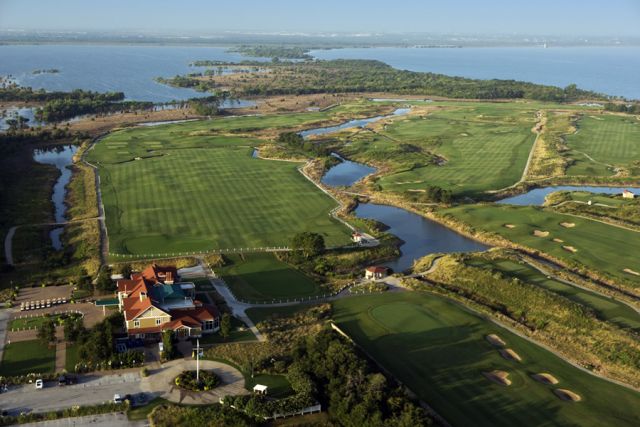
We haven't even discussed the control yet, oh, the control! There are a number of assignments that I shoot each year in digital format, that I probably wouldn't have gotten done if I was relegated to film. A good example is an assignment I shot last week. I was booked to shoot this golf course in the Spring, but our weather has just been ridiculous. The course was under water a month ago. The Client several times needing magazine cover images and I went out, picked my shot, waited for some sort of reasonable light and then worked magic in Photoshop. They got the covers and nobody had any idea what the original light was really like. Last week they were under a deadline for aerials. It has decided to become summer in Texas, with unusually high humidity so the skies are very hazy, but there was no wiggle room for these aerials so we took off in the dark and hovered around the project until the colors were rich and the shadows were long. The sky was so hazy that the sun was well above the horizon before it was casting anything but diffused light across the course. Shutterspeeds were in the 125th range tops and we had a stiff wind from 300' above the surface on up. That condition gave us a shear turbulence layer beginning at about 250' to about 1,000 agl. Other than that, conditions were just peachy!
I knew what we'd be up against so I fired up my Kenyon stabilizer for the assignment and it was a life saver.At $3,000, it's not an inexpensive accessory, but it has become indispensable in the short time I've owned it. I never mind spending money on equipment if it does what is expected of it, and this unit does far more than that.
In just over an hour in the air, I blew through about 800 exposures. Sitting in front of my Mac, I was happy to see that about 95% were tack sharp, even given the moderate f/stops I was shooting. The images that were staring back at me from my monitor were really milky, which I anticipated. I held my breath as I worked my way through all the digital tools CS3 has to offer. It wasn't long before I knew digital would allow me to pull this one out of the fire for my client.
There is no way that film would have allowed me the exposure latitude, fine grain and control over the end product that the digital medium did. I am ever more cognizant throughout the year, of being on an assignment that is over the edge of the film/digital chasm.
JW
|