Stefan Official
Offline
• •
Upload & Sell: Off
|
 p.1 #1 · C2PA / Content Credentials – Have you come across this yet? p.1 #1 · C2PA / Content Credentials – Have you come across this yet? | |
I find this topic pretty fascinating, and I suspect many photographers still have no idea what is currently developing in the background.
C2PA and Content Credentials are essentially a kind of digital provenance record for images. They can document how an image was created, which applications or devices were involved, whether generative AI was used, and which relevant editing steps were recorded in its provenance history. Depending on the workflow, even source images – so-called “ingredients” – and earlier states of an image can be visible.
Adobe has used Content Credentials with Firefly for quite some time, but the much broader automatic rollout across Adobe applications is new. **Adobe began rolling this out across its applications in August 2026, with the rollout continuing throughout the month.**
Since then, when qualifying generative AI functions are used in supported Adobe applications, C2PA information is automatically attached to the resulting content. According to Adobe, this automatic AI labeling cannot be disabled for qualifying content.
So this is actually a very recent change – only a few weeks old in many Adobe workflows – which is probably one reason why many photographers have not even noticed it yet.
What makes this particularly interesting is how persistent this information is becoming.
Ordinary metadata is relatively easy to remove. That is exactly why these systems now go considerably further. With so-called **Durable Content Credentials**, invisible watermarks and digital fingerprints are also used. The associated provenance information is additionally stored in a Content Credentials cloud.
So the information does not simply disappear just because someone removes the metadata from the file. Using the watermark and fingerprint, the image can be matched back to its stored Content Credentials. These methods are specifically designed to survive editing, resizing, compression, cropping and even screenshots.
Adobe explicitly states, for example, that Content Credentials stored in the cloud can even be rediscovered from a screenshot.
So simply removing the metadata and assuming everything is gone no longer works in the same way. That is what I find so interesting about it: the provenance and AI information is no longer tied only to some EXIF field that can be removed with a couple of mouse clicks.
And this is **not an Adobe-only system**.
C2PA is an open standard. Adobe, Google, Microsoft, Meta, Sony, OpenAI, Amazon and other major companies support C2PA, are involved in its development, or are gradually integrating this kind of provenance information into their products and platforms.
Adobe Inspect is therefore not limited to information created by Photoshop or Lightroom. If another application or device has created valid C2PA Content Credentials, Adobe's tool can read those as well.
That is what makes the whole thing particularly interesting in the long run: it is becoming a cross-platform and cross-manufacturer standard rather than just another proprietary Adobe solution.
If you want to try it yourself, you can upload an image and inspect it here:
**Adobe Content Authenticity – Inspect:**
https://contentauthenticity.adobe.com/inspect
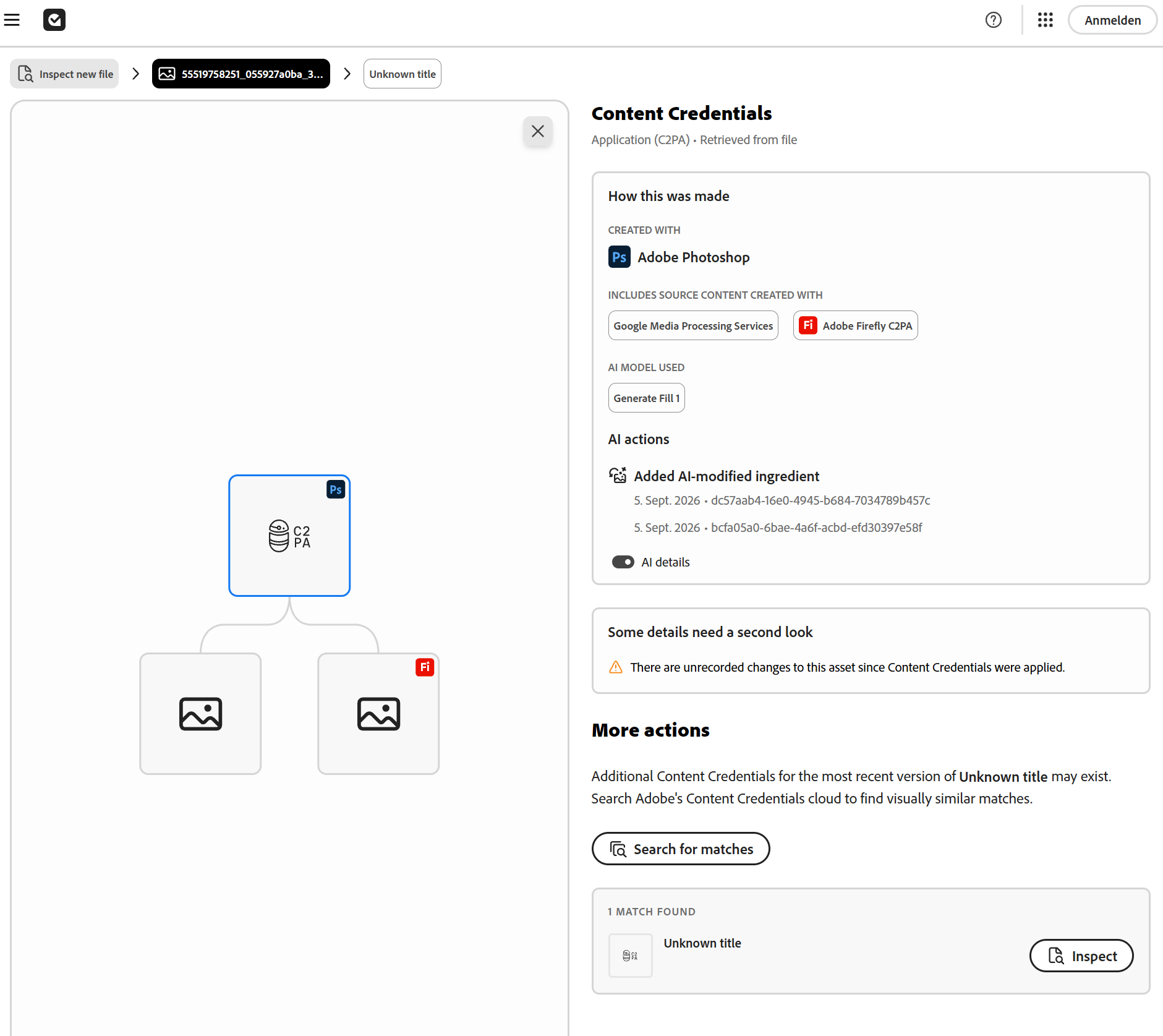
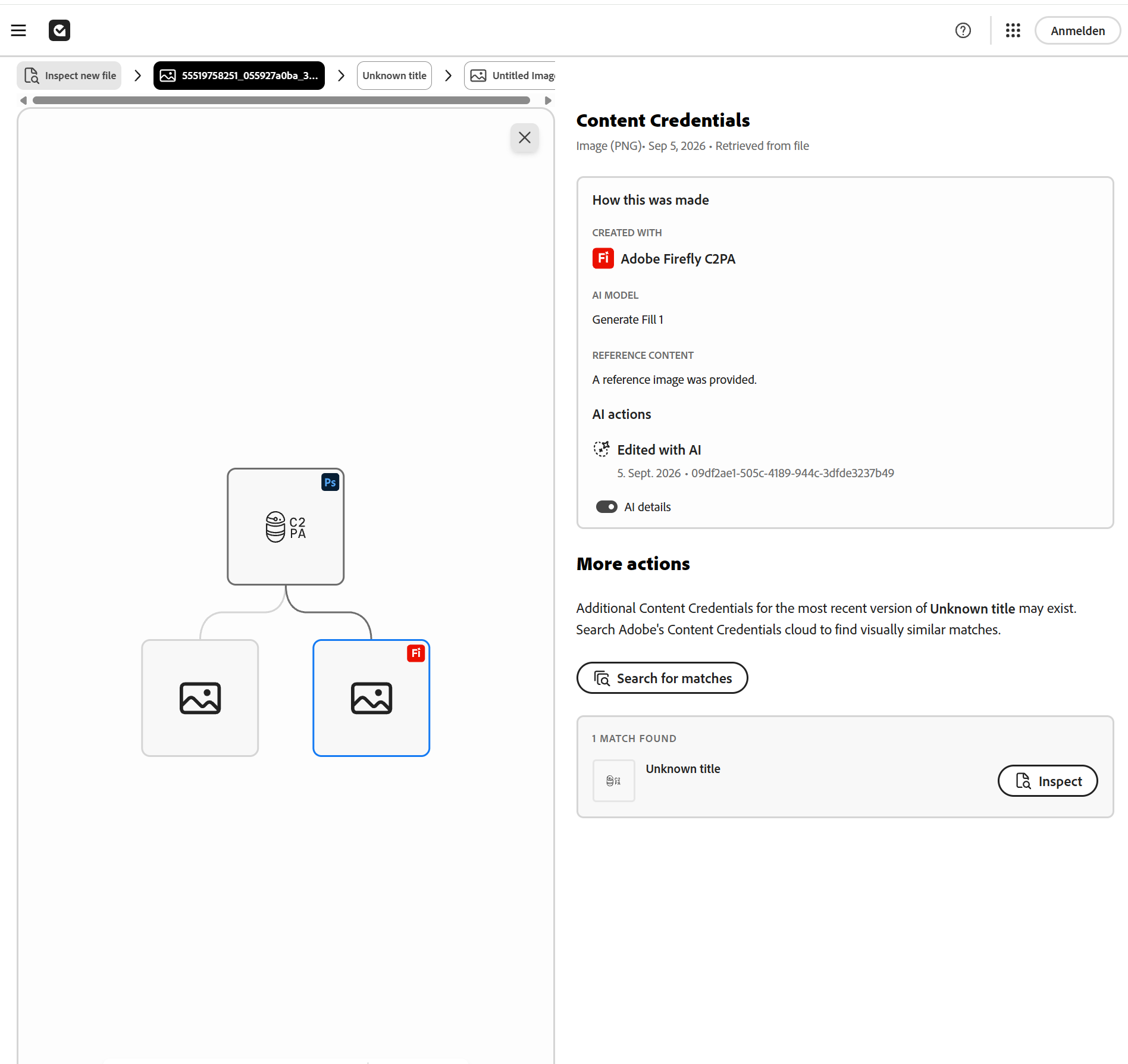
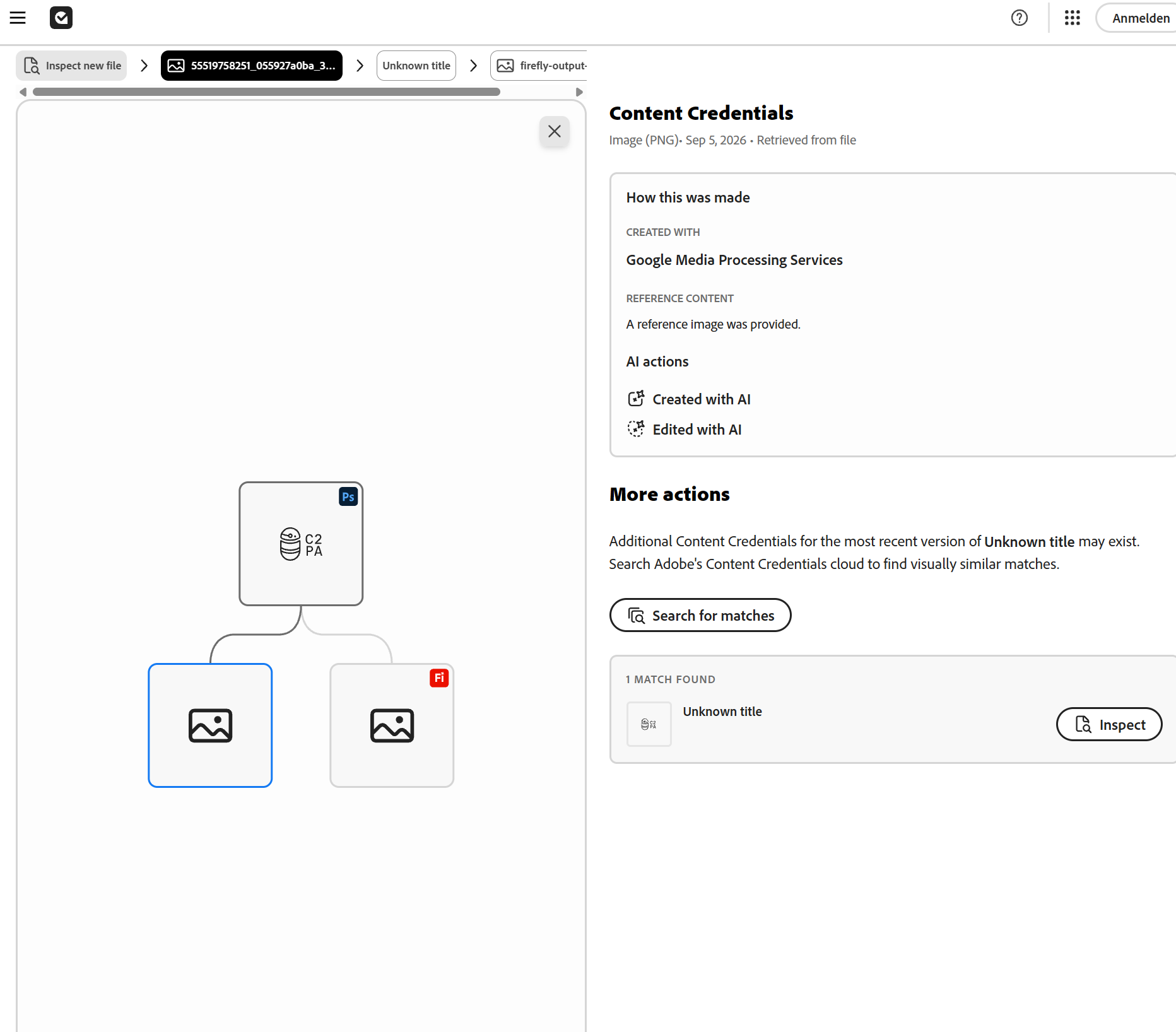
It shows whether Content Credentials are present and what has been recorded – for example the applications or devices involved, generative AI use, editing steps and other parts of the provenance chain.
Adobe also has a Chrome browser extension that can detect Content Credentials directly on images displayed on websites. So you do not necessarily have to download an image first and inspect it manually.
I think this is where things are ultimately heading: at some point, while simply looking at an image online, you may see a small symbol and be able to click it to find out how the image was created and whether generative AI was involved.
Out of curiosity, I have already checked quite a few images on Flickr. Particularly images where my first thought was:
*There is simply no way this could have been photographed like that, no matter how skilled the photographer is.*
And that is where things became interesting.
In the images I checked, I found entries such as **Adobe Firefly, Generative Fill, Created with AI, Edited with AI**, as well as AI-modified ingredients in the provenance information.
And I am explicitly **not** talking about somebody removing a dust spot or a tiny distracting object.
In some cases, entire areas of the image had been generatively altered, replaced or newly created. At that point, for me personally, it is no longer conventional photographic editing.
I have absolutely nothing against AI-generated images. They can look fantastic. I also have nothing against retouching. I simply think it should remain transparent **what is still photography and at what point a photograph increasingly becomes a generated or digitally constructed image.**
There is one aspect of this that affects me personally as well.
I like using generative removal for small spots because it can sometimes work more reliably than the traditional Clone Stamp. But using a generative function for something that minor is also documented accordingly.
Someone who only sees “edited with AI” without looking any further might initially assume that far more was changed than was actually the case. If you inspect the Content Credentials in detail, however, you get a much better idea of what was actually done.
For small corrections like that, I will probably go back to using the good old Clone Stamp more often. :-)
The subject has also gained additional momentum through the EU AI Act. Since **August 2, 2026**, the relevant transparency requirements for artificially generated or manipulated content have been in effect. That is another reason why machine-readable labeling and provenance information are becoming increasingly important.
Of course, this does not mean that we can suddenly take any ten-year-old photograph and reconstruct what was done to it. If this provenance information never existed in the first place, it cannot simply be recreated afterwards.
But for current and future images, things are changing quite fundamentally.
And I suspect many photographers still have no idea what information their newly exported, generatively edited images may now carry with them.
Eventually, we may no longer have to argue about whether an image merely *“looks a bit like AI.”*
We will simply be able to look at what is actually documented in its provenance chain.
If you use Adobe software, you can easily try this yourself: take one of your own photographs, use a generative function in Photoshop or Lightroom, export the finished image and then upload it to Adobe Inspect.
You can then see for yourself what has actually been recorded.
And my personal wish for Flickr and similar platforms would eventually be one very simple option:
**“Hide generatively altered images.”**
Then I would not even have to look at them. ;-)
|


