Ulysseita
Online
• •
Upload & Sell: On
|
 p.1 #1 · From Cobalt, Leica M vs world. p.1 #1 · From Cobalt, Leica M vs world. | |
Having finally tried, and tested with a monochromator and all the related stuff, pretty much every Leica M from the M9 to the EV1, sorry, I mean the M11, because the EV1 for me is NOT an M... 
We now have a pretty clear set of values describing both the colour of Leica’s JPGs and what is really happening upstream in the RAW.
If we talk about JPGs.
The M9 is the queen and, as has been said many times by people who have worked with Leica forever, Overgaard and company, over in Wetzlar they had clearly decided to create their own very strong interpretation of colour. In some ways we are almost in "Kodachrome" territory: skies drifting towards teal, very orange lights, saturation and separation deliberately given a strong character.
Yes, the colour of NON-modified M9s, meaning the colour of the original JPG, is very obviously something unique that Leica never really reproduced again with the same strength in the generations that followed....We are basically in this philosophy:
"We give you the JPG. With the RAW, you’re on your own."
And in fact the RAW is a fairly bare DNG, with embedded profiles that are certainly nothing miraculous and, on the Adobe side, essentially matrix-based profiles.
With the M240, the prototype with video and a million options that even today makes me miss ONLY one thing, the viewfinder lines turning RED... they could have kept that going, CHEAP BASTARDS! [MrGreen] (https://www.juzaphoto.com/shared_files/layout/icon_mrgreen.gif), and then with the later M262, the JPG gets toned down a little but still stays on the strong side.
To give you an idea, we are more in the territory of Fuji’s Provia: punchy, but still reasonably balanced.
From the M10 onwards, in my opinion the philosophy itself changes.
We move much more into Fuji Pro Neg Std territory: softer, cleaner, less characterised, much more generic.
But let’s get to the RAW files, because that is where things get much more interesting.
The data is here:
https://www.cobalt-image.com/spectre-laboratory-measurements/
We have already looked at the separation of the M9, CCD and all the mythology that comes with it.
Just to give a reference, the sacred monsters we have measured, almost all Nikon, sit roughly between 85 and 89.
Then, apart from a few interesting exceptions I will talk about, we often find Canon above 70, followed by Sony, Fuji etc.
And Leica?
M9: 72.2
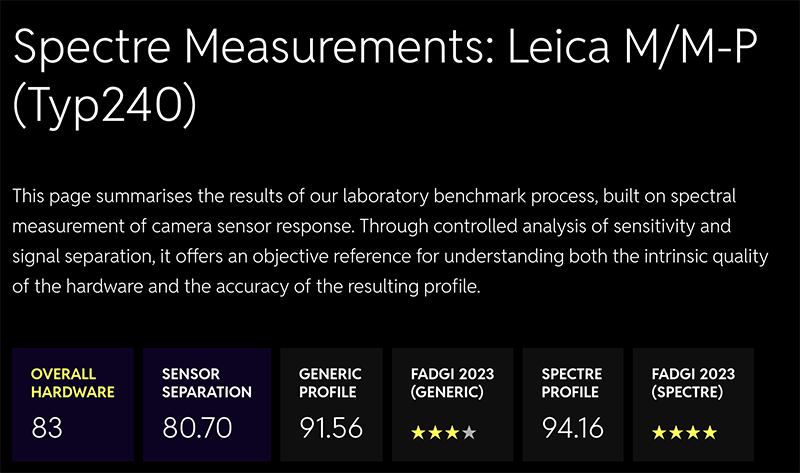
M240: 80.70
M10: 80.80
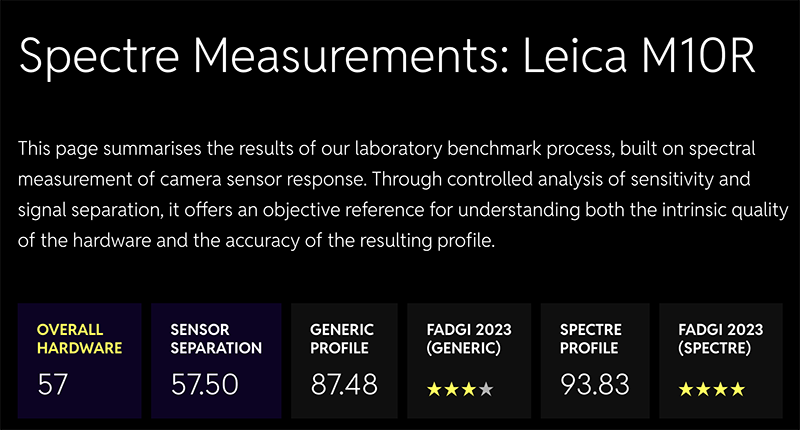
M10-R: 57.5
M11: 61.60
And here, in my opinion, something VERY interesting comes out.
Some people will remember that, having first measured the M10-R and then various SL and Q models, we had started wondering whether Leica simply did not care that much about hardware colour separation...
These numbers tell a different story, because the M240 and M10 are EXCELLENT.
80.7 and 80.8 mean that Leica, after the mess of the M8 and the whole IR story, had not only fixed the problem, but had clearly invested quite heavily in the spectral discrimination of the sensor + CFA system as well.
The real drop happens with the M10-R.
And it is a huge one.
We go from 80.8 on the M10 to 57.5 on the M10-R.
At the same time they gain almost twice the megapixels, greater dynamic range and a much better recovery capability.
Here though we need to be precise; Leica does NOT officially state, at least not in the specifications I have found, that the M10-R is simply "the M10 Monochrom sensor with a Bayer filter added on top".
The M10 Monochrom and M10-R clearly belong to the same roughly 40 MP generation, but from that we cannot automatically conclude that the silicon is literally identical, even if their shared branching strongly suggests there is more to it...
What we can say for certain is that the M10-R uses a 40.89 MP CMOS sensor without a low-pass filter.
And it is exactly from this generation that separation collapses.
The most plausible explanation, looking at the SSFs, is that the CFA trade-off changed heavily.
More selective filters separate R, G and B better, but throw away more light; broader, more transmissive filters let more photons reach the sensor, but they also make the three spectral responses overlap more.
So you can gain efficiency, noise performance, DR etc., while losing the ability to distinguish between two different spectra that produce similar RGB values.
And careful: this is an explanation compatible with the data, it does NOT automatically mean that "more megapixels = worse colour".
Quite the opposite.
The M11 climbs slightly back to 61.60, but still remains miles away from the M240 and M10.
And it is a 60.3 MP sensor with RGB filter, UV/IR filtering and no low-pass filter. Leica states that clearly in the specifications.
Now go and look at the other monsters, A7R6, GFX100, Hasselblad 100... all low.
So it becomes very easy to think:
"Yeah well, sensors are insanely dense now, pixels are small, they need more open CFAs to keep quantum efficiency and DR up, so separation goes down."
Nice.
Except then the 45 MP Nikons come along and ruin the easy explanation, because some of them sit between 85 and 89.
So high resolution and strong spectral separation are NOT necessarily incompatible.
And this, in my opinion, is the most interesting point of all.
The M10-R tells us that, moving to the 40 MP generation, Leica clearly accepted a very different compromise compared with the M10.
The M11 recovers something, but does not even come close to the levels of the 24 MP M bodies.
Meanwhile Nikon manages to put 45 MP on full frame and stay right up there with some of the best values we have ever measured.
So the question remains:
WHY THE HELL IS NIKON STILL UP THERE with 45 megapixels?
Because clearly this is not just a megapixel issue.....and that is the next interesting thing to understand.
PS. translated from my topic on another italian forum.
|