Sony a1 shutter lag measurements
p.1 #1Sony a1 shutter lag measurements
Today I measured the latency between a shutter half/full press and the start of the exposure on a Sony a1. You can read about the methodology I use here.
Electronic shutter:
Mechanical shutter:
Sony publishes measurements on their cameras for half-presses here. Their measurement for the a1's electronic shutter is 40ms and the mechanical 20ms (compared to my measurement of 41ms-43ms and 21ms-23ms).
Per Sony's results, the a1's electronic has the highest shutter latency of all their MILCs.
The above were measured using staggered LEDs on my Arduino. Here is a measurement of the lag from a half-press to the a1's digital shutter sound (mp3 clip):
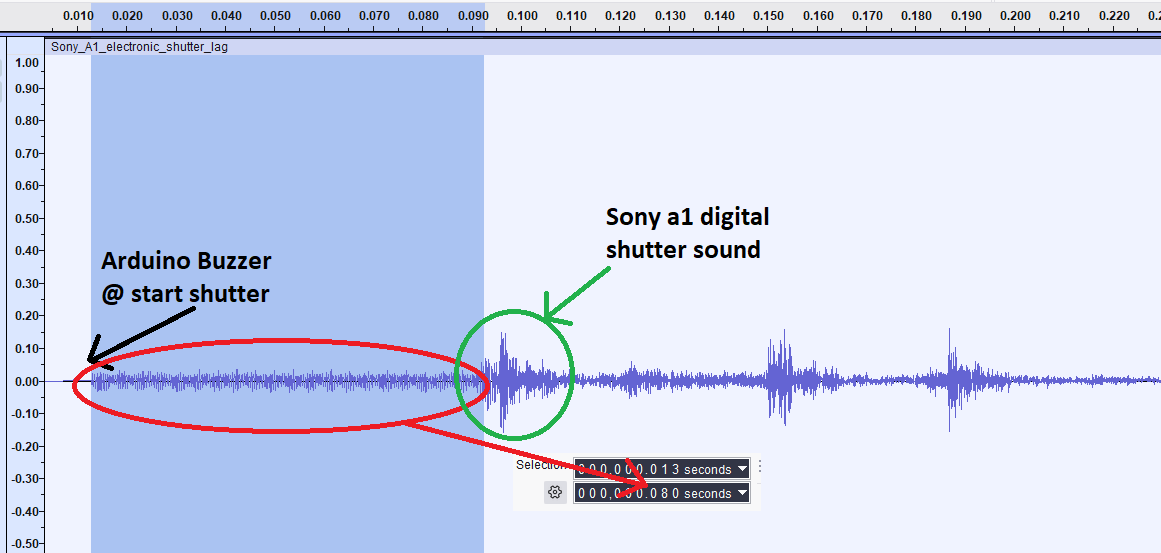
So it seems the camera doesn't start to generate the simulated shutter sound until after the exposure.
For comparison, here are the measurements I've previously done, all for full-press:
Nikon Z6 III
Nikon Z8
Edited on Sep 04, 2026 at 02:11 PM · View previous versions
Electronic shutter:
- For full-press:
110ms80ms to 105ms
- From half-press:
70ms41ms to 43ms
Mechanical shutter:
- For full-press:
80ms60ms to 80ms
- From half-press:
45ms21ms to 23ms
Sony publishes measurements on their cameras for half-presses here. Their measurement for the a1's electronic shutter is 40ms and the mechanical 20ms (compared to my measurement of 41ms-43ms and 21ms-23ms).
Per Sony's results, the a1's electronic has the highest shutter latency of all their MILCs.
The above were measured using staggered LEDs on my Arduino. Here is a measurement of the lag from a half-press to the a1's digital shutter sound (mp3 clip):
So it seems the camera doesn't start to generate the simulated shutter sound until after the exposure.
For comparison, here are the measurements I've previously done, all for full-press:
Nikon Z6 III
- Fully-mechanical shutter: 65ms
- EFCS: 35ms
- Electronic shutter: 38ms
Nikon Z8
- Electronic shutter: 43ms to 48ms
- Electronic shutter with "Photo Flicker Reduction" enabled: 85ms
Edited on Sep 04, 2026 at 02:11 PM · View previous versions
Sep 04, 2026 at 05:28 AM
p.1 #2Sony a1 shutter lag measurements
Interesting measurement! Remembers me of the beginning of digital cameras where quick subject was able to leave the frame beween shutter button press an actual capture.
Since you use sound - are there distances that would have to be taken into account?
Since you use sound - are there distances that would have to be taken into account?
Sep 04, 2026 at 08:37 AM
p.1 #3Sony a1 shutter lag measurements
I find it interesting and I don't doubt your results, but for me, it's maybe my most responsive camera. Here's why: I shoot a lot of strobed dance images. For some of these, the dancers jump and I try to capture them at their peak or best body position, etc. With my a7r5, I'm late quite often and it takes several times for me to get in sync with the dancer. With the a1 it seems as if I can fire when I see their peak and it fires. With the a7r5, I've got to anticipate the peak and fire a bit before to allow for shutter lag. I also have the a9v3 but don't really use it for portrait work so don't know how responsive it is. When I am shooting with the strobe, it's mechanical shutter.
Sep 04, 2026 at 09:01 AM
p.1 #4Sony a1 shutter lag measurements
Altglas wrote:
Interesting measurement! Remembers me of the beginning of digital cameras where quick subject was able to leave the frame beween shutter button press an actual capture.
Since you use sound - are there distances that would have to be taken into account?
The primary measurement is with the LEDs. The secondary confirming measurement is with sound - the camera is right next to the Arduino buffer that is turned on when the shutter is triggered so the distance between the camera and buzzer isn't material.
Sep 04, 2026 at 09:37 AM
|
p.1 #5Sony a1 shutter lag measurements
To follow-up, I did a visual measurement of the camera's shutter / exposure indications. They conflict with my measurements. I'm very confident in my LED/audio methodology so it's not clear to me why the camera's visual indications of shutter lag are so much faster than my measurements. I'll think it over and report back my thoughts on the conflicting data. EDIT: I thought it over and my methodology was correct but I was misinterpreting my own results lol; I just posted a detailed description of the methodology in my post here and updated the results in the OP.
Here's how how I do the visual measurements:
Here are the visual measurements from a half-press, with screen shots:
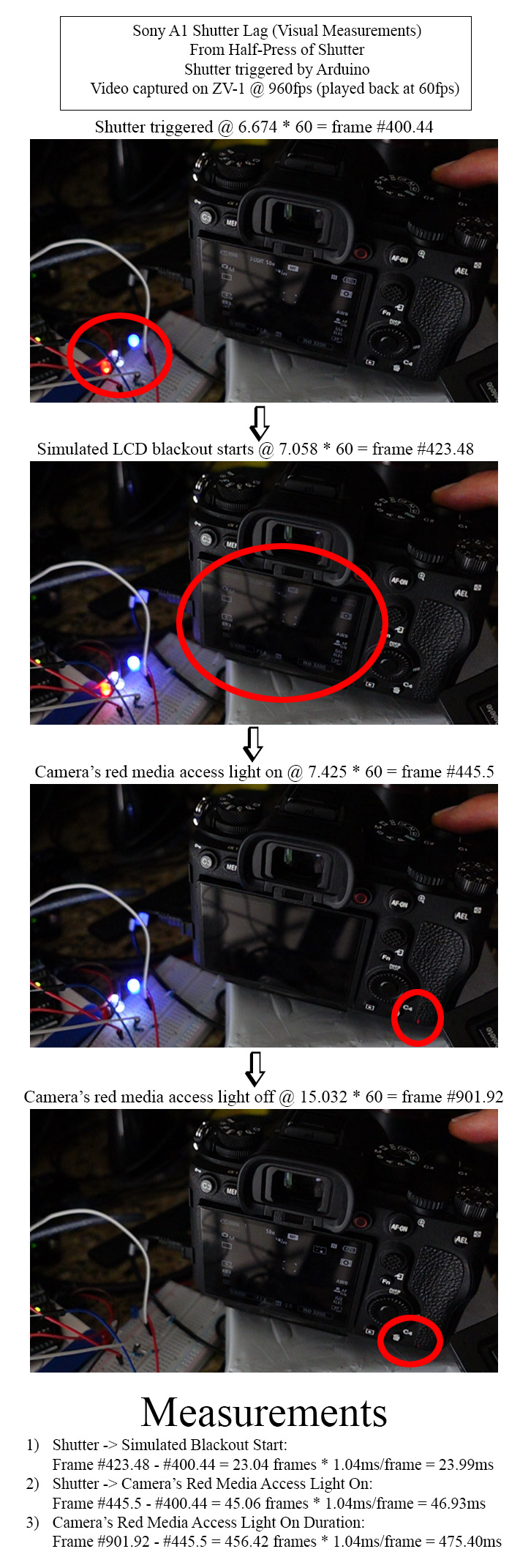
So the visual measurements from a half-press indicate:
Here are the visual measurements for a full-press (screenshots not included above):
Here are the 960fps videos from the ZV-1, for those who would like to see/measure the intervals themselves. Note the meatadata is configured to play back @ 60fps (16x slow motion).
Half-Press:
https://images.horshack.net/forums/all/shutterlag/sonya1/A1_Shutter_to_Media_LED_From_Halfpress_With_Simulated_Blackout.MP4
Full-Press
https://images.horshack.net/forums/all/shutterlag/sonya1/A1_Shutter_to_Media_LED_Full_Press_With_Simulated_Blackout.MP4
Here's how how I do the visual measurements:
- I set up my Sony ZV-1 to record both the a1's rear and my Arduino LEDs @ 960fps.
- I've configured the a1 to simulate an LCD blackout on the exposure by setting "Shoot. Start Display (still image)" to ON. This is to provide an additional visual indication of when the shutter trigger is recognized.
- I trigger the a1's shutter from my Arduino code
- At the same instant my code triggers the shutter, it also turns on all the Arduino LED's.
- When done recording, I play back the footage on my computer and measure the frame intervals between the various events. The footage is 960fps that plays back @ 60fps, which means 16x slow motion, so the conversion between playback timestamp and 960fps frame # is timestamp*60. The conversion between the 960fps frame # to wall-clock elapsed time is frame # * 1.0416ms (1000ms in one second divided by 960fps).
Here are the visual measurements from a half-press, with screen shots:
So the visual measurements from a half-press indicate:
- Shutter triggered -> start of rear LCD simulated blackout = 24ms
- Shutter triggered -> camera's Red media access light turning on = 47ms
- Media access light on duration = 475ms
Here are the visual measurements for a full-press (screenshots not included above):
- Shutter triggered -> start of rear LCD simulated blackout = 45ms
- Shutter triggered -> camera's Red media access light turning on = 81ms
- Media access light on duration = 550ms
Here are the 960fps videos from the ZV-1, for those who would like to see/measure the intervals themselves. Note the meatadata is configured to play back @ 60fps (16x slow motion).
Half-Press:
https://images.horshack.net/forums/all/shutterlag/sonya1/A1_Shutter_to_Media_LED_From_Halfpress_With_Simulated_Blackout.MP4
Full-Press
https://images.horshack.net/forums/all/shutterlag/sonya1/A1_Shutter_to_Media_LED_Full_Press_With_Simulated_Blackout.MP4
Sep 04, 2026 at 09:53 AM
p.1 #6Sony a1 shutter lag measurements
I just updated (corrected) the results in the OP. I was misinterpreting my own test lol, which I figured out as I was writing up a detailed explanation of my methodology, which you can read in my post here.
Sep 04, 2026 at 01:38 PM
p.1 #7Sony a1 shutter lag measurements
@timgangloff 's experience isn't really backed by Sony's data. So what leads to this difference between practice and theory?
Shutter speed and aperture setting maybe? Or sensor read time?
Shutter speed and aperture setting maybe? Or sensor read time?
Sep 04, 2026 at 05:09 PM