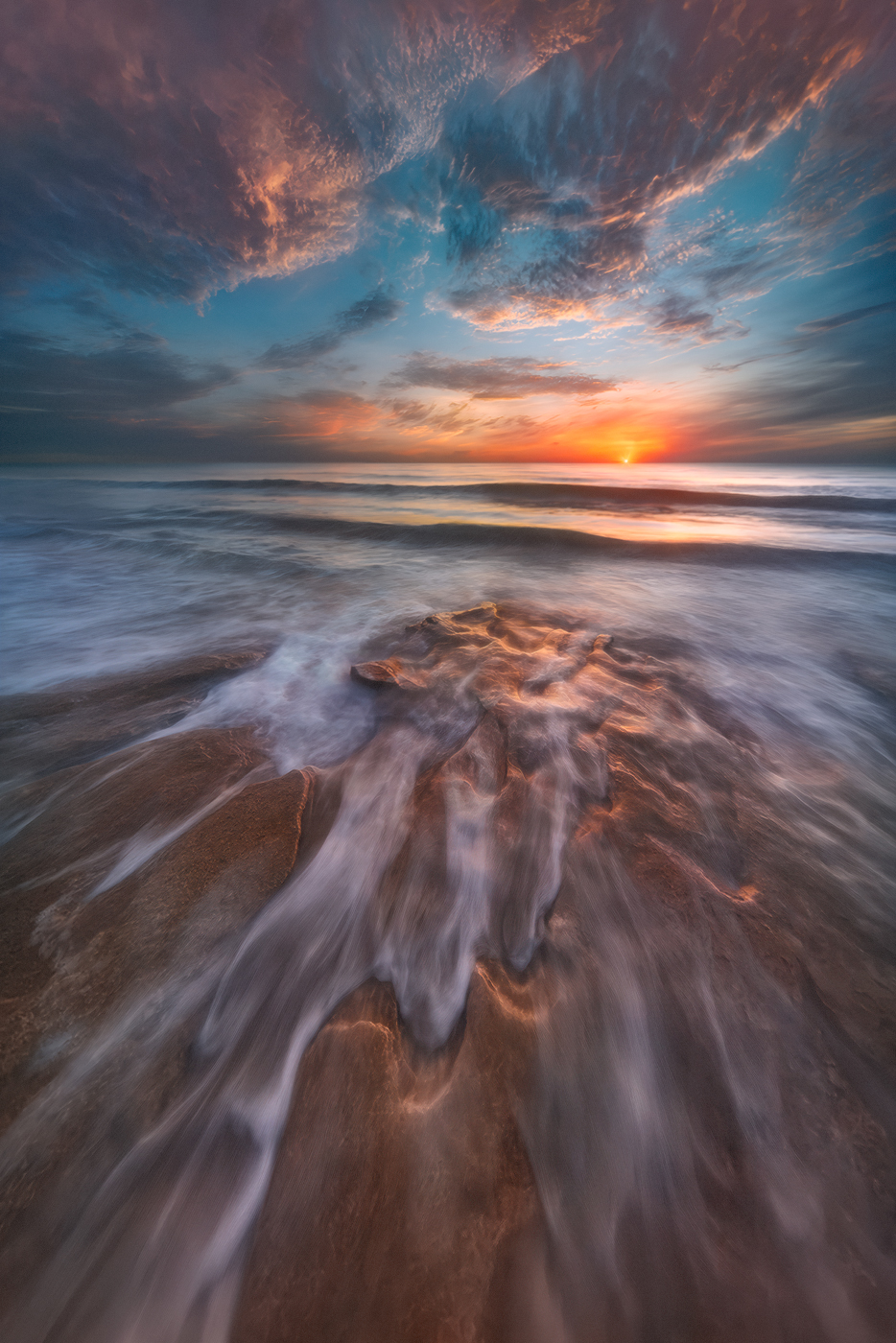
One of my favorite sunrise shots/moments from this summers thunderstorm season ("lightning alley") on Floridas east Atlantic coast.
[Techie Details in the first comment below the image...
After living at this very special location for about 4-1/2 years (and shooting here for almost 10) and doing 7 workshops (4 private) just this year so far, putting in a ton of time and work to get extremely familiar with the weather patterns, tides, compositions, shutter speeds, technical approaches… here my private client (YOU are awesome!) wanted me to set up side by side him, and shoot together (him shooting his preferred - better composition, I helped him find in the hour of scouting earlier in the AM) and teach him, by telling him what was working best, and then most importantly making sure it was working for him. It worked for him in spades! One really cool thing I learned, literally during this moment, was that the timing of the far mid to background waves rolling in (but not quite yet cresting) right where we wanted them, was happening almost always at the same time that the water in our foregrounds (near our feet) was retreating back out! This allowed us to get all the compositional elements, right where we wanted them the most, much more often in a single shot. Usually I primarily shoot when I see the water retreating (foreground being very primary to me) then secondarily when mid-background waves are rolling in, and then also when the various best lighting conditions climax… usually I just over shoot like nuts!
Here we started to figure out how to get all or most of what we wanted in a single shot (sometimes minus exposure bracketing when the dynamic range gets extreme).
Instead of exposure bracketing each series of shots in a less thoughtful way, we worked very hard to get the exact land/ocean elements we wanted (over and over) and then each time we knew were getting that, and the light was doing something special (and the dynamic range got extreme) we would just manually meter down, auto bracket 5 frames (3 stops apart) to have the full insurance that we had the sun and specular highlights exposed down to not clipping. Then we would go immediately meter back to working the land/and ocean (the foreground water texture we wanted and also the mid to background rolling waves - trying to get that in one shot).
I shot with the Laowa 9mm on my Leica SL2, he shot with a 10mm on his Nikon.
We shot in Shutter Priority mode, auto bracketing (5 shots), Auto ISO (so the camera changes ISO to shoot darker or brighter) with our f/stop (f/11) and focus locked in manually. We both used a 6-stop ND filter (I used a Kolari clip in ND filter that drops in between the lens and the sensor). I drop this in AFTER the blue hour is over and the sun is starting to break the horizon line).
Occasionally the sun got so bright that after shooting our foreground and ocean portion, we very quickly metered down (by quickly choosing a faster shutting speed - like 3, 6 or 9 clicks on the cameras rotating dial) shot that almost instantly (sometimes checking the LCD to ensure a dark sun was caught) then clicked back to 0.50 (1/2 second) shutter speed, and got back to biz. When clouds block the sun moderately the going back and forth was not necessary.
Processing:
Images for dynamic range were processed in Camera Raw (either though Adobe Lightroom Classic - where the “Develop Tab” IS Camera Raw or through Adobe Bridge which accesses the Camera Raw plug in). Of course Photoshop can access Camera raw as well. I most often use the Bridge/Camera Raw option. I am convinced it is still the best in the biz, for quality processing by a long shot.
I am a huge convert to using the “Adaptive Color” profile (no more linear profiles as I used to teach - and certainly not the default "adobe color").
I always choose “Raw Details” which is far better demosaicing than not checking it.
I ALWAYS turn off the very damaging sharpening default settings and never ever use it on a master file! This is the worst thing ever for damaging our master files, severely limiting the potential quality of a print/enlargement.
I turn down the color noise slider to a minimum amount (5 is my default preset) to prevent color bleeding (which kills micro color variations) and a few other tricks I’ll be disclosing in a soon coming video.
I get the Raw file as best as I can, then import it into Photoshop as a Raw Smart Object (literally a lossless Raw Layer) then by duplicating the raw layer (right click/new smart object via a copy) we can push lossless Raw Layers a lot further than just Lightroom or Camera Raw alone.