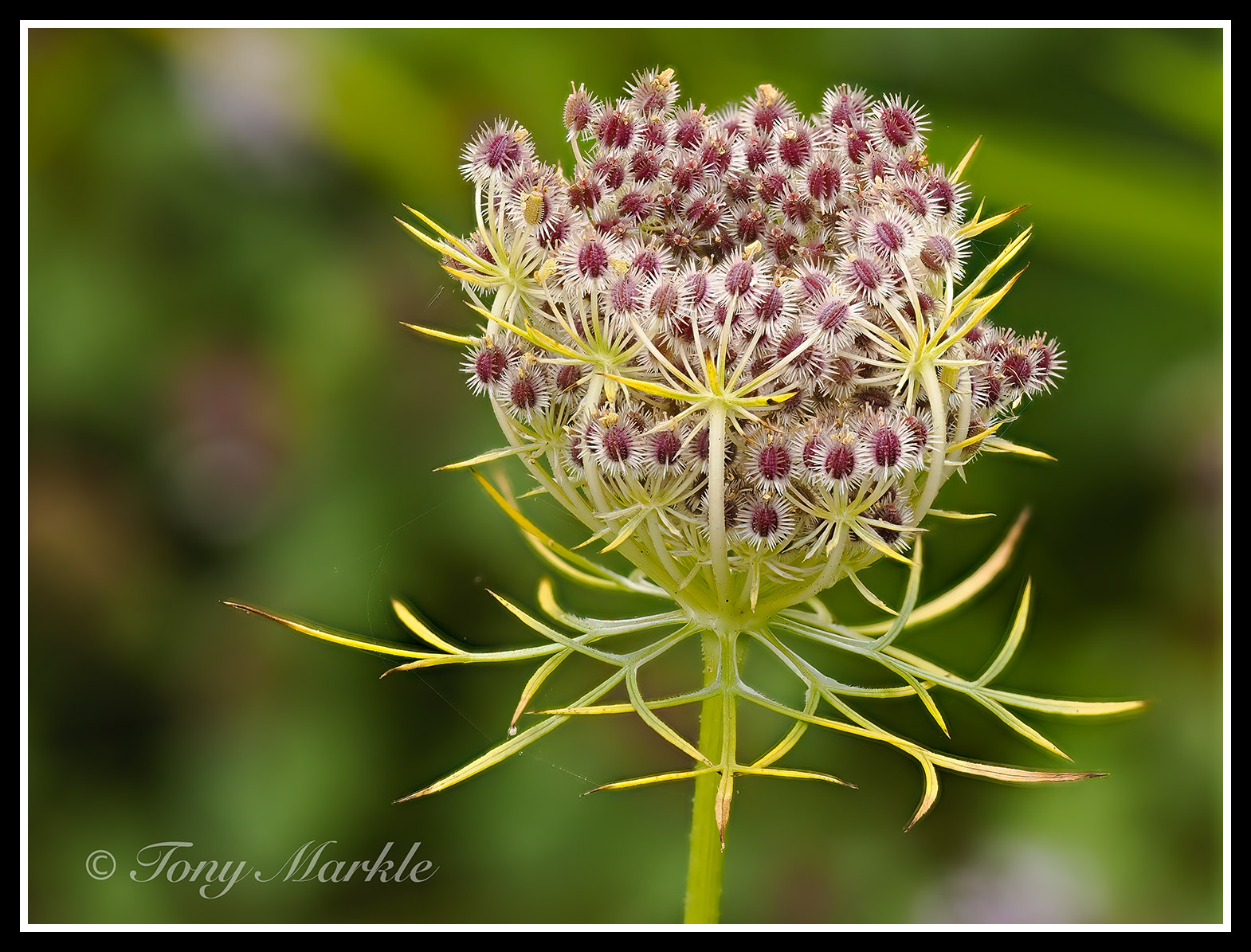
It thrives in great numbers in the wild around here at this time of year. Unless one stops and has a close look at it, you do not notice the intricate and numerous purple prickly seeds.
Queen Anne's lace (Wild carrot) is common to roadsides and other disturbed areas. It was introduced from Europe as a medicinal herb. This biennial plant persists in clay soils and can be a threat to recovering grasslands. After going to seed the dried flower takes on a “birds’ nest” like appearance and can move like a tumble weed to help spread its seeds.
There are many explanations for the origin of this common name, including the flower’s resemblance to the lace that was fashionable around the time of the British monarch, wife of King James I; because people thought it resembled Queen Anne’s lace headdress; 18th-century English courtiers used the flowers as “living lace;” and supposedly because Queen Anne challenged her ladies-in-waiting to a contest to see who could produce a piece of lace as beautiful as the flower, but none could rival her own efforts.
It is also called wild carrot because this is the European plant that cultivated carrots were developed from. It was brought to North America with the colonists as a medicinal plant and is now naturalized throughout the continent.
This biennial flowers in its second season, then dies. Hollow, branched flower stems grow 2 to 4 feet tall, and both the stems and leaves are covered with short, coarse hairs. The attractive, airy two- to four-inch “flower” is actually a compound flower. Up to a thousand tiny white flowers are produced in lacy, flat-topped clusters (umbels) with a dark, purplish center. As the seeds ripen, the inflorescence curls inward to form a “bird’s nest” shape and turns a brownish color. A small bristly seed is produced at the end of each flower stalk, and once dry they readily latch onto fur or feathers to be disseminated beyond where the seeds would otherwise fall.
Queen Anne’s Lace is so adaptable that in some habitats it crowds out native species that can’t compete with its vigorous growth. Many people consider Queen Anne’s lace an invasive weed. It is listed as a noxious weed in at least 35 states, but is not currently regulated in Wisconsin. The plant is used by some native animals for food. It is a host plant for eastern black swallowtail caterpillars and many butterflies and adult bees and beneficial insects utilize the flower nectar.
Handheld and focus-stacked in-camera
OM-1MarkII OLYMPUS M.60mm F2.8 Macro lens60mmf/4.01/180s200 ISO0.0 EV