Original A1 vs A7RVI for birds
p.1 #1Original A1 vs A7RVI for birds
Does anyone have experience with both? I'm mostly a landscape photographer, but do some birds too. I'm thinking about trading my A7RV for an A7RVI or trading my A6700 for a used original A1. The A7Rvi reportedly has better subject acquisition and stickiness than the A1, but is it that much better in the real world? The pre-capture is a selling point.
Thanks.
Thanks.
Aug 21, 2026 at 02:40 PM
p.1 #2Original A1 vs A7RVI for birds
For perched birds, the A7RVI is probably better than the A1 or even the A1II. For birds in flight, I would pick the A1 for faster sensor read out and AF calculation/second. I owned A1, now A1I and A7RVI. I will pick the A1II over the A7RVI for actions. But if pre capture is essential to you, then A7RVI is the choice since the A1 doesn't have that.
Aug 21, 2026 at 05:39 PM
p.1 #3Original A1 vs A7RVI for birds
67Mp
30 FPS ES
10 FPS MS
Lastest machine learned focus training -
I take the A7rVI - Its going to get you the shot one way or the other!
You are a landscape shooter, get the better all around camera for what you shoot and this will handle everything else beautifully-
30 FPS ES
10 FPS MS
Lastest machine learned focus training -
I take the A7rVI - Its going to get you the shot one way or the other!
You are a landscape shooter, get the better all around camera for what you shoot and this will handle everything else beautifully-
Aug 21, 2026 at 05:54 PM
p.1 #4Original A1 vs A7RVI for birds
Good video by Ari on the A7Rmk6
Didn't watch all of it, but from what I saw the BLUF is that the A7Rmk6 is good for birds except for hummingbirds because of wing distortion. I don't care for pre-capture my self so I'm still rocking the og A1 but yeah considering going to the A7Rmk6 so I can crop more since I'm maxed out at 600 with the 300 and 2x TC as my current setup.
Didn't watch all of it, but from what I saw the BLUF is that the A7Rmk6 is good for birds except for hummingbirds because of wing distortion. I don't care for pre-capture my self so I'm still rocking the og A1 but yeah considering going to the A7Rmk6 so I can crop more since I'm maxed out at 600 with the 300 and 2x TC as my current setup.
Aug 21, 2026 at 07:51 PM
p.1 #5Original A1 vs A7RVI for birds
john tunney wrote:
Does anyone have experience with both? I'm mostly a landscape photographer, but do some birds too. I'm thinking about trading my A7RV for an A7RVI or trading my A6700 for a used original A1. The A7Rvi reportedly has better subject acquisition and stickiness than the A1, but is it that much better in the real world? The pre-capture is a selling point.
Thanks.
The A7R6 has effectively replaced my A1ii but I do use my A9iii for the very fast action. I would simply use mechanical shutter for hummingbirds. Subject detection is slightly better and in my experience autofocus is as good as or slightly better. Some times the A1ii will not find the subject but the A7R6 does immediately - however usually the subject is too far to make a decent image so it's not particularly useful. They are all extremely good.
Rolling shutter distortion on the background objects like trees, buildings, poles etc. can be an issue if you are panning. That's not an issue with the A1/A1ii.
Given you are mainly landscape I would think of upgrading to the A7R6 since you get a small bump in IQ from the A7R5 as well as a very capable action camera. Your wildlife stills will also be unmatched by anything in the FF world
Pre-capture is a little overrated imo but it works.
Check the A7R6 thread for images or select from the list on the left at the link below to find links to many A7R6 images of birds in flight, sprinting whippets etc.. If you plan on shooting more challenging subjects than those or shooting in very poor light you might need to get advice elsewhere.
https://duncangroenewald.com/pages/collections/collections.html
Edited on Aug 21, 2026 at 11:53 PM · View previous versions
Aug 21, 2026 at 10:22 PM
p.1 #6Original A1 vs A7RVI for birds
john tunney wrote:
Does anyone have experience with both? I'm mostly a landscape photographer, but do some birds too. I'm thinking about trading my A7RV for an A7RVI or trading my A6700 for a used original A1. The A7Rvi reportedly has better subject acquisition and stickiness than the A1, but is it that much better in the real world? The pre-capture is a selling point.
Thanks.
What lenses are you going to use?
Aug 21, 2026 at 10:59 PM
p.1 #7Original A1 vs A7RVI for birds
I have the same questions about buying a Sony A1 II or the cheaper Sony A7R VI. I currently have an A1, but I'm looking to buy a new camera. I use my A1 for aviation photography, so I need a fast readout speed to track fighter jets as they pass by, sometimes with backgrounds like trees and buildings. Given that, can the A7R VI handle this scenario, or is it better to get the A1 II?
Sep 25, 2026 at 05:51 AM
p.1 #8Original A1 vs A7RVI for birds
mslino wrote:
I have the same questions about buying a Sony A1 II or the cheaper Sony A7R VI. I currently have an A1, but I'm looking to buy a new camera. I use my A1 for aviation photography, so I need a fast readout speed to track fighter jets as they pass by, sometimes with backgrounds like trees and buildings. Given that, can the A7R VI handle this scenario, or is it better to get the A1 II?
I shoot A LOT of airshows. I tried the A7RVI one time. It did great but if you pan, you will see leaning buildings in the background, for helicopters you may see distorted blades sometimes. Sometimes the subjects can become elongated but it's not visibly recognized as rolling shutter effect by most people. The A1II's faster AF calculation per second can make a difference in some situations. I am talking about electronic shutter here. If I have to choose between an A1II or the A7RVI for aviation photography, I would say the A1II is a better tool. Others may have different opinion...
Sep 25, 2026 at 06:24 AM
p.1 #9Original A1 vs A7RVI for birds
Douglas L wrote:
I shoot A LOT of airshows. I tried the A7RVI one time. It did great, but if you pan, you will see leaning buildings in the background; with helicopters, you may see distorted blades sometimes. Sometimes the subjects can become elongated but it's not visibly recognized as rolling shutter effect by most people. The A1II's faster AF calculation per second can make a difference in some situations. I am talking about electronic shutter here. If I have to choose between an A1II or the A7RVI for aviation photography, I would say the A1II is a better tool. Others may...Show more →
Thank you. I will rent an A7R VI to try at the next airshow I go to. I used to use an A9 before buying the A1, and the A9 has a better readout speed than the A7R VI, but today it feels like an old camera compared with the new features added in the latest Sony models, like AI chips, Pre-capture, etc.
mslino wrote
I have the same questions about buying a Sony A1 II or the cheaper Sony A7R VI. I currently have an A1, but I'm looking to buy a new camera. I use my A1 for aviation photography, so I need a fast readout speed to track fighter jets as they pass by, sometimes with backgrounds like trees and buildings. Given that, can the A7R VI handle this scenario, or is it better to get the A1 II?Thank you. I will rent an A7R VI to try at the next airshow I go to. I used to use an A9 before buying the A1, and the A9 has a better readout speed than the A7R VI, but today it feels like an old camera compared with the new features added in the latest Sony models, like AI chips, Pre-capture, etc.
Sep 25, 2026 at 07:07 AM
p.1 #10Original A1 vs A7RVI for birds
I'm sticking to my A1. I may just wait for A1III but if I could get a good price on a second hand A1II I might be tempted to update just for pre-capture.
I think if the A7RVI had half the roiling shutter, say 1/100s in 14 bit, I would jump for sure. Still I watch guys like Jan Wegner who takes tens of thousands of bif shots and he says he only occasionally notices the rolling shutter effects on wings. But second hand A1II's are already cheaper than new A7RVI. I think if the A7RVI was at A7RV prices I would more inclined to try it.
I think if the A7RVI had half the roiling shutter, say 1/100s in 14 bit, I would jump for sure. Still I watch guys like Jan Wegner who takes tens of thousands of bif shots and he says he only occasionally notices the rolling shutter effects on wings. But second hand A1II's are already cheaper than new A7RVI. I think if the A7RVI was at A7RV prices I would more inclined to try it.
Sep 25, 2026 at 05:09 PM
|
p.1 #11Original A1 vs A7RVI for birds
The A7RVI will do great for action if your panning fast things I would suggest using the mechanical shutter this will avoid the crooked stuff.
The Sony A7V has some decent features.
I think all around the best choice if you want Eshutter for fast things is the A1II. Unless you really need the A9III and most of us just don't.
Here the A1II used is still a good bit more expensive than the A7RVI around 1300 by what I see mostly.
The Sony A7V has some decent features.
I think all around the best choice if you want Eshutter for fast things is the A1II. Unless you really need the A9III and most of us just don't.
Here the A1II used is still a good bit more expensive than the A7RVI around 1300 by what I see mostly.
Sep 25, 2026 at 08:47 PM

p.1 #12Original A1 vs A7RVI for birds
Pixel Perfect wrote:
I'm sticking to my A1. I may just wait for A1III but if I could get a good price on a second hand A1II I might be tempted to update just for pre-capture.
I think if the A7RVI had half the roiling shutter, say 1/100s in 14 bit, I would jump for sure. Still I watch guys like Jan Wegner who takes tens of thousands of bif shots and he says he only occasionally notices the rolling shutter effects on wings. But second hand A1II's are already cheaper than new A7RVI. I think if the A7RVI was at A7RV prices...Show more →
I am not sure about down under but used A1 IIs are selling for $4,700-$4,900 here in good ol' USA while a brand new A7r VI sells for $3,700, which is not the MSRP alright, but a brand new one can be purchased at that price. That's a "G" between the two cameras.
Sep 25, 2026 at 09:00 PM
p.1 #13Original A1 vs A7RVI for birds
I'm currently evaluating an A7RVI. I shot A1 for 5yrs and now A1II.
I'd say the A7RVI would be my recommended bird camera for most people. Only if you are really into fast, erratic BIF and/or a lot of fast BIF coming straight at you. I feel the A1II does better keeping focus on straight on BIF but only if we are talking small and fast birds. There is some risk of wing problems with the A7RVI and leaning lines in the background if panning. But for 90%+ of my BIF shots there are no issues. Even most of my hummingbird shots are fine (although not all of them).
But the Eye-AF on the A7RVI is magnitudes better than the A1II and the A1II is already a bit better than A1.
Other nice advantage of the A7RVI over the A1 is you get precapture.
Sep 26, 2026 at 05:12 AM
p.1 #14Original A1 vs A7RVI for birds
arbitrage wrote:
I'm currently evaluating an A7RVI. I shot A1 for 5yrs and now A1II.
I'd say the A7RVI would be my recommended bird camera for most people. Only if you are really into fast, erratic BIF and/or a lot of fast BIF coming straight at you. I feel the A1II does better keeping focus on straight on BIF but only if we are talking small and fast birds. There is some risk of wing problems with the A7RVI and leaning lines in the background if panning. But for 90%+ of my BIF shots there are no issues. Even most of my hummingbird...Show more →
You've shared excellent shots of small songbirds in flight with the A1 in the past, like your beautiful work on this page https://www.fredmiranda.com/forum/topic/1881202/7/.
I don't know if that scenario is more difficult or the hummingbirds, but I'd love to hear what you think on that front.
Sep 26, 2026 at 06:04 AM
p.1 #15Original A1 vs A7RVI for birds
umut_h_toprak wrote:
I'd say the A7RVI would be my recommended bird camera for most people. Only if you are really into fast, erratic BIF and/or a lot of fast BIF coming straight at you. I feel the A1II does better keeping focus on straight on BIF but only if we are talking small and fast birds. There is some risk of wing problems with the A7RVI and leaning lines in the background if panning. But for 90%+ of my BIF shots there are no issues. Even most of my hummingbird shots are fine (although not all of them).
But the Eye-AF on the A7RVI is magnitudes better than the A1II and the A1II is already a bit better than A1.
Other nice advantage of the A7RVI over the A1 is you get precapture.You've shared excellent shots of small songbirds in flight with the A1 in the past, like your beautiful work on this page https://www.fredmiranda.com/forum/topic/1881202/7/.
I don't know if that scenario is more difficult or the hummingbirds, but I'd love to hear what you think on that front.
Hummingbirds hover a lot (stay in place mid flight like a helicopter). That is when almost all hummingbird flight shots happen and in that scenario it is rather easy to "get the shot". Small songbirds virtually never hover and hence are way more difficult to shoot in flight.
arbitrage wrote
I'm currently evaluating an A7RVI. I shot A1 for 5yrs and now A1II.I'd say the A7RVI would be my recommended bird camera for most people. Only if you are really into fast, erratic BIF and/or a lot of fast BIF coming straight at you. I feel the A1II does better keeping focus on straight on BIF but only if we are talking small and fast birds. There is some risk of wing problems with the A7RVI and leaning lines in the background if panning. But for 90%+ of my BIF shots there are no issues. Even most of my hummingbird shots are fine (although not all of them).
But the Eye-AF on the A7RVI is magnitudes better than the A1II and the A1II is already a bit better than A1.
Other nice advantage of the A7RVI over the A1 is you get precapture.
I don't know if that scenario is more difficult or the hummingbirds, but I'd love to hear what you think on that front.
Hummingbirds hover a lot (stay in place mid flight like a helicopter). That is when almost all hummingbird flight shots happen and in that scenario it is rather easy to "get the shot". Small songbirds virtually never hover and hence are way more difficult to shoot in flight.
Sep 26, 2026 at 06:25 AM
p.1 #16Original A1 vs A7RVI for birds
Daran wrote:
Hummingbirds hover a lot (stay in place mid flight like a helicopter). That is when almost all hummingbird flight shots happen and in that scenario it is rather easy to "get the shot". Small songbirds virtually never hover and hence are way more difficult to shoot in flight.
Thank you!
I asked my question with respect to wing distortion and AF tracking. I agree it is a bigger challenge. However, due to the non-hovering characteristics of songbirds, they will necessarily need to be smaller in the frame in most situations. This could offer some respite with wing distortion.
His previous comment goes in this direction too. I was just curious if he could get some photos such as he posted in his previous work with the A1 on small songbirds.
Sep 26, 2026 at 06:42 AM
p.1 #17Original A1 vs A7RVI for birds
umut_h_toprak wrote:
Thank you!
I asked my question with respect to wing distortion and AF tracking. I agree it is a bigger challenge. However, due to the non-hovering characteristics of songbirds, they will necessarily need to be smaller in the frame in most situations. This could offer some respite with wing distortion.
His previous comment goes in this direction too. I was just curious if he could get some photos such as he posted in his previous work with the A1 on small songbirds.
If your camera has too slow readout for hovering hummers, just use mechanical for that, would still get you quite a few images to choose from and no risk of excessive distortion.
Daran wrote
Hummingbirds hover a lot (stay in place mid flight like a helicopter). That is when almost all hummingbird flight shots happen and in that scenario it is rather easy to "get the shot". Small songbirds virtually never hover and hence are way more difficult to shoot in flight.I asked my question with respect to wing distortion and AF tracking. I agree it is a bigger challenge. However, due to the non-hovering characteristics of songbirds, they will necessarily need to be smaller in the frame in most situations. This could offer some respite with wing distortion.
His previous comment goes in this direction too. I was just curious if he could get some photos such as he posted in his previous work with the A1 on small songbirds.
If your camera has too slow readout for hovering hummers, just use mechanical for that, would still get you quite a few images to choose from and no risk of excessive distortion.
Sep 26, 2026 at 09:19 AM
p.1 #18Original A1 vs A7RVI for birds
umut_h_toprak wrote:
I'd say the A7RVI would be my recommended bird camera for most people. Only if you are really into fast, erratic BIF and/or a lot of fast BIF coming straight at you. I feel the A1II does better keeping focus on straight on BIF but only if we are talking small and fast birds. There is some risk of wing problems with the A7RVI and leaning lines in the background if panning. But for 90%+ of my BIF shots there are no issues. Even most of my hummingbird shots are fine (although not all of them).
But the Eye-AF on the A7RVI is magnitudes better than the A1II and the A1II is already a bit better than A1.
Other nice advantage of the A7RVI over the A1 is you get precapture.You've shared excellent shots of small songbirds in flight with the A1 in the past, like your beautiful work on this page https://www.fredmiranda.com/forum/topic/1881202/7/.
I don't know if that scenario is more difficult or the hummingbirds, but I'd love to hear what you think on that front.
I haven't had a good opportunity to test the A7RVI on the songbirds in flight. I just don't have enough in my yard right now to get enough chances.
I did shoot some Western Sandpipers in flight and wasn't getting any wing distortion.
But shooting songbirds and sandpipers you typically have to keep them a bit small in frame to have a chance and therefore the risk of wing distortion is a lot lower.
I have one more day with my A7RVI loaner so will try some more in the backyard and see if I can get a few chances on the finches that are around right now.
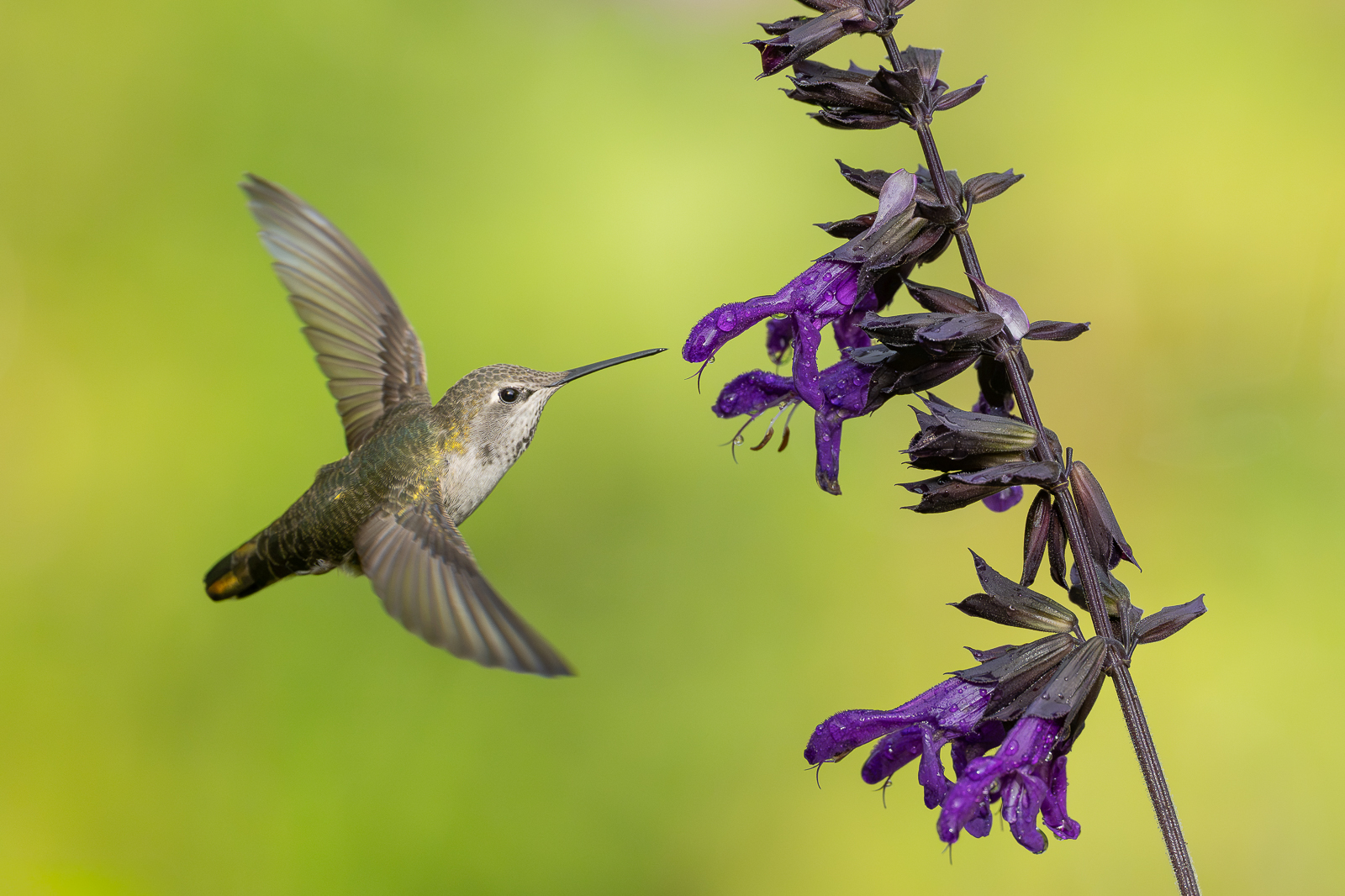
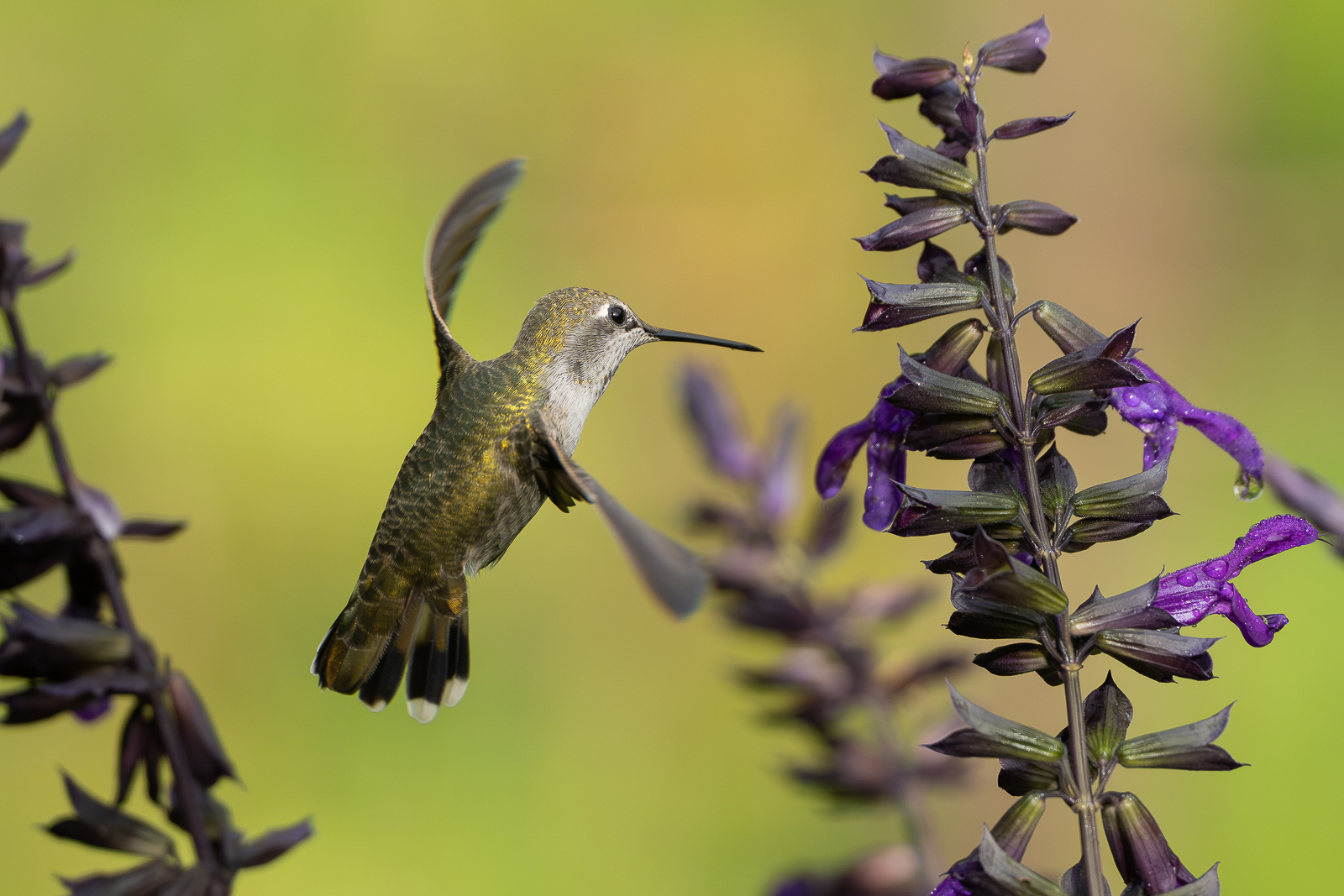
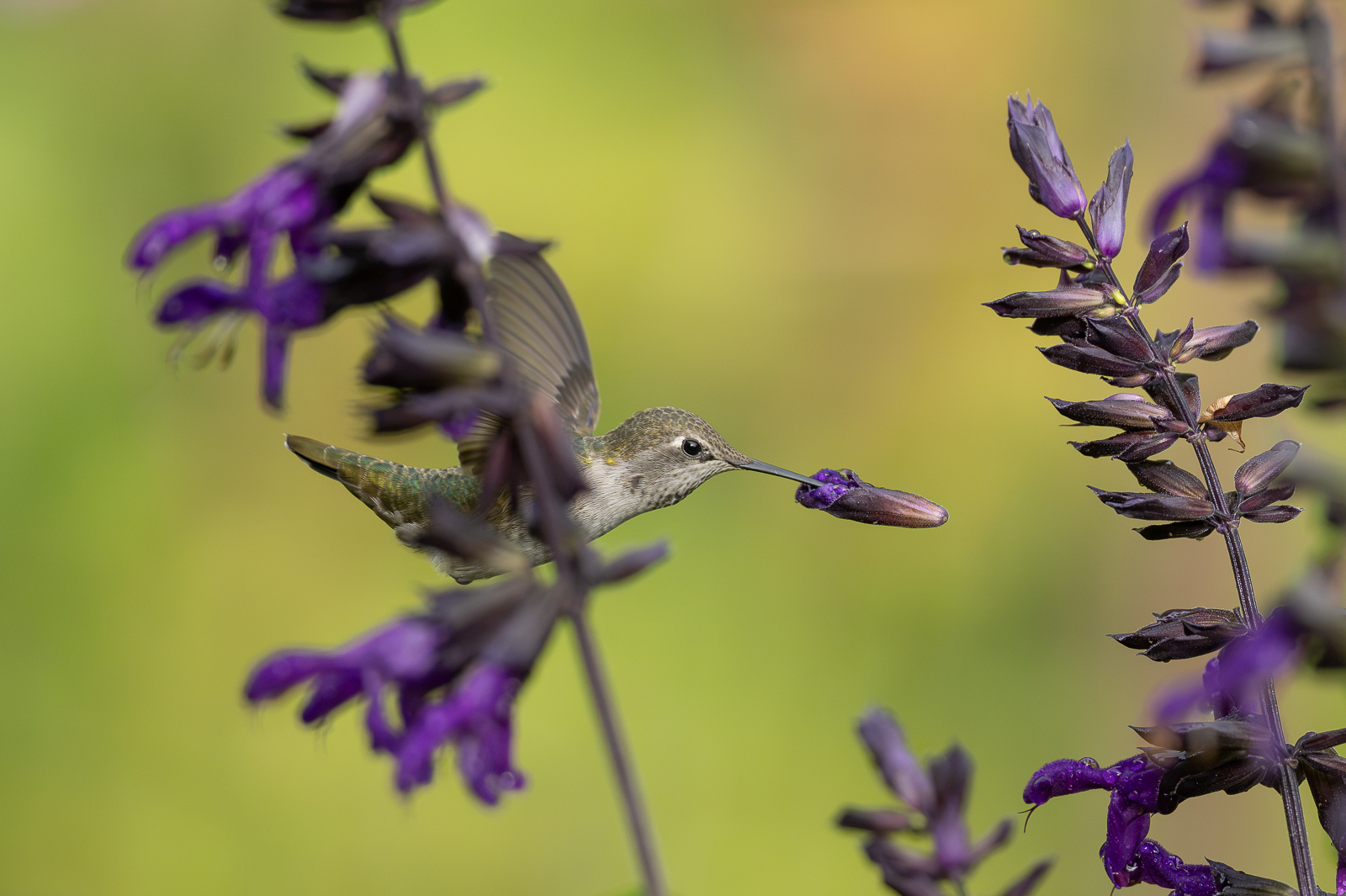
For most hummingbird shots that I usually keep the wings are fully back or fully forward, hovering at a flower. Those shots don't show any wing distortion as the wing is stationary at that split second. If the hummer did a more dramatic movement away from the flower then I was getting some wing wonkiness.
Here are a couple examples of some wing distortion as the hummer backed away. Also the final one showing no distortion as the wings are fully back and showing how well the A7RVI will hold the bird even as it went behind the other stem.
arbitrage wrote
I'm currently evaluating an A7RVI. I shot A1 for 5yrs and now A1II.I'd say the A7RVI would be my recommended bird camera for most people. Only if you are really into fast, erratic BIF and/or a lot of fast BIF coming straight at you. I feel the A1II does better keeping focus on straight on BIF but only if we are talking small and fast birds. There is some risk of wing problems with the A7RVI and leaning lines in the background if panning. But for 90%+ of my BIF shots there are no issues. Even most of my hummingbird shots are fine (although not all of them).
But the Eye-AF on the A7RVI is magnitudes better than the A1II and the A1II is already a bit better than A1.
Other nice advantage of the A7RVI over the A1 is you get precapture.
I don't know if that scenario is more difficult or the hummingbirds, but I'd love to hear what you think on that front.
I haven't had a good opportunity to test the A7RVI on the songbirds in flight. I just don't have enough in my yard right now to get enough chances.
I did shoot some Western Sandpipers in flight and wasn't getting any wing distortion.
But shooting songbirds and sandpipers you typically have to keep them a bit small in frame to have a chance and therefore the risk of wing distortion is a lot lower.
I have one more day with my A7RVI loaner so will try some more in the backyard and see if I can get a few chances on the finches that are around right now.
For most hummingbird shots that I usually keep the wings are fully back or fully forward, hovering at a flower. Those shots don't show any wing distortion as the wing is stationary at that split second. If the hummer did a more dramatic movement away from the flower then I was getting some wing wonkiness.
Here are a couple examples of some wing distortion as the hummer backed away. Also the final one showing no distortion as the wings are fully back and showing how well the A7RVI will hold the bird even as it went behind the other stem.
ILCE-7RM6 FE 300mm F2.8 GM OSS + 1.4X Teleconverter lens 420mm f/4.0 1/5000s 1600 ISO 0.0 EV
ILCE-7RM6 FE 300mm F2.8 GM OSS + 1.4X Teleconverter lens 420mm f/4.0 1/5000s 1600 ISO 0.0 EV
ILCE-7RM6 FE 300mm F2.8 GM OSS + 1.4X Teleconverter lens 420mm f/4.0 1/3200s 1600 ISO 0.0 EV
Sep 27, 2026 at 04:14 AM
p.1 #19Original A1 vs A7RVI for birds
arbitrage wrote:
I haven't had a good opportunity to test the A7RVI on the songbirds in flight. I just don't have enough in my yard right now to get enough chances.
I did shoot some Western Sandpipers in flight and wasn't getting any wing distortion.
But shooting songbirds and sandpipers you typically have to keep them a bit small in frame to have a chance and therefore the risk of wing distortion is a lot lower.
I have one more day with my A7RVI loaner so will try some more in the backyard and see if I can get a few chances on the finches...Show more →
Thank you very much for sharing this and your other detailed impressions.
Your first hummingbird shot looks artistic in a way. I like it even if it may be distorted.
I agree that the A1 III will be amazing.
Sep 27, 2026 at 10:07 AM
p.1 #20Original A1 vs A7RVI for birds
Guess I'll throw my opinion out there too. SPS loaned me out an A7RVI to test out for a couple weeks. Shot a bunch of birds in Colorado and back home. I haven't touched my A1ii since the first day I got this camera. As noted above, the area it struggles with is hummingbirds. The warping is brutal. I think that'd be the only area I'd pick my A1ii/OG A1 up over this camera right now. The body is a bit less "professional" feeling, but nothing too crazy. The subject detection is, in my opinion, a lot better than the A1ii, which means it blows the original A1 out of the water. I took it out tonight for some lowlight screech owls and it had zero issue focusing in 20-30 minutes after sunset with the 400 GM. The files themselves are beautiful and have tons of DR with acceptable noise levels for the 17 extra MP. Honestly, I am blown away by this camera and am extremely excited about the future A1iii. I will be purchasing myself an A7RVI this coming week and my A1ii will likely become a B cam for most birding. 
Sep 28, 2026 at 01:22 AM