lens_payoff_0l wrote: rscheffler wroteRoamingScott wroteAs a resident 35mm nut, I still don't see $2000 worth of rendering out of the LLL, but that's just my 2 cents. Sure it's cheaper than native Leica options, but it doesn't seem to be otherwise industry leading (which it would have to be for its price amongst its cheaper competitors).mkuredjian wroteYeah, I'm not seeing it either, but given the different things we all take photos of, I'm not clear whether it's a matter of subject or not, which is why I'll probably head to the Leica Store SF and try one out. I know that the Leica APO has some jaw-dropping rendering - both the 35 and 50.As an M-mount 35mm lens it is among the best I've seen for even wide open across-the-frame OOF background smoothness. Most 35mm M-mount lenses are great in the center portion but background smoothness degrades into the periphery.Genuine question – would a casual/ inexperienced viewer be able to tell the difference?
If they see A/B comparisons. They would be way more interested in things like how the lens renders their face and body.
Leica 50/1.2, patent expired August 5, 1986
Leica 35/2 8E, patent expired October 31, 1978
Leica 35 11873, patent expired February 15, 2011
Cooke 50/2 SPII, patent expired November 8, 1977
Anyone can legally copy (or so-called replica) these legacy lenses. But when it comes to their first modern design, LLL suddenly get secretive and refuse to publish the lens diagram.🙄
To make matters more interesting, Brightin Star is releasing a 35/1.7 APO shortly, it’s cheaper and half a stop faster. While it definitely looks much 'ugly' because they don't clone Leica’s mechanical housing.
DIXI 50 wrote: highdesertmesa wroteThe LLL optical design doesn't copy the Leica, so it's a moot point.How do you know that without published diagram? Just look at the spec comparison:
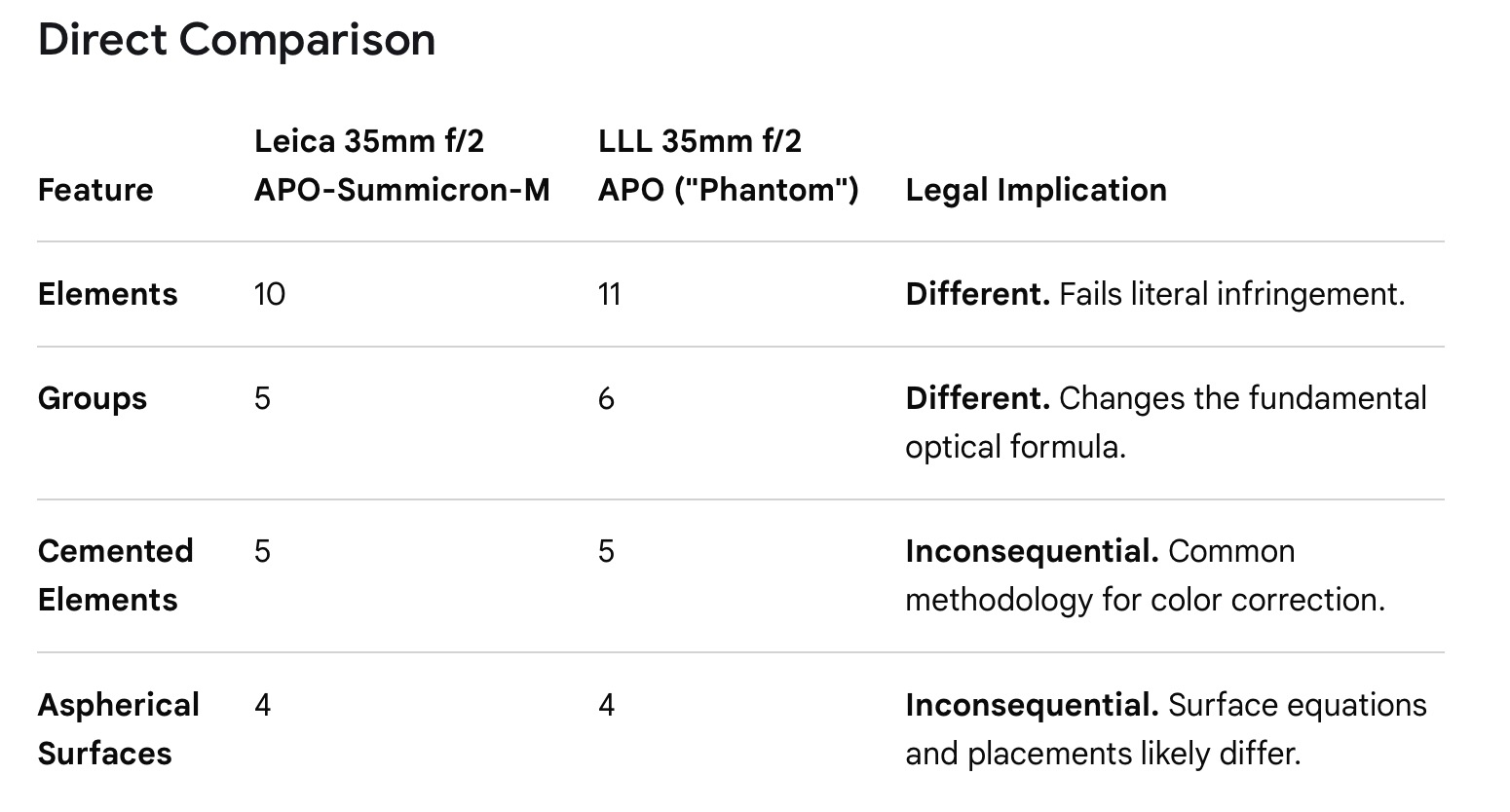
Leica 35 APO: 10 elements in 5 groups, with 5 cemented elements and 4 aspherical surfaces.
LLL 35 APO: 11 elements in 6 groups, with 5 cemented elements and 4 aspherical surfaces.
The patent of Leica 35 APO won't expire until May 03, 2042.
The count of cemented elements and ASPH surfaces is not enough to make a case for a patent violation. LLL would have had to have copied the exact physical curvatures and chemical glass compositions patented by Leica.
highdesertmesa wrote:
The count of cemented elements and ASPH surfaces is not enough to make a case for a patent violation. LLL would have had to have copied the exact physical curvatures and chemical glass compositions patented by Leica.
In Leica's 35mm and 50mm ASPH patents, Wetzlar simply claims the optical refractive power of each group, the cemented elements, and the aspherical surfaces. As long as the power distribution matches, adding an additional glass element still constitutes patent infringement under the Doctrine of Equivalents.
Something I wrote on August 5, after seeing a very explicit diagram I cannot find now, showing the LLL 35/2 ray paths and full block details:
'They installed a new (and very thin) element at L3. It sits between the L1-2 doublet and the L3-4 doublet. At first glance, it looks like a close copy but you can see quite large differences in some glass surface curvatures - always remembering we are dealing with block chart shapes that are subject to varying accuracies.'
Every element adds correction so their claim (and your analysis) appear to reflect that inclusion. They will almost certainly have used HRI formulations as well, as did Leica in the source design. The new element probably won't be doing much heavy lifting so as not to overly interrupt the ray paths further down the design.
Note the much more extreme curvature in the final elements behind the aperture - the triplet and the doublet, and even the last (asph) element. I doubt they would have any trouble with the patent, but plenty will stick to the 'Chinese copy' claim, unjustifiably in my view, in this instance at least.'
And here we are. It's easy to empathize with your state of mind over this matter, and it can do you good to vent your feelings. As Carl Jung said: you can't help your emotions. But getting in touch with the corporate realities is important. Would you not imagine that this very savvy company of LLL would not have checked patent law before pursuing this venture?
'Patent law' in this sense has to include enforcement regimes and unforeseen consequences, of course. So it's shorthand in this usage. Maybe a war is needed?
'Carl Zeiss lost its patent protections for the Sonnar lens layout as a direct result of Germany’s unconditional surrender at the end of World War II. Under the Allied war capitulation terms and subsequent reparations acts, German intellectual property was seized, liquidated, and placed into the public domain.
The Allied Seizure of Intellectual Property
Following WWII, the Allied powers enacted a sweeping policy of intellectual property confiscation as part of war reparations. The Allied Control Council stripped German corporations of their domestic and international patents. Patents for legendary Zeiss optical breakthroughs—including Ludwig Bertele’s revolutionary f/1.5 and f/2.0 Sonnar formulas and Alexander Smakula’s "T" anti-reflective lens coating—were effectively abolished.'
They stole it all, all of it.
See, we live in the real world and pointing fingers can lead to glass houses. As Louis Vuitton found out recently when they won a dubious decision for a symbol, of all things. The mass desertion of Chinese buyers cost LV a vast sum in the only market that really matters these days - China. Details in the YT title: 'Why Louis Vuitton sank in China', a fascinating story of pyrrhic victory. Or the ASML fiasco. Sanctioning market entry, etc.
We can talk about market manipulation comparisons by China and their western counterparts if you wish. We could start with pharmaceuticals, and move into cancer treatments, just for starters. It's all about market power. I'd prefer people to practice competition, and just be better. Including realistic pricing levels, of course. cheers, and good luck.
DIXI 50 wrote: highdesertmesa wroteThe count of cemented elements and ASPH surfaces is not enough to make a case for a patent violation. LLL would have had to have copied the exact physical curvatures and chemical glass compositions patented by Leica.In Leica's 35mm and 50mm ASPH patents, Wetzlar simply claims the optical refractive power of each group, the cemented elements, and the aspherical surfaces. As long as the power distribution matches, adding an additional glass element still constitutes patent infringement under the Doctrine of Equivalents.
Sounds like a tough case as you've framed it.
Google AI analysis:
Based on optical design and patent law principles, the structural differences between the Light Lens Lab (LLL) 35mm APO and the Leica 35mm APO-Summicron-M make a patent infringement case highly unlikely, and the sheer count of cemented elements or aspherical surfaces is not enough to establish a violation.
In optical engineering and patent law, layout differences and specific mathematical surface equations dictate infringement, rather than a high-level tally of components.
Why a Patent Case is Highly Unlikely
1. Fundamental Formula Differences (11/6 vs. 10/5)
The most critical factor in lens design patents is the exact arrangement of elements and groups.
– Leica 35mm APO-Summicron-M: Features 10 elements in 5 groups.
– LLL 35mm APO: Features 11 elements in 6 groups.
In patent law, to prove literal infringement, an accused device must meet every single limitation of a patent claim. If a Leica patent claim specifies an optical system consisting of 10 lens elements divided into 5 groups, a lens with 11 elements in 6 groups physically cannot literally infringe that claim. The addition of an entire element and an entirely separate group changes the power distribution, air spaces, and fundamental optical formula.
2. Component Counts Do Not Equal Copying
Having the same number of cemented elements (5) and aspherical surfaces (4) is a surface-level similarity, not a legal conflict.
– Cemented elements are used to correct chromatic aberration (essential for an apochromatic "APO" designation). A count of 5 cemented elements simply means both manufacturers are using similar classical methodologies (like doublets or triplets) to achieve color correction.
– Aspherical surfaces are used to correct spherical aberrations and distortion, especially in ultra-compact, high-performance wide-angle lenses.
– Many modern high-performance 35mm lenses share similar counts of specialized elements to achieve similar performance goals within tight physical dimensions.
3. The "Doctrine of Equivalents" is a High Bar
If literal infringement fails, a patent holder might argue the Doctrine of Equivalents—claiming the LLL lens does substantially the same work, in substantially the same way, to achieve the same result.
However, in optics, adding a 6th group and an 11th element fundamentally changes how the light rays are bent, toleranced, and corrected throughout the optical path. An expert witness or optical engineer could easily argue that the LLL lens achieves its correction in a mathematically distinct way, defeating the "substantially the same way" requirement.
4. Literal Curvature and Glass Substrates
Even if the element/group count were identical, a lens patent typically claims specific radii of curvature, thicknesses, air gaps, refractive indices ((n_{d})), and Abbe numbers ((nu _{d})) of the glass substrates within narrow tolerances. Unless LLL copied the exact physical curvatures and chemical glass compositions patented by Leica, it is legally considered a distinct optical design.
The Verdict
The counts of cemented elements and aspherical surfaces are simply design metrics driven by physics to achieve a shared goal: a perfectly corrected, compact 35mm APO lens. Because Light Lens Lab altered the fundamental layout to an 11-element, 6-group design, they created a legally distinct optical formulation that cleanly avoids Leica's specific structural patent boundaries.
If you want to dive deeper into how these two lenses compare, I can look into their historical design lineages or explore how their real-world rendering and optical trade-offs differ due to these formula changes.