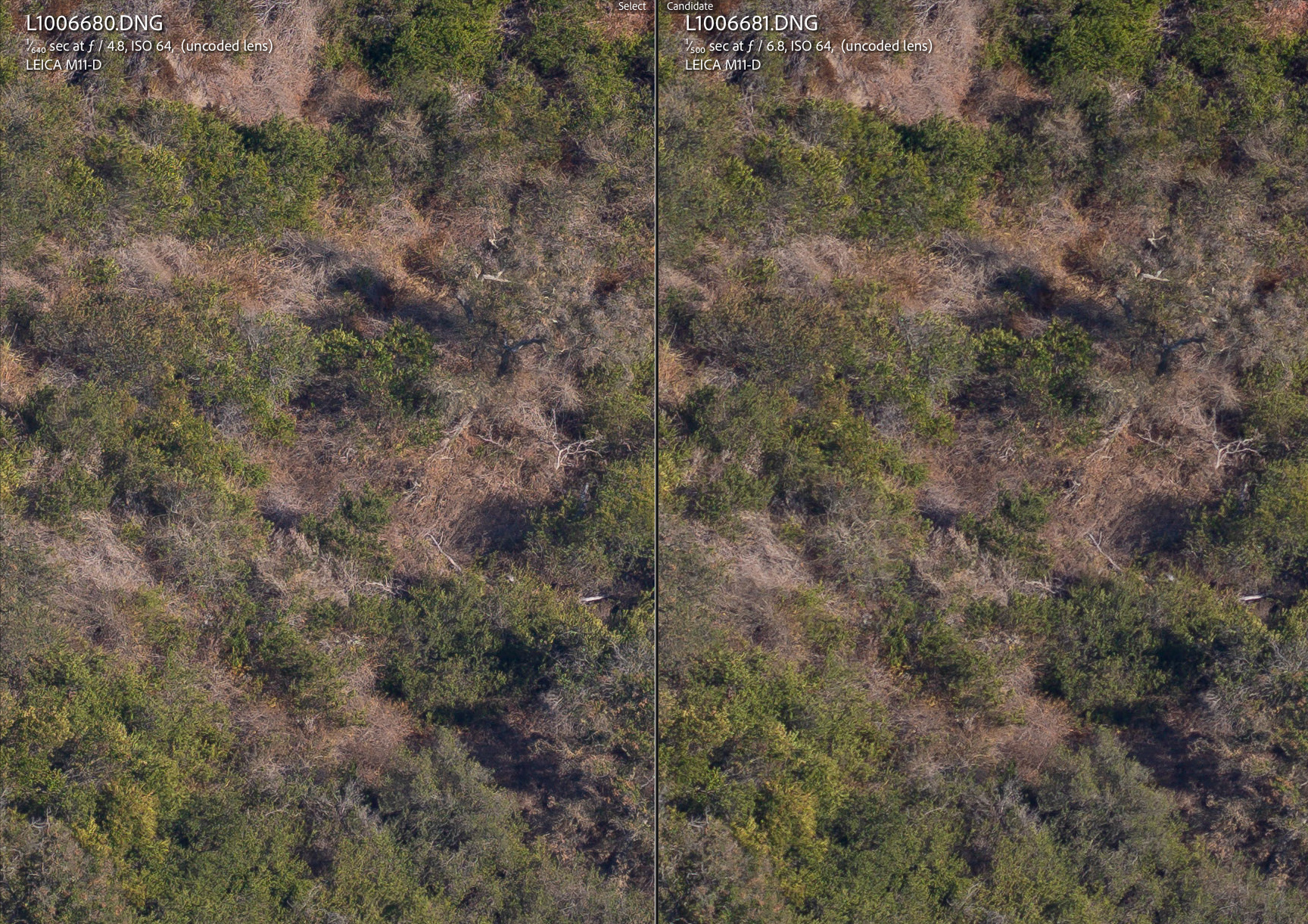
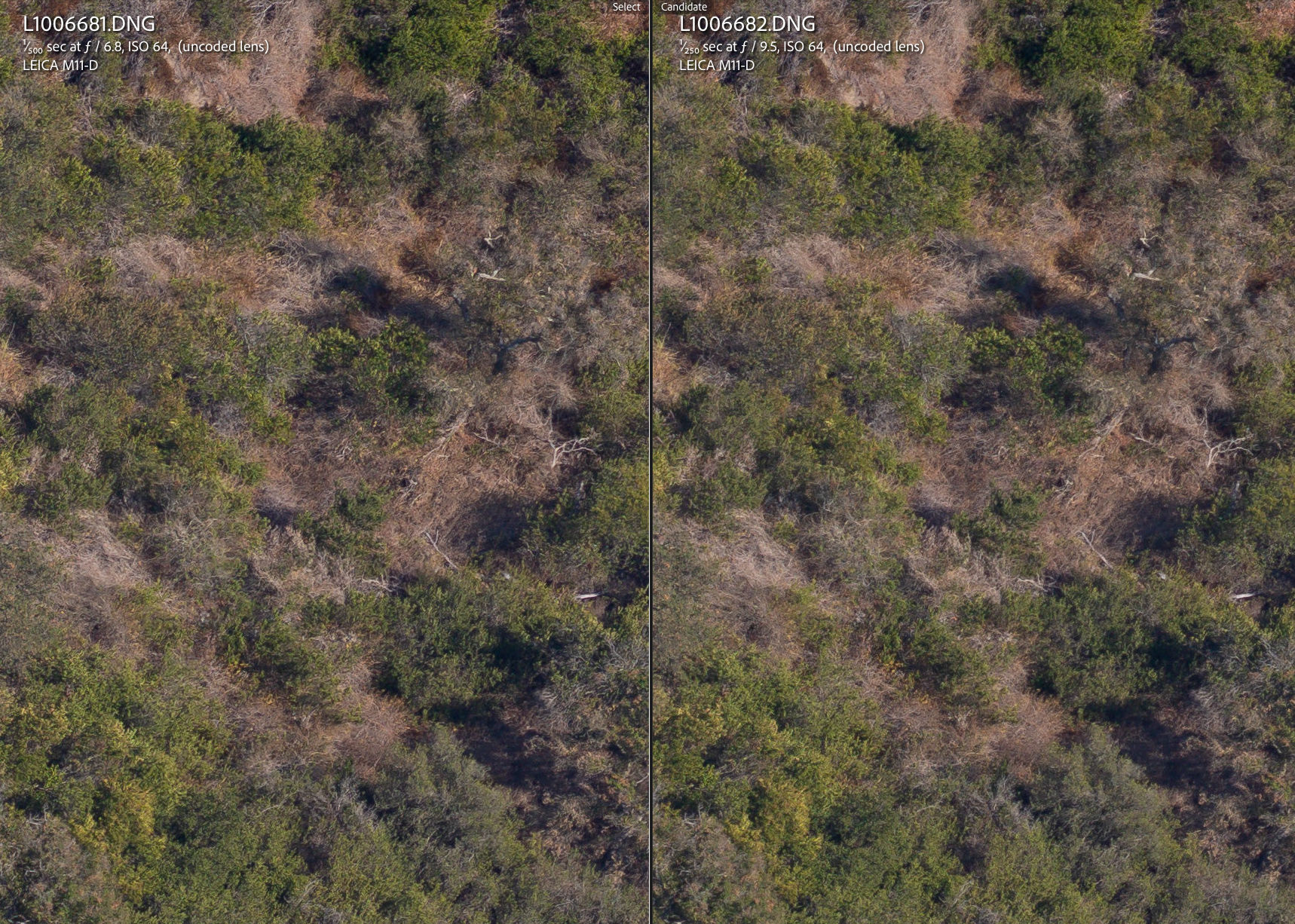
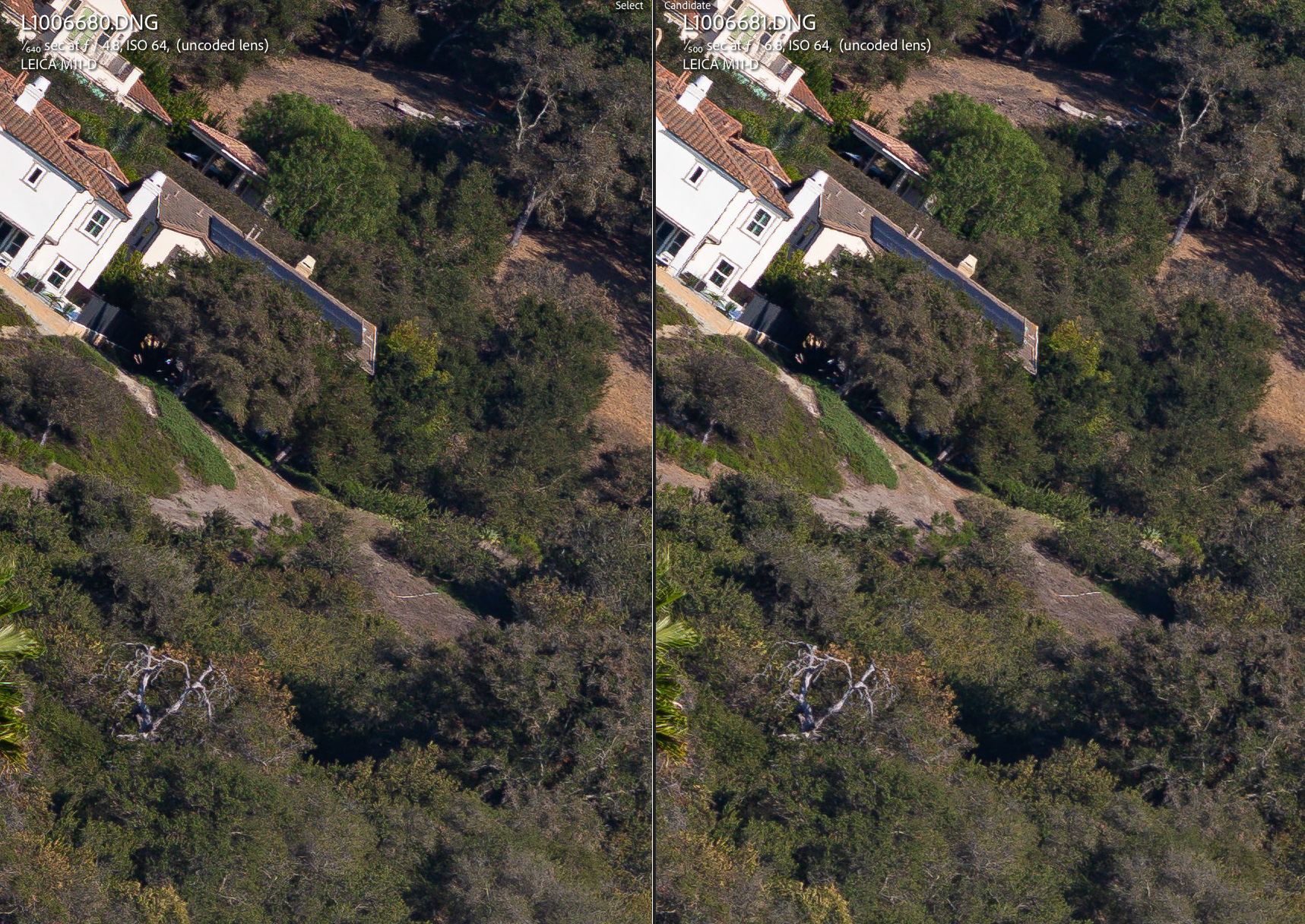
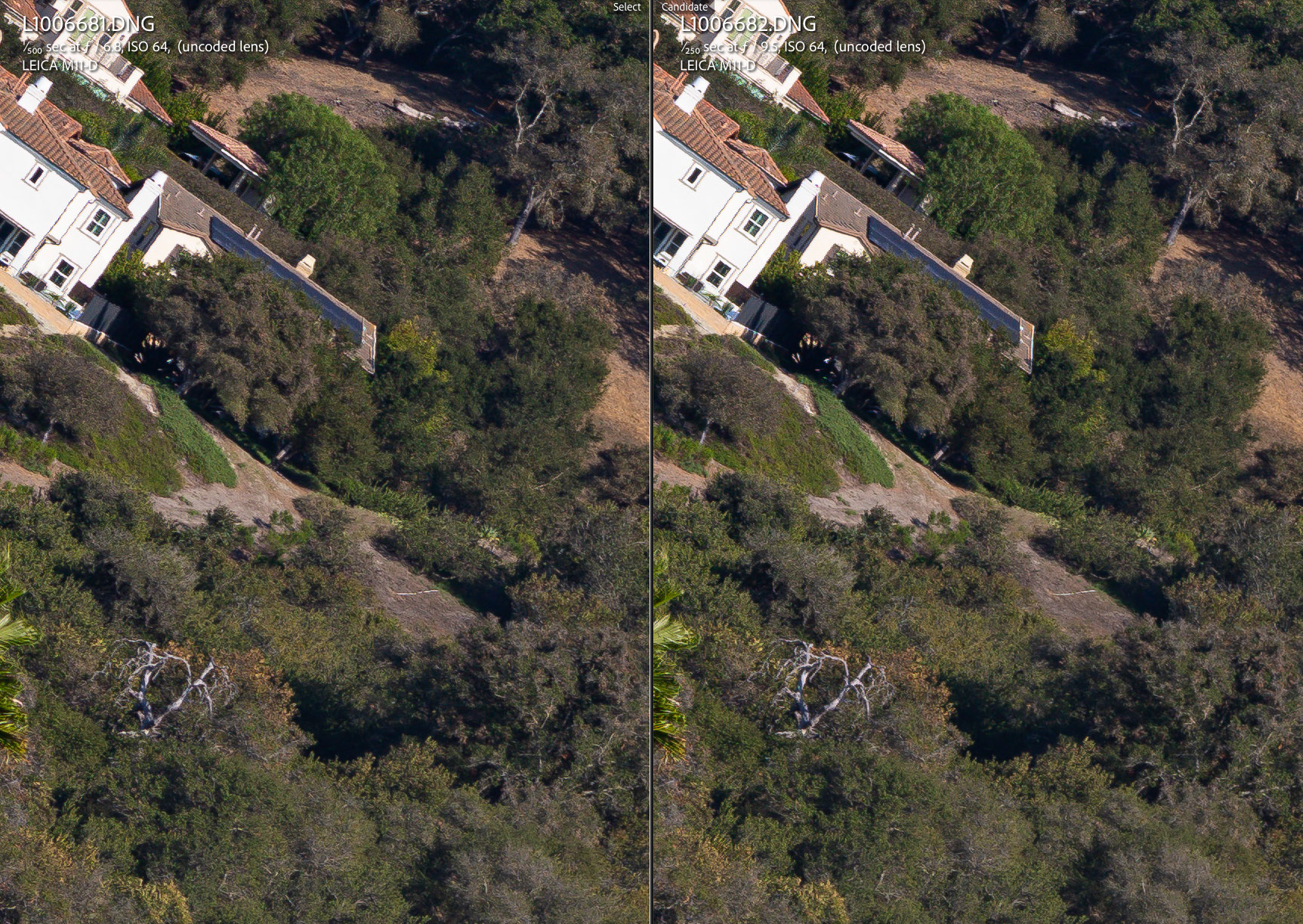
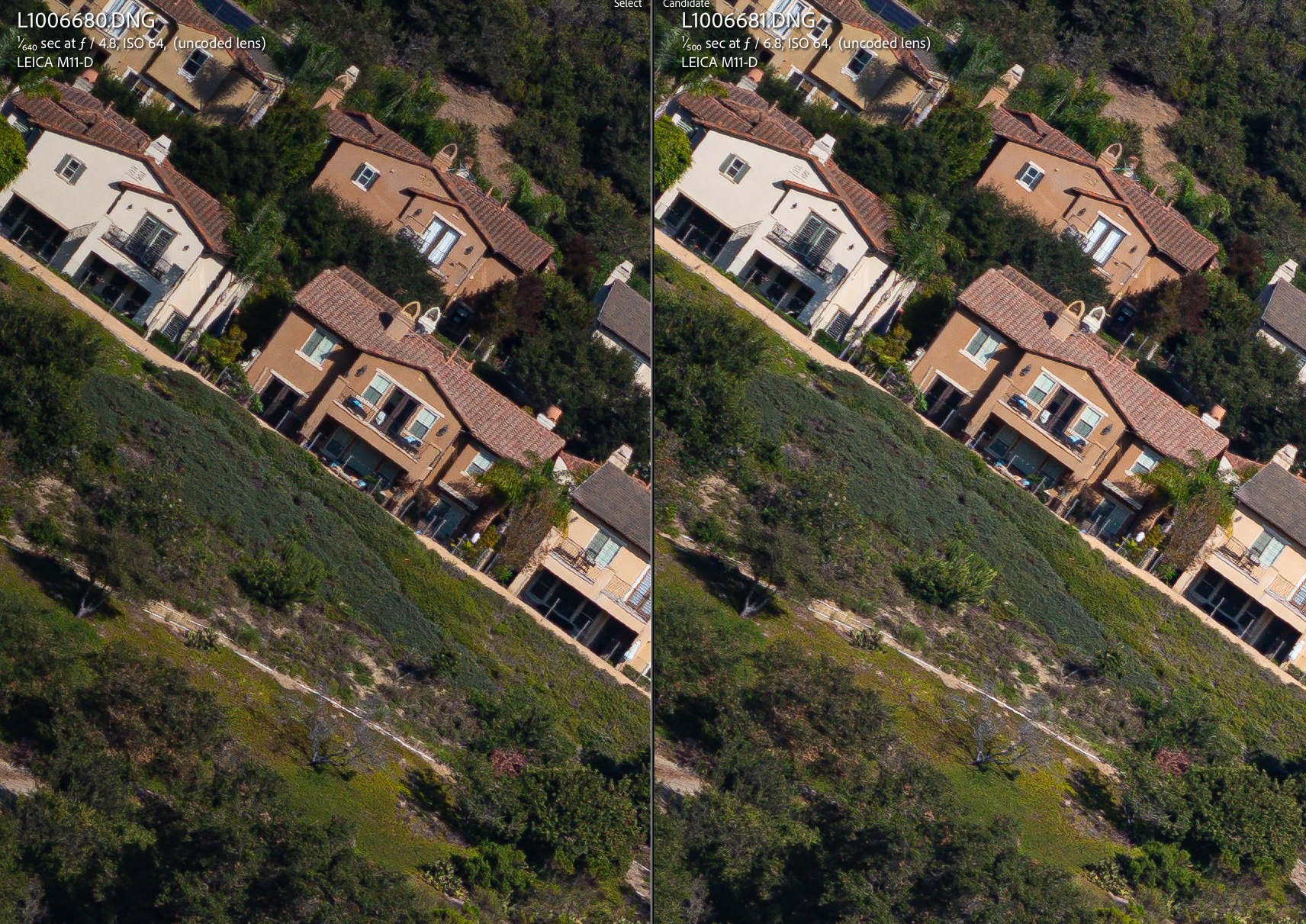
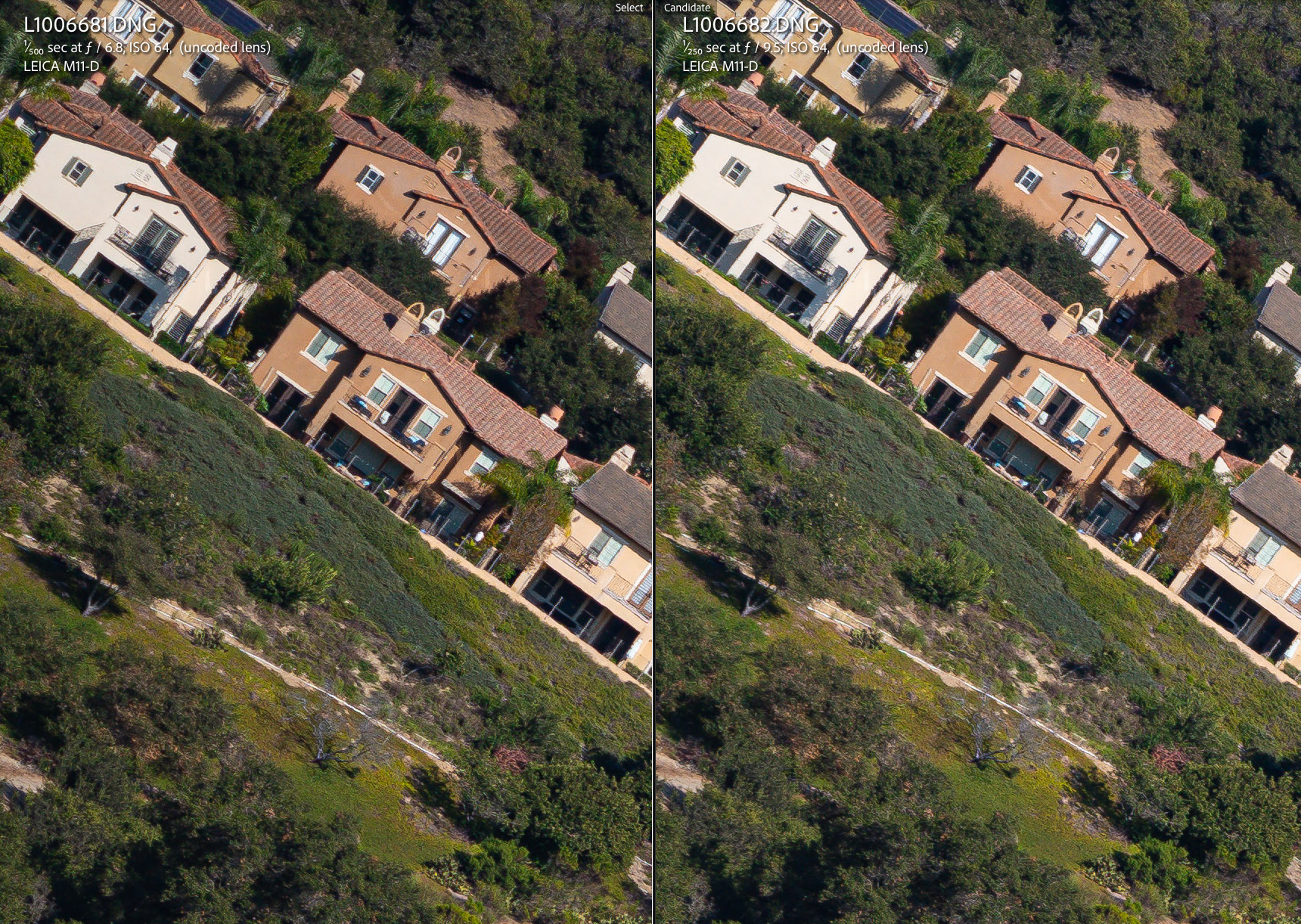
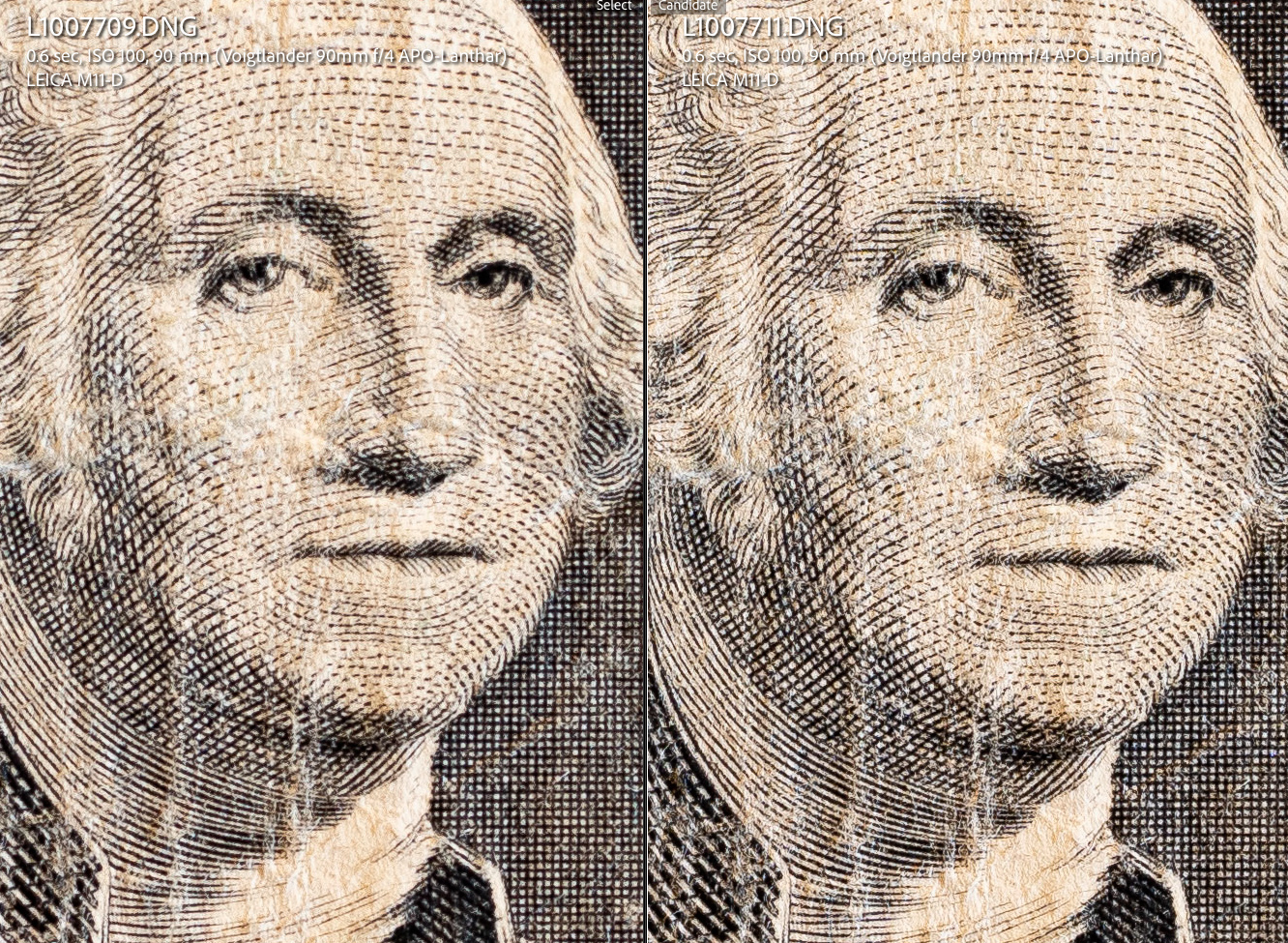
That said, I don't think the CV 90/4 APO-Lanthar is actually worse than the APO-Ultron here. In this review's comparison, the APO-Ultron was stopped down two stops, from f/2 to f/4, so naturally it looks brighter at that point. It's not quite a fair fight since we're not comparing them at their respective wide-open apertures.
The other advantage of the Ultron already being stopped down two stops appears to be slightly better fine detail sharpness at f/4 vs. the Lanthar wide open, at least centrally (assuming the test photo series for each lens wasn't affected considerably differently by atmospherics, which I think are affecting the overall infinity test photos). It's splitting hairs but slightly disappointing, if not unsurprising, that the Lanthar appears to benefit at pixel level, to being stopped down to f/5.6. Whether it makes a real world difference though... I doubt it would be noticed in standalone images.
formula4speed wrote:
Fred, if you happen to have a close focus adapter for E mount it would be interesting to see how close you can focus on the Sony.
Thanks for the thorough reviews.
I do, and I've played with it. The thing is, extension doesn't do as much for telephotos as it does for wide angle lenses. With telephotos, you need a lot of extension to get meaningfully closer, perhaps the reason Leica's own Macro-Adapter-M offers up to 30mm of extension, while most "macro" M-to-E adapters only offer 4-5mm, which is nice to have but barely moves the needle for something like a 90mm lens.
With the Leica 90/4 Macro-Elmar and its modest 0.15x native magnification (1:6.7 reproduction ratio), adding 30mm of extension gets you to roughly 0.5x. Using that same adapter on the Voigtlander 90/4 APO-Lanthar, which already starts at 0.30x, would likely put you in the ballpark of ~0.65x, a meaningful jump into true macro territory.
rscheffler wrote:
The other advantage of the Ultron already being stopped down two stops appears to be slightly better fine detail sharpness at f/4 vs. the Lanthar wide open, at least centrally (assuming the test photo series for each lens wasn't affected considerably differently by atmospherics, which I think are affecting the overall infinity test photos). It's splitting hairs but slightly disappointing, if not unsurprising, that the Lanthar appears to benefit at pixel level, to being stopped down to f/5.6. Whether it makes a real world difference though... I doubt it would be noticed in standalone images.
I'm not sure I'd call it disappointing, even slightly, it's really just what you'd expect. We're comparing a lens two stops down against one shot wide open. If the CV 90/4 APO-Lanthar performed exactly the same as, or better than, that other high-performing APO under those conditions, that would actually surprise me.
I always bump up against the MFD of any given lens, I apparently like getting close. I like the idea of the close focus adapters but I've never had a chance to use one. It seems more convenient than adding and removing an extension tube, but I didn't realize how little extension there is.
formula4speed wrote:
Good info on the adapter, thanks.
I always bump up against the MFD of any given lens, I apparently like getting close. I like the idea of the close focus adapters but I've never had a chance to use one. It seems more convenient than adding and removing an extension tube, but I didn't realize how little extension there is.
A close-up lens (screwed onto the front of the lens) works much better for telephotos, and without any loss of light. There's no free lunch, but if you get the Leica "ELPRO 52 Close-Up Lens Set", you can likely bring the Voigtlander 90mm f/4 APO-Lanthar close to 1:1 macro. https://leicacamerausa.com/leica-elpro-e52-close-up-lens-set.html
The set doesn't come with a 43mm ring, so you'll need to pick up a separate 43-52mm step-up ring, but that's a cheap, easy add.
0.28x (native) + ~0.67-0.72x (ELPRO 52 contribution on a 90mm lens) ≈ 0.95x to 1x
------------
Another much cheaper option (and high quality "Achromat" lens) is the Marumi DHG 49mm Achromat Lens (close-up lens)
Since I own the Marumi DHG 330 (+3 diopter), it brings the Voigtlander 90mm f/4 APO-Lanthar just past half life-size (1:2), a bit more than what the Leica Macro-Adapter-M does for the Elmar.
Here are the results:
1) Voigtlander 90mm f/4 APO-Lanthar native: 0.28x (0.5m MFD)
2) Voigtlander 90mm f/4 APO-Lanthar native + Marumi DHG 330: ~0.27x added, for a total of 0.55x (half life-size)
Testing the Voigtlander 90mm f/4 APO-Lanthar with my brand new Leica M11-D!
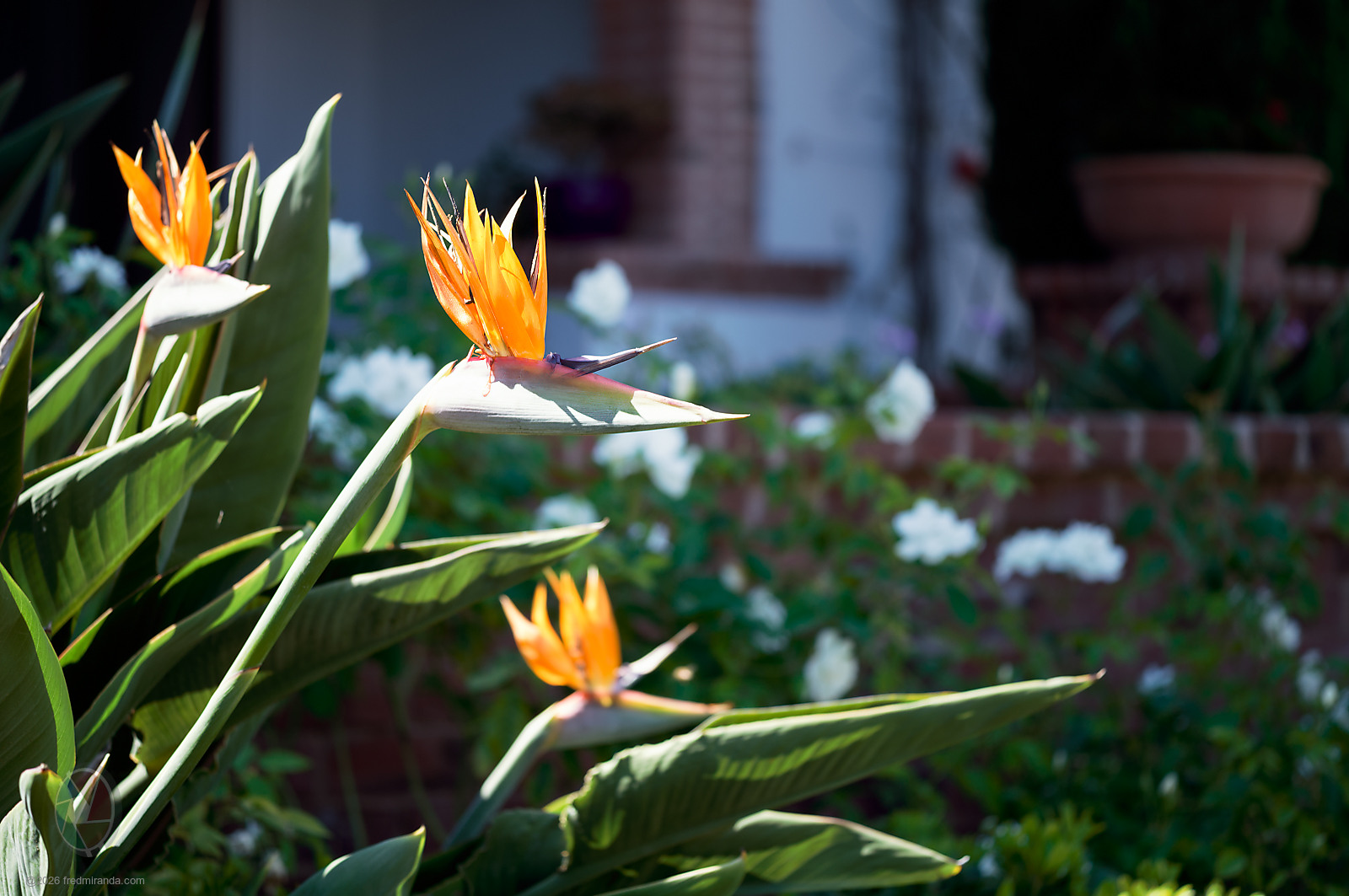
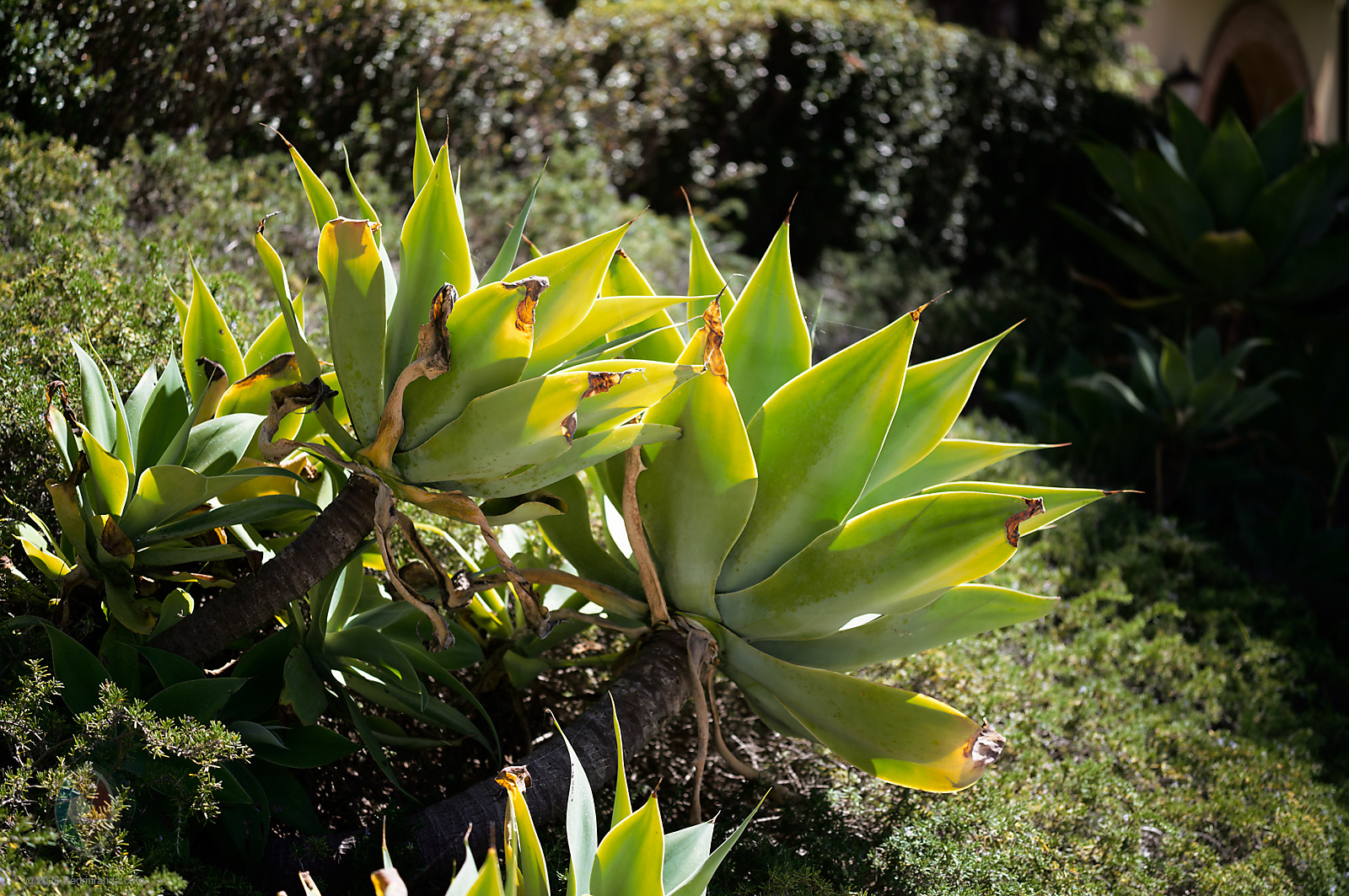
If you've tried focusing a 90mm or 135mm lens through the rangefinder patch, you know it's not easy to nail focus, but f/4 is much more forgiving than faster apertures. Here are a few shots I took an hour ago in very contrasty lighting (awful). Focus was spot on, and the 60MP file didn't intimidate the 90mm f/4 APO at all. I manually set the Leica 90mm f/4 Elmar code on the camera. All images shot wide open.
LEICA M11-DMacro-Elmar-M 1:4/90 lens90mmf/4.81/160s64 ISO0.0 EV
LEICA M11-DMacro-Elmar-M 1:4/90 lens90mmf/4.01/1000s64 ISO0.0 EV
LEICA M11-DMacro-Elmar-M 1:4/90 lens90mmf/4.01/1250s64 ISO0.0 EV
LEICA M11-DMacro-Elmar-M 1:4/90 lens90mmf/4.01/125s64 ISO0.0 EV
LEICA M11-DMacro-Elmar-M 1:4/90 lens90mmf/5.61/250s64 ISO0.0 EV
Fred Miranda wrote:
Since I own the Marumi DHG 330 (+3 diopter), it brings the Voigtlander 90mm f/4 APO-Lanthar just past half life-size (1:2), a bit more than what the Leica Macro-Adapter-M does for the Elmar.
Here are the results:
1) Voigtlander 90mm f/4 APO-Lanthar native: 0.28x (0.5m MFD)
2) Voigtlander 90mm f/4 APO-Lanthar native + Marumi DHG 330: ~0.27x added, for a total of 0.55x (half life-size)
I am happy you did this- it looks like the lens would work well as a light duty (grab shot) macro M with a leica adapter as well for me that means it is not a weighty intrusion (unlike my nikon macros I use on Z) into an outdoors camera bag and could be carried already attached to the adapter for flowers, bugs whatever……. what is one lens added…… I already have far too many with little prospects I am stopping buying them. At least this one is not expensive.
EMH2025 wrote:
I am happy you did this- it looks like the lens would work well as a light duty (grab shot) macro M with a leica adapter as well for me that means it is not a weighty intrusion (unlike my nikon macros I use on Z) into an outdoors camera bag and could be carried already attached to the adapter for flowers, bugs whatever……. what is one lens added…… I already have far too many with little prospects I am stopping buying them. At least this one is not expensive.
Agreed. Currently, for an extra $50, you can add a very high quality "Achromat" close-up lens to the Voigtlander 90mm f/4 APO and get 1:2 half-life-size magnification. Not bad at all, and you can use that same close-up lens on any of your other lenses too.
Infinity Resolution and Contrast on Leica M11-D (60MP)
Since the lens outperforms other 90mm APO lenses tested here, I wanted to put it to the test on a 60MP sensor to see diffraction kick in even earlier.
The Voigtlander 90mm f/4 APO-Lanthar is such a high performer that at center, we're already seeing the limits of diffraction by f/5.6, and definitely off-axis by f/8.
Wide open, the lens has already corrected the most noticeable spherical and chromatic aberration, meaning it's optimal wide open, and stopping down is only needed for depth of field, not for correction. A truly impressive performance, better than any other lens currently on the market. Here's a test with the M11-D's 60MP sensor:
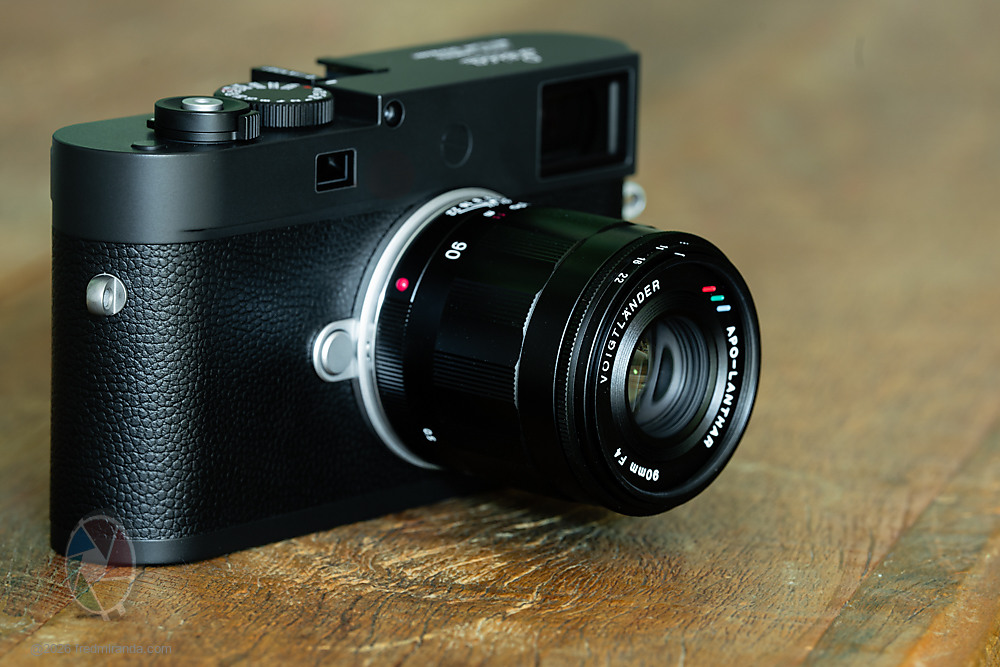
Voigtlander 90mm f/4 APO-Lanthar mounted on a black paint Leica M11-D
Distance: Infinity
Focus: Center - Best of three shots at maximum magnification
White Balance: Daylight
Both lenses are perfectly centered, as verified with my decentering test.
Software used: Lightroom with FM Default Landscape Sharpening; all other settings are at default.
PS: Vignetting, Chromatic Aberration (CA), and distortion were not corrected either in post-processing or in-camera.
Center Resolution and Contrast Infinity Resolution and Contrast on Leica M11-D (60MP)
Fred, thanks for your review and thorough testing. Looks like this is an exciting lens for us Sony shooters too. What I'm seeing from your is basically identical performance at infinity on Leica M and Sony sensors--excellent wide open at f4 and even better at f5.6. Would you concur or am I missing something?
OwenMG wrote:
Fred, thanks for your review and thorough testing. Looks like this is an exciting lens for us Sony shooters too. What I'm seeing from your is basically identical performance at infinity on Leica M and Sony sensors--excellent wide open at f4 and even better at f5.6. Would you concur or am I missing something?
Yes, performance is identical on both Leica and Sony. Thanks to its focal length, optical design, and f/4 max aperture, this lens avoids the usual sensor stack issues you get when adapting M-mount glass to Sony bodies. Naturally, the same applies to Nikon, where the sensor glass is even thinner than Sony's.
And also yes, the lens is already optimal from wide open. Stopping down just gains depth of field.
Minimum Focus Distance: 0.7m, 0.5m, and with a Close-up Lens (1:2 Macro)
The Voigtlander 90mm f/4 APO-Lanthar Close Focus focuses down to 0.7m, which is ideal for rangefinder use since it matches the system's closest coupled focusing distance. However, through a tactile click at that point, focus can be pushed further to 0.5m (0.28x magnification) using Live View. Additionally, with the help of a close-up lens, I used a Marumi DHG Macro 330 (+3), the lens can reach half life-size magnification (1:2 macro) while still maintaining strong optical performance.
Cosina doesn't mention a floating element design for this lens, but despite that, its optical construction delivers high performance, particularly at 0.7m (the rangefinder-coupled limit).
I tested the Voigtlander 90mm f/4 APO-Lanthar Close Focus at 0.7m across apertures from f/4 to f/8. There's a small improvement stopping down from f/4 to f/5.6, with a slight increase in resolution and contrast. Beyond that, gains become more marginal as diffraction sets in.
What I found surprising in this test is focus shift at close-up distances, especially when pushing to 0.5m or closer. I say surprising because APO lenses are well corrected and usually only show traces of this. My best guess is that correcting a lens for color is a different job than correcting it for focus consistency across the aperture, so a lens can excel at one while still carrying a small quirk in the other. This lens also doesn't use a floating element, a small internal group that shifts to maintain consistency as you focus closer, which many close-focusing lenses rely on. Without it, small imperfections tend to become more visible the closer you focus.
This means the best performance comes from focusing at your working aperture at close distances. If you want optimal resolution and contrast at f/5.6 up close, you should stop down to f/5.6 before focusing, not after.
For rangefinder use, this can't be compensated for at close range, since focusing is always done with the lens wide open. The good news is that the shift is only noticeable with a high-resolution sensor and only at very close focusing distances. At normal distances it's a non-issue, and up close you're already using Live View anyway.
The following sequence shows the lens's performance from wide open at f/4 through f/8. The lens was focused at f/4, and subsequent aperture changes to f/5.6 and f/8 were made without refocusing. I've also included a comparison between crops focused at f/4 and stopped down to f/5.6 versus the same shot focused directly at f/5.6, to help illustrate the amount of focus shift. This test was repeated at 0.7m, 0.5m, and 0.5m plus the Marumi 3x close-up lens (1:2 macro).
At 0.7m MFD using LiveView
***Expand the browser window to view the full image without any resizing.
LEFT: f/4 | Right: f/5.6 (focused at f/4)
LEFT: f/5.6 | Right: f/8 (focused at f/4)
LEFT: f/5.6 (focused at f/4) | Right: f/5.6 (focused at f/5.6) - Notice the small focus shift