p.1 #1 · Hive mind advice on pushing color negative film
I just haven't pushed color negative film before. It has taken me awhile to settle on a few B&W combos of film, developer, temperature, and technique to get results that don't have obvious deleterious effects from being pushed. Color is an odd bird with C-41 - if shot at box speed they all (regardless of film used) have the same time and temp. I must admit I still have trouble with that, but it works - somehow. I assume when pushing film there must be some adjustment to not end up with grainy, thin or otherwise messed up results. If you soup your own C-41 - what accommodation do you make for +1, +2, or even +3 stops? What films work best or tolerate pushing? Thank you in advance for sharing your experience.
p.1 #2 · Hive mind advice on pushing color negative film
Ah, the deafening sound of crickets. Guess I'm the only one interested in pushing C-41 color negative film. I found two mentions after much searching. Just in case anyone was interested
BASIS: ALL C-41 is 3.5 minutes at 102 degrees
Method #1- Add 1 minute 15 seconds for each stop pushed to the development time (example +1 stop = 4min 45 sec)
Method #2- Add 33%-36% development time per stop (Essentially the same thing)
p.1 #3 · Hive mind advice on pushing color negative film
I’ve processed a lot of color negative and if I needed a higher ISO just bought film with a higher ISO back in the day. If I had pushed film I would only adjust the time in the developer as that is the only chemical, I think, that would have your desired change.
p.1 #4 · Hive mind advice on pushing color negative film
I've never pushed because I never needed to. I have found that I can reliably recover 1 stop during the scanning process. I suppose that's "pushing" digitally, not with the chemicals. I shoot digital if I'm in a situation where I would need to push +2 or more.
I don't process C41 at home, and this may not be the answer you're looking for. I thought I'd say something, just in case it helps.
p.1 #5 · Hive mind advice on pushing color negative film
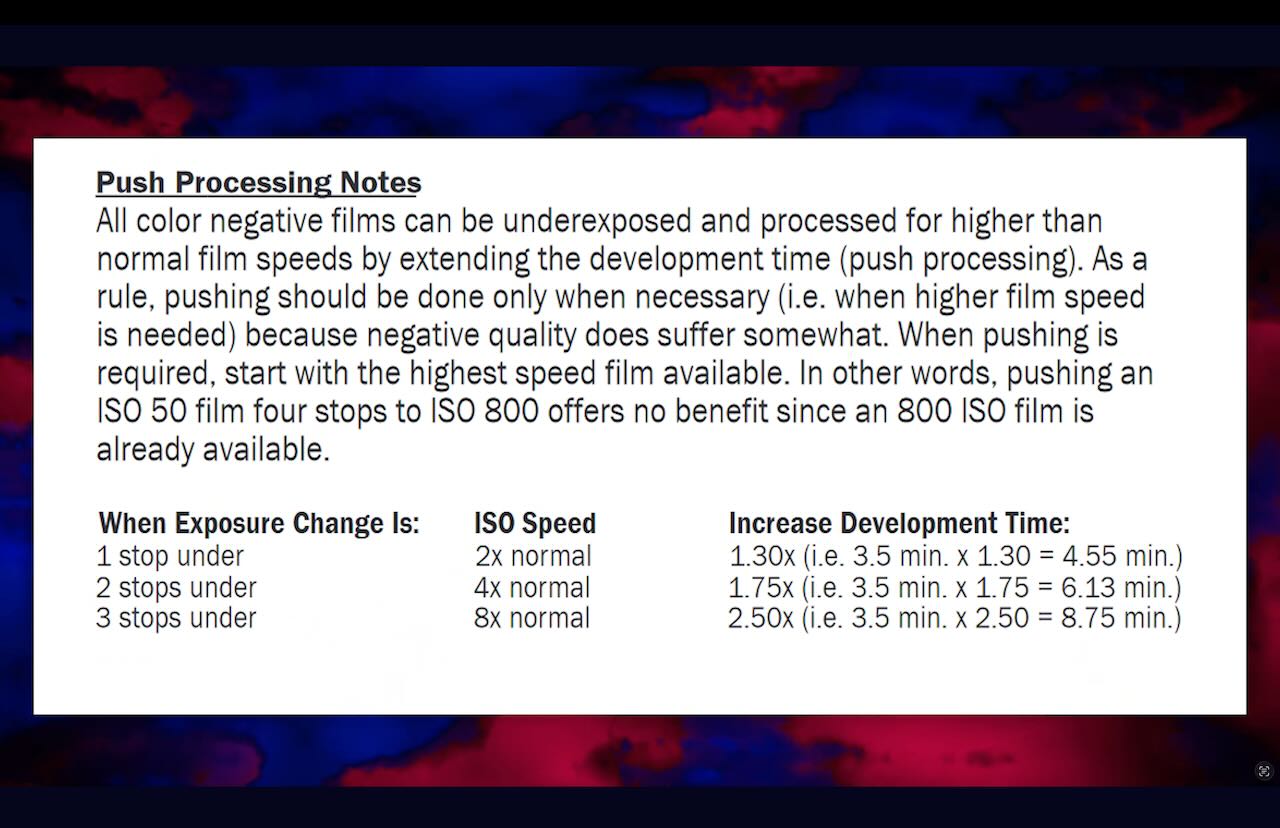
I suppose it isn't apparent why I would want to push color negative film. When I developed and scanned my first 15 roll batch of C-41 in 20 years I noticed that the grain in color negative film is finer or better than same ISO black and white films. That means - to me - that there is headroom to exploit for lower light situations and higher shutter speeds. I gives me options. Almost every "guide" or "tutorial" would start out like they knew the secret sauce, and then reveal that when you brought the film to the processor - just tell them to add a stop or two. I thought - that is useless info. I found a Kodak data sheet, and someone with practical experience.
p.1 #8 · Hive mind advice on pushing color negative film
3:15 for N
3:45 for +1
4:15 for +2
4:45 for +3 and may god have mercy on your soul.
Real talk, C41 is not really designed to be pushed. That's not to say there is no value in doing it but it's not like B&W where you can really salvage an under exposed negative. It basically only increases contrast. Under exposed film is by nature low contrast, and you can compensate for the muddiness by adding development time which will increase that contrast. You WILL NOT gain shadow detail and you WILL blow out highlights that were properly exposed.
If you do it, make sure your subject is lit to some degree, ie under a light source. If you can, don't fully cut your film by a stop. Lots of people as a matter of course shoot Portra 160 at 250 and push +1, which gives an interesting look.
Again, pushing just adds contrast. If you want to add contrast, push away!
p.1 #9 · Hive mind advice on pushing color negative film
speedgraphic wrote:
3:15 for N
3:45 for +1
4:15 for +2
4:45 for +3 and may god have mercy on your soul.
Real talk, C41 is not really designed to be pushed. That's not to say there is no value in doing it but it's not like B&W where you can really salvage an under exposed negative. It basically only increases contrast. Under exposed film is by nature low contrast, and you can compensate for the muddiness by adding development time which will increase that contrast. You WILL NOT gain shadow detail and you WILL blow out highlights that were properly exposed.
If you do it, make sure your subject is lit to some degree, ie under a light source. If you can, don't fully cut your film by a stop. Lots of people as a matter of course shoot Portra 160 at 250 and push +1, which gives an interesting look.
Again, pushing just adds contrast. If you want to add contrast, push away!...Show more →
Your development time corrections are only one third the amount I found on line. Experience?
I don't think I agree with two of your statements. First, C-41 was made to push. That is why the exhaustion rate is built into each successive roll, and why Kodak produced a data sheet about pushing C-41 processing. C-41, even in a partially exhausted state, can produce identical results to fresh chemistry by increasing development time to compensate. Pushing won't effect shadow or highlight detail, because you are NOT over developing a pushed roll. You are only compensating for it's under exposure. Of course, this is only theory in my head, because I haven't done it yet. However, the processing labs do it all the time, and I would expect demand would dry up if the result were as dire as you say. I'll revisit this thread next C-41 batch I do.
I built a working Wing-Lynch film processor (out of two broken ones) that did both C-41 and E6. All I had to do was change out a circuit card at the beginning. For about 12 years it was great,, but I got concerned about my kids exposure to the chemistry, and decommissioned the machine, and turned over all the unmixed chemistry to a federal recycling center. I never had to change the development times, because the chemistry was single shot and discarded. The tanks were all preheated with a layer of pressurized nitrogen in the top. Some of the largest tanks would last over two years, because my volume was so low doing only my and my photog friends film. So, I don't have experience pushing color negative (or E6), but I believe should be possible.
These are not exactly secrets. They also pretty much only recommend pushing Portra 800 and the now discontinued 400UC. Again, you can do it with other films. Portra 400 responds reasonably well. But C41 films don't push like B&W or E6 pushes.
These are not exactly secrets. They also pretty much only recommend pushing Portra 800 and the now discontinued 400UC. Again, you can do it with other films. Portra 400 responds reasonably well. But C41 films don't push like B&W or E6 pushes.
I just wanted to thank you for that link. Flexicolor is old school C-41, and I was not familiar with it. I always used Agfa - which also had separate fixers, stabilizers, and washes. with the developer, and bleach. I plan to follow Kodak's correction factors, and will switch to Flexicolor on my next C-41 purchase.