p.1 #1 · Learning the Leica M6,Leica IIIf and shooting film
Well I did what I always said I would never do, I am now shooting film on two different Leica bodies (M6, IIIf) with a mix of screw mount and M Leica lenses.
I have shot about 5 rolls of film so far and have had 2 developed at a local camera shop. The reason I have chosen to do this is my project in Parma Italy. This is a historic city and I find that the vintage lenses, bodies, and lenses give me results that I don't get with my digital M11 and modern Summilux lenses. So I will incorporate the film into the project along with the digital wok. Plus, the film process turns out to be fun and inspiring to do.
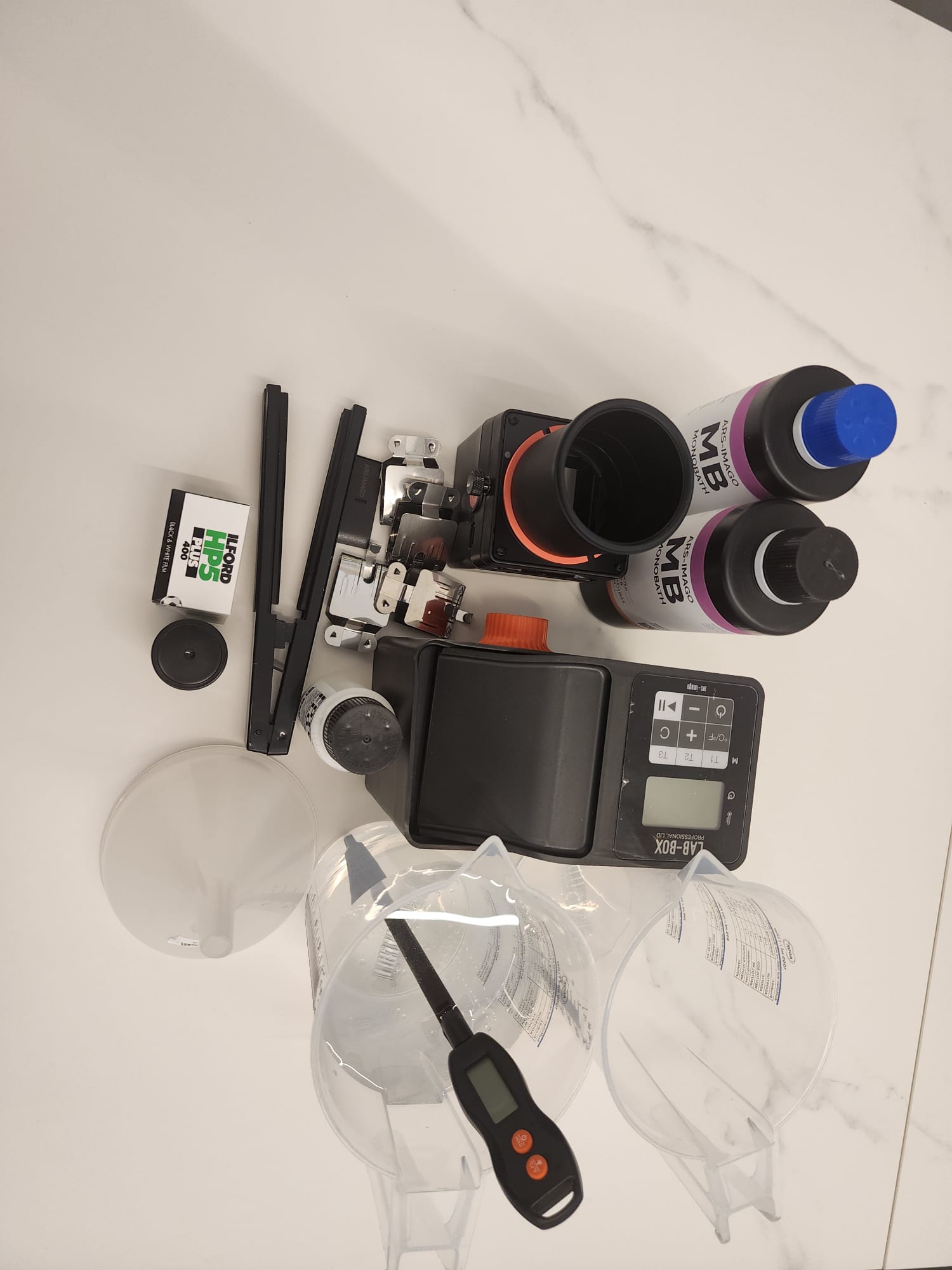
One thing I found quickly is that the expense of film, processing, and scanning at labs is irritatingly high. Plus the results were not what I hoped as the local labs standard is low quality jpeg scans. I want better, less expense, more control, and better quality scans. So, I have decided to process, and scan myself. I have assembled the following kit.
A Lab-Box Pro daylight developing tank using, mono-bath chemistry and all needed accessories.
A Valoi Easy 35 vII scanning setup using with my SL3 and 50mm APO-SL lens with extension tubes for 1:1 reproduction.
The total cost of the processing and scanning kit was just under $450. The consumable cost of doing my own processing I estimate to be less that $1.50 per 36 frame roll. I should quickly be able to recover the investment in equipment as high quality TIFF scanning here is between $27 and $30 per roll. I get 60mpx DNG RAW files to work with which I strongly prefer to what the labs offer.
So that is the theory at this point. We will see how this works out. I am sure to screw stuff up at the beginning. My intent with this thread is to share the adventure, headaches, failures, successes, and resultant images with everyone here in the hoes that I will receive some good advice, tips, and others might also find it interesting and useful. Everyone is invited to contribute to this thread as they see fit.
Below is a photograph of my entire assembled kit ready to process and scan my first roll of Ilford HP5+ 400. It is a small kit, doesn't require a darkroom or any real installation. So far my Wife is OK with my using the guest/my (she never goes in there) bath as long as I clean up and store everything immediately on finishing each time.
p.1 #2 · Learning the Leica M6,Leica IIIf and shooting film
Enjoy!
I'll be curious to see if you find that your high-res TIFF files actually make much difference with B&W film. I scan my negatives as TIFFs for archiving, but I export JPEGs for editing; I find that reasonably high-res JPEGs (360 dpi, 2048 pixels) work fine for editing B&W, especially since my edits are mainly adjustments to black and white point, contrast, a bit of mid-tone detail, sometimes a tiny bit of sharpening, maybe some dodging and burning here and there, etc. along with the usual dust and hair removal edits.
But it all depends on what you plan to do with your files: if you're making large digital prints I'm sure the TIFFs are a better choice. I almost never print my photos (I have no place to store or hang prints) so the JPEGs work for my purposes; I mainly post my photos to Flickr and occasionally social media.
p.1 #3 · Learning the Leica M6,Leica IIIf and shooting film
It's a good kit to start out with even I have no personal experience with the temperature-controlled Lab Box Pro development tank. I am using an older std development tank (500 ml volume) with plastic reels for 35 and 120 films. I always control the water temperature myself with a thermometer, all B&W developments I do at 20 deg C and mix water and developer to adjust the temperature accordingly. Same I do for C-41 and E-6 developments - here I just pre-heat the developer and bleach/fixer storage containers to the required temperature in a vanity sink and water bath. Where I would be cautious to use is the squeegee - biggest con of it is that small debris particles can cause streaks on the film strip when swiping to rinse droplets off. Instead, I replaced the squeegee with a distilled water rinse and shake droplets off mechanically before hanging the film strip to dry. This works much better and leaves the film unharmed.
p.1 #4 · Learning the Leica M6,Leica IIIf and shooting film
retrofocus wrote:
Where I would be cautious to use is the squeegee - biggest con of it is that small debris particles can cause streaks on the film strip when swiping to rinse droplets off. Instead, I replaced the squeegee with a distilled water rinse and shake droplets off mechanically before hanging the film strip to dry. This works much better and leaves the film unharmed.
I let the wetting agent do its thing and never use a squeegee or my fingers; never had any streaks or scratches but I think it depends on your water (my water is not hard and I never bother with distilled water).
I use the Ilford method for the rinsing: fill the tank with water and invert 5 times and pour out, fill it again and invert 10 times, fill it again and invert 20 times, and then for the final rinse I use a wetting agent in water and invert five times, hang to dry, no squeegee. I've developed close to 200 films now and never got any streaking, but if our water was hard I'd use distilled water for that final rinse.
p.1 #5 · Learning the Leica M6,Leica IIIf and shooting film
bjhurley wrote:
I let the wetting agent do its thing and never use a squeegee or my fingers; never had any streaks or scratches but I think it depends on your water (my water is not hard and I never bother with distilled water).
I use the Ilford method for the rinsing: fill the tank with water and invert 5 times and pour out, fill it again and invert 10 times, fill it again and invert 20 times, and then for the final rinse I use a wetting agent in water and invert five times, hang to dry, no squeegee. I've developed close to 200 films now and never got any streaking, but if our water was hard I'd use distilled water for that final rinse....Show more →
I used wetting agent a few times years ago when I started out doing my developments. Made no good experience with it - every time I used it, it left residue behind on the negative which was difficult to remove in digital PP after scanning, so I had to wash the film again in dist. water anyway. I fully gave up on wetting agent, it did not work for me.
p.1 #6 · Learning the Leica M6,Leica IIIf and shooting film
retrofocus wrote:
I fully gave up on wetting agent, it did not work for me.
Totally understandable, it's one of the interesting things about developing film: what works perfectly for some people doesn't work at all for others. There are so many variables at play in home developing, it's far from a controlled environment and nobody's setup or practices are exactly the same.
p.1 #7 · Learning the Leica M6,Leica IIIf and shooting film
bjhurley wrote:
Enjoy!
I'll be curious to see if you find that your high-res TIFF files actually make much difference with B&W film. I scan my negatives as TIFFs for archiving, but I export JPEGs for editing; I find that reasonably high-res JPEGs (360 dpi, 2048 pixels) work fine for editing B&W, especially since my edits are mainly adjustments to black and white point, contrast, a bit of mid-tone detail, sometimes a tiny bit of sharpening, maybe some dodging and burning here and there, etc. along with the usual dust and hair removal edits.
But it all depends on what you plan to do with your files: if you're making large digital prints I'm sure the TIFFs are a better choice. I almost never print my photos (I have no place to store or hang prints) so the JPEGs work for my purposes; I mainly post my photos to Flickr and occasionally social media....Show more →
The files I work with in LightRoom will not even be TIFFs. They will be actual Leica SL3 60mpx DNG RAW files. So my entire workflow will be non destructive, and as any other file I shoot on my SL3. I will export from there in a format that suits the use case for sharing or printing. I can't think of a higher quality file to work with.
Yes, there is a difference at least from the jpeg scans I have been getting from the labs which tend to be less sharp, less flexible, less dynamic range (only 8 bit) tonality, and the jpeg sharpening causes much higher grain and noise.
p.1 #8 · Learning the Leica M6,Leica IIIf and shooting film
bjhurley wrote:
Totally understandable, it's one of the interesting things about developing film: what works perfectly for some people doesn't work at all for others. There are so many variables at play in home developing, it's far from a controlled environment and nobody's setup or practices are exactly the same.
I plan on using distilled water with Foto Flo for the final rinse. I will try and avoid using the squeegee if this works as expected.
p.1 #10 · Learning the Leica M6,Leica IIIf and shooting film
retrofocus wrote:
I used wetting agent a few times years ago when I started out doing my developments. Made no good experience with it - every time I used it, it left residue behind on the negative which was difficult to remove in digital PP after scanning, so I had to wash the film again in dist. water anyway. I fully gave up on wetting agent, it did not work for me.
Yeah no matter what I tried w wetting agents, they always left residue on my film so I gave up on them.
I wipe my film with Kimwipes and hang dry.
Kimwipes are ok but often they leave tiny bits of filaments - unlike the claim on the box that they do not do that.
p.1 #11 · Learning the Leica M6,Leica IIIf and shooting film
1bwana1 wrote:
Well I did what I always said I would never do, I am now shooting film on two different Leica bodies (M6, IIIf) with a mix of screw mount and M Leica lenses.
I have shot about 5 rolls of film so far and have had 2 developed at a local camera shop. The reason I have chosen to do this is my project in Parma Italy. This is a historic city and I find that the vintage lenses, bodies, and lenses give me results that I don't get with my digital M11 and modern Summilux lenses. So I will incorporate the film into the project along with the digital wok. Plus, the film process turns out to be fun and inspiring to do.
One thing I found quickly is that the expense of film, processing, and scanning at labs is irritatingly high. Plus the results were not what I hoped as the local labs standard is low quality jpeg scans. I want better, less expense, more control, and better quality scans. So, I have decided to process, and scan myself. I have assembled the following kit.
A Lab-Box Pro daylight developing tank using, mono-bath chemistry and all needed accessories.
A Valoi Easy 35 vII scanning setup using with my SL3 and 50mm APO-SL lens with extension tubes for 1:1 reproduction.
The total cost of the processing and scanning kit was just under $450. The consumable cost of doing my own processing I estimate to be less that $1.50 per 36 frame roll. I should quickly be able to recover the investment in equipment as high quality TIFF scanning here is between $27 and $30 per roll. I get 60mpx DNG RAW files to work with which I strongly prefer to what the labs offer.
So that is the theory at this point. We will see how this works out. I am sure to screw stuff up at the beginning. My intent with this thread is to share the adventure, headaches, failures, successes, and resultant images with everyone here in the hoes that I will receive some good advice, tips, and others might also find it interesting and useful. Everyone is invited to contribute to this thread as they see fit.
Below is a photograph of my entire assembled kit ready to process and scan my first roll of Ilford HP5+ 400. It is a small kit, doesn't require a darkroom or any real installation. So far my Wife is OK with my using the guest/my (she never goes in there) bath as long as I clean up and store everything immediately on finishing each time.
That’s a good set up. I just use a regular dev tank and put the film inside it using a dark bag. Much simpler process, plust it is always handy to have a dark bag in case you have an issue with film inside a camera and need to open it up.
p.1 #13 · Learning the Leica M6,Leica IIIf and shooting film
Desmolicious wrote:
Yeah no matter what I tried w wetting agents, they always left residue on my film so I gave up on them.
+1. It is one of the great divides between film photographers and development methods. For some it works great for others not at all. I suspect it has to do with the water hardness - soap (what wetting agent is) might form salts with Calcium-based hard water which then leaves traces behind on film.
p.1 #15 · Learning the Leica M6,Leica IIIf and shooting film
The only wetting agent I've used is Flic Film's Slick 200, which I assume is the same stuff as the others and I've never had residue or streaks on any film; I use tap water for all my development and rinses, 5ml of Slick 200 into a liter of tap water for the final rinse (5 agitations) before hanging. I guess it'll be one of those "I don't know why it works, but it does so I'll keep using it" things. Maybe it's very specific to my tap water.
p.1 #16 · Learning the Leica M6,Leica IIIf and shooting film
Looks exciting - have a good time. I'm glad my choices were vastly reduced 50+ years ago. I just use stainless steel tanks and reels. One note on Photo-Flo - it basically is like soap. I bought two 5 ounces bottles in the 1970s, and I am still working on bottle one. The cap is about .5ml, and i use half a cap per quart or liter or 0.25ml. As long as it doesn't have precipitate I use it for 8-10 rolls per batch. The whole point of Photo-Flo is too break the surface tension of the water so it will not bead on the film. Let it soak for one to two minutes while rotating the reel with a lift stick. I use a Yankee brand sponge squeegee. It is the very first thing a do when developing is to soak it in running water. Just before use I pour 5-10ml of Photo-flo on it and squeeze it as dry as possible. I also just do one swipe. because there aren't any beads of water left to make marks. Then I thoroughly clean it for next time. About two years ago when I started up film again. Out of curiosity I wanted to see if I could still load a reel with my eyes closed.
p.1 #17 · Learning the Leica M6,Leica IIIf and shooting film
Desmolicious wrote:
Steve, now that you have gone down the Leica film camera rabbit hole, DO NOT LOOK AT ROLLEIFLEXES!
It is annoying how people respond to them when they see you use one, insisting that you take their portrait.
I saw a big collection of them for sale in Prague last weekend at what seemed to be good prices. I was tempted, but resisted since what I have on my plate right now seems like more than enough to figure out.
p.1 #18 · Learning the Leica M6,Leica IIIf and shooting film
retrofocus wrote:
+1. It is one of the great divides between film photographers and development methods. For some it works great for others not at all. I suspect it has to do with the water hardness - soap (what wetting agent is) might form salts with Calcium-based hard water which then leaves traces behind on film.
p.1 #19 · Learning the Leica M6,Leica IIIf and shooting film
1bwana1 wrote:
I saw a big collection of them for sale in Prague last weekend at what seemed to be good prices. I was tempted, but resisted since what I have on my plate right now seems like more than enough to figure out.
Like I said, resist the temptation! Smart anyway to get a handle on what you have, otherwise it just becomes a GAS obsession.
p.1 #20 · Learning the Leica M6,Leica IIIf and shooting film
Desmolicious wrote:
Like I said, resist the temptation! Smart anyway to get a handle on what you have, otherwise it just becomes a GAS obsession.
On the one hand, yeah, on the other hand, YOLO.
Within reason, I see no harm in trying out legit cool cameras/lenses/film if the cost of ownership is equal to the cost of shipping (resale price = purchase price). This is how I found out that the Q2M is a keeper.