p.2 #1 · What is the point of digitally post-processing film?
tzhang4284 wrote:
I’m not surprised - the first roll of film I got back printed from the lab had a different look and feel to what I remembered from my childhood. It is what it is.
I hardly ever got decent results from those labs of old. I'd see the washed out punchless prints, then look at the negatives they returned. The negatives always looked great, so I wondered why the prints were so crappy.
It's because even then their machines are set to the mid tone/grey levels, and so everything printed was auto 'corrected' to that mid level no matter what you were trying to achieve.
Back then I had access to a darkroom and used that for my B&W (the school darkroom only was set up for B&W). My prints were as I wanted - unlike the colour stuff from regular labs.
Fast forward to today - I scan all my film, adjust in LR to get the result I actually want. And when I send the images out to print, I hit that magic button 'auto correct OFF'. Finally, after all these years, I get film prints that look exactly how I want them to look! Thanks to this hybrid digital workflow.
Here is a recent thread comparing film vs digital using the same subject matter:
p.2 #2 · What is the point of digitally post-processing film?
Desmolicious wrote:
I hardly ever got decent results from those labs of old. I'd see the washed out punchless prints, then look at the negatives they returned. The negatives always looked great, so I wondered why the prints were so crappy.
It's because even then their machines are set to the mid tone/grey levels, and so everything printed was auto 'corrected' to that mid level no matter what you were trying to achieve.
Back then I had access to a darkroom and used that for my B&W (the school darkroom only was set up for B&W). My prints were as I wanted - unlike the colour stuff from regular labs.
Fast forward to today - I scan all my film, adjust in LR to get the result I actually want. And when I send the images out to print, I hit that magic button 'auto correct OFF'. Finally, after all these years, I get film prints that look exactly how I want them to look! Thanks to this hybrid digital workflow.
Here is a recent thread comparing film vs digital using the same subject matter:
The processing on those images are totally different with a few having an awful lot of grain and saturation while the other two are muted down with almost no grain. Did you apply exact processing to the images from their respective cameras.
p.2 #3 · What is the point of digitally post-processing film?
The "SOOC" trend has become endemic in photography sadly, with everyone wanting a complete product out of their camera as if that's how it ever was. Fujifilm's simulations have done a lot to push this idea that editing your photos after clicking the shutter is a sign of bad photography. Since darkrooms are far less common than they used to be and most film photography is consumed in a digital format now, people also seem to think film photos were meant to be taken and printed with no editing.
Look at all the editing that happened in the darkroom to get to the final print. Most of us don't have a darkroom these days (I only started shooting film last year so I never had one), but editing your photos is a morally valid part of the process whether you're shooting digital or film. I personally dislike those film simulations since the vast majority aren't even accurate to the film stock they claim to be, but to each their own.
p.2 #5 · What is the point of digitally post-processing film?
Now I have time to write a comment or two. I'm one of those guys who "never worked in a darkroom" because I had neither time nor the space to do so. However back in the old days, which was around 1972 and well before digital processing existed, I took a bunch of 35mm slides (Zenit B and 55mm lens) to the camera shop where I had just bought my Nikkormat, and asked for a large print of each. They were not cheap but the prints came back looking like what I was hoping for, sharp and with accurate color. It never occurred to me that digital conversion, editing, then printing was part of the process. Someone had taken the time to print each carefully.
Decades later but still long ago and in a very different place I wanted a print from a slide. IIRC someone (myself?) just stuck it in a machine, punched a button or two, and a print came out. It was okay, not great. I don't recall there being options. It was clearly a scanning device with integrated color printer. Either the scanner or the processing or the printer or any combination could have been the limiting factor.
For sufficient cost I would think a real lab would do a real print, or maybe not. A "real print" made digitally might be as good as or better than whatever is done by a typical lab tech. Regardless of the process, if you aren't there to describe carefully to either a machine or a person what you want, then the default you get might or might not be what you want.
p.2 #6 · What is the point of digitally post-processing film?
jimmuller wrote:
For sufficient cost I would think a real lab would do a real print, or maybe not. A "real print" made digitally might be as good as or better than whatever is done by a typical lab tech. Regardless of the process, if you aren't there to describe carefully to either a machine or a person what you want, then the default you get might or might not be what you want.
The lab I use for colour film will do prints from your own edited scans, you just bring in a USB key with the files and they print them for you. A lot of labs today don't even have enlargers but some do and can offer traditional darkroom prints.
I think I got spoiled when I saw some of Elliot Porter's dye-transfer prints and saw what was possible with colour prints back in the day; I'm almost always disappointed by conventional prints from colour film, including slide film. B&W is a different story; I love looking at good wet-darkroom B&W prints but have no interest in doing that again myself.
p.2 #7 · What is the point of digitally post-processing film?
chez wrote:
The processing on those images are totally different with a few having an awful lot of grain and saturation while the other two are muted down with almost no grain. Did you apply exact processing to the images from their respective cameras.
Why would they look the same? One was taken w a Leica M7 and Summicron lens with Fuji 200 film, the other with a Reto Ultrawide N Slim fixed focus, fixed exposure (f10 @ 1/100 sec) single element plastic lens that is notorious for creating very saturated and vignetted images, and using Fojak 400 film.
Of different subject matter. Taken five years apart.
p.2 #8 · What is the point of digitally post-processing film?
Desmolicious wrote:
Why would they look the same? One was taken w a Leica M7 and Summicron lens with Fuji 200 film, the other with a Reto Ultrawide N Slim fixed focus, fixed exposure (f10 @ 1/100 sec) single element plastic lens that is notorious for creating very saturated and vignetted images, and using Fojak 400 film.
Of different subject matter. Taken five years apart.
p.2 #9 · What is the point of digitally post-processing film?
chez wrote:
So what was the purpose of your post then?
I happened to be taking pics with my Nikon Z and when I processed the images remembered I had taken very similar images with a film Leica five years prior. That link compared the two.
The second set taken months earlier I happened to be using my digital Leica and the Reto at the same time.
Now loop it all back to post #1 when the question was asked why do we do this?
This was to show the differences in how film and digital images look taken of the same subject matter at the same time.
For some reason you expect all film images to look exactly the same, no matter the equipment or film type used from your statement:
The processing on those images are totally different with a few having an awful lot of grain and saturation while the other two are muted down with almost no grain. Did you apply exact processing to the images from their respective cameras
p.2 #10 · What is the point of digitally post-processing film?
I enjoyed the process of learning how to scan and process images. It was another aspect of photography that was entirely its own microcosm of gear and methodology that was fun to explore. The actual act of scanning film sucks. For the most part, I'd rather just work with the lab scans for anything I'm not printing above 5x7.
p.2 #11 · What is the point of digitally post-processing film?
I think its the Darkroom thing. I personally had a beautiful Pro Darkroom for Color and Black and White processing from beginning to end. After going digital I disassembled it and never went back. Although I still prefer to do it myself, but its a cost versus supply issue thses days. Most of my favored chemicals are not produced anymore. And the equipment is not too available either.
p.2 #12 · What is the point of digitally post-processing film?
My reason for scanning film is for sharing with friends and family.
I enjoy buying old film cameras and using them to get nice images. It's a great feeling when you load film into a camera that has not been used in 30+ years and breath new life into it!
Perfect examples; my elderly mom picked up a Canon FT at a local yard sale for $10.00. She got it for me because she knows I love old cameras. I used that same camera to capture images of her. I then scanned those images and sent them to her grandkids. I'm now working on doing the same with an old Canon point and shoot my elderly dad gave me last week. While I was visiting him due to an illness, I was able to take him out for dinner and also got the chance to bring him along to a local antique shop where I purchased a Pentax SP 500 for $28.00. He was so excited to be with me when I found that great deal! As soon as I get rolls developed from both cameras I'll be mailing him prints and sharing the scans with other family members.
If I want pixel-peeping, spectacular images, I simply shoot with either my Canon R6II or my Sony A7iv. However, I enjoy using old cameras, especially when they hold sentimental value like the three that I mentioned above.
p.2 #13 · What is the point of digitally post-processing film?
snegron7 wrote:
My reason for scanning film is for sharing with friends and family.
I enjoy buying old film cameras and using them to get nice images. It's a great feeling when you load film into a camera that has not been used in 30+ years and breath new life into it!
The fact that some of these cameras actually still work after 50 plus years is a testament to Japanese craftsmanship. That is motivation enough for me to keep them going.
p.2 #15 · What is the point of digitally post-processing film?
I shoot a hybrid process so 2 years after I shoot something I will second guess my scan and post processing. I then search for the negative, go through the pains of scanning it again, only to arrive at the same result.
p.2 #16 · What is the point of digitally post-processing film?
ottokbre wrote:
I shoot a hybrid process so 2 years after I shoot something I will second guess my scan and post processing. I then search for the negative, go through the pains of scanning it again, only to arrive at the same result.
I had a similar experience with digital pics. Admittedly a small sample size but I tried saving both jpgs and raw files then process the raw. I could do no better than the jpgs. Apparently Nikon is better at it than I am.
Whenever I've re-scanned or reprocessed film or slides I've ended up with similar results as my first attempt.
p.2 #17 · What is the point of digitally post-processing film?
A dear 90 year old friend passed away recently and I will have access to his film gear (Nikon 35mm & Linhof 23 roll film) so I wandered over to the film forum and got interested in this thread. I have personally gone digital since 2002 but before that ran a small commercial custom printing business and a majority of the work was Cibachrome, using my own custom developers to reduce the extreme contrast of the process. Dodging and burning and the like was done on almost every exposure. An early 80's recession did me in!
I do not see much difference between film processing & printing (darkroom) and digital (computer) processing, if the desire is the same - and that is arriving at a satisfactory print from your image. Obviously, how you get that print is quite different between the two processes, DUH. Also, at 83+ now, I would not want to ever again sustain the environmental hazards I reckoned with daily and am lucky I don't have the "shakes" that beset more than one commercial printer I knew.
But I am again heavily involved with film in a special way: I have photographed in the redwoods before and after the creation of Redwood National Park and was actually very active in the creation efforts. I am working on a volunteer "50 Years Later" project that I started when the park celebrated its 50th anniversary in 2018. With the park's blessing and some minor assistance, I am working on a report documenting changes to the park's environment I've photographed with my first image dating from Oct 1964 and the last significant batch taken on a trip along Redwood Creek in Aug 2023 when I was 80. That river float covered the same area I had photographed 58 years earlier. I captured a lot of change!
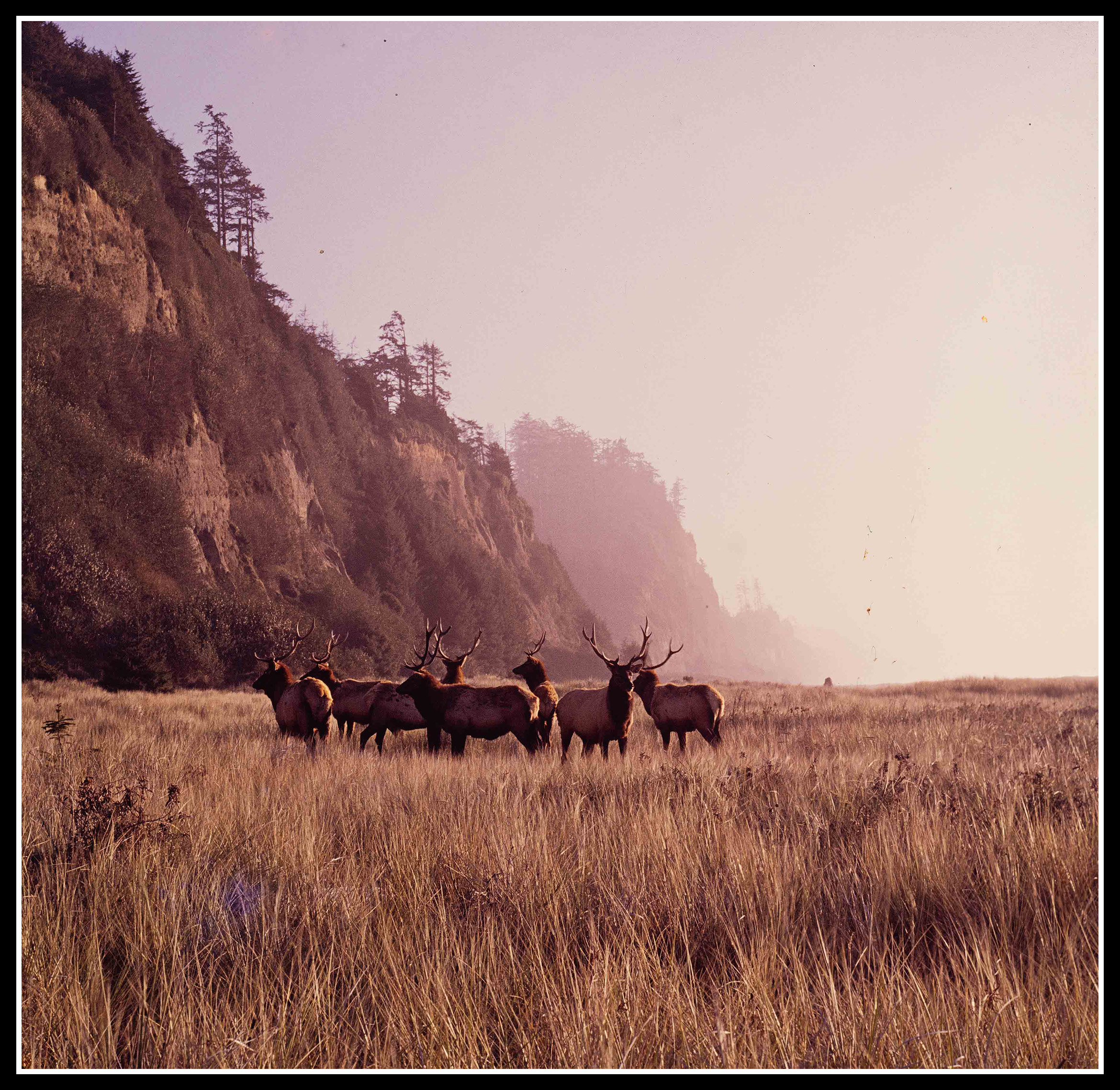
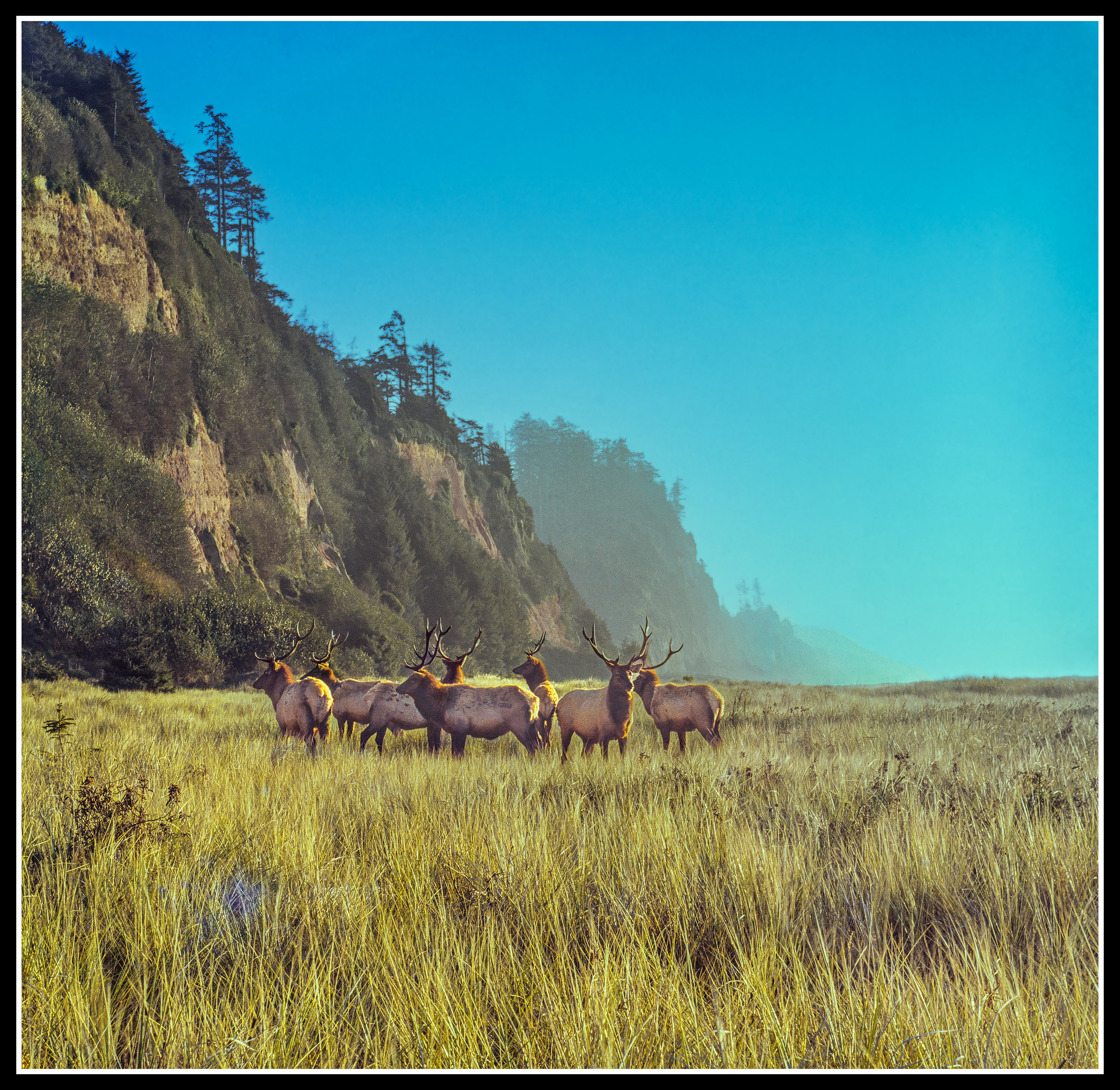
I am still scanning my oldest films and doing the best I can to correct color casts and other time related deterioration of the films and slides. An example is a photo I took of some elk along the coast in fall of 1967. It was a hazy late afternoon day and there was blue sky. The image now has a heavy magenta color cast and the sky looks washed out. I digitized the 6x6cm film with a Nikon Z7ii and Tamron 90mm macro lens.
The results of my work in ACR & Photoshop I'm reasonably pleased with and this image will be joined by a photo I'll take at the same location this fall - providing I live that long:-) I have hundreds of more images to work on...
Dave
Dave
Heavy magenta color cast of 59 year old original Ektachrome
Sky, bluffs, elk and beach grasses all needing separate treatments
p.2 #18 · What is the point of digitally post-processing film?
old_hikingman wrote:
...
But I am again heavily involved with film in a special way: I have photographed in the redwoods before and after the creation of Redwood National Park and was actually very active in the creation efforts.
Thanks for that great work!
Nice pics too. I'm curious about how they were made. The first (aged film version) looks like it could have been made by digitizing a negative, then negating it with incorrect or no base film color correction. Was it an Ektachrome slide that really changed color that much? I have lots of old slides and none have changed that much.
The second is lovely but at least on my laptop which shows colors as slightly soft the colors look unnatural. If you created that by scanning an original print then perhaps that's really what it looks like. Only you know what the original looked like so maybe that's an accurate reproduction.
p.2 #19 · What is the point of digitally post-processing film?
jimmuller wrote:
Thanks for that great work!
Nice pics too. I'm curious about how they were made. The first (aged film version) looks like it could have been made by digitizing a negative, then negating it with incorrect or no base film color correction. Was it an Ektachrome slide that really changed color that much? I have lots of old slides and none have changed that much.
The second is lovely but at least on my laptop which shows colors as slightly soft the colors look unnatural. If you created that by scanning an original print then perhaps that's really what it looks like. Only you know what the original looked like so maybe that's an accurate reproduction.
The original image was a 6x6cm Ektachrome transparency that was taken 59 years ago. The Berkeley, CA Kodak lab at the time often screwed up the processing of my 6x6 film and this image had a color cast issue from the get go and deteriorated more in my possession. In 1988, I donated over 5,000 images to RNP and the images have been stored more carefully in a frozen state. They pulled them out so I could scan them for my project.
Your observation of my restoration effort being "soft" is correct. First off, the original isn't really sharp to start with + now there has been more dye deterioration. It was a hazy (lazy) day with ocean spray in the air. The setting sun cast a bit of warmth on the bluffs and vegetation.
I think the colors are very "plausible" on my calibrated screens. Of course I can't remember the "exact" blue of the blue sky. I am guilty of "processing to taste" so to speak, but I did take some of my later digital images of the area, grasses and elk and used those color samples to work on various parts of the image restoration.
I'm not an expert by any means and really only have the time to get "reasonable" with color correcting. Each image I face is different and I am not wanting anything like a "velvia" outcome - low contrast and soft is fine. Many of my images are much sharper however. Given I have so much more to do to complete my life's work, the pursuit of "perfection" is something I have to yield to! At 83.5 with worsening macular degeneration, time isn't on my side.
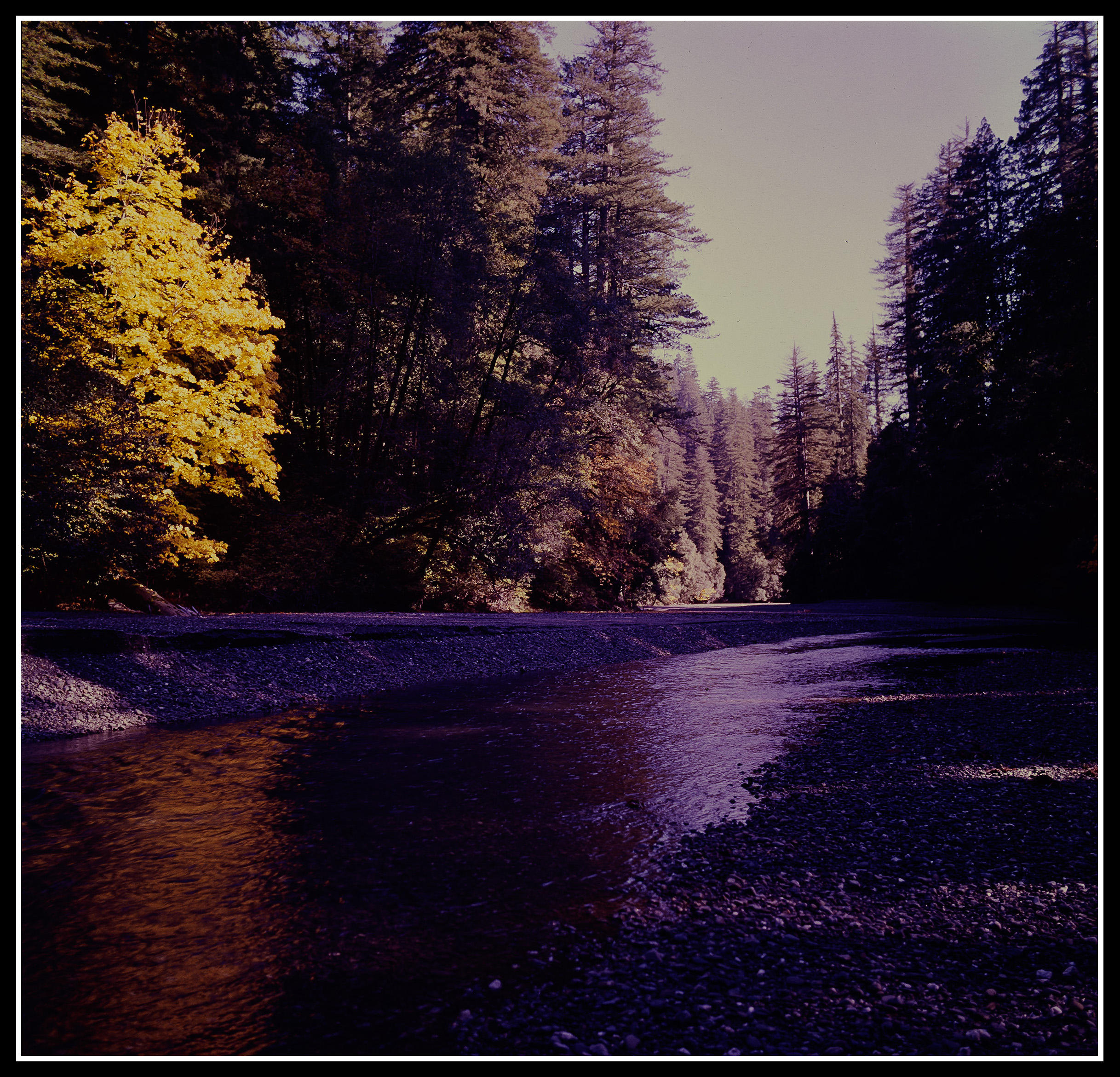
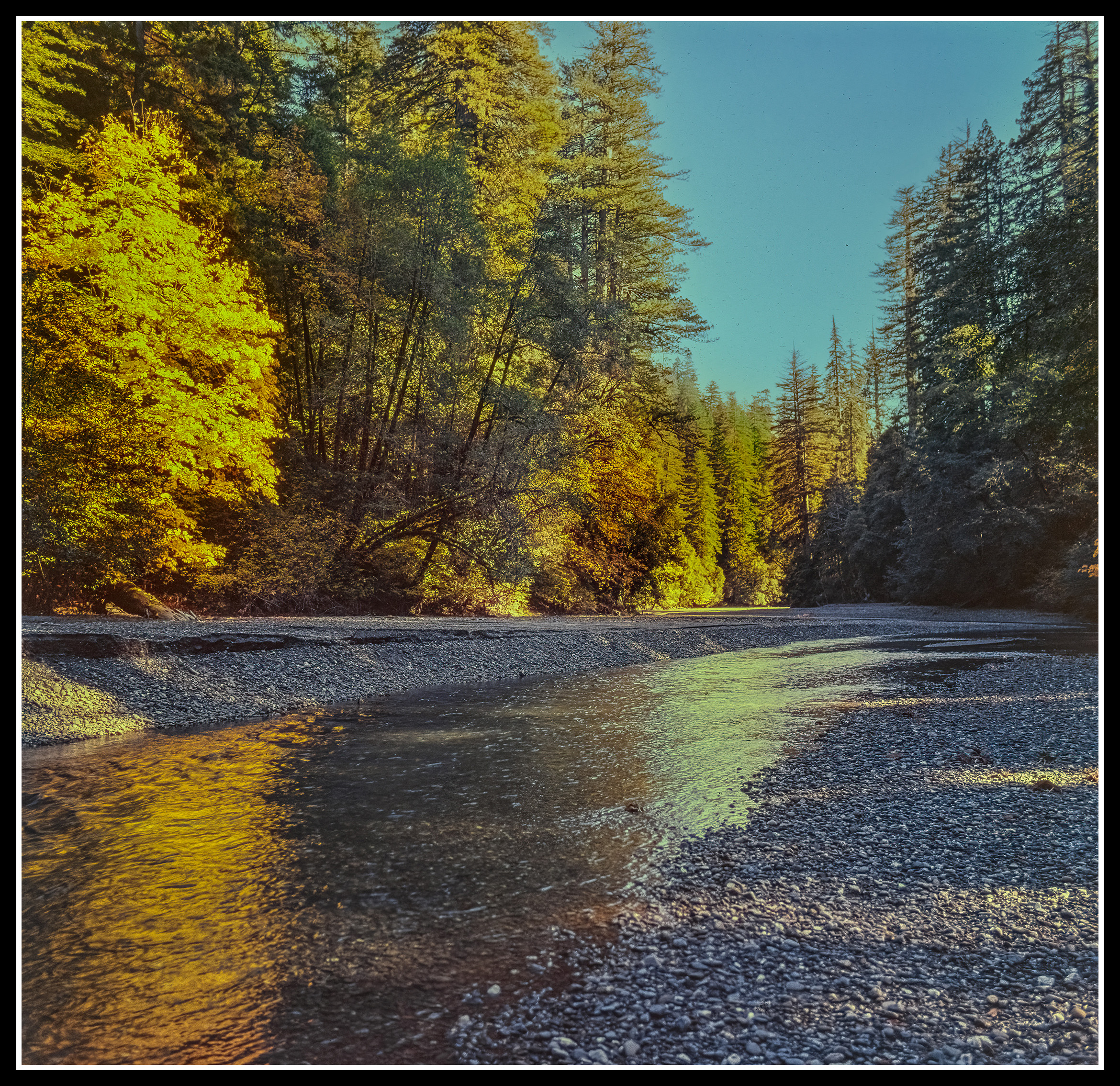
Below is another sample of restoration efforts that will be matched by a very similar 50+ years later photo. By "similar" I mean the followup image is very close to the same spot or angle (sometimes exactly the same spot). The silted in channel you see in this late fall photo has dropped over 10 feet in level, exposing bed rocks and now deep pools have replaced the shallow riffles.
Dave
EDIT: I can, indeed, add a little more contrast and "snap" to these restored images, but normally I let a little time go by and then give them a 2nd look.
Underexposed 6x6cm Etachrome with severe color cast - taken Nov 06, 1971
p.2 #20 · What is the point of digitally post-processing film?
old_hikingman wrote:
A dear 90 year old friend passed away recently and I will have access to his film gear (Nikon 35mm & Linhof 23 roll film) so I wandered over to the film forum and got interested in this thread. I have personally gone digital since 2002 but before that ran a small commercial custom printing business and a majority of the work was Cibachrome, using my own custom developers to reduce the extreme contrast of the process. Dodging and burning and the like was done on almost every exposure. An early 80's recession did me in!
I do not see much difference between film processing & printing (darkroom) and digital (computer) processing, if the desire is the same - and that is arriving at a satisfactory print from your image. Obviously, how you get that print is quite different between the two processes, DUH. Also, at 83+ now, I would not want to ever again sustain the environmental hazards I reckoned with daily and am lucky I don't have the "shakes" that beset more than one commercial printer I knew.
But I am again heavily involved with film in a special way: I have photographed in the redwoods before and after the creation of Redwood National Park and was actually very active in the creation efforts. I am working on a volunteer "50 Years Later" project that I started when the park celebrated its 50th anniversary in 2018. With the park's blessing and some minor assistance, I am working on a report documenting changes to the park's environment I've photographed with my first image dating from Oct 1964 and the last significant batch taken on a trip along Redwood Creek in Aug 2023 when I was 80. That river float covered the same area I had photographed 58 years earlier. I captured a lot of change!
I am still scanning my oldest films and doing the best I can to correct color casts and other time related deterioration of the films and slides. An example is a photo I took of some elk along the coast in fall of 1967. It was a hazy late afternoon day and there was blue sky. The image now has a heavy magenta color cast and the sky looks washed out. I digitized the 6x6cm film with a Nikon Z7ii and Tamron 90mm macro lens.
The results of my work in ACR & Photoshop I'm reasonably pleased with and this image will be joined by a photo I'll take at the same location this fall - providing I live that long:-) I have hundreds of more images to work on...
Absolutely lovely Dave! I actually like both - they just have a different vibe.
My only criticism is the sky in the second one looks too cyan/saturated on my monitor. I would see if reducing the saturation a little and adding a little pink tone helps.
And you will be fine this fall! I predict many more happy and productive years! Especially since you have now joined us here