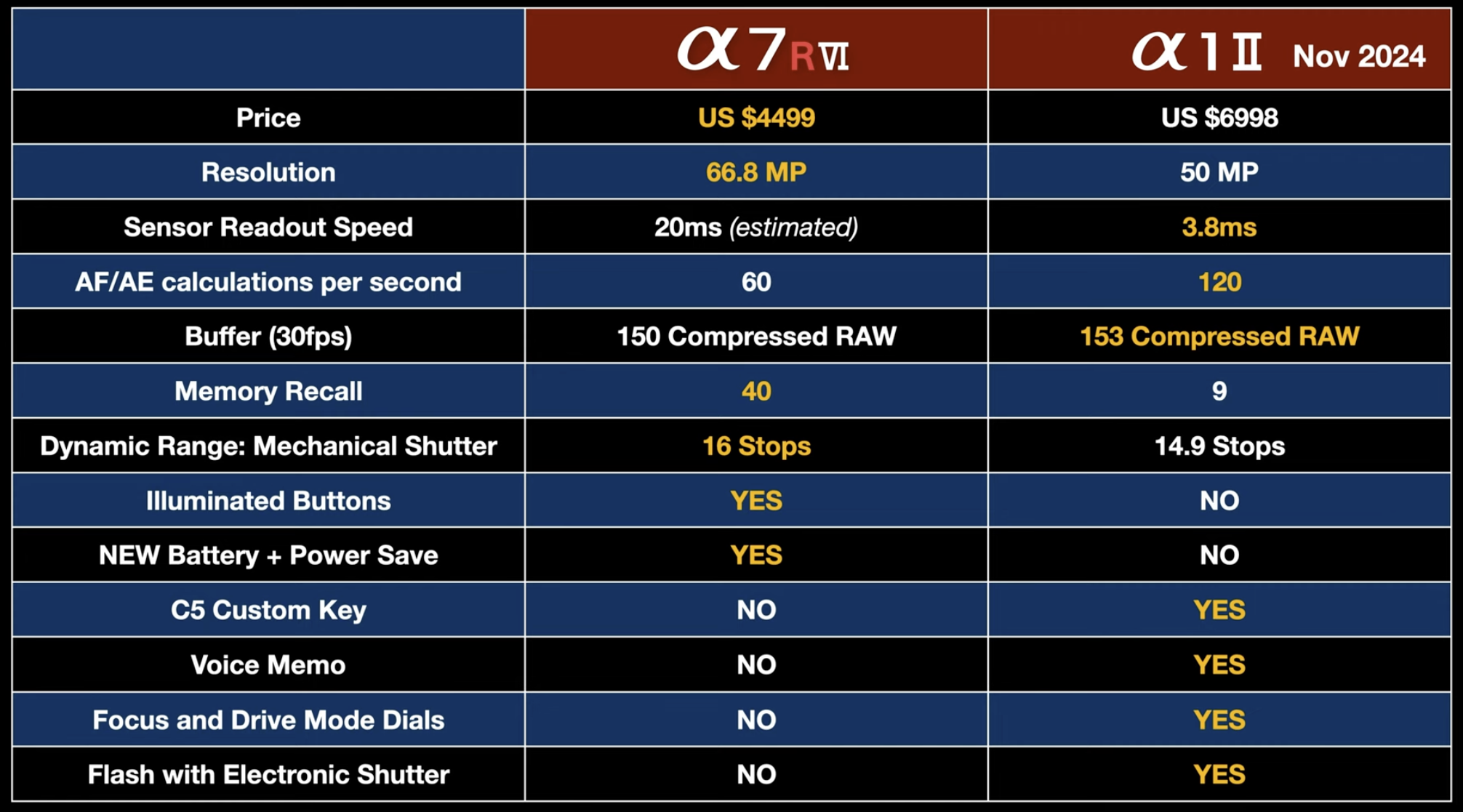
i didn't have any trouble at all this morning - used Fred's link, watched the video while i waited for BH to make the product available and already ordered. Unfortunately, it won't make it in time for my trip to Sicily next wk, oh well.
p.2 #5 · Official: Sony A7RVI and Sony FE 100-400mm f/4.5 GM OSS
Fred Miranda wrote:
Anyone excited about the possibility of an A7CR II inheriting some of these features, similar to what Sony did when they brought many of the A7RV’s capabilities into the A7CR?
It would be amazing if some of the features trickled down to a7CR II, however, in my case, I use my a7CR for family pictures and travel, and for those, the current capabilities of this camera is plenty enough. That definitely does not mean that I am not interested in features trickling down in the next version.
p.2 #10 · Official: Sony A7RVI and Sony FE 100-400mm f/4.5 GM OSS
Really like the new battery design, could lead to even a smaller A7CRiii or more battery life in upcoming compacts. So I guess A7R6 is first to lead the new gen of Alphas.
p.2 #12 · Official: Sony A7RVI and Sony FE 100-400mm f/4.5 GM OSS
Depending on how you look at it, it can be considered a nice upgrade to A7r v or not. Let's compared it to Canon r5 mark ii.
Advantages:
- Better dynamic range. Whether the difference is marginal or significant is to be seen.
- Better EVF
There may some some other marginal advantages.
In most other aspects, A7r vi is either just on par with the now 2-year-old Canon R5 ii or still noticeably lagging behind. The most important shortcomings are related to the video specifications.
Don't get me wrong. It is a fine camera and the fact that the price hasn't risen up much compared to A7r v is nice. However note it is priced at US$4500 while the Canon is currently priced at US$3900 yet the Canon can be overall a better camera depending on the user specific usage.
Here is a dilemma with Sony. They seem to be overly focused on certain aspects of photography (and video) that sometimes they come across as if they are neglecting or ignoring other aspects. As a result nowadays, sometimes they come across as if they are just playing catch-up with Canon and Nikon and even then, they are not doing a good job of it.
This is not new. Remember how long it took them to add features such as touch interface, intervalometer and a few other ones. They are coming out little by little addition of touch interface in each new camera release as if it was the century challenge of engineering to them!
Now, they are running the same game with video specification: so little by little enhancing the video specifications while Canon, Nikon and Panasonic are already miles ahead in their same level camera.
I have the impression that adding their stacked/ semi-stacked sensor which improves the camera readout speed and fps, is just forced upon them by the competition as if it was up to them, they would have rather kept it only for their top tire level models such as A1 and A9 series.
Don't get me wrong, I am not dismissing A7r vi by any means. This is only meant to explain my impression or understanding of Sony's attitude towards their camera generation upgrades. I do believe that at the end, this is costing them some market loss to the competition even if it may not be noticeable right away.
p.2 #13 · Official: Sony A7RVI and Sony FE 100-400mm f/4.5 GM OSS
I am not disappointed at all with this however I am also not compelled to rush out and buy it. I do want to change my cameras soon but these upgrades are not going to really change my photos. I have always been an early adopter but more and more i am learning to relax and see how things pan out. I have the 3 body problem right now with one being relegated to landscape one do it all and one compact street. That will have to change and this may combine two of those but..... no rush.
"The heart of the a7R VI is a new, 66.8MP Stacked CMOS sensor. Unlike the sensors in Sony's previous high-end bodies, the second layer of the sensor isn't DRAM memory, to buffer the data coming off the sensor, instead it's described as a processing layer.
Noticeably, this means that the full sensor readout speed is slower than in the likes of the sports-focused a1 II; instead, it's able to combine the output of its two conversion gain modes, using both the low noise and high capacity modes to give wider dynamic range.
The net result is a sensor that's much faster than its predecessor (around 5.6x quicker than the a7R V, according to Sony) but with better dynamic range. This should significantly expand the range of photographic situations the a7R VI can lend itself to, without a negative impact on the areas where the a7R V already performed well.
As for autofocus and handling, the differences between the a7R VI, Z8 and EOS R5 II will all come down to your preferences and use cases (eg, whether you like a top-panel display, need illuminated buttons or both). All three cameras will outperform each other in different scenarios, and some people will prefer one camera's way of doing things over the others. Autofocus was the main area where we found the S1RII fell behind this extremely capable competition, especially in terms of tracking reliability, but it offers a less expensive route to resolution if action isn't a regular feature of your photography.
The one major callout for the a7R VI is its rolling shutter speeds in its e-shutter modes; while it uses a Stacked sensor like the Z8 and EOS R5 II, it's the slowest of the kind we've seen. This means rolling shutter will put an upper limit on how fast the action it can follow is.
The a7R VI isn't as quick in practice as the Nikon Z8 or Canon EOS R5 II, but instead it offers higher resolution, excellent DR, a very customizable, multi-dial interface and by far the best battery life in class. There are plenty of people for whom that will (and should) matter a whole lot more than some of the menu phrasing needing another round of localization.
Anyone hoping for a cut-price a1 II will find themselves disappointed: you can definitely feel the limitations as you push towards the outer edge of what the camera promises to do. But, then again, it promises to do an awful lot, and it brings its image quality excellence to a much broader range of applications than previous a7R models could."
p.2 #15 · Official: Sony A7RVI and Sony FE 100-400mm f/4.5 GM OSS
Does anyone have an authoriative source on the sensor readout speed? It has been reported as between 5 and 10 ms, but that is a signficant range of possibilties.
p.2 #16 · Official: Sony A7RVI and Sony FE 100-400mm f/4.5 GM OSS
eriet30 wrote:
I am not disappointed at all with this however I am also not compelled to rush out and buy it. I do want to change my cameras soon but these upgrades are not going to really change my photos. I have always been an early adopter but more and more i am learning to relax and see how things pan out. I have the 3 body problem right now with one being relegated to landscape one do it all and one compact street. That will have to change and this may combine two of those but..... no rush.
I think a lot of photographers are in this boat. Less incentive to upgrade to another Sony camera as the upgrades don't personally do anything that will impact my own photography. Even upgraded lenses...85GM proved to not really be an upgrade for me personally.
This is the rationale behind the price increases tbh. I used to follow Sony's financials and the long-term strategy in one of their filings a few years back was literally to off-set lower unit volumes by increasing margins on "prosumer" offerings. I forget the language exactly but they are less interesting in stealing market-share these days as they are getting higher margins on their captive customers.
p.2 #17 · Official: Sony A7RVI and Sony FE 100-400mm f/4.5 GM OSS
I will stay with Nikon... Nice camera but not impressed.
And if I have to replace my 8 batteries (+$1000) and CfExpress A cards ( $1500) ...This will cost my $7000 just for a camera
Maybe Nikon will release similar Z7 III for $3500-3800
p.2 #18 · Official: Sony A7RVI and Sony FE 100-400mm f/4.5 GM OSS
Looks like a great camera for the money, I can’t find the following from Sony’s publications
- sensor readout time
- buffer depth at full shooting speed
- the finder now only offers 120Hz or it also has 60Hz and 240Hz modes like the A1 series? Is there the same resolution trade off?


 ...
...