chrswlch wrote:
Greetings folks. Has anyone found a solution for the difference in color between the EVF and LCD on this camera?
The viewfinder color adjustment slider that Sony provides is too rudimentary to get them to be a close match.
I’ve checked several A7RVI bodies and this seems to be a fairly universal quirk. Must come down to a difference in components/calibration.
It does leave me to wonder which of the two is more “accurate,” though I’d imagine that’s surely the EVF.
Anyway, hope it’s something they eventually patch in firmware. This is my first Sony body; does something like this usually get resolved?
Stellar camera, otherwise, as many of you seem to agree with. ...Show more →
I’m a bit confused. When you are looking for accuracy.. Does this mean that you shoot JPG and want to make sure that the JPG color rendition is acceptable. I’ve never relied upon any cameras EVF, or LCD to provide accurate colors, because I just don’t care. What I want is consistent color and a color balance setting that I can rely upon in the environment that I’m in and generally I know this from past experience. Sittting down in post all these things are settled, so wanting JPG is the only reason I can think of to want “accurate” colors.
bwcolor wrote:
I’ve never relied upon any cameras EVF, or LCD to provide accurate colors, because I just don’t care. What I want is consistent color and a color balance setting that I can rely upon in the environment that I’m in and generally I know this from past experience. Sittting down in post all these things are settled, so wanting JPG is the only reason I can think of to want “accurate” colors.
Same.
I would not use the viewfinder or the LCD to judge scene colors. (I also would not use the optical display of a DSLR to make those judgments.) For me the viewfinder is a place to work out a composition, perhaps time the initiation of the exposure, keep an eye on what is happening in the frame (unless I’m on the tripod, in which case I just look right at the scene), check various settings and readouts (focus, histogram, etc.).
My goal is to capture the most useful image data in the exposure, and the exposure may often not really look like the scene did.
I supppose that I can understand why one might want the screen to somewhat accurately represent what the in-camera jpg will look like, but beyond that it isn’t all that important to me.
I would not use the viewfinder or the LCD to judge scene colors. (I also would not use the optical display of a DSLR to make those judgments.) For me the viewfinder is a place to work out a composition, perhaps time the initiation of the exposure, keep an eye on what is happening in the frame (unless I’m on the tripod, in which case I just look right at the scene), check various settings and readouts (focus, histogram, etc.).
My goal is to capture the most useful image data in the exposure, and the exposure may often not really look like the scene did.
I supppose that I can understand why one might want the screen to somewhat accurately represent what the in-camera jpg will look like, but beyond that it isn’t all that important to me....Show more →
I never did either. But the counter point is with the A7R6 EVF, it's so good you can judge color and exposure. Incredible really.
I never use the a7RVI EVF to judge accurate color nor exposure.
Outside the ambien lighting is uncontrolled so the eye/brain are always autoadjusting. The histograms have some general value, but don't work in all exposure modes. The Zebroids are good for some purposes.
BigBabyMoses06 wrote:
It's almost 2027, and we still can't use the rear screen or EVF on our $4,500 camera to get real accurate representations of color and exposure... 😭
What you can do is setup your EVF to provide an HDR image. This is an improvement over what we had previously. The LCD should have been upgraded, but it wasn’t.
Some of us go through a good bit of effort with regards to ambient lighting and repeated calibration of our monitors to provide a color standard in our post work. So, to have color accurate EVF/LCD, wouldn’t you need some equivalent process and environment? Do some camera manufacturers make claims regarding color accuracy of EVF and LCD? I know that Hasselblad is proud of their X2D2 LCD and they make marketing claims regarding capturing accurate colors.
* I have astigmatism on both eyes but more on my left.
* when I compare my left eye vision with right eye vision I can clearly see that my left eye presents color much cooler than my right eye.
* So when looking with both eyes I get something between.
so the only thing I can do is to edit my photos the way I like them if they are off in color temp I wouldn't know.
EB-1 wrote:
I never use the a7RVI EVF to judge accurate color nor exposure.
Outside the ambien lighting is uncontrolled so the eye/brain are always autoadjusting. The histograms have some general value, but don't work in all exposure modes. The Zebroids are good for some purposes.
A more nuanced explanation of my thinking about EVFs and LCD displays and color is that while they don’t (for a bunch of reasons of reasons) show us “accurate” color we can use them to make useful judgments about color, especially relative to exposure decisions.
For example, while I don’t believe that they would show me accurate color in situations such as colorful sunsets (that’s really problematic) of with autumn foliage I can make useful judgments about color by what I see in the display. For example, I recognize (at least on the camera I’ve used for a decade and another one that I’ve used for a few years) when colorful highlights are likely to blow out the red color channel — the color in those areas shifts in a particular manner.
In a way, the concept of accurate color in an electronic display is fundamentally problematic, and for several reasons. Think about the following:
1. In low light our vision becomes less sensitive to color, but a camera does not. Should an accurate electronic display mimic this characteristic of human vision and suppress colors in low light situations?
2. We respond differently to a scene when we view it in person, as a print, or as an electronic display. In person our eyes adapt dynamically to local luminosity variations within the scene — looking into a shaded area our eyes dilate for example, and our focus adjusts as we move between near and far elements of the scene. That does’t really happen when we look at a print with its much more limited dynamic range a a predetermined focus — or expanded DOF. An electronic display looks different that a top-illuminated print — as one friend likes to say, it seems to glow from within. It can never literally look the same as a print or the real world.
3. Frequently, at least for some of us who shoot raw and think more about the image data we are capturing than about a SOOC image, our exposure choices would — and should! — produce an image in an electronic viewfinder or LCD that look very different from the image we intend to create. An obvious example — as in a sample I shared recently — is scenes with extremely bright highlights and dark shadows. Unless we want to blow out those highlights we are likely to “underexpose” (by which I mean correctly expose!) the scene to protect those highlights while planning to lift the shadows in post. What should the display show us here — the very dark and dim image that we intend to capture or some approximation of the real scene in front of us.
I’m all for making electronic displays more closely reflect what we might capture in a photograph to the extent that this is possible — but that extent is quite limited.
In the end, just as we did with film, we have to develop an ability to predict what the final image will look like.
An exception may well be for those who do in-camera jpg capture rather than working with the raw file. Here it probably is useful to get some decent idea of what that jpg may look like as a screen presentation… which is probably why we’re familiar with situations in which the camera’s display is based on the jpg settings.
I would agree I don’t use the evf to decide exposure, but the way I have it set up on the R6 it alerts me to a potential problem. One of the modes I occasionally shoot in is M with auto ISO in a fairly narrow range. Here the evf can alert me if I wander outside my chosen ISO range with my current manual shutter and aperture set — and this camera does that quite effectively.
The other thing it does is offer remarkably clean low light detail, a definite plus.
I would also add that any tech notably better than its predecessor usually becomes more appreciated as we learn to better utilize it.
biggles2002 wrote:
Well are you sure your eyes work 100% ?
* I have astigmatism on both eyes but more on my left.
* when I compare my left eye vision with right eye vision I can clearly see that my left eye presents color much cooler than my right eye.
* So when looking with both eyes I get something between.
so the only thing I can do is to edit my photos the way I like them if they are off in color temp I wouldn't know.
No, unfortunately they do not lol. I've never heard or read anyone else talk about that eye temp difference before tho! I have the same exact thing. Forget which eye has a stiggy tho. It's tricky, thankfully I finally bought a good monitor and calibration software/tools, so even when my eyes/brain is yelling at me that the colors are off, I can usually ignore it now.
gdanmitchell wrote:
A more nuanced explanation of my thinking about EVFs and LCD displays and color is that while they don’t (for a bunch of reasons of reasons) show us “accurate” color we can use them to make useful judgments about color, especially relative to exposure decisions.
For example, while I don’t believe that they would show me accurate color in situations such as colorful sunsets (that’s really problematic) of with autumn foliage I can make useful judgments about color by what I see in the display. For example, I recognize (at least on the camera I’ve used for a decade and another one that I’ve used for a few years) when colorful highlights are likely to blow out the red color channel — the color in those areas shifts in a particular manner.
In a way, the concept of accurate color in an electronic display is fundamentally problematic, and for several reasons. Think about the following:
1. In low light our vision becomes less sensitive to color, but a camera does not. Should an accurate electronic display mimic this characteristic of human vision and suppress colors in low light situations?
2. We respond differently to a scene when we view it in person, as a print, or as an electronic display. In person our eyes adapt dynamically to local luminosity variations within the scene — looking into a shaded area our eyes dilate for example, and our focus adjusts as we move between near and far elements of the scene. That does’t really happen when we look at a print with its much more limited dynamic range a a predetermined focus — or expanded DOF. An electronic display looks different that a top-illuminated print — as one friend likes to say, it seems to glow from within. It can never literally look the same as a print or the real world.
3. Frequently, at least for some of us who shoot raw and think more about the image data we are capturing than about a SOOC image, our exposure choices would — and should! — produce an image in an electronic viewfinder or LCD that look very different from the image we intend to create. An obvious example — as in a sample I shared recently — is scenes with extremely bright highlights and dark shadows. Unless we want to blow out those highlights we are likely to “underexpose” (by which I mean correctly expose!) the scene to protect those highlights while planning to lift the shadows in post. What should the display show us here — the very dark and dim image that we intend to capture or some approximation of the real scene in front of us.
I’m all for making electronic displays more closely reflect what we might capture in a photograph to the extent that this is possible — but that extent is quite limited.
In the end, just as we did with film, we have to develop an ability to predict what the final image will look like.
An exception may well be for those who do in-camera jpg capture rather than working with the raw file. Here it probably is useful to get some decent idea of what that jpg may look like as a screen presentation… which is probably why we’re familiar with situations in which the camera’s display is based on the jpg settings.
Since you are not shooting (yet) with a Sony camera, you will find underexposing shadows to preserve highlights is handled quite well by the "meter for highlights" feature. I have been using this 8 years or so across multiple generations of Sony bodies and have learned to trust it implicitly. Except last year, I stupidly tried to second guess the metering just once on a slot canyon hike by relying on the EVF and discovered I had about 1.5-2 stops of highlight headroom in post - whew!
Newenglandrocks wrote:
Since you are not shooting (yet) with a Sony camera, you will find underexposing shadows to preserve highlights is handled quite well by the "meter for highlights" feature. I have been using this 8 years or so across multiple generations of Sony bodies and have learned to trust it implicitly. Except last year, I stupidly tried to second guess the metering just once on a slot canyon hike by relying on the EVF and discovered I had about 1.5-2 stops of highlight headroom in post - whew!
>>"meter for highlights" feature<<
Thank you for pointing this out. I automatically went to "multi" since that's what I've used forever, and never bothered to cycle through the other meter pattern options, so never even knew it was a thing.
Newenglandrocks wrote:
Since you are not shooting (yet) with a Sony camera, you will find underexposing shadows to preserve highlights is handled quite well by the "meter for highlights" feature. I have been using this 8 years or so across multiple generations of Sony bodies and have learned to trust it implicitly. Except last year, I stupidly tried to second guess the metering just once on a slot canyon hike by relying on the EVF and discovered I had about 1.5-2 stops of highlight headroom in post - whew!
Thanks, I too never new about this mode, it sounds good
Newenglandrocks wrote:
Since you are not shooting (yet) with a Sony camera, you will find underexposing shadows to preserve highlights is handled quite well by the "meter for highlights" feature. I have been using this 8 years or so across multiple generations of Sony bodies and have learned to trust it implicitly. Except last year, I stupidly tried to second guess the metering just once on a slot canyon hike by relying on the EVF and discovered I had about 1.5-2 stops of highlight headroom in post - whew!
BigBabyMoses06 wrote:
It's almost 2027, and we still can't use the rear screen or EVF on our $4,500 camera to get real accurate representations of color and exposure... 😭
BigBabyMoses06 wrote:
It's almost 2027, and we still can't use the rear screen or EVF on our $4,500 camera to get real accurate representations of color and exposure... 😭
Really…you’d use the rear screen in the field to judge exposure and colour.
Absolutely. Why not? Why shouldn't one be able to do that? What if I have the camera in a position where I cant view the EVF? Even when you can, the EVF isn't perfect. The screen should be a much higher priority for Sony.
I REALLY want a button/setting I can program that toggles the jpeg preview on and off so I can get a clear idea of how I'll be able to pull the file in different directions.
Mind you, I almost exclusively shoot with off camera flash. It's just a bit silly to me that one can't really judge exposure better than we are currently able to, on the rear screen. I can't even show my clients the back of the screen when we're outside. It's less as much about the color (tho why not?) and more about exposure for me. For on the fly fast paced portrait or media day sessions, using the histogram is pretty much worthless for me. For one, I need to be judging my subjects exposure as accurately as possible, especially their face/skin and not just the overall scene which often has bright backgrounds. Zebras can help in some instances.
Anyway, I still love the camera, even with my dust speck under the sensor glass, and the old rear screen
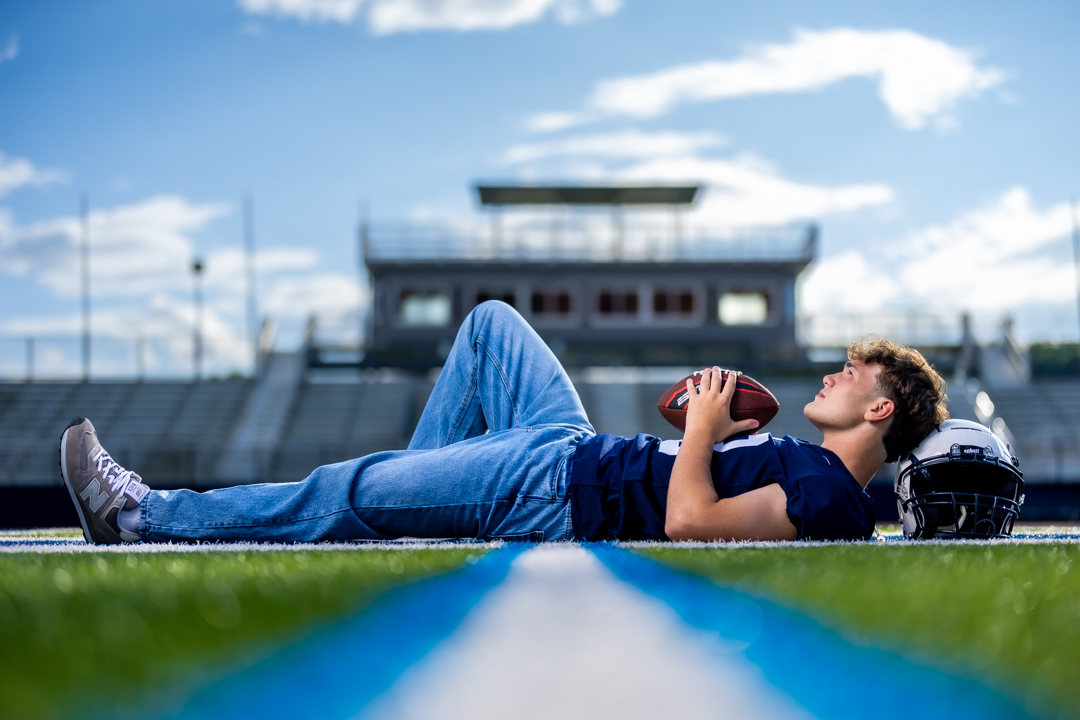
Here are a few pieces of my recent work with it, and the 50 1.2 or 20-70.
ILCE-7RM6FE 50mm F1.2 GM lens50mmf/1.21/8000s100 ISO0.0 EV
Entering diffraction for sure at F13, but I wasn't sure what they wanted to do for a team photo before I got there, and didn't have time to experiment with a lower f-stop. The F13 V formation was at 33mm.
duncangr wrote:
Nice work !
Whats that spec I see though... ?
Just kidding
What f-stop did you use for the first and last images to get everyone in focus ?