Ross Martin wrote:
This data is for mechanical shutter. Bill has not yet added measurements for ES. The new dual gain optimization only works in mechanical shutter mode (at least for stills), so the ES measurements will not be as high. The biggest difference will be below the 2nd gain ISO.
I'm just hoping the noise from 800-3200 ISO is not worse between the a7rV in MS and a7rVI in ES.
I did not order the a7rVI mainly to use in MS. The a7rV sensor was like Jell-O so ES was not feasible.
old-gregg wrote:
In recent times Sony cameras did not suffer from any extra read noise in their ES implementations, stacked or not, as evidenced by A1 and A7RV each having the same DR regardless of the shutter setting. The 0.6EV gap is not a noise penalty, but a pure bonus offered by DGO. I expect the A7RVI ES DR to be a touch higher than A7RV's.
The only way the 0.6EV gap is not a noise penalty is if the A7M4's MS has 0.6EV more PDR /DR than the A7M4's ES. Do you have a reference demonstrating that is the case?
snapsy wrote:
The only way the 0.6EV gap is not a noise penalty is if the A7M4's MS has 0.6EV more PDR /DR than the A7M4's ES.
Nope. It's not "the only way". I already demonstrated the absence of noise penalty using another Sony body with ES+MS on a stacked sensor, the A1. It delivers the same DR/SNR regardless of the shutter type. Sony R&D clearly knows how to stack two layouts without adding extra noise, and I fully expect the A7RVI to follow this trend.
old-gregg wrote:
Nope. It's not "the only way". I already demonstrated the absence of noise penalty using another Sony body with ES+MS on a stacked sensor, the A1. It delivers the same DR regardless of the shutter type. I fully expect the A7RVI to follow this trend.
And all the DRAM-less partially-stacked sensors I've tested have a DR penalty so the fact the A1 doesn't exhibit the penalty is nowhere near dispositive. Also, the A1 shares the same core sensor IP as the Z8/Z9, based on their identical resolution-normalized readout speeds - the Z8/Z9 have the penalty, so I would need to measure the A1 myself before I would accept the absence of NR not being behind it (previous analytical tests have missed NR/DGO on other sensors).
snapsy wrote:
And all the DRAM-less partially-stacked sensors I've tested have a DR penalty so the fact the A1 doesn't exhibit the penalty is nowhere near dispositive. Also, the A1 shares the same core sensor IP as the Z8/Z9, based on their identical resolution-normalized readout speeds - the Z8/Z9 have the penalty, so I would need to measure the A1 myself before I would accept the absence of NR not being behind it (previous analytical tests have missed NR/DGO on other sensors).
snapsy wrote:
I would need to measure the A1 myself before I would accept the absence of NR not being behind it (previous analytical tests have missed NR/DGO on other sensors).
Please do. I never had any reason not to trust Bill, and his measurements show almost no difference between ES and MS on the A1 II.
I’m hoping the same thing. I am ok with a7rv levels of DR with the es as I will be shooting that almost exclusively.
EB-1 wrote:
I'm just hoping the noise from 800-3200 ISO is not worse between the a7rV in MS and a7rVI in ES.
I did not order the a7rVI mainly to use in MS. The a7rV sensor was like Jell-O so ES was not feasible.
As another data point: The dealer where I ordered my A7R6 does not yet have additional batteries or accessories in stock, but today I ordered from B&H an extra NP-SA100 battery which showed not yet available on their website and it has already shipped and will be here Friday. I also ordered the VG-C6 Vertical Grip but B&H still shows that backordered.
joychris wrote:
Canon has raw because of an agreement to license the RF mount for the Komodo. Nikon has raw because it acquired Red. Everyone else is stuck with Braw or licensing Prores - which itself required a license from Red to even allow it to exist after Apple backed down from its challenge to Red's patents. Canon raw will likely go away once that agreement expires unless Nikon is willing to license it, but my bet is they won't. If Red didn't agree to any of this, nobody would have internal compressed raw other than Red and Braw or some old Cinema DNG like the OG Pocket.
But that's beside the point - Raw is not processor intensive as demonstrated by an 18-year-old camera that can record raw in the 5d2 - especially compared to 10-bit h265. Compressing all of that raw data in real time requires an incredible amount of processing. Canon's processors can't handle it, all of its oversampled 4k modes cause rampant overheating. Most have a varying degree of noise reduction as well. Just look at how bad Nikon's own h265 is with the Zr and Z6III. It's comical to think Sony cameras lack the power to do raw video when its h265 absolutely crushes Nikon's - especially with the Zr and Z6III. It's just a licensing issue - they're not paying for one.
Yep and clearly most of the world doesn't care for it. It's completely unnecessary. If you're doing serious shooting you will use an attached solution to record your raw anyway. It's not like people have flocked to Nikon to get in-camera raw video. For the majority of the world it's taxing from a file storage and editing standpoint, and totally unnecessary for the way most video shooters work. If you're a pro who can really leverage raw you have much better solutions than in-camera raw shooting.
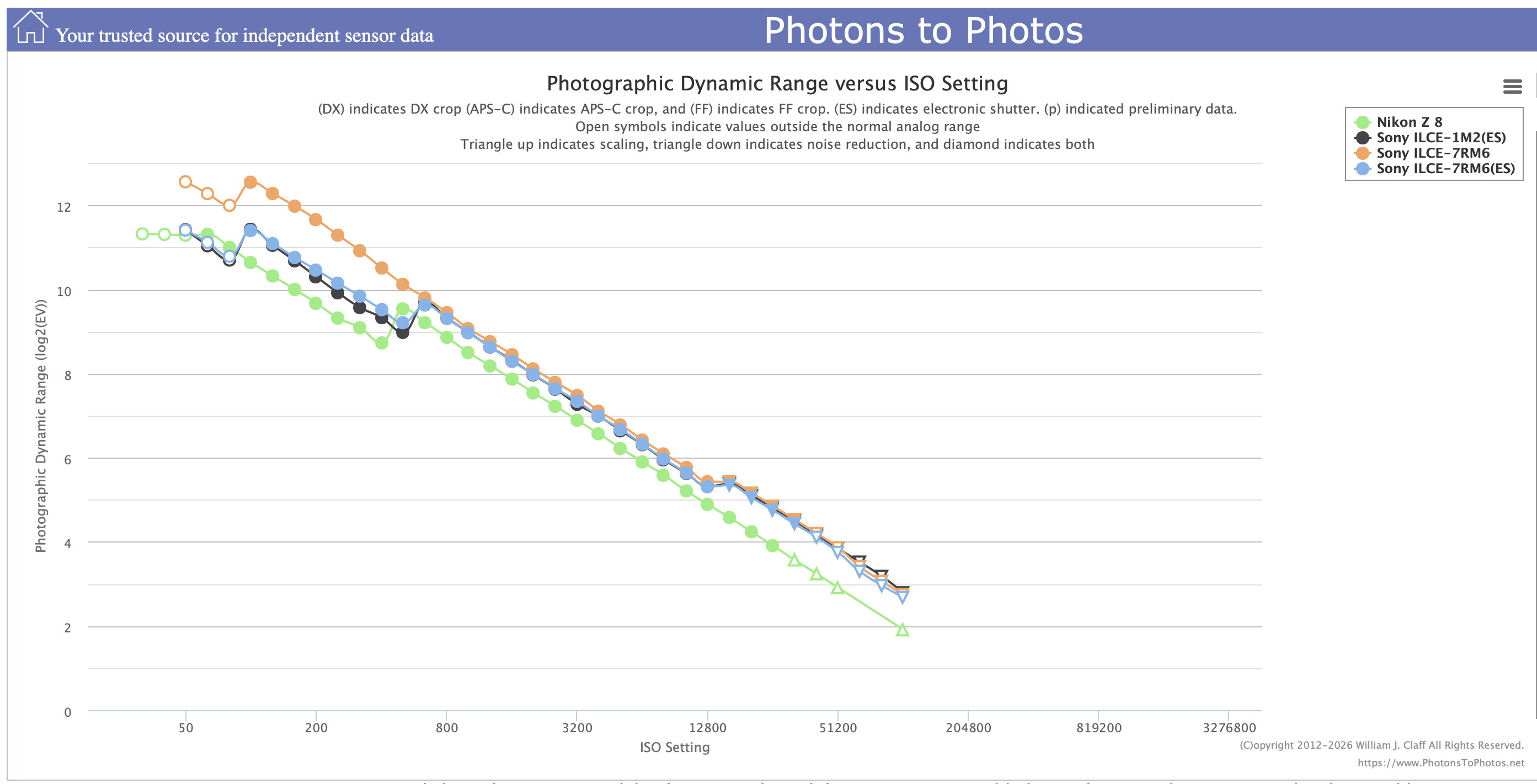
In the DR the a7rVI ES is just slightly better than the a7rV (MS) at high ISO, but all three are quite close at high ISO. As expected the a7rVI low ISO loses a lot of DR in ES. It's interesting that the a7rV high gain starts at ISO 320 as compared to the a7rVI which starts at ISO 640.
In the DR the a7rVI ES is just slightly better than the a7rV (MS) at high ISO, but all three are quite close at high ISO. As expected the a7rVI low ISO loses a lot of DR in ES. It's interesting that the a7rV high gain starts at ISO 320 as compared to the a7rVI which starts at ISO 640.
EBH
Yes, I know that data is for the A7x not the A7Rx. The discussion was about the source of the 0.6 difference in PDR with the ES in the A7x cameras.
Ross Martin wrote:
Electronic shutter DR measurement is now up, virtually identical to A1II.
Here's the comparison of the a7rVI ES to the a7rV MS, which establishes whether or not the A7RM6 incurs a noise penalty for its stacked sensor. I also include the a7rVI MS to show the DGO improvement.
PDR: a7rVI MS 12.55EV vs a7rVI ES 11.40EV vs a7rV MS 11.69EV: noise penalty = 0.29EV
Input-referred read noise: a7rVI MS 0.59 e-(log2) vs a7rVI ES 1.44 e-(log2) vs a7rV MS 1.77 e-(log2): noise penalty = none, noise reduction of 0.33 e-(log2)
This is a bit puzzling - the a7rVI ES PDR shows a 0.29EV penalty vs a7rV MS, yet shows a 0.33 e-(log2) input-referred noise reduction. I would say the PDR "penalty" is within the margin of measurement error (ie no penalty), while the input-referred read noise "penalty" shows an actual a7rVI improvement of 0.33 e-(log2).
On balance I would say this indicates the a7rVI has no stacked-sensor noise penalty vs the a7rV. Having an ES measurement for the a7rV would be helpful though to make it more definitive.
It's noteworthy that the dual-conversion gain (DCG) switchover point changed. On the a7rV it was ISO 320, on the a7rVI it's ISO 640.