fredmiranda.com
Login

Moderated by: Fred Miranda
  New fredmiranda.com Mobile Site
  New Feature: SMS Notification alert
  New Feature: Buy & Sell Watchlist
  

FM Forums | Sony Forum | Join Upload & Sell

1       2       3              42              44              60       61       end
  

Sony A7RVI


jojib
Offline
• • •
Upload & Sell: Off
p.43 #1 · Sony A7RVI


EB-1 wrote:
Battery grips are too heavy at this point, especially at higher altitudes, not to mention on aircraft with all the other limitations.
I'd rather have a slightly larger body with just slightly greater weight than have to add a grip that is much larger and heavier. The a7rVI has the ~25% greater capacity battery and in ES I'm expecting quite high frame counts per battery. But I already had to spend an extra $400 on a charger and two batteries. Three batteries should be more than enough for one day of stills without needing a grip. I'm sure the video folks
...Show more

Yeah that makes sense. I shoot mostly portraiture thus the vertical grip is very helpful.


May 22, 2026 at 08:02 PM
rico
Online
• • • • •
Upload & Sell: Off
p.43 #2 · Sony A7RVI


EB-1 wrote:
Battery grips are too heavy at this point, ...

I was a grip junkie going back to the Contax RTS III and continuing with 1Ds, D3X, and D4. The add-on grips I attached to the D300, D500 and A7ii. Lately, the weight seems more hassle than the benefit (pinkie finger demands), so my Z6 and A1 have the base plate only: partly to extend the grip a little and partly for the A/S rail.


May 22, 2026 at 08:59 PM
EB-1
Offline
• • • • • • •
Upload & Sell: Off
p.43 #3 · Sony A7RVI


The Smallrigs for the a7rV is very nice and has a clever swing out part that allows for battery removal.
I hope they make one for the a7rVI, but who knows how long that takes.
Wish I had some skills with the 5D plastic printing machines. We could at least have something cranked out in the early times after new camera release.

EBH


May 22, 2026 at 09:33 PM
Ilumo
Offline

Upload & Sell: Off
p.43 #4 · Sony A7RVI


Do you know if the small rig for the a7R5 will fit the 6? I have the cage and all of the accessories and would love to reuse it. I just sold my a7R5 body.

EB-1 wrote:
The Smallrigs for the a7rV is very nice and has a clever swing out part that allows for battery removal.
I hope they make one for the a7rVI, but who knows how long that takes.
Wish I had some skills with the 5D plastic printing machines. We could at least have something cranked out in the early times after new camera release.

EBH


May 23, 2026 at 01:46 PM
EB-1
Offline
• • • • • • •
Upload & Sell: Off
p.43 #5 · Sony A7RVI


I don't know, just being a consumer in line for an eventual delivery this summer. Even if it is close to a decent contour, the battery is different so you probably won't be able to remove and replace it.

EBH


May 23, 2026 at 03:40 PM
Ulysseita
Offline
• •
Upload & Sell: On
p.43 #6 · Sony A7RVI


Tested one today. I am copying below what I wrote on another forum, translated into English.

Please keep in mind that the handling part is only a first impression, not a full field review. The colour comment at the end, however, comes from my own calibration / measurement workflow, so that part is based on actual measurements rather than just looking at files.

Today I had the new, rather well-fed Sony A7R VI in my hands for the first time.

Obviously I did not have the chance to test it properly, and I certainly did not do a real photographic session with it. But I can already say that, if this camera had existed earlier, I probably would have thought twice before buying the monster called the A1 II.

In the hand they feel very similar. The new A7R VI is even larger, but weighs only a little less than the A1 II. The viewfinder feels basically in the same class to me: one may have better refresh options, the other a better OLED, but in practical use they are very close.

The battery is huge compared with the older generations. The menus are the usual modern Sony menus. What you miss are the extra controls of the A1 II, and once you get used to the A1 / A9 level bodies, it is honestly hard to go back to the lower-tier layout.

I tested it briefly with the electronic shutter.

Yes, the shooting experience feels very close to the A1 family: instant, pleasant, and honestly excellent for probably 90% of the people who will use it. For the remaining 10%, you already know why the A1 / A9 bodies exist.

And this is exactly the point behind my opening comment.

While keeping a high-resolution sensor, you no longer have that lag, shutter shock, or slightly hesitant shooting feel that can affect high-resolution bodies. The act of taking the picture becomes very A1-like: fluid, smooth, precise, without that sense of mechanical or electronic interference between you and the shot.

To be clear, I did not test whether the AF update rate, which is obviously not at A1 II level, makes a real difference in more demanding use. This was only a short handling and shooting impression. But the shooting feedback itself is excellent.

What surprised me when opening the files — Camera Raw only for now — was the white balance and exposure. They looked almost futuristic compared with the other cameras I had beside it during the quick test.

Of course, when working with RAW files this is not magic, since you can adjust everything afterwards. But it does look as if something has changed there, especially in the metering. It seems much more precise than previous bodies, and honestly I had read about this even though many people probably considered it one of the less important updates.

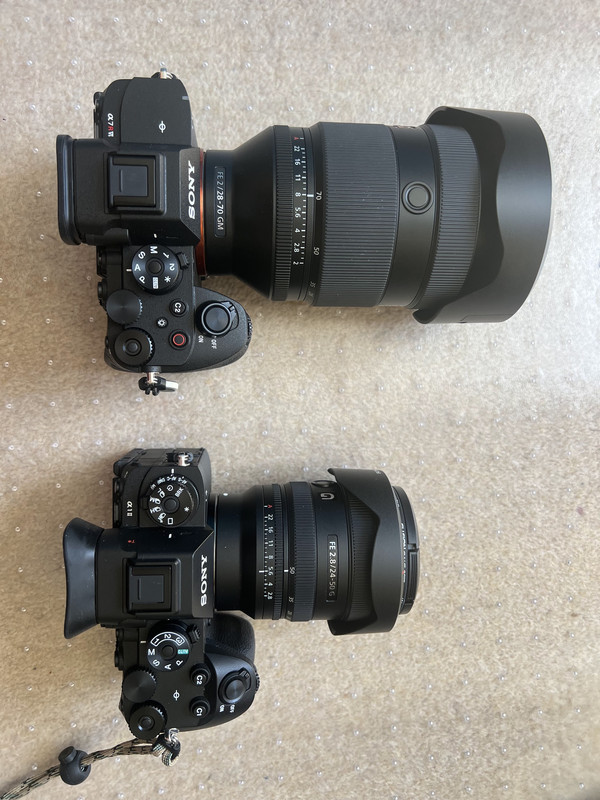
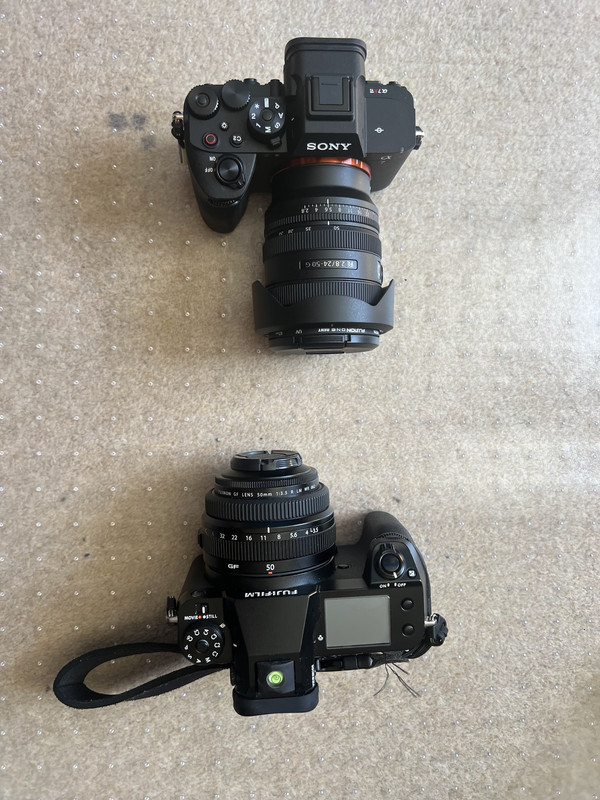
Here it is next to its big sister and its medium-format relative.


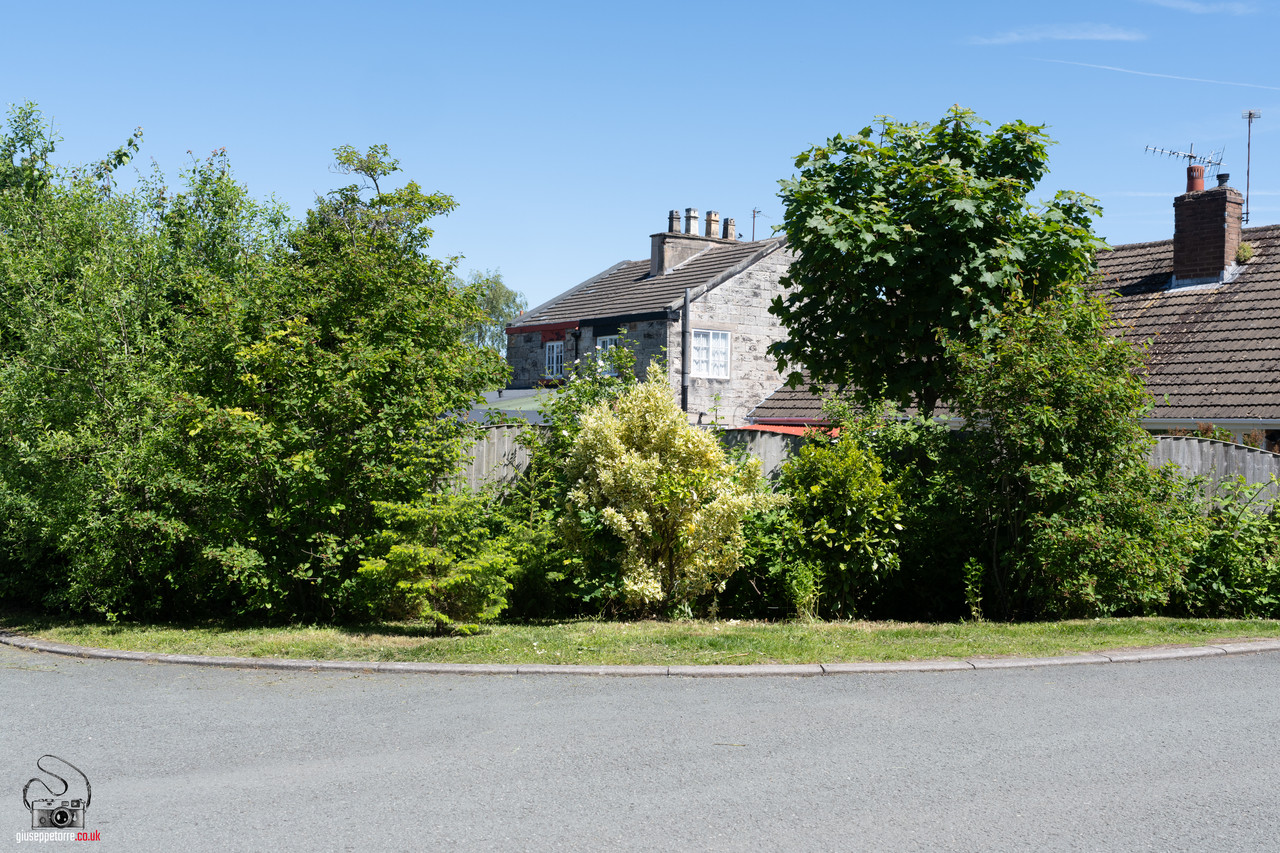
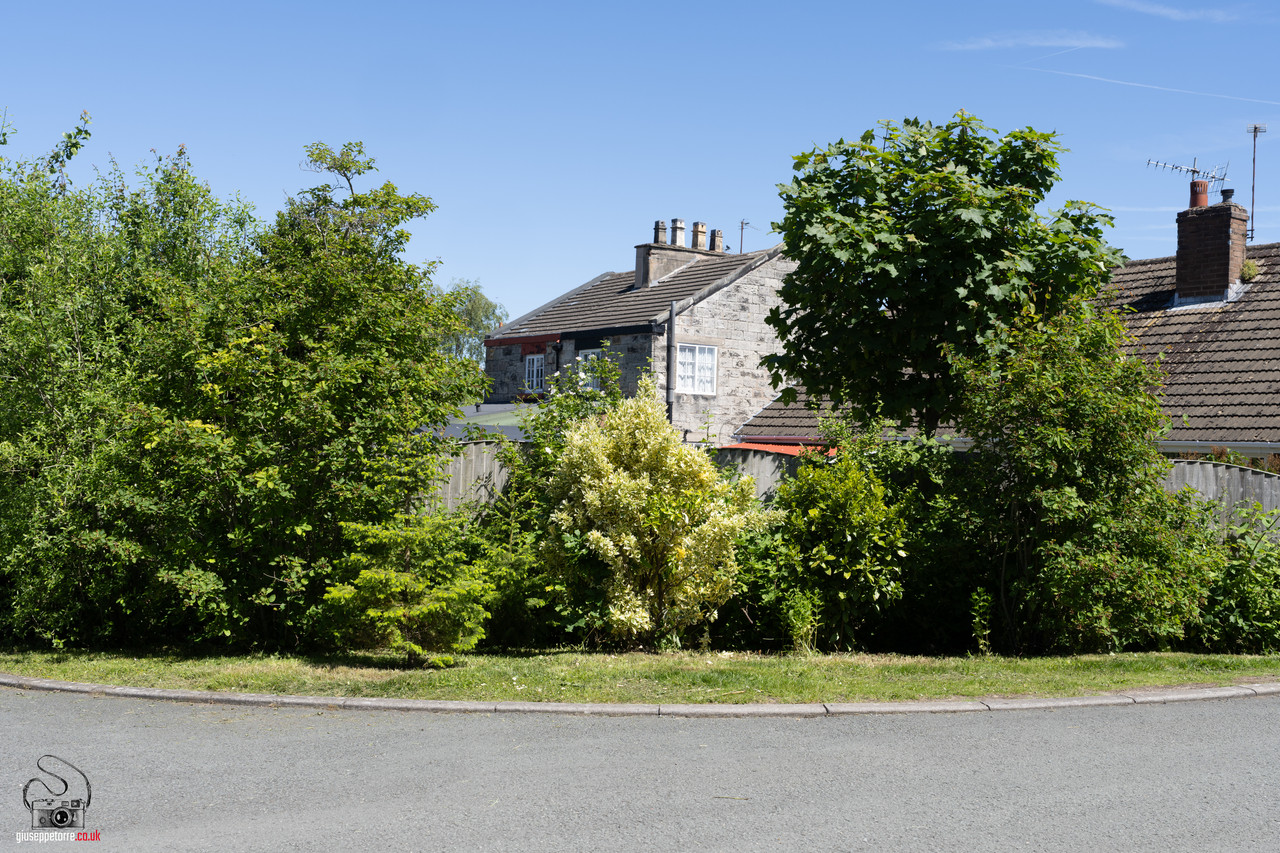
Here is more or less the same framing, in a very rough and improvised way, just to compare what comes out of the A7R VI and the others when you shoot and export at 7k on the long side.

I will not post full-resolution files. Anyone looking for those can find them elsewhere eventually. For my own use, full-res 100% viewing is not very relevant, because I normally export my photos at around 24–30 MP, whatever camera they come from.

Right click and open in another tab to see them at 7k on the long side.

The Sonys were shot with the 28-70mm f/2 at f/8, 35mm.
The Fuji with the GF 50mm at f/10.


Sony A1 II


Sony A7R VI


Fuji GFX100S


For practical output, I think you can see that there is not a dramatic difference between the three once exported at this size. Or at least, not enough to change the result for most real-world uses.


PS. I also tested and calibrated the A7R VI today.

From a colour-measurement point of view, my first impression is not especially positive. Compared with the best Sony body I have measured so far, the A1 II, the A7R VI does not seem to improve the colour side of the equation. In fact, in my measurements it appears to lose something compared with the A1 II, while still remaining clearly behind the better Nikon bodies in terms of colour separation / colour-filter behaviour.

This is not about JPEG colour, Adobe colour, Capture One colour, profiles, or personal taste. I am talking about the camera’s measured colour response before profiling.

In simple terms, my impression is that Sony is still investing more in resolution, speed, and computational metering than in improving the spectral quality of the colour filters.


May 24, 2026 at 11:20 AM
RomanMF
Offline
• •
Upload & Sell: On
p.43 #7 · Sony A7RVI


Ross Martin wrote:
Benj Haisch reports that his testing shows the new A7RVI no longer drops EVF resolution during AF-C focusing like the A7RV did, starts at 4:22 mark:


HELL YES! One of my biggest gripes with the Sony A7R V.


May 24, 2026 at 12:24 PM
deepDEEPpurple
Offline

Upload & Sell: Off
p.43 #8 · Sony A7RVI


Olli Nilsson shared a video where he does some BIF with the A7R VI


10:42 for some examples.

The EyeAF performance is insane.


May 24, 2026 at 12:27 PM
bwcolor
Offline
• • • •
Upload & Sell: Off
p.43 #9 · Sony A7RVI


Ulysseita wrote:
Tested one today. I am copying below what I wrote on another forum, translated into English.

Please keep in mind that the handling part is only a first impression, not a full field review. The colour comment at the end, however, comes from my own calibration / measurement workflow, so that part is based on actual measurements rather than just looking at files.

Today I had the new, rather well-fed Sony A7R VI in my hands for the first time.

Obviously I did not have the chance to test it properly, and I certainly did not do a real photographic session with it.
...Show more

Thank you for cross posting on this forum. Sony has struggled with color since the NEX-7, but has slowly improved. If readily available, would you be able to post a comparison chart from your testing of the A1ii, or Nikon? Regardless, thank you for posting.


May 24, 2026 at 12:42 PM
Rialto
Offline

Upload & Sell: Off
p.43 #10 · Sony A7RVI


Ulysseita wrote:
...


Thank you for the benchmark!

Here's the methodology for those curious:

https://www.cobalt-image.com/deep-into-the-spectre-benchmarks/


May 24, 2026 at 12:48 PM


Search in Used Dept. 

Ulysseita
Offline
• •
Upload & Sell: On
p.43 #11 · Sony A7RVI


Here is the benchmark page:

https://www.cobalt-image.com/spectre-laboratory-measurements

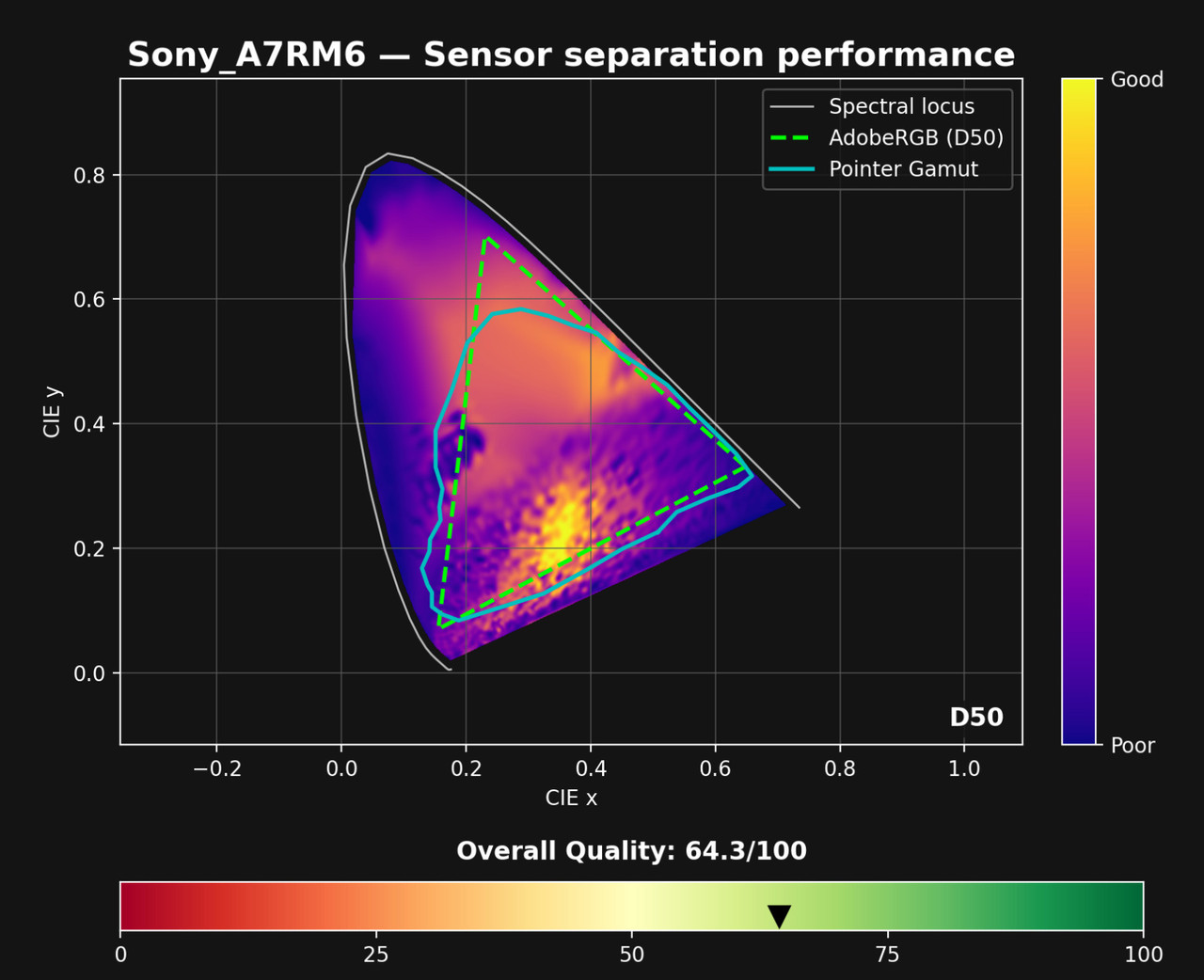
On the A7R line, Sony goes from a D50 colour separation value of 66.8 on the A7R V to 64.3 on the A7R VI.

If you read the article carefully, you will see what that number refers to: colour separation. It is not a subjective “colour look” score, and it is not about JPEG rendering, Adobe profiles, or personal taste. It is a measurement of how well the camera’s sensor/filter system separates colour information before profiling.
Increasing dynamic range, ISO performance, readout speed, or resolution does not automatically mean improving this side of the equation. In fact, quite often, the opposite can happen.

You can see this quite clearly across brands.

In Nikon, the old D3 and D700 still sit extremely high within the Nikon family, and Nikon in general remains at the top from this point of view. In Canon, you can see how colour separation dropped after the 1Ds Mark III generation. With Sony, there has been a slow climb over time up to the A1 II, which actually reaches very high values — and this also helps explain just how high the best Nikon values are.

So why does this difference exist?

The Leica M9 may give a clue. It has the highest value I have measured so far for a Leica camera, despite being an “ancient” CCD camera compared with the latest BSI CMOS bodies.

One possible explanation is that stronger or more selective colour filters improve separation, but they may also reduce the amount of light reaching the sensor. That can work against ISO performance, dynamic range, or other modern sensor priorities.

But looking at what Nikon manages to do, it may also be simply a matter of design choice: the CFA/filter stack placed in front of the sensor, the sensor design itself, and the electronic handling around it.

In other words, better modern sensor performance does not automatically mean better colour separation. These are related, but they are not the same thing.

I would add that I was struck by the accuracy of the Sony’s white balance. From this point of view, it is clear that they have worked to improve its precision, and for landscape photographers this is excellent news

bwcolor wrote:
Thank you for cross posting on this forum. Sony has struggled with color since the NEX-7, but has slowly improved. If readily available, would you be able to post a comparison chart from your testing of the A1ii, or Nikon? Regardless, thank you for posting.


May 24, 2026 at 01:23 PM
Nifty Fifty
Offline
• • •
Upload & Sell: Off
p.43 #12 · Sony A7RVI


Ulysseita wrote:
In fact, in my measurements it appears to lose something compared with the A1 II, while still remaining clearly behind the better Nikon bodies in terms of colour separation / colour-filter behaviour.

Which models do you consider to be among the better Nikon bodies?


May 24, 2026 at 02:14 PM
bwcolor
Offline
• • • •
Upload & Sell: Off
p.43 #13 · Sony A7RVI


I’m trying to make sense out of the intrinsic ability of a sensor and my perception of tonal purity, if there is such a thing. The Hasselblad X2Dii isn’t particularly high on the chart of best intrinsically subtle sensors. Now, I have been progressively happier with Sony skin tones and colors derived from raw files, but the Hasselblad processed through Phocus have been so much easier to get the colors where I want them. So, we have a case of less than perfect sensor, but great processing. I’m guessing that the Cobalt cameras specific emulations are designed to provide such processing for other brands. The hope of better Sony colors with the claimed improvement in auto white balance was one of the features that spurred my interest in the A7Rvi.


May 24, 2026 at 04:16 PM
q-w-z
Offline
• •
Upload & Sell: Off
p.43 #14 · Sony A7RVI


Jim Kasson did a rather deep research on such matters (I don't know nothing about methodology of the Cobalt tests, though)
https://blog.kasson.com/the-last-word/camera-color-accuracy-outside-of-the-training-set/
It appears to be not so straightforward and not always reducible to one number result.


May 25, 2026 at 01:19 AM
gdanmitchell
Online
• • • • • • •
Upload & Sell: Off
p.43 #15 · Sony A7RVI


I have a question. If, as I understand it, these are assessments of the physical sensor’s ability to distinguish between ( and record) very similar colors and not tests of things like camera software, etc., then would different camera brands using the same Sony sensors (e.g. Sony, Nikon, Fujifilm…) have the same test values? And would not sensor size be irrelevant?


May 25, 2026 at 01:35 AM
Ulysseita
Offline
• •
Upload & Sell: On
p.43 #16 · Sony A7RVI


I do not want to expand this too much here, since this is an A7R VI thread and not a thread about colour science, spectral profiling, or profiling methodology.

For anyone who wants to understand the benchmark more deeply, or simply wants a starting point, these are the relevant pages:

Database / laboratory measurements, with the possibility to inspect each camera body:
https://www.cobalt-image.com/spectre-laboratory-measurements

Methodology:
https://www.cobalt-image.com/deep-into-the-spectre-benchmarks

A more practical explanation of the benchmarks, using “better” and “worse” examples:
https://www.cobalt-image.com/tutorials/spectre-benchmarks-explained

Regarding the Jim Kasson link, I actually think it supports the reason why we do not base this kind of work on a simple CC24 test.

Testing on the same 24-patch ColorChecker used to build or optimise a profile can easily become circular. That is precisely why, in our workflow, we work at spectral level and use much broader datasets.

The FADGI approach is based on the ColorChecker SG, not only the classic 24-patch chart, and our Spectre profiles are built from spectral measurements: in other words, many reflectance samples, not just 24 patches.

So the colour separation number I quoted is not intended to mean “this camera makes prettier colours” or “this profile scores well on a CC24 chart”. It is a way to look at the intrinsic colour-discrimination behaviour of the sensor / CFA / filter system before subjective rendering, JPEG processing, or profile taste enters the discussion.

For anyone who wants to understand the benchmark more deeply, or wants to investigate the subject further, I would suggest opening a dedicated thread.


May 25, 2026 at 03:57 AM
Ilumo
Offline

Upload & Sell: Off
p.43 #17 · Sony A7RVI


Curious. I don’t use the evf much. I shoot mostly indoor gymnastics/ floor sports. Will the stacked sensor help with autofocus / stuttering while composing with the LcD? Comparing this to the r5 that is.


May 25, 2026 at 06:56 AM
Steve Spencer
Offline
• • • • • • •
Upload & Sell: On
p.43 #18 · Sony A7RVI


gdanmitchell wrote:
I have a question. If, as I understand it, these are assessments of the physical sensor’s ability to distinguish between ( and record) very similar colors and not tests of things like camera software, etc., then would different camera brands using the same Sony sensors (e.g. Sony, Nikon, Fujifilm…) have the same test values? And would not sensor size be irrelevant?


Dan, at least as I understand it and I could be wrong, when Sony, Nikon, and Fujifilm use the "same" sensor that means the same silicon layer that convert light into signal, but they don't necessarily and often don't share the same color filter array (CFA), and we know they don't share the same sensor cover glass. If I am right that they don't share the same CFA (and sometimes it seems likely they do not, for example Fuji uses their X-trans filter array rather than a Bayer pattern filter array for their APS-C cameras) it makes sense to me that could affect the sort of tests described on this page. Sensor size probably does not matter if the pixels, CFA, and sensor cover glass including UV filtration are the same, but we rarely know that is true even in different sized sensors from the same camera brand.


May 25, 2026 at 09:13 AM
gdanmitchell
Online
• • • • • • •
Upload & Sell: Off
p.43 #19 · Sony A7RVI


Steve Spencer wrote:
Dan, at least as I understand it and I could be wrong, when Sony, Nikon, and Fujifilm use the "same" sensor that means the same silicon layer that convert light into signal, but they don't necessarily and often don't share the same color filter array (CFA), and we know they don't share the same sensor cover glass. If I am right that they don't share the same CFA (and sometimes it seems likely they do not, for example Fuji uses their X-trans filter array rather than a Bayer pattern filter array for their APS-C cameras) it makes sense to
...Show more

I know that, at least in the obvious x-trans case, the filter array is different. I’m not so sure that is (or is not) the case with, say, Nikon where the Bayer array is used.

I’m also perplexed by how the other companies would theoretically (in the case of Fujifilm miniMF and Nikon FF at least) somehow have significantly better color filter arrays than Sony, who actually designs and builds the sensors… or that somehow different sensor cover glass would diminish Sony’s performance by not that of Fujifilm’s and Nikon’s Bayer sensor applications.

I’m also not impressed that the poster did not respond to my question.

For the moment, count be as skeptical about all of this. (It is all too easy to throw up a whole bunch of semi-incomprehensible “data” along with a lot of technical sounding writing and have it accepted uncritically by readers.)


May 25, 2026 at 10:05 AM
tschopp
Offline
• • •
Upload & Sell: On
p.43 #20 · Sony A7RVI


Ilumo wrote:
Curious. I don’t use the evf much. I shoot mostly indoor gymnastics/ floor sports. Will the stacked sensor help with autofocus / stuttering while composing with the LcD? Comparing this to the r5 that is.


It's safe to say the autofocus won't be worse.

We know the R6 does 60 AF / sec in 12 bit compressed and 30 AF / sec in 14 bit lossless, from Sony sources. I don't think I have seen figures for the R5 that I trust. I have seen estimates that the a7Rv does 20 AF/sec in 12 bit and 10 AF/s in 14 bit lossless. If that's all true, then a 3x improvement in the AF/AE rate would certainly help.

If you're shooting indoors, you might need to use mechanical shutter due to banding from LED lighting. That will cause some interruption in the AF processing as the sensor is covered. Overall it can't be worse as the a7Rv would need to use mechanical shutter as well. I think Sony claims to do 4D focus, ie they look at how the focus point has evolved over time to predict where it will be on the shutter capture. So not as good as actual data with the sensor exposed, but the engineers are doing their best.

The a7Rv does not cover the full sensor with AF points, the a7Rvi does. So if your subject wonders into the extreme top or bottom without coverage that will effectively stop the AF.


May 25, 2026 at 10:22 AM
1       2       3              42              44              60       61       end


FM Forums | Sony Forum | Join Upload & Sell

1       2       3              42              44              60       61       end


Welcome back
Log in to your account