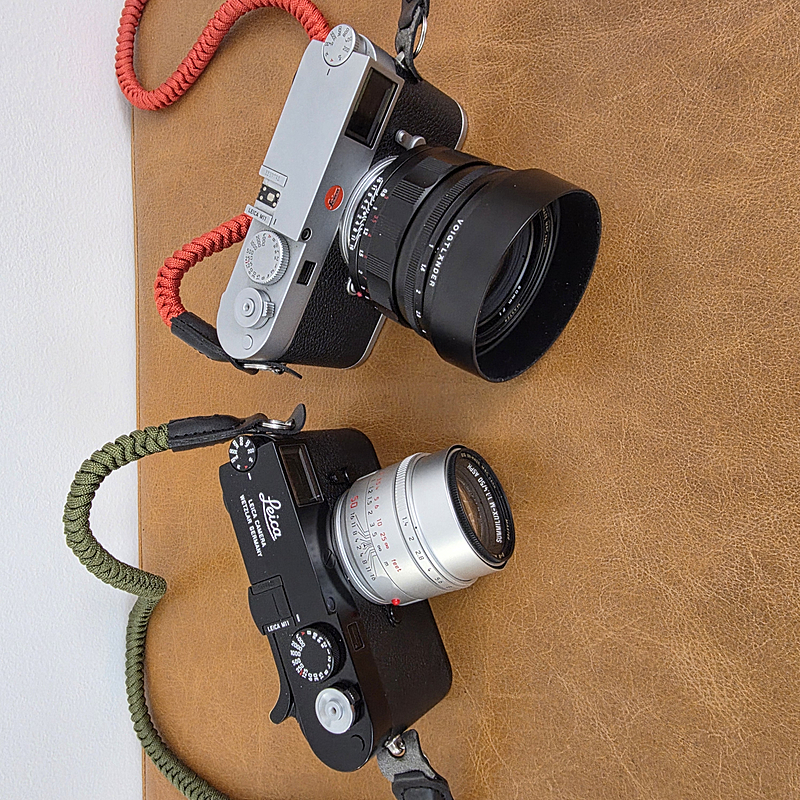
p.1 #3 · Leica 50 summilux, close focus vs nokton 1.0
Jorge Torralba wrote:
I am in the middle of writing up a comparison of these two lenses. Big difference in price and size.
But, the difference in image quality is negligible
At one point, I had the Summilux and the 50 mm/1:1.2 Nokton aspherical II.
The Voigt was better for a fraction of the price. The Leica was still very good, compact and perfectly calibrated with my rangefinder though.
p.1 #4 · Leica 50 summilux, close focus vs nokton 1.0
Thanks for these images, Jorge. I find them very revealing. Did you use the older regular Summilux or the new CF edition? The older one had 9 blades, the new has 11, different focus mechanism too. They even have different angles of view. The newer lens is a little hotted up and heavier, shorter MFD (the 'CF'), These things will make a difference to the optical performance (not the weight of course).
Anyway, the above images show how lovely the 50/1 Nokton is, even against a giant of the industry. The top image has muted saturation and contrast levels in its bokeh, with cinematic fade off the hot spot.
This settled rendering of the top image invites the eye into the picture - even the gritty focus point is better managed. It has much better 3D because the main line structures are more intact. The lower image is chaotic. Some crazy line work on the carry racks. The Summ's fabled curvature doesn't help. (But it's only one image.) cheers.
p.1 #5 · Leica 50 summilux, close focus vs nokton 1.0
The summilux is the newer version with 11 blades.
I have other images to share but am waiting to capture some portraits as well since I don't really want to talk about inanimate objects only. So it's coming together.
But, here is another subject t o see.
Remember, this is not to say one is better than the other but simply how close to each other do they perform.
Both shot at 1.4
Keep in mind the Nokton circle are not perfectly round at 1.4 since the blades are visible at this point. Whereas, the summilux the bokeh balls are smoother only because no blades are in the image path at the wide open point.
This one is from the Voigtlander
p.1 #8 · Leica 50 summilux, close focus vs nokton 1.0
Jorge Torralba wrote:
I have other images to share but am waiting to capture some portraits as well since I don't really want to talk about inanimate objects only. So it's coming together.
Thanks for sharing these, Jorge. Look forward to the portraits!
p.1 #9 · Leica 50 summilux, close focus vs nokton 1.0
philip_pj wrote:
I do say one is better. My comments above still apply here. Portraits will be interesting, for sure..
Agreed. In both cases, I find the Nokton images to be more pleasing with respect to both detail and overall effect. (I don’t ever normally zoom in on bokeh effects.) This is, of course, very subjective, and says nothing about size or haptics.
I do appreciate, though, that for some (many?) folk here, the 50mm ‘Lux is just the ticket. There have been times when I have been very tempted to buy one, and if the new version had addressed some of the aspects of its rather old design (I am taking care not to say ‘flaws’ here), I probably would have done. As it is, it’s not for me.
This will be an interesting comparison, though. I suppose the CV 50/1.0 is more a direct competitor to the Noctilux (for me, there’s no contest) but I also find it mildly interesting that Voigtländer have not, so far, released a lens that is a direct analogue to the ‘Lux (the 50/1.2 Nokton is great, but has no FLE).
p.1 #12 · Leica 50 summilux, close focus vs nokton 1.0
Interestingly, if shown the above sample images without attribution I would have said I prefered the Summilux each time.
Maybe because I have the current version 35mm and 50mm Summilux and am just used to the way their images look.
I used to have the pervious 9 bladed 50mm Summilux and was not in love with the polygonal bokeh. The Voigtlander also suffers from this in a very obvious way. So, I also have the 50mm 14 blade Simera for times I wanted rounder bokeh and more character. Since I got the new Summilux those times are almost non existent so I am thinking of passing that lens on.
I enjoy using my Voigtlander and Thypoch lenses. But prefer the build, features, and ergonomics of the Leica lenses by a big margin.
Maybe I am not as price sensitive as some. But, I can understand that, and why they choose differently.
p.1 #13 · Leica 50 summilux, close focus vs nokton 1.0
Just from the personal perspective of a cinematographer...
In the example above, the Nocton shows a not at all negligible more relief image:
- The Sumilux image is pretty/very saturated and contrasty, and is therefore less flexible in terms of further postprocessing.
- Most importantly.. the relationship between the object (decoration) in focus and the background in the right corner (from the viewer's perspective) has a noticeably greater depth with the Nocton than with the Sumilux, whose overall image is more flat, i.e. not as perspectively layered.
- The background blur is smoother with the Nocton.
- In the upper left corner of the image, the tonal separation between brown and burgundy tones is somewhat better with the Nocton: due to its overall higher saturation and tendency to emphasize warmer (yellow-red) tones, the Sumilux may be more noticeable at first glance, but the palette of its tonal reproduction in this example is reduced compared to that of the Nocton.
In fact, judging by this comparison, I would personally be very happy if Noxton made a cine rehoused version of this lens.
p.1 #14 · Leica 50 summilux, close focus vs nokton 1.0
1bwana1 wrote:
Interestingly, if shown the above sample images without attribution I would have said I prefered the Summilux each time.
….
Your first sentence coupled with the fact that I prefer the two Nokton images perfectly illustrates that this is very much a subjective comparison. Which is perfectly fine.
I don’t know whether either image could be declared to be objectively better, although the perspective from @vashadobri is fascinating and quite compelling. (By contrast, perhaps one could make the case that the Nokton’s image quality is better than that of the Noctilux 0.95/50.) As it happens, in these two comparisons, I prefer the Nokton’s colours.
As for price sensitivity, I’m sure you are correct to say that that dictates some purchase decisions, but it wasn’t a major factor for me (although I do care about what I perceive to be value for money). I actually came very close to buying the new Summilux a couple of years ago but, after trying it and viewing a number of images and discussions here, ultimately decided that the combination of the CV f/1.2 Nokton and the f/2.0 APO was the better option for me (I also have the Summicron v5 and Rigid for use on my M3 and MP, although I may sell the v5 because I use it so infrequently).
p.1 #15 · Leica 50 summilux, close focus vs nokton 1.0
When Leica first went digital I hjad sold off most of mylenses still had my 35 AA and that was about it. I got a 50 Zeiss ZM f2 and the %0 1,5 voigt man i hated that lens. Purple fringing like hell had changed the color of blood to purplle then got a lux asph for 1900 and got rid of that junk not bought a voigt since, Funny how one lens can ruin a company for you. But I really dont like the images from the nokton flat as hell.
p.1 #16 · Leica 50 summilux, close focus vs nokton 1.0
Here is another set to compare.
Again, the nokton shows the non smooth bokeh balls because it is stopped down to 1.4 and the aperture blades are in the image path. Whereas the lux is wide open with no blades in the image.
p.1 #17 · Leica 50 summilux, close focus vs nokton 1.0
I welcome images like this above, and this 'bottle cap bokeh ball' effect will certainly afflict faster lenses more readily. We need lens designers to factor in higher blade counts if they see this kind of thing in their prototyping test regimes. All of them claim smooth bokeh while retaining these image-disrupting artifacts.
I saw Leica's Seth Emmons mention this from a 2017 interview. He thinks a rounded light path is also implicated in bokeh quality, and after using the 14-16 blade Simeras for over a year, so do I. But the Chinese actually design for bokeh, so they would notice the effect.
All fast lenses produce a lot of specular highlights, all of them. You can do a little about it, for example Zeiss is suspected of using a small amount of under-correction of spherical aberration to help light spread in speculars. The worst part is that you see it most glaringly within one to two stops down, exactly the region where many users will want to be able to use for several reasons: better contrast, a little more DOF, etc.
The Nokton 50mm has 12 blades, but it needs 14 or 15. For a company that championed rounded apertures in the 35/50 APOs through clever iris design, why did they let this one through in its current form? It's been known about for many decades, well over 50 years.
Think what it is doing to the image formation process. It's on the way out in many cine lens ranges, for example Supreme Primes and Thalias, they use 16-18 and 15 blades. Iris mechs don't cost a lot of money. It's a case of self-sabotage, I'm afraid.
p.1 #18 · Leica 50 summilux, close focus vs nokton 1.0
Jorge, it's important to note that rounded bokeh balls are no guarantor of imaging excellence, that is YT reviewer level thinking. It's an integral part of cine imaging, for example, and I can show you many examples of it in $25k lenses. And Leica's $9700 35/1.2 Noct also.
There is nothing virtuous in ball circularity per se, no prizes are handed out for it. Most people respond favorably to outer frames redirecting viewer attention back into the broader center and its subject matter, using reductions in focus (curvature), contrast, saturation and yes, bokeh ball shape.
What matters in bokeh balls are: grinding or other internal marks; uneven illumination (for example, 'donut' balls with over-bright rings and darker centers); and level of brightness especially in background overlays. The idea is to not distract, but to provide an aesthetic complement to the 'story' of the image .
p.1 #19 · Leica 50 summilux, close focus vs nokton 1.0
puting aside the boke balls, which on the Leica show onion rings, I would say so far the over all images between the two lenses seem fairly comparable. Not one lens in particular stands out as better than the other. They both seem to produce wonderful images.
As far as davidsees comments regarding the nokton "flat as hell" i would disagree. I just don't see it. For me at this point the only advantage the lux has over the Nokton is purely in size.
Now the question for myself is. What do I do? I dont need 3 50's so which one ore ones should i get rid of if I were keeping just one.
p.1 #20 · Leica 50 summilux, close focus vs nokton 1.0
Interesting comparison. Everyone sees exactly what they want to see. It's fine. I'm a Lux fan myself. More pleasing to my eyes. I also greatly prefer the size of the Leica. All that said, both produce a perfectly fine image. Just personal preference.