https://www.arri.com/en/learn-help/arri-camera-technology/alev-sensors
"The Dual Gain Architecture simultaneously provides two separate read-out paths from each pixel with different amplification. The first path contains the regular, highly amplified signal. The second path contains a signal with lower amplification to capture the information that is clipped in the first path. Both paths feed into the camera's A/D converters, delivering a 14-bit image for each path. These images are then combined into a single 18/16-bit high dynamic range image. This method enhances low light performance and prevents the highlights from being clipped, thereby significantly extending the dynamic range of the image."
So, yeah there's some noise reduction (or something similar) baked in.
I'm sure people will have different opinions about this, but I'm more interested understanding the practical outcome of this. Does it mean better dynamic range in real life (for which has very clear practical meaning) or is it just something like 'less-noise-in-shadows' (which really doesn't have practical meaning)?
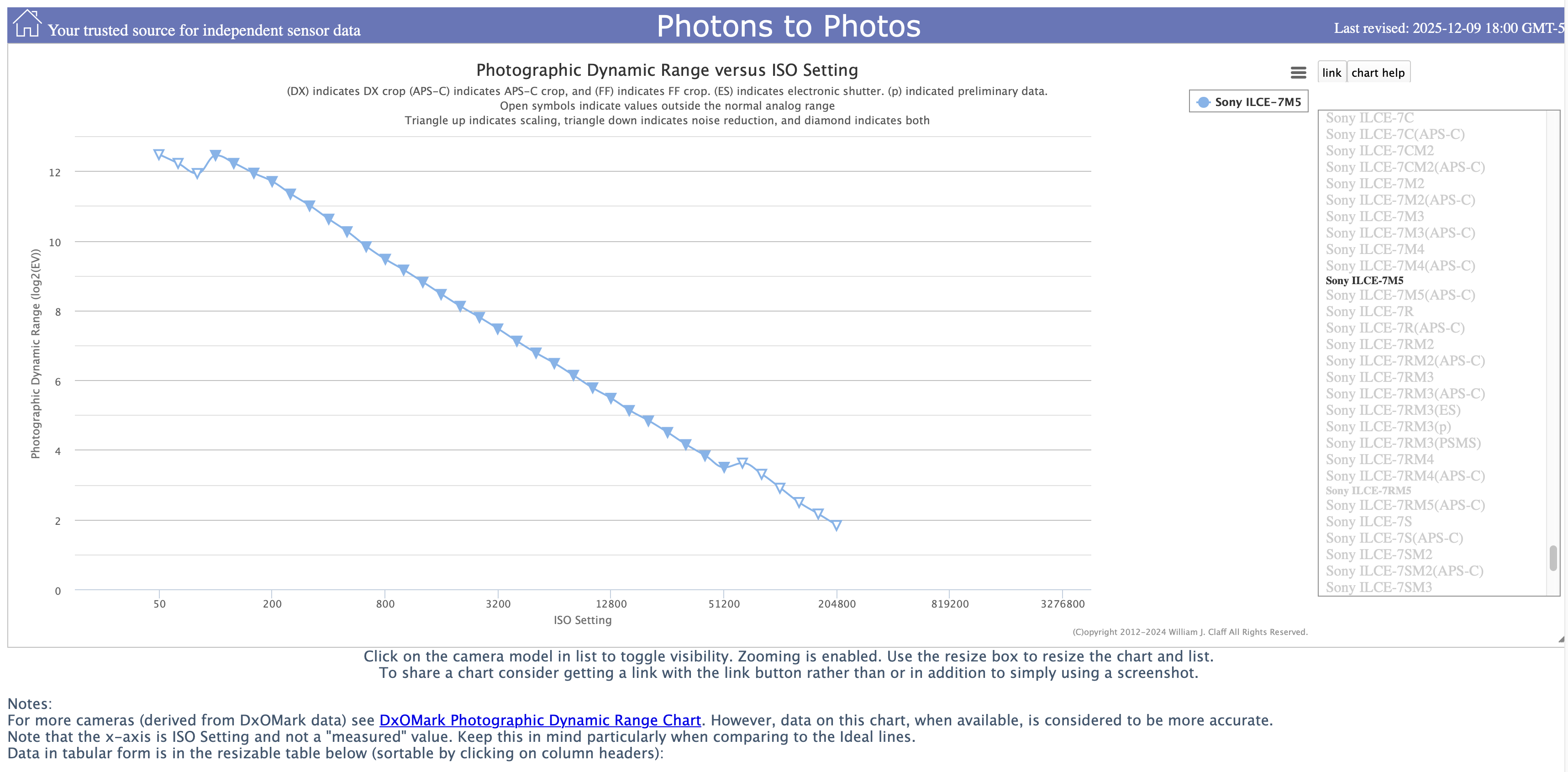
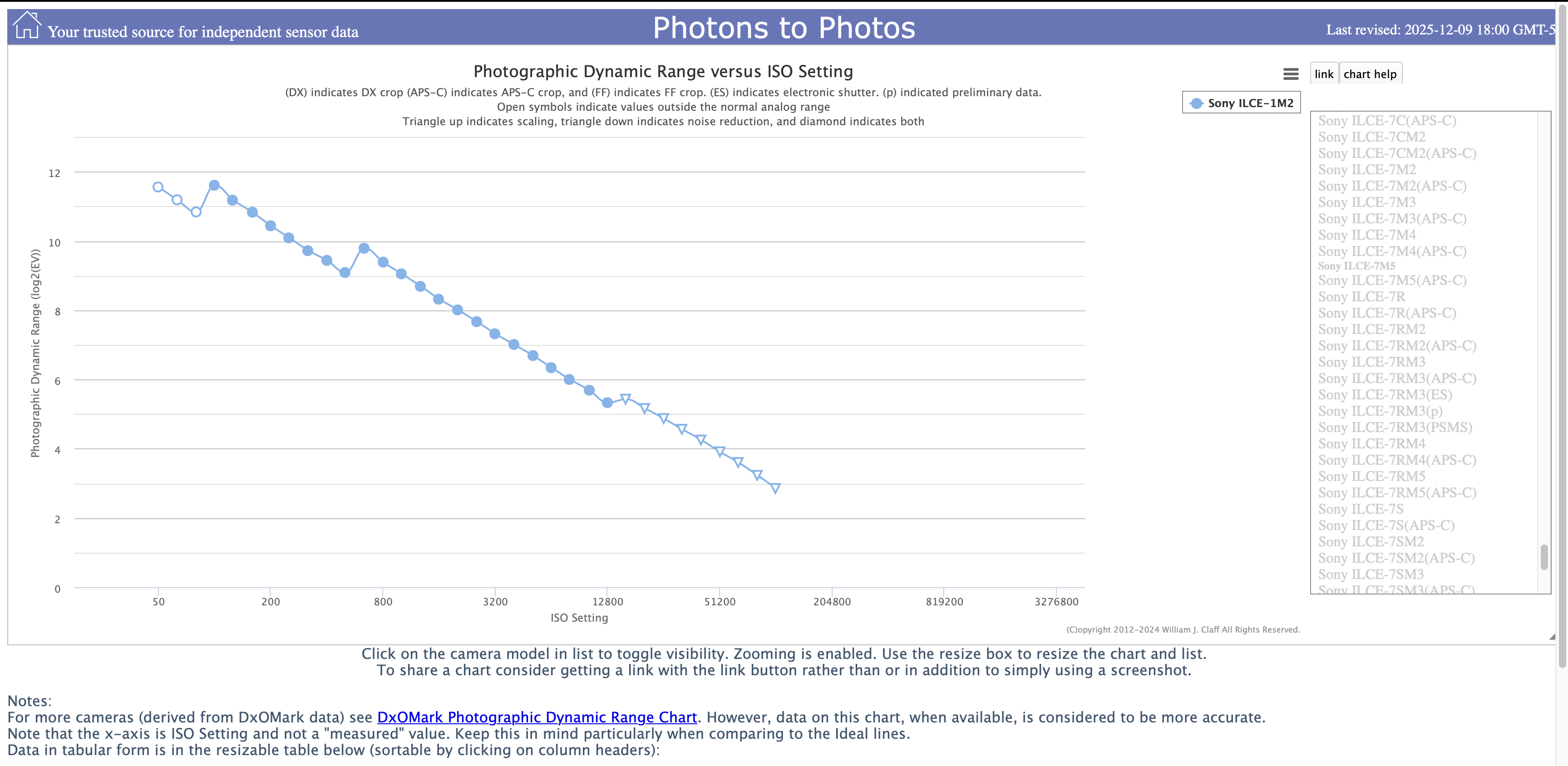
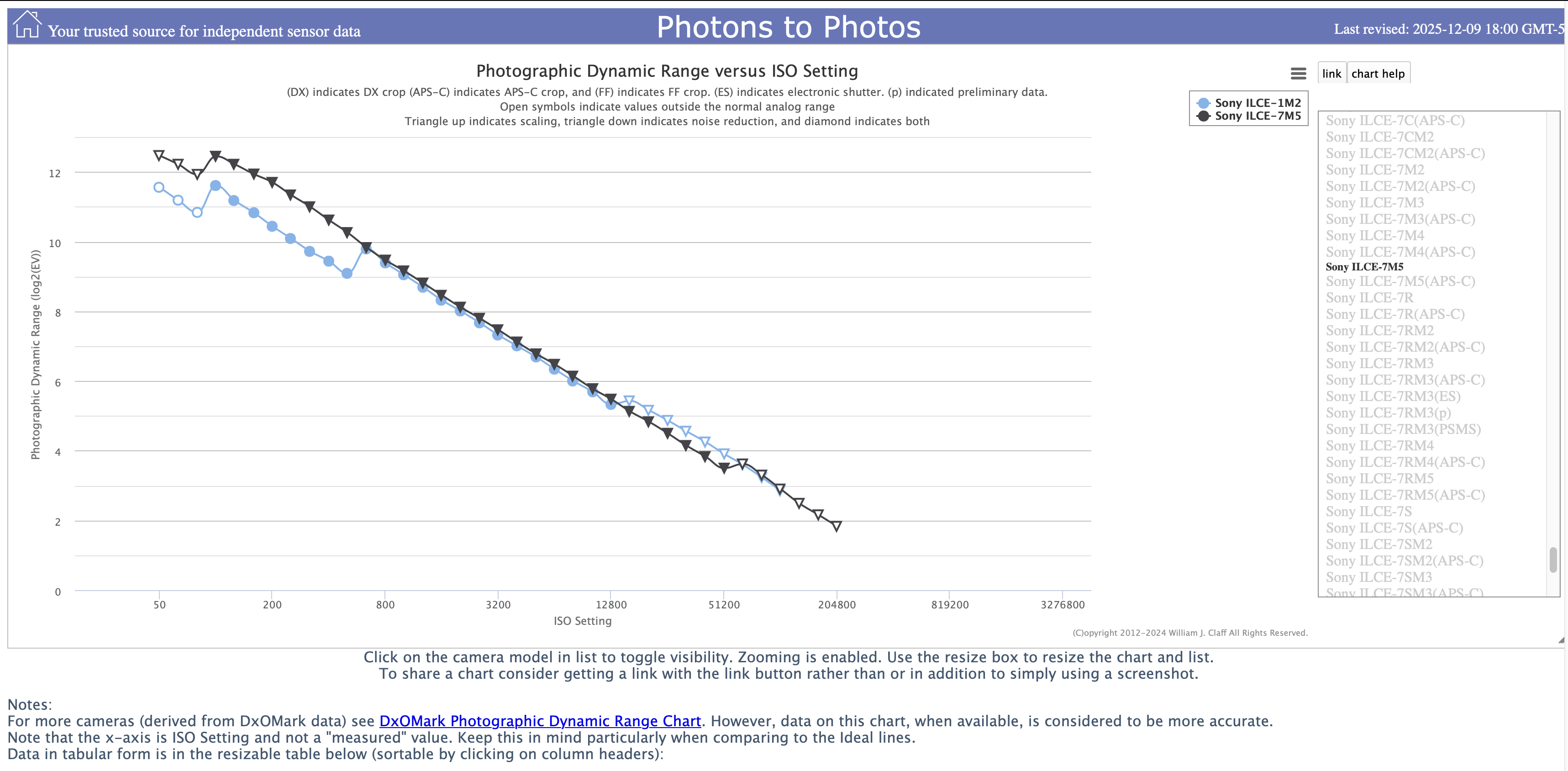
If the current performance means better dynamic range in real life (bright image elements, like skies etc., fitting better into dynamic range of the sensor), then the Sony A7V seems to outperform even the some medium format cameras like the GFX100mkI and Hasselblads... But I kind of doubt it...
Kalainen wrote:
So, yeah there's some noise reduction (or something similar) baked in.
I'm sure people will have different opinions about this, but I'm more interested understanding the practical outcome of this. Does it mean better dynamic range in real life (for which has very clear practical meaning) or is it just something like 'less-noise-in-shadows' (which really doesn't have practical meaning)?
If the current performance means better dynamic range in real life (bright image elements, like skies etc., fitting better into dynamic range of the sensor), then the Sony A7V seems to outperform even the some medium format cameras like the GFX100mkI and Hasselblads... But I kind of doubt it......Show more →
That's the thing it's not an apples to apples comparison anymore. If those medium format cameras had NR applied to RAW, they would be the ones to score higher ...
You don't know the real dynamic range since Sony baked in NR at all ISO. If anything this can indicate that the real DR is pretty mediocre at best and Sony decided to bake in NR to make the numbers look good for PR reasons.
The newer camera has different (higher) dual ISO sensitivity…That needs to be considered when doing comparisons.
The mentioned video does not compare them properly.
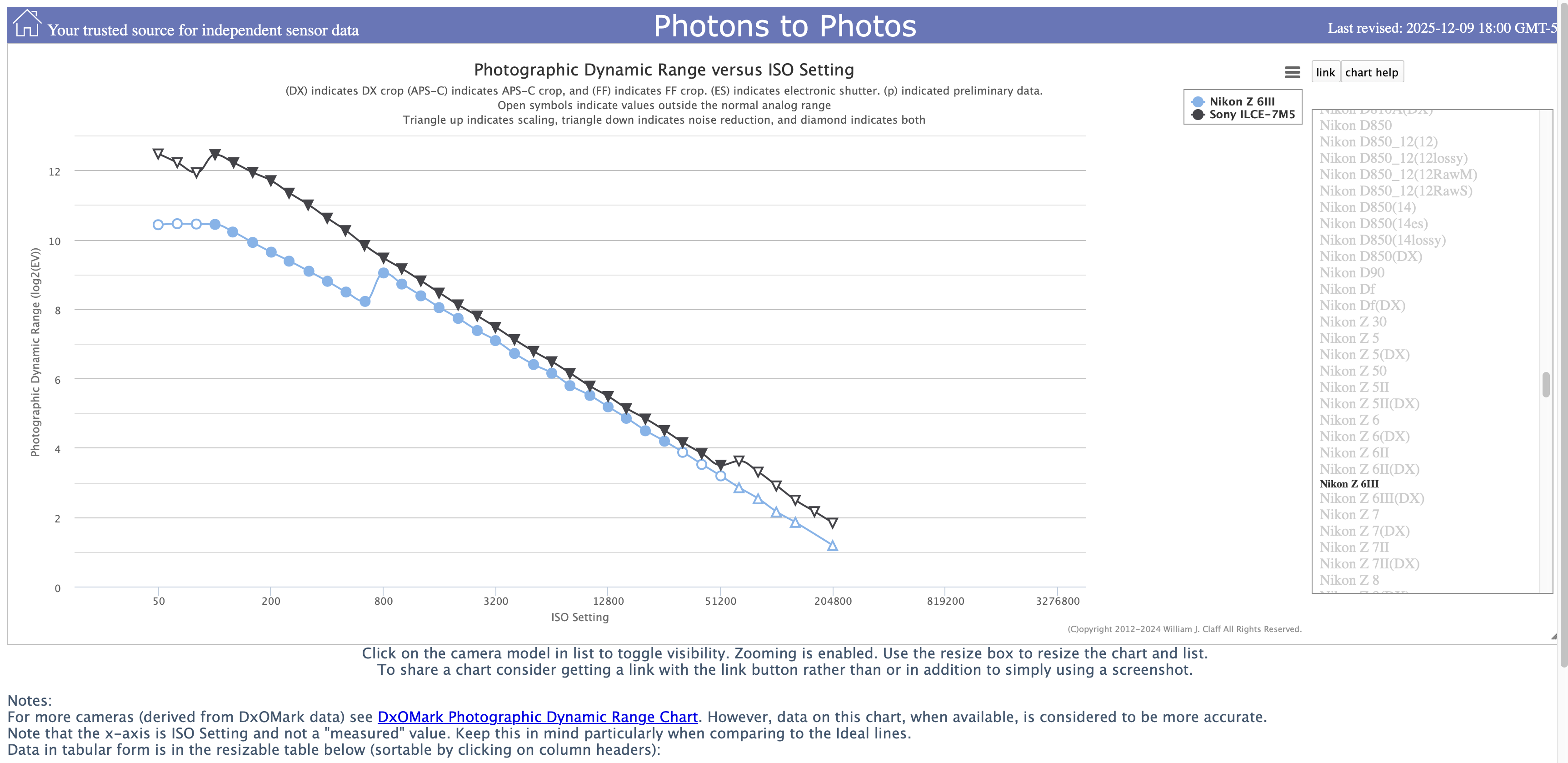
A74me wrote: , watch Tony's review video. the sensor performs as good as the z6iii and ZR.
Kalainen wrote:
I'm sure people will have different opinions about this, but I'm more interested understanding the practical outcome of this. Does it mean better dynamic range in real life (for which has very clear practical meaning) or is it just something like 'less-noise-in-shadows' (which really doesn't have practical meaning)?
The practical outcome of having NR applied to the RAW data in camera is: slightly worse IQ.
Whatever an algorithm can do in camera, an algorithm in post can do at least as well. But applying NR in camera loses information and hence the algorithm working in post has less information to work with, causing a deterioration of the overall result.
j4nu wrote:
That's the thing it's not an apples to apples comparison anymore. If those medium format cameras had NR applied to RAW, they would be the ones to score higher ...
For many, the Photons to photos website has been the definitive source of knowledge for estimating real life dynamic range performance. If camera manufacturers’ new approach — baking noise reduction into the signal path — obscures this, it’s very unfortunate.
In itself, who ends up with the highest score doesn’t matter that much. What is important is being able to grasp the real performance of these sensors quite accurately (and not merely on the basis of marketing claims).
In my view, Sony has historically had a certain baseline level when it comes to dynamic range, and practically all newer models have fallen more or less within that range (with the exception of the A9 III, which represents a very different technology). I would have assumed that if Sony were to bake noise reduction into the camera, they would do so in order to raise the performance of the partially stacked sensor to a similar level as their other models. I’m surprised that the public is suddenly being offered a clearly better-performing model after years of dynamic range figures being nearly identical from one generation to the next - color me skeptical..
Edit: the difference in A7V's dynamic range compared to A7IV is about as much as A7 vs A7III. Having experienced it before I can say it's definitely a difference that matters in real life and you can see it in pictures right away (in sunny/dynamic conditions). But I doubt that it's going to happen with the A7V, or this would make the A7RV obsolete right away in terms of dynamic range.. I bet it's more like a measurable little difference in the shadows (that means nothing to most of us)..
I'm guessing Sony is applying a combination of DGO and NR to improve DR. Here's my video on the Panasonic S1 II's DGO using the 24MP partially-stacked Sony sensor:
Kalainen wrote:
For many, the Photons to photos website has been the definitive source of knowledge for estimating real life dynamic range performance. If camera manufacturers’ new approach — baking noise reduction into the signal path — obscures this, it’s very unfortunate.
In itself, who ends up with the highest score doesn’t matter that much. What is important is being able to grasp the real performance of these sensors quite accurately (and not merely on the basis of marketing claims).
In my view, Sony has historically had a certain baseline level when it comes to dynamic range, and practically all newer models have fallen more or less within that range (with the exception of the A9 III, which represents a very different technology). I would have assumed that if Sony were to bake noise reduction into the camera, they would do so in order to raise the performance of the partially stacked sensor to a similar level as their other models. I’m surprised that the public is suddenly being offered a clearly better-performing model after years of dynamic range figures being nearly identical from one generation to the next - color me skeptical..
Edit: the difference in A7V's dynamic range compared to A7IV is about as much as A7 vs A7III. Having experienced it before I can say it's definitely a difference that matters in real life and you can see it in pictures right away (in sunny/dynamic conditions). But I doubt that it's going to happen with the A7V, or this would make the A7RV obsolete right away in terms of dynamic range.. I bet it's more like a measurable little difference in the shadows (that means nothing to most of us).. ...Show more →
It seems counterintuitive, but all the DR difference exists in the shadows. That's why if the photo is not exposed to the right, it can't really show any meaningful difference in DR (if we're talking about sensors that are not worlds apart at least ).
I have mixed feelings on baked-in-raw noise reduction. The best existing denoising methods, in DxO Photolab and Adobe apps, don't degrade IQ to the best of my knowledge. At least, I don't recall seeing reports to the contrary. Thus, if Sony's baked-in raw denoising is as good, this would simply make denoising in post unnecessary, probably in most cases.
The real question is how well Sony implemented this denoising. That is, whether the IQ of the A7V is noticeably degraded, compared to the IQ of its predecessor A7IV?
So, we previously had the star-eater, the compression method causing troubles (rare, but nevertheless), the vignetting compensation baked in in the raw files and now we get noise reduction in raw files.
This is stupid and tiresome in my opinion.
Sony, in the name of anything holy:
Let the raw file be raw! Any fix is allowed as a setting in meta-data only!
Jonas B wrote:
So, we previously had the star-eater, the compression method causing troubles (rare, but nevertheless), the vignetting compensation baked in in the raw files and now we get noise reduction in raw files.
This is stupid and tiresome in my opinion.
Sony, in the name of anything holy:
Let the raw file be raw! Any fix is allowed as a setting in meta-data only!


 ...
... , watch Tony's review video. the sensor performs as good as the z6iii and ZR.