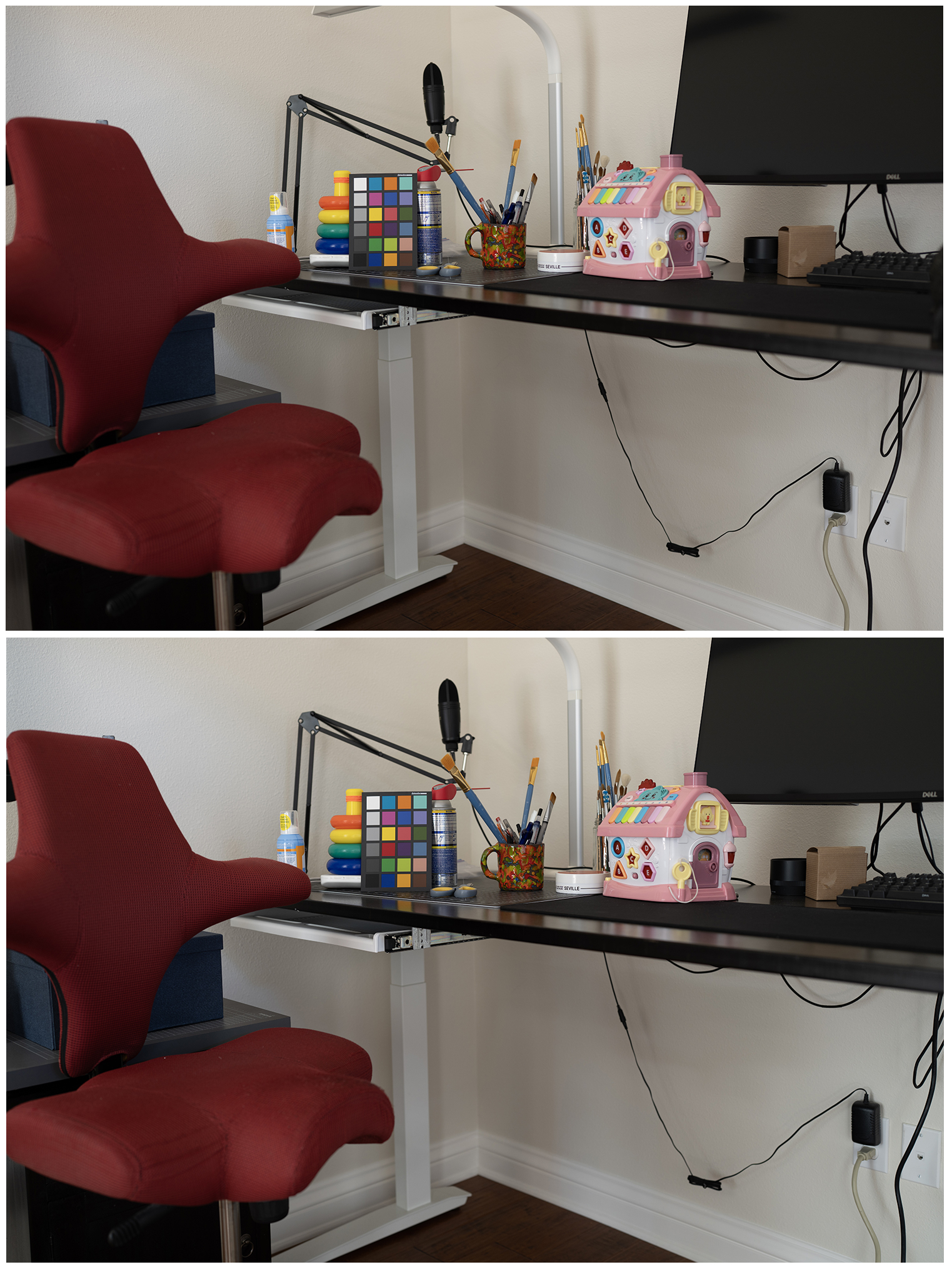
Same exposure with the A7R V (35mm f/1.4. GM) and Z8 (35mm f/1.8 S).
- Converted using 100% default settings in Lightroom. Adobe Color profile.
- White balance is set on the grey card.
- Both were shot at ISO 100 with identical shutter speed and aperture.
- Unfortunately focus is not 100% identical, but it doesn't matter.
I hope this will be helpful for future discussions about "color science" and maybe "color rendering" of lenses too.
[EDIT] For folks who missed my scarcasm: your camera manufactrer has absolutely nothing to do with the colors you're getting into the Adobe ecosystem.
Unfortunately, gents, both of my available models are refusing to show their faces to a bunch of Internet strangers. But I can assure you the conclusion is the same, at least to my eye. [1] Lenses, when adjusted for WB, also don't introduce any color differences.
[1] I am willing to agree that some people's eyes are more color-sensitive than others.
Some background: I have both cameras for a couple of weeks, and I wanted to see which one would make a better film scanner, which one is better for close-distance focusing on moving subjects (kids), and which one would be better at high ISO. But just for fun, I am comparing everything I can. The pattern is that the difference between these is negligible. Some examples:
Their EVFs differ more in auto-brightness and auto-WB implementations than in anything else. The resolution difference is not that noticeable in real world use, despite looking dramatic on the spec sheet. I would give a slight nod to Nikon for more natural looking EVF representation under some lighting conditions.
The dynamic range difference is not observable in Lightroom, no matter how much I push/pull shadows/highlits at different ISOs. I am not disputing the published measurements, I am saying that the seemingly large gap you see in the graphs is not practically exploitable when editing RAW files.
Z8 with 35mm f/1.8S weights within 3 grams of A7R V with 35mm f/1.4 GM, but balances a bit better.
Superb machines, I am enjoying both of them equally. TBH they mostly differ from the ergonomics and size perspective. Can't comment on video.
And even these minor differences of software interpretation can disappear with different profiles.
If we were truly stuck with manufacturer’s choices on colour output I probably would be selling all my sony/nikon gear to buy fujifilm cameras, personally :-)
The thing is that the two should look identical as Lightroom will first translate the raws to a common base (Adobe Standard) and then apply its own twist (in this case Adobe Colour). So what is being tested is Adobe’s ability rather than Sony or Nikon’s. Using a native profile for each camera (such as is used to produce in camera jpegs) might be more revealing, if not in camera jpegs themselves.
There is a difference in exposure that makes the top photo darker, and as a result, some colors look more "deep." This is best seen in the cap in the central area of the image. The colors in this cap look a bit washed out in the bottom photo, whereas the top photo shows this cap with more deep, saturated colors. The same can be said about the chair.
I think the difference is due to different exposure, and I think this kind of a difference can be challenging to avoid. This can affect the perception of colors significantly.
old-gregg wrote:
Same exposure with the A7R V (35mm f/1.4. GM) and Z8 (35mm f/1.8 S).
- Converted using 100% default settings in Lightroom. Adobe Color profile.
- White balance is set on the grey card.
- Unfortunately focus is not 100% identical, but it doesn't matter.
I hope this will be helpful for future discussions about "color science" and maybe "color rendering" of lenses too.
I could never take a good picture with one of these cameras. The colors would ruin it.
It's helpful in that it shows there is no meaningful difference for Raw files processed in Lightroom with the Adobe Color profile, at least for those two cameras and lenses. It's good to know that this works as it should.
It's always how a SOFTWARE (the internal JPG engine of the camera or an editing software) interprets the RAW data, and that interpretation is always a decision of the programmers.
So of course the "Sony color science" will be different depending on the editing program used or the preset used in one if the programs.
Thus there is no such thing as "Sony color science" if you are shooting RAW.
I agree with that the whole subject of "color science" is ill-defined; thus, it cannot be properly discussed.
A more specific question is whether any two cameras, e.g. A7R V and Z8 (with the same lens), produce equivalent raw files. By equivalent, I mean that the values in the R-G-B channels are practically the same at any point. Do the sensors have practically the same color filter arrays?
On top of the questions about the sensors, I wonder if Auto-WB on A7R V and Z8 work to measure and return the same WB? If not, then (in the absence of a color-checker and a specific color profile) I expect a raw processor can produce visibly different colors after demosaicing. This actually brings the question:
How did the photos posted by the OP look BEFORE the WB was corrected?
ruthenium wrote:
A more specific question is whether any two cameras, e.g. A7R V and Z8 (with the same lens), produce equivalent raw files. By equivalent, I mean that the values in the R-G-B channels are practically the same at any point. Do the sensors have practically the same color filter arrays?
Similar, but not the same. While the Z8 also uses a Sony sensor, the sensor stack is different, they have different low and high pass cut-offs. Which for "normal" colors (black body spectra within the srgb gamut) should be virtually indistinguishable after applying a corresponding color profile. For a practical demonstration of the RAW data difference, see e.g. this post, where someone compared sun spectra (that Nikon also used a Sony sensor): https://www.dpreview.com/forums/thread/4315294
On top of the questions about the sensors, I wonder if Auto-WB on A7R V and Z8 work to measure and return the same WB?
No. They employ different algorithms and the Sony camera has a dedicated sensor for ambient color, which may or may not help.
If not, then (in the absence of a color-checker and a specific color profile) I expect a raw processor can produce visibly different colors after demosaicing.
That is usually the case. You could simply pin both images to the same manual WB, which might already yield the same colors, but only if the color profiles actually do their job (they often don't).
Daran wrote:
Similar, but not the same. While the Z8 also uses a Sony sensor, the sensor stack is different, they have different low and high pass cut-offs. Which for "normal" colors (black body spectra within the srgb gamut) should be virtually indistinguishable after applying a corresponding color profile. For a practical demonstration of the RAW data difference, see e.g. this post, where someone compared sun spectra (that Nikon also used a Sony sensor): https://www.dpreview.com/forums/thread/4315294
No. They employ different algorithms and the Sony camera has a dedicated sensor for ambient color, which may or may not help.
That is usually the case. You could simply pin both images to the same manual WB, which might already yield the same colors, but only if the color profiles actually do their job (they often don't)....Show more →
This is just as I thought. Thus, raw images of THE SAME scene, taken simultaneously with different bodies, can display some apparent visual color differences - what might be incorrectly referred to as different "color science." I don't think these differences should be dismissed.
ruthenium wrote:
This is just as I thought. Thus, raw images of THE SAME scene, taken simultaneously with different bodies, can display some apparent visual color differences - what might be incorrectly referred to as different "color science." I don't think these differences should be dismissed.
Those differences are not what you'd see as differences in final images though. No sensor adequately mimics the sensitivity curves of the human eye cones. Similarly the RGB channels used on modern display devices are close in spectrum to those used by cameras and accordingly fairly different from human sensitivities. Hence you need recalculation of the colors. Which is what a sensor specific color profile is supposed to do. Which does work so well, that within reason (as above: sRGB, black body type light and appropriate color profile) you should not be able to visually distinguish any resulting colors (aka: the error is <1∂E). So when someone says he prefers the color of one camera or lens over another, what he probably should have said is that he prefers the outcome of using those together with the inappropriate color profile and WB he happens to use.


 But I can assure you the conclusion is the same, at least to my eye. [1] Lenses, when adjusted for WB, also don't introduce any color differences.