p.5 #1 · After 13 years of all Sony, I'm trying Nikon
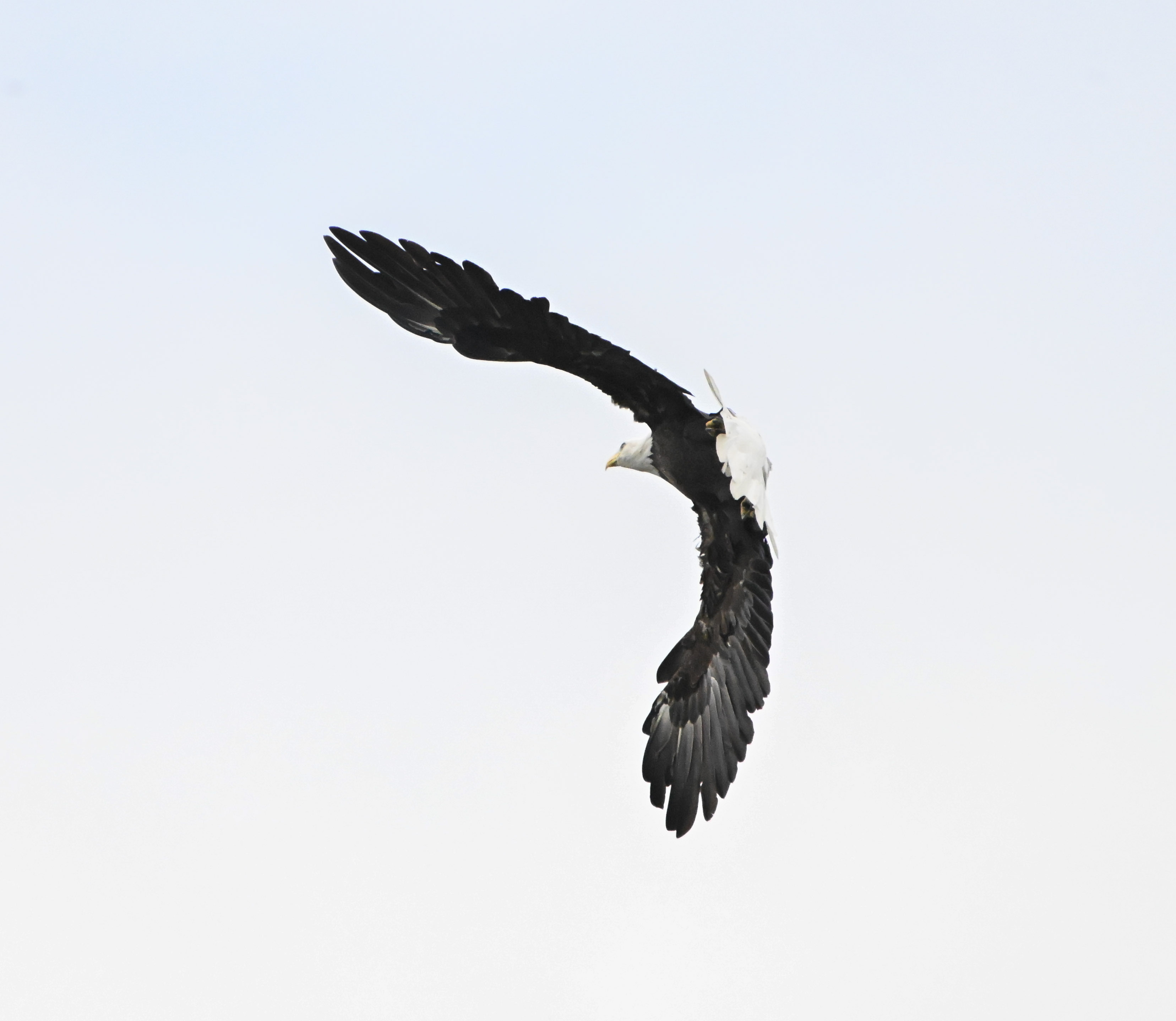
I’m out fishing…an eagle pops up unexpectedly…hurry…grab Z6iii with 100-400mm GM out of the bag. Damn…ISO was set too high from previous session (trying to shoot hummers in the shade) but at least I got something.
p.5 #2 · After 13 years of all Sony, I'm trying Nikon
M + Auto ISO prevent things like this from ever happening 🙃
MikeEvangelist wrote:
I’m out fishing…an eagle pops up unexpectedly…hurry…grab Z6iii with 100-400mm GM out of the bag. Damn…ISO was set too high from previous session (trying to shoot hummers in the shade) but at least I got something.
p.5 #6 · After 13 years of all Sony, I'm trying Nikon
DES-1 wrote:
For this feature, have you considered the Olympus cameras?
I had the same thought when saw "FE 100-400mm F4.5-5.6 GM OSS + 1.4X Teleconverte lens 560mm f/8.0"
Compared to this, OM-1 II with the Olympus 300mm F4 (full-frame equivalent 600mm F8) makes more sense to me, from my experience. I owned the Sony 100-400 lens and used it extensively with 1.4 and 2.0 TC and I very much expect better user experience and satisfaction with the micro four thirds system.
p.5 #7 · After 13 years of all Sony, I'm trying Nikon
ruthenium wrote:
I had the same thought when saw "FE 100-400mm F4.5-5.6 GM OSS + 1.4X Teleconverte lens 560mm f/8.0"
Compared to this, OM-1 II with the Olympus 300mm F4 (full-frame equivalent 600mm F8) makes more sense to me, from my experience. I owned the Sony 100-400 lens and used it extensively with 1.4 and 2.0 TC and I very much expect better user experience and satisfaction with the micro four thirds system.
It's an interesting thought, although my tentative plan is to get a Z8 and the Nikkor 180-600mm. This combo costs less than the OM system you mentioned, and I think for me will be more generally useful (lens ecosystems, adaptability, etc). The one thing I like about the OM system, however, is that it does RAW format pre-capture. More to ponder.
p.5 #8 · After 13 years of all Sony, I'm trying Nikon
Chat GPT tells me that Z8 + Nikkor 180-600mm (2.87 kg) is heavier than the OM-1 II + Olympus 300mm (1.87 kg) by 1 kg. The latter really does not require the tripod leg and collar. When removed, the weight of OM-1 II + 300mm is ca. 1.74 kg.
Another (important to me) advantage of the OM system is the superior (incredible, actually, by the FF standards) image stabilization that allows using SS as slow as 1/15s with the 300 mm lens. The OM camera system is very useful for those who need a relatively compact, portable and high-quality prime equivalent to FF 600 mm (with the understanding of what F4 means on the 300mm lens) that can be used hand-held for extended periods of time.
p.5 #9 · After 13 years of all Sony, I'm trying Nikon
The Z8 has more than double the number of pixels as the OM-1 II so of course the system should be heavier. Of course the a7rV has triple the number of pixels, but obviously it is not so action orientated.
p.5 #10 · After 13 years of all Sony, I'm trying Nikon
EB-1 wrote:
The Z8 has more than double the number of pixels as the OM-1 II so of course the system should be heavier. Of course the a7rV has triple the number of pixels, but obviously it is not so action orientated.
EBH
The MP size is a contentious issue. I haven't heard anyone saying that the A9iii is not a good camera because it has "only" 24MP. My guess is that 99.99% of photos are viewed on devices that dont have more than ca. 8 MP. Those few who print probably rarely need more than 20MP. Another guess is that 99% of photos posted on FM (not mine) have been resized to 1-2MP. I have a 50MP A1 and a 20MP OM-1 II, and the megapixel count is not a factor that makes some of my photos better to my eye. The number of MPs is like the lens "sharpness" - everyone wants these but I doubt that many FMers use or need these attributes, or that these attributes are central to photography in general. Basically, there is no need to worry too much about the "low" megapixel count of the 20 - 24MP sensors.
p.5 #11 · After 13 years of all Sony, I'm trying Nikon
ruthenium wrote:
The MP size is a contentious issue. I haven't heard anyone saying that the A9iii is not a good camera because it has "only" 24MP. My guess is that 99.99% of photos are viewed on devices that dont have more than ca. 8 MP. Those few who print probably rarely need more than 20MP. Another guess is that 99% of photos posted on FM (not mine) have been resized to 1-2MP. I have a 50MP A1 and a 20MP OM-1 II, and the megapixel count is not a factor that makes some of my photos better to my eye. The number of MPs is like the lens "sharpness" - everyone wants these but I doubt that many FMers use or need these attributes, or that these attributes are central to photography in general. Basically, there is no need to worry too much about the "low" megapixel count of the 20 - 24MP sensors....Show more →
I see wildlifers often comment on the A1's limitations due to mp. All the time. You don't need to call the camera bad. But the limitations are there and noticed.
I can't speak for others, but we all make choices. All my photos are on a photo hosting site with 100% resolution. I print every year. I prefer viewing on an oled monitor, and always encourage others to view on their largest and highest resolution screen.
I had both m43 and sony's FF at the same time before fully transitioning. I went with both macros and took as close to identical shots as possible..the difference was much larger than I thought, and part of that is likely due to MP. And similarly, the amount of detail in the 100mp gfx shots are clearly ahead of sony. Whether that matters to people is an individual choice.. but there is a difference. I couldn't go back to 24mp at this point unless i had a very specialized need that the A1s couldn't hit.
p.5 #12 · After 13 years of all Sony, I'm trying Nikon
ruthenium wrote:
Chat GPT tells me that Z8 + Nikkor 180-600mm (2.87 kg) is heavier than the OM-1 II + Olympus 300mm (1.87 kg) by 1 kg. The latter really does not require the tripod leg and collar. When removed, the weight of OM-1 II + 300mm is ca. 1.74 kg.
Another (important to me) advantage of the OM system is the superior (incredible, actually, by the FF standards) image stabilization that allows using SS as slow as 1/15s with the 300 mm lens. The OM camera system is very useful for those who need a relatively compact, portable and high-quality prime equivalent to FF 600 mm (with the understanding of what F4 means on the 300mm lens) that can be used hand-held for extended periods of time....Show more →
As someone that used both m43 and FF at the same time for period(circa 2019), I often read about how advanced the ibis was, but in practice, I could not notice much of a difference.
As for weight, a sony 3000 with 2xtc is pretty darned light. 1270g vs 1450g.
p.5 #13 · After 13 years of all Sony, I'm trying Nikon
j4nu wrote:
I'm sure you will notice the difference even now, the corners are really mushy AFAIR.
MikeEvangelist wrote:
What holds me back, is the difference in cover-glass thickness between Sony and Nikon. I have read numerous posts citing that the Sony glass does not perform as well on the Nikon bodies.
Did some tests today and confirmed what you said. The 14mm GM adapted on the Nikon has bad corners unless stopped down to ƒ4. After that it's close to the performance on the Sony. So using the 14mm adapted on the Nikon is definitely out for me.
I also compared the 20-70mm G and found it works great at all focal lengths. Not surprising given it's ƒ4.
p.5 #14 · After 13 years of all Sony, I'm trying Nikon
MikeEvangelist wrote:
Can’t use auto iso with pre-capture, unfortunately.
I've seen some weird restrictions in the past with cameras and you can't have one setting with another, but I have never seen this one before. I use the A9iii with pre-capture and manual + auto iso, as well as the Canon R5ii (with same settings). That would probably be a deal breaker for me as I really love pre-capture and manual + iso is my go-to setting for all sporting events.
p.5 #15 · After 13 years of all Sony, I'm trying Nikon
I think maybe Mike mispoke a bit about Auto ISO, though I didn't bother to test this myself...but this explanation from BCG makes a ton of sense. Precapture seems to be taking stills from the video feed, and needs certain lower shutter speeds to do that. It's not that Auto ISO isn't working, per se, but rather it's ignoring the min shutter speed, which can make it FEEL as if it's not working if conditions are right.
"There's an interesting discussion on DP Review about an odd behavior of Nikon Z bodies capable of pre-release capture. In normal still photography mode when using auto ISO, you can set a minimum shutter speed that the camera will observe under most circumstances. However, when using auto ISO in pre-release capture mode, the camera will ignore the auto ISO minimum shutter speed.
The scenario that brought up the discussion was a Z6III in aperture priority with auto ISO engaged and configured with a 1/1600- second minimum shutter speed. When that person put their Z6III into pre-release mode, the camera no longer observed the 1/1600-second shutter speed.
This morning I confirmed my Z9 exhibits the same behavior. In aperture priority & auto ISO, the camera observed the 1/1600 min. shutter speed. When entering pre-release mode, the shutter speed instantly dropped to 1/500.
The speculation is that the Z bodies enter video mode to record pre-release JPEGs. There is no minimum shutter speed setting for auto ISO in video mode."
p.5 #16 · After 13 years of all Sony, I'm trying Nikon
RoamingScott wrote:
Precapture seems to be taking stills from the video feed, and needs certain lower shutter speeds to do that. It's not that Auto ISO isn't working, per se, but rather it's ignoring the min shutter speed, which can make it FEEL as if it's not working if conditions are right.
Exactly; I was being imprecise, but the net effect is the same. Since pre-release is the raison d'être for me trying the Nikon body at all, it's disappointing. I work around it by having a recall function set to toggle between two appropriate ISOs.
p.5 #17 · After 13 years of all Sony, I'm trying Nikon
MikeEvangelist wrote:
Exactly; I was being imprecise, but the net effect is the same. Since pre-release is the raison d'être for me trying the Nikon body at all, it's disappointing. I work around it by having a recall function set to toggle between two appropriate ISOs.
In truth, there are several parts of the Z8/Z9 that annoying rely on the video feed. The EVF is a double-edged-sword of one...it's both why the refresh rate is so buttery smooth and why magnification is SO bad and laggy.
I'm hoping that these are simply bandwidth issues and will be rectified with Expeed 8 and the Z9ii (and eventual Z8ii).
p.5 #18 · After 13 years of all Sony, I'm trying Nikon
ruthenium wrote:
The MP size is a contentious issue. I haven't heard anyone saying that the A9iii is not a good camera because it has "only" 24MP. My guess is that 99.99% of photos are viewed on devices that dont have more than ca. 8 MP. Those few who print probably rarely need more than 20MP. Another guess is that 99% of photos posted on FM (not mine) have been resized to 1-2MP. I have a 50MP A1 and a 20MP OM-1 II, and the megapixel count is not a factor that makes some of my photos better to my eye. The number of MPs is like the lens "sharpness" - everyone wants these but I doubt that many FMers use or need these attributes, or that these attributes are central to photography in general. Basically, there is no need to worry too much about the "low" megapixel count of the 20 - 24MP sensors....Show more →
I'm more concerned with that resolution / weight relation.
p.5 #19 · After 13 years of all Sony, I'm trying Nikon
MikeEvangelist wrote:
I went with the Z6iii, as the price for the refurb from Nikon was the same as the Z5ii.
I have the Z6iii as a backup to my Z8. The Z6iii is an excellent choice. Make sure you install the latest firmware 2.0 which came out a couple of weeks ago.
p.5 #20 · After 13 years of all Sony, I'm trying Nikon
ruthenium wrote:
Chat GPT tells me that Z8 + Nikkor 180-600mm (2.87 kg) is heavier than the OM-1 II + Olympus 300mm (1.87 kg) by 1 kg. The latter really does not require the tripod leg and collar. When removed, the weight of OM-1 II + 300mm is ca. 1.74 kg.
Another (important to me) advantage of the OM system is the superior (incredible, actually, by the FF standards) image stabilization that allows using SS as slow as 1/15s with the 300 mm lens. The OM camera system is very useful for those who need a relatively compact, portable and high-quality prime equivalent to FF 600 mm (with the understanding of what F4 means on the 300mm lens) that can be used hand-held for extended periods of time....Show more →
Apart from the fact that such a 180-600 zoom solution naturally offers much more flexibility than a fixed focal length lens, there are also much more compact solutions in the Z range that are much more comparable.
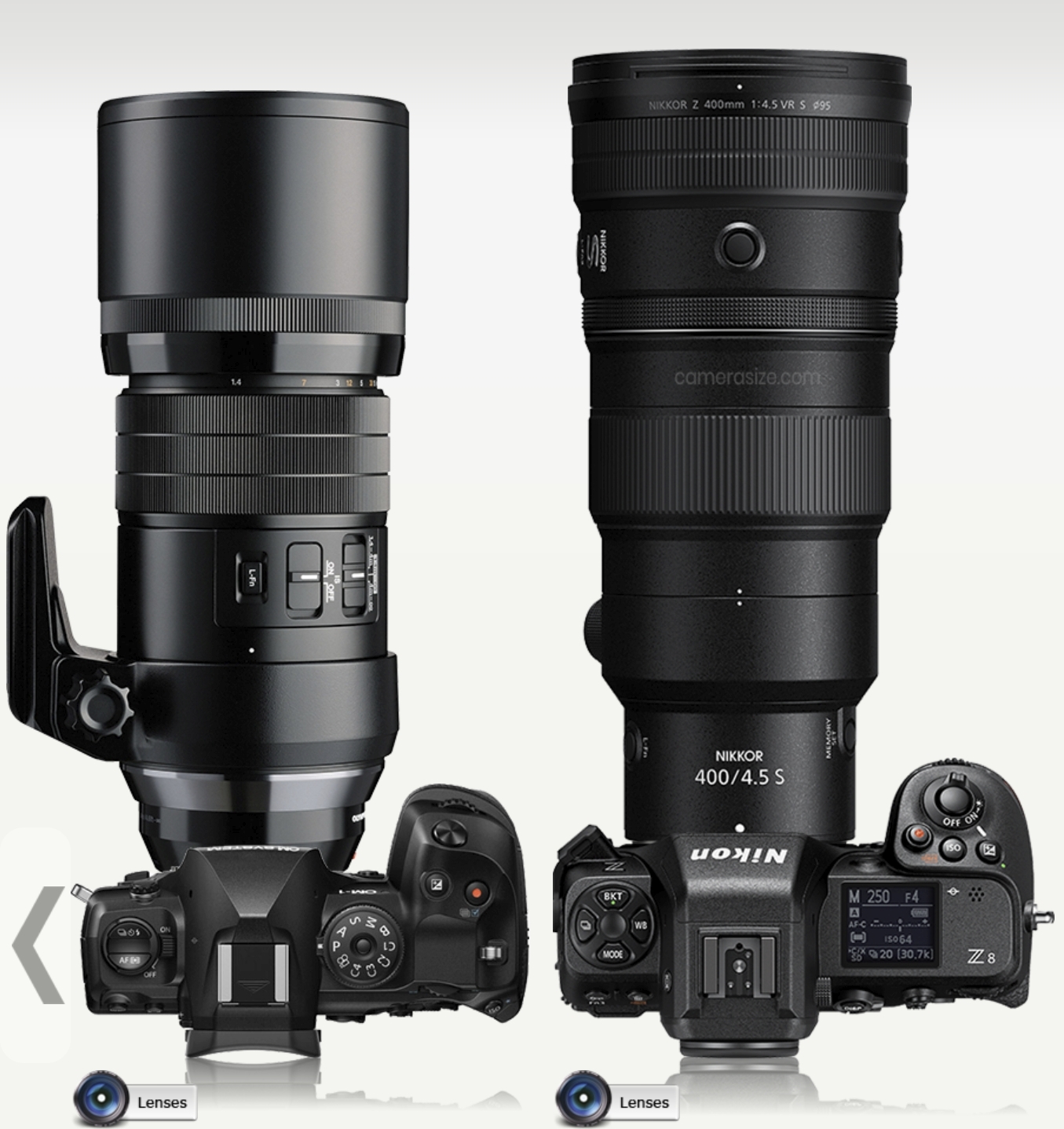
My Z8 with the Z 400/4.5 VR S weighs only 200g more than the OM System combo, with significantly better weight balance.
The body/lens weight balance of the Nikon combination is approximately 45:55, while the OM combination has a balance of ~ 30:70, making it significantly top/front-heavy.
If necessary, the Z TC-1.4x can be added, but apart from that, the Z8's sensor has sufficient potential for cropping.
Nikon's Synchro VR is also very effective in practice.
Those who prefer not to use a TC will find another lightweight option in the Z 600/6.3 PF VR S.