p.17 #2 · After 13 years of all Sony, I'm trying Nikon
"when the Z8 gets overexposed just shy over 1EV. The color shift happens way before any of the RGB channels are clipped, he showed RawDigger data as well"
This sounds a bit confusing. I wish we could see the histogram of the image when not "overexposed." I see the color shift in the blue. The most "overexposed" (right-most) image has more cyan. This is in the midtones, I guess. Maybe slightly toward the highlights. What is confusing is that this area in the histogram must be perfectly well-exposed in every image in the series. There is no "recovering" any image information, no clipping. Then, why the ETTR by 4/3 stops should have resulted in the color shift?
p.17 #4 · After 13 years of all Sony, I'm trying Nikon
ruthenium wrote:
"when the Z8 gets overexposed just shy over 1EV. The color shift happens way before any of the RGB channels are clipped, he showed RawDigger data as well"
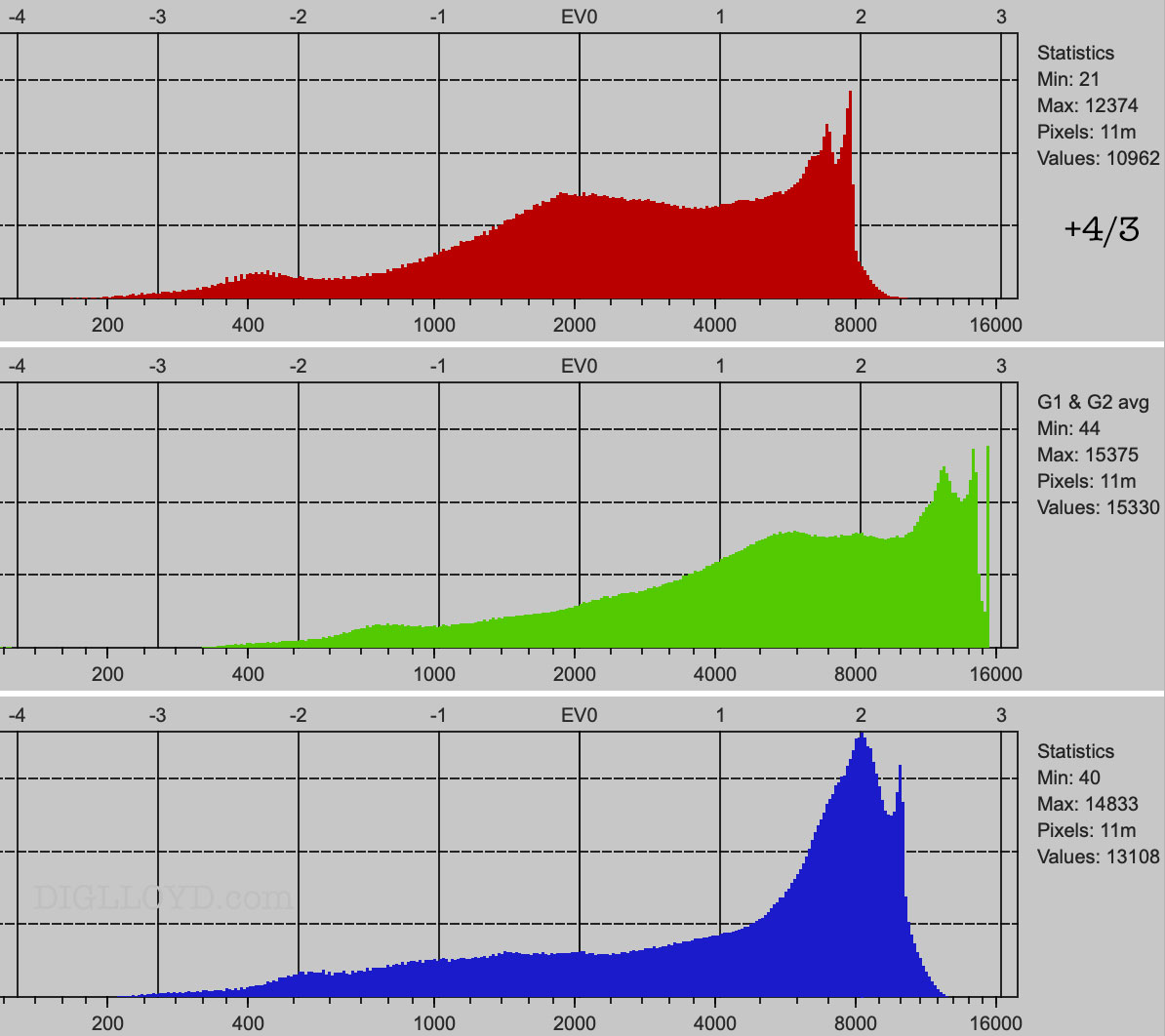
This sounds a bit confusing. I wish we could see the histogram of the image when not "overexposed."
Here's the histogram. I hope I won't get blasted for sharing more of the paywalled content:
I see the color shift in the blue. The most "overexposed" (right-most) image has more cyan. This is in the midtones, I guess. Maybe slightly toward the highlights. What is confusing is that this area in the histogram must be perfectly well-exposed in every image in the series. There is no "recovering" any image information, no clipping. Then, why the ETTR by 4/3 stops should have resulted in the color shift?
These are great questions, and I believe only a Nikon engineer could explain what we're looking at here. I suspect that some sensors aren't 100% linear/parallel in their RGB response at the margins. Lloyd claims that his other cameras don't exhibit this behavior. But my point is that the topic of dynamic range and color is more neuanced/complicated that some folks here dare to admit.
p.17 #5 · After 13 years of all Sony, I'm trying Nikon
j4nu wrote:
re:ETTR I'm sorry, what?
Exposing to the right, meaning giving the sensor maximum amount of light just short of highlight clipping. This is what people do to minimize noise/maximize DR. What many do not realize, is that color shifts may precede clipping on both ends, depending on sensor quality. BTW, this used to be common knowledge with early DSLRs in the early 2000s, but apparently it is news again in 2025
p.17 #6 · After 13 years of all Sony, I'm trying Nikon
My 1Ds comes to mind nearly 23 years ago.
I don't know what kind of crappy light people are shooting in nowadays but it's not necessary to obsess about capturing every photon in the darkest shadows to make great images.
p.17 #7 · After 13 years of all Sony, I'm trying Nikon
EB-1 wrote:
I don't know what kind of crappy light people are shooting in nowadays but it's not necessary to obsess about capturing every photon in the darkest shadows to make great images.
Shooting milky way in a nearly moonless night, with a shutter speed of 8s or less to avoid star trails, in a single shot to avoid the trouble of stacking, and want to bring up the foreground to make it visible. Granted it's not ISO 100, but I'm pretty sure most people in such a situation still wish they have a couple of extra stops of DR.
p.17 #8 · After 13 years of all Sony, I'm trying Nikon
old-gregg wrote:
Exposing to the right, meaning giving the sensor maximum amount of light just short of highlight clipping. This is what people do to minimize noise/maximize DR. What many do not realize, is that color shifts may precede clipping on both ends, depending on sensor quality. BTW, this used to be common knowledge with early DSLRs in the early 2000s, but apparently it is news again in 2025
I meant the aggresive part ... old-gregg wrote:
This is what happens when one aggressively ETTR.
BTW, I was not aware of color shifts preceding clipping. I'm not sure this is common knowledge. I also think this is some kind of a flaw in Nikon image processing pipeline rather than a general fact about DR/sensors...
p.17 #9 · After 13 years of all Sony, I'm trying Nikon
old-gregg wrote:
These are great questions, and I believe only a Nikon engineer could explain what we're looking at here. I suspect that some sensors aren't 100% linear/parallel in their RGB response at the margins.
Not really. The sensor has a fixed limit on it's capacity and simply makes sure that extra electrons have no effect (no bleeding). You are looking at a software artifact. Besides the sensor in the Z8 happens to be made by Sony.
Note that a percentage of pixels are already clipping in the histogram. What you are seeing is the effect of software trying to color any clipped (or nearly clipped) areas into the color of the surrounding non-clipped color. This clipping filter if you will is triggered for pixel areas even slightly below any actual clipping, as the exact value where a pixel clips is unknown (and slightly varying due to minute analog properties). This is a software feature necessary for any decent RAW developer to support since it is so common to have the sun or bright clouds clip even in otherwise well exposed images. Without this feature the color of clipped areas would look very funky, as the color channels don't start to clip at the same brightness. I believe a fully clipped sun without this treatment would look violet, as the green channel usually clips first.
p.17 #10 · After 13 years of all Sony, I'm trying Nikon
EB-1 wrote:
My 1Ds comes to mind nearly 23 years ago.
I don't know what kind of crappy light people are shooting in nowadays but it's not necessary to obsess about capturing every photon in the darkest shadows to make great images.
EBH
dont be fooled that modern sensors are any better then 23 y/old sensors, i downloaded some images from the canon d30 3 meg sensor and it holds more shadow DR than the latest 100 mf sensor.
p.17 #11 · After 13 years of all Sony, I'm trying Nikon
j4nu wrote:
BTW, I was not aware of color shifts preceding clipping.
There is a lot of shot noise in bright areas. Consider an area that has an average near the clipping point. Some pixels will exceed the clipping limit. Now even if all you do is exclude these pixels from consideration, the remaining pixels will have a lower average than what they would have had when including the higher out-layer values. This affects the clipping channel more than the other channels. Viola, a color shift.
p.17 #12 · After 13 years of all Sony, I'm trying Nikon
Daran wrote:
There is a lot of shot noise in bright areas. Consider an area that has an average near the clipping point. Some pixels will exceed the clipping limit. Now even if all you do is exclude these pixels from consideration, the remaining pixels will have a lower average than what they would have had when including the higher out-layer values. This affects the clipping channel more than the other channels. Viola, a color shift.
Yes, you're right. I thought the example didn't get even close to clipping value...
p.17 #13 · After 13 years of all Sony, I'm trying Nikon
j4nu wrote:
Yes, you're right. I thought the example didn't get even close to clipping value...
Seeing the histogram also makes me feel that the claim of no clipping is questionable. The green channel looks "too close to tell" to confidently claim no clipping and I am with Daran on that there's some clipping. This is the simplest explanation for the color shift, and I tend to like simple explanations.
Also, to my eye, the color shift is visible only in the rightmost image in the series, "overexposed" by 4/3 stops. I see no gradual or systematic color shift. It seems abrupt. Thus, clipping is a good explanation.
p.17 #14 · After 13 years of all Sony, I'm trying Nikon
A74me wrote:
dont be fooled that modern sensors are any better then 23 y/old sensors, i downloaded some images from the canon d30 3 meg sensor and it holds more shadow DR than the latest 100 mf sensor.
According to photons to photos, the GFX-100II has 4.29 stops more DR at ISO 100 than the Canon 30D.
Note that the 0.4 stop separating the Z8 from the a7rV has been described by some here as a "large" gap... so here we have 10x a large gap.
p.17 #16 · After 13 years of all Sony, I'm trying Nikon
j4nu wrote:
You keep repeating that, but if your read this thread, you'll see people said that 1EV is a "large" gap...
It was a tongue in cheek comment, sorry if that wasn't clear enough. I guess that one smiley wasn't enough. And/Or I need to work on my smiley selection.
Glad we agree that the gap between Z8 and a7rV is in fact not large.
p.17 #17 · After 13 years of all Sony, I'm trying Nikon
j4nu wrote:
You keep repeating that, but if your read this thread, you'll see people said that 1EV is a "large" gap...
Regardless, I don't understand how people can conclude that the sensor of 30D with DR of 8 at ISO of 100 is even remotely close to GFX-100II with DR of 12.3.
p.17 #19 · After 13 years of all Sony, I'm trying Nikon
tctmp wrote:
Regardless, I don't understand how people can conclude that the sensor of 30D with DR of 8 at ISO of 100 is even remotely close to GFX-100II with DR of 12.3.
who said the gfx has 12.3 ? and the d30 only has 8. sites have changed the method of testing over the years to market smaller pixels, but in reality bigger win every time. do your own test and then make an opioion instead of relying on others. take a file from the d30 and process it from the latest software and it will blow your mind 😊
p.17 #20 · After 13 years of all Sony, I'm trying Nikon
A74me wrote:
who said the gfx has 12.3 ? and the d30 only has 8. sites have changed the method of testing over the years to market smaller pixels, but in reality bigger win every time. do your own test and then make an opioion instead of relying on others. take a file from the d30 and process it from the latest software and it will blow your mind 😊
Since it seems you’ve shot with both the d30 and Gfx100, maybe post some samples that backs up your points. Talk is cheap.



 ...
...