New Voigtlander 35mm, 40mm & 50mm f/1.2 Nokton Review
p.6 #1New Voigtlander 35mm, 40mm & 50mm f/1.2 Nokton Review
Is anyone using THE 40 1.2 II on a Sony body? Do you know if It performd better than the original?
Apr 16, 2026 at 01:52 AM
p.6 #2New Voigtlander 35mm, 40mm & 50mm f/1.2 Nokton Review
carlos212 wrote:
Is anyone using THE 40 1.2 II on a Sony body? Do you know if It performd better than the original?
Just to clarify, there are no optical design changes, it's simply a cosmetic update for the Voigtländer 40mm f/1.2 II VM Mount.
Adapted to a Sony body, you'll still see the usual compromises in rendering and off-axis performance due to the thicker sensor stack.
Apr 23, 2026 at 08:36 AM
p.6 #3New Voigtlander 35mm, 40mm & 50mm f/1.2 Nokton Review
Thought they upgrade the coatings on the new version, didn't they?
Apr 24, 2026 at 03:12 AM
p.6 #4New Voigtlander 35mm, 40mm & 50mm f/1.2 Nokton Review
The 35/1.2 IV. Feels the same, I can’t tell a change in optics or coatings…but the all black looks much better IMO


Portra800
Portra800
Apr 27, 2026 at 07:06 PM
p.6 #5New Voigtlander 35mm, 40mm & 50mm f/1.2 Nokton Review
Digging up some old threads here. Now that I am retired I have too much time on my hands.
M11 and 50mm 1.2


M11 and 50mm 1.2
Apr 28, 2026 at 06:01 PM
p.6 #6New Voigtlander 35mm, 40mm & 50mm f/1.2 Nokton Review
Looking at the 40mm 1.2 due to the size as I have the original 50mm 1.2 and love that lens. Just curious and wanted to confirm, the lens hoods on these redesigns are reversible right? Can anyone share a photo of how that looks? Just curious how wide they can get for packability.
Jun 28, 2026 at 11:08 PM
p.6 #7New Voigtlander 35mm, 40mm & 50mm f/1.2 Nokton Review
Richardh54 wrote:
Looking at the 40mm 1.2 due to the size as I have the original 50mm 1.2 and love that lens. Just curious and wanted to confirm, the lens hoods on these redesigns are reversible right? Can anyone share a photo of how that looks? Just curious how wide they can get for packability.
Yes, the new separately sold accessory lens hoods for the latest versions of these lenses are reversible. There are 2 new Bayonet hoods for these, LH-14 (smaller) can work on all of them and LH-15 (larger) can work on 40/1.2 II and 50/1.2 II.
See Cosina's product introduction video for the segment that shows the hoods:
Jun 29, 2026 at 01:04 AM
p.6 #8New Voigtlander 35mm, 40mm & 50mm f/1.2 Nokton Review
Richardh54 wrote:
Looking at the 40mm 1.2 due to the size as I have the original 50mm 1.2 and love that lens. Just curious and wanted to confirm, the lens hoods on these redesigns are reversible right? Can anyone share a photo of how that looks? Just curious how wide they can get for packability.
Yes, the new separately sold accessory lens hoods for the latest versions of these lenses are reversible. There are 2 new Bayonet hoods for these, LH-14 (smaller) can work on all of them and LH-15 (larger) can work on 40/1.2 II and 50/1.2 II.
I guess LH-15 is too long to be used on 35/1.2 IV and would cause some additional vignetting, so that's why it's only meant for the 2 longer focal lengths.
See Cosina's product introduction video for the segment that shows the hoods (starting from around 4min 20s):
Jun 29, 2026 at 01:05 AM
p.6 #9New Voigtlander 35mm, 40mm & 50mm f/1.2 Nokton Review
Juha Kannisto wrote:
Richardh54 wrote
Looking at the 40mm 1.2 due to the size as I have the original 50mm 1.2 and love that lens. Just curious and wanted to confirm, the lens hoods on these redesigns are reversible right? Can anyone share a photo of how that looks? Just curious how wide they can get for packability.See Cosina's product introduction video for the segment that shows the hoods:
Ah, appreciate that. Looks like a 2 second section where it’s shown so I must have missed it way back.
Jun 29, 2026 at 07:21 AM
p.6 #10New Voigtlander 35mm, 40mm & 50mm f/1.2 Nokton Review
I believe I'm in a small minority of those who never bonded with the 40/1.2. Recently I've become interested in the 50/1.2 but am concerned about my experiences with the 40/1.2 carrying over. I found this review and thought it worth sharing. Greg has me convinced that I ought to try the 50/1.2.
Aug 23, 2026 at 09:41 AM
|
p.6 #11New Voigtlander 35mm, 40mm & 50mm f/1.2 Nokton Review
Juha Kannisto wrote:
Yes, the new separately sold accessory lens hoods for the latest versions of these lenses are reversible. There are 2 new Bayonet hoods for these, LH-14 (smaller) can work on all of them and LH-15 (larger) can work on 40/1.2 II and 50/1.2 II.
I guess LH-15 is too long to be used on 35/1.2 IV and would cause some additional vignetting, so that's why it's only meant for the 2 longer focal lengths.
See Cosina's product introduction video for the segment that shows the hoods (starting from around 4min 20s):
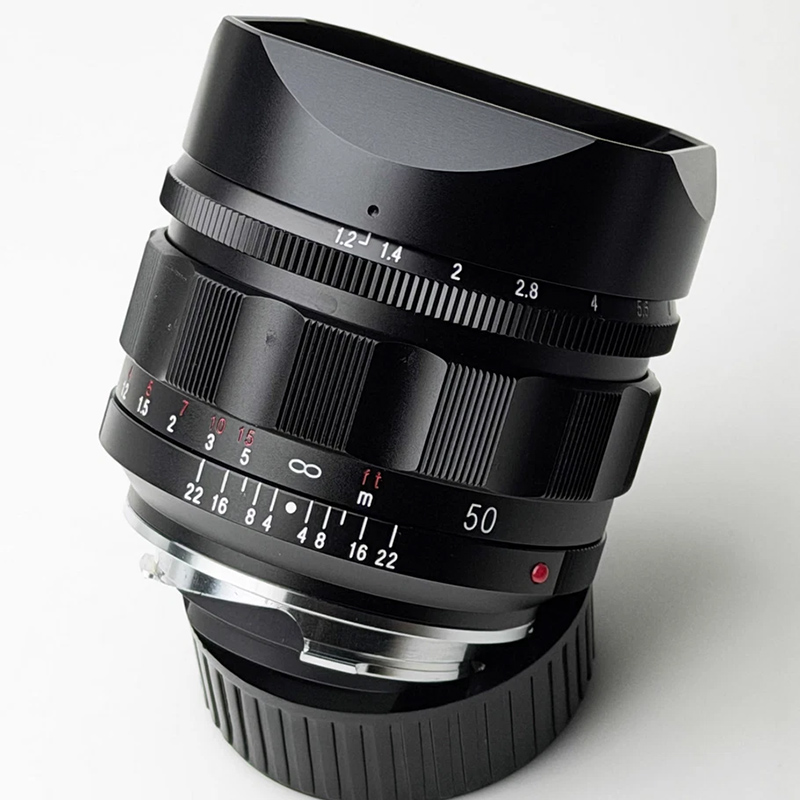
What's nice about the new lens versions and their updated hood is that the hood is reversible. If you'd prefer a different style, there's now a square hood option: https://www.ebay.com/itm/366010403348
Richardh54 wrote
Looking at the 40mm 1.2 due to the size as I have the original 50mm 1.2 and love that lens. Just curious and wanted to confirm, the lens hoods on these redesigns are reversible right? Can anyone share a photo of how that looks? Just curious how wide they can get for packability.I guess LH-15 is too long to be used on 35/1.2 IV and would cause some additional vignetting, so that's why it's only meant for the 2 longer focal lengths.
See Cosina's product introduction video for the segment that shows the hoods (starting from around 4min 20s):
What's nice about the new lens versions and their updated hood is that the hood is reversible. If you'd prefer a different style, there's now a square hood option: https://www.ebay.com/itm/366010403348
 |
||
 |
||
|
Oct 10, 2026 at 10:07 AM
p.6 #12New Voigtlander 35mm, 40mm & 50mm f/1.2 Nokton Review
Here's a fun bit of info for anyone thinking about the CV 40mm f/1.2 Nokton (all versions).
It is actually a little longer than 40mm. Cosina lists the angle of view at 55°, which works out to roughly 41.6mm on full frame. A true 40 would be closer to 57 degrees. I noticed it framing a bit tighter when comparing it to other 40s, and the numbers back that up.
The CV 50mm f/1.2 Nokton goes the other way and is closer to 49mm. So the real gap between the two is more like 7mm, not 10mm.
Is that good or bad? Depends on your setup. If you shoot a 35 and a 50, the 40 Nokton sits almost right in the middle. The midpoint between 35mm and 50mm, in terms of framing, is about 41.8mm, and the Nokton lands at roughly 41.6mm, so the spacing is nearly even, which is pretty nice.
This kind of thing is common across all brands, so it is not a knock on Voigtlander. Just something worth knowing before you buy both.
Oct 10, 2026 at 10:38 AM
p.6 #13New Voigtlander 35mm, 40mm & 50mm f/1.2 Nokton Review
Trying to figure out if I want the 40 or the 35 of these 1.2. I like that the 40 is a little smaller and its a different focal length. I’m already going to have two 35s in the Mandler and LLL APO, but obviously that 1.2 is different. I liked your 40mm samples, a lot. Good compression.
Oct 10, 2026 at 11:06 AM
p.6 #14New Voigtlander 35mm, 40mm & 50mm f/1.2 Nokton Review
The 40mm 1.2 is a special gem 💎
https://www.flickr.com/photos/200129422@N04/albums/72177720324508915/
https://www.flickr.com/photos/200129422@N04/albums/72177720324508915/
Oct 10, 2026 at 12:15 PM
p.6 #15New Voigtlander 35mm, 40mm & 50mm f/1.2 Nokton Review
'The lens suffers from pretty major focus breathing'.
In the 318 page review thread of the 40/1.2 (!) it takes but a moment to see that the vast majority of images are shot at close range. Focal length (AOV) is always determined at infinity, so if it starts out at 41.6mm, what is it when you reach 1m, 2m, 5m - let alone the commendably short MFD of 0.5m (VM), or even the Z version MFD of 0.3m?
See at 2:00 here:
..
..
Focus shift too, the Z at least really draws you into the picture - at 3:17:
..
We still love it, anyway.
Oct 10, 2026 at 02:12 PM
p.6 #16New Voigtlander 35mm, 40mm & 50mm f/1.2 Nokton Review
philip_pj wrote:
'The lens suffers from pretty major focus breathing'.
In the 318 page review thread of the 40/1.2 (!) it takes but a moment to see that the vast majority of images are shot at close range. Focal length (AOV) is always determined at infinity, so if it starts out at 41.6mm, what is it when you reach 1m, 2m, 5m - let alone the commendably short MFD of 0.5m (VM), or even the Z version MFD of 0.3m?
See at 2:00 here:
Focus shift too, the Z at least really draws you into the picture - at 3:17:
We still love it, anyway....Show more →
Good point about close focus, and you're right that the framing gets tighter as you focus closer. But I think 'pretty major focus breathing' may be overstating it.
With a unit-focusing lens like the CV 40/1.2 Nokton, the whole optical block moves forward as you focus, so the angle of view narrows a bit. Running the numbers for a lens that is about 41.6mm at infinity:
5m: about 42mm
2m: about 42.5mm
1m: about 43.5mm
0.5m (M-mount MFD): about 46mm
0.3m (Z-mount MFD): about 50mm
So at typical shooting distances, the change is only around 1 to 5%. It becomes more noticeable near MFD, especially on the E or Z version.
It's also not unique to the 40. Nearly every M lens behaves this way, including the 50/1.2 Nokton, which tightens up by a similar proportion at the same distance. So the difference between the two stays about the same whether you are shooting at infinity or up close.
That's why the infinity figure is still the right basis for comparing lenses. These numbers assume pure unit focusing, so actual results could vary a little depending on the optical design.
Oct 10, 2026 at 02:27 PM
p.6 #17New Voigtlander 35mm, 40mm & 50mm f/1.2 Nokton Review
It always looks worse than it is, in tests. Plenty of non-M lenses also, of course. I don't mind them doing it, I just want them to state the FL at typical shot-making focal distances, as well as the 'official' technical specification. Maybe I've been watching too many movies shot on telecentric lenses. 
Interesting that some SL primes have plenty of breathing:
Leica APO-Summicron-SL 75mm f/2 ASPH and related long-focal-length primes exhibit a substantial degree of focus breathing, with test measurements on the 75mm exceeding 20% change in the field of view/image section during focus pulls. I expected less as they are more video-oriented.
It also plays into the wide throat debate, with the wide mirrorless mounts from Canon and Nikon - greater opportunity for telecentric designs leading to lower rates of breathing. The issue was largely mismanaged, in my view, due to the technical nature of it.
"Canon avoided the trap of "marketing guff" by letting the actual performance of the native lenses do the talking. Canon's RF lenses achieve highly telecentric behavior.
Modern sensor designs feature microscopic shift-microlenses to capture oblique light, but reducing that obliqueness natively via lens architecture—as seen in wide RF primes—significantly reduces digital correction overhead."
So swings and roundabouts. Iain Neil says that digital sensors really 'like the taste' of telecentric rays. cheers.
Oct 10, 2026 at 03:14 PM
p.6 #18New Voigtlander 35mm, 40mm & 50mm f/1.2 Nokton Review
Loving the civil nature of the discussion.
Loving the images being posted.
I am grateful. The 40mm f/1.2 option has most of my attention, by far.
Focus breathing is not a problem, for me. Training/familiarization prevents surprises.
Now, it is a matter of whether M or Z mount should be prioritized, now that I have added a ZR, to complement my Nikon DSLRs and my Leica M cameras. I should clear two other financial priorities, first. An initial goal of early 2027 has had to be pushed farther down the road. Such is life.
Oct 11, 2026 at 08:47 AM
p.6 #19New Voigtlander 35mm, 40mm & 50mm f/1.2 Nokton Review
Would be interested to see a comparison of the 35/1.5 and the 35/1.2 IV. I like what I'm seeing from the 1.5 besides the really heavy astigmatism off center, that I'd very much rather avoid. How does the 35/1.2 fare in this regard?
On an unrelated note: given my experience using the Tahusa hood on the 50/1.2, I absolutely cannot recommend it. It noticeably clips bokeh balls starting from the mid field. Now I just use a UV filter and the stock lens cap instead.
On an unrelated note: given my experience using the Tahusa hood on the 50/1.2, I absolutely cannot recommend it. It noticeably clips bokeh balls starting from the mid field. Now I just use a UV filter and the stock lens cap instead.
Nov 09, 2026 at 01:11 PM
p.6 #20New Voigtlander 35mm, 40mm & 50mm f/1.2 Nokton Review
Do you want to hear a theory about astigmatism, which is an aberration that does not get much press,and all of that bad? I used to wonder about it, as many of my older CY lenses have it in plentiful supply, and despite this they are for sure sharp 'enough' for me at least. Their astigmatism was of the pattern of slowly divergent lines of sag and tan.
Well, all the Simera lenses (and plenty of other good ones too) have this steady back and forth line crossing across the frame, with generally two crosses. And it occurs at the high and mid frequencies, and even at times in the low frequency lines. Including Otuses and Milvus and even SL and M APOs (wide open).
I watch a guy at the Dirty Photography Club (YouTube), he was suggesting astigmatism promotes 3D, and that eradicating it produced flatter images that we associate (he and I, at least) with well and over-corrected lenses. I'd never heard that before about astigmatism and figured no one could do anything about it, and that they were trying to get it out of their designs. Now I feel differently as none of these lenses lack much in resolution or contrast, they are among the best, in fact.
So I am inclined to chalk it up to being another optical purity spiral (as I call them) that have little to do with the quality of the final images that come out of the lenses. And in fact, as these design guys are not mugs, it might be something they actually target in their designs, strange as that may seem. Actually, with respect to the Chinese, I do believe that.
Nov 09, 2026 at 04:15 PM