1bwana1 wrote:
It is not just about the EVF dot resolution. Size, shape, and glass optics, of an EVF make big differences. I have both the 9.44 Sony A1 and the 5.76 Leica SL3. I find the Leica EVF much easier to focus, and much nicer to shoot through.
I assume that might be because the SL3 EVF is wider or larger and perhaps has better glass inside?
Wonder if the Fuji 9.44 has a large size EVF? Anyone-thanks.
1bwana1 wrote:
How are they going to implement touch AF? M mount lenses have neither electronic communication with the camera, nor motors with which to do AF. The M platform is manual focus and always will be. The Q line is fixed lens, and always will be. The SL line is about build, weather sealing, and a lens line that is entirely image quality orientated. Size, weight, and form factor is not a priority for SL.
It will take an entirely new line of both bodies, and lenses for Leica to have a small form factor, interchangeable lens, auto focus camera line. The M platform is Leica's unique point of difference. It will never have AF....Show more →
You're right.... As I was typing I was thinking implentation similar to the leica CL once I saw the lack of rear buttons and possible touch screen. Total brain fart.
1bwana1 wrote:
It is not just about the EVF dot resolution. Size, shape, and glass optics, of an EVF make big differences. I have both the 9.44 Sony A1 and the 5.76 Leica SL3. I find the Leica EVF much easier to focus, and much nicer to shoot through.
I think it comes down to the EVF optics. The Leica definitely shows fewer aberrations, like distortion and other artifacts. Even the edges stay clear, which is impressive. That said, the EVF does feel smaller compared to the best Sony models, especially with 0.90x magnification versus 0.78x.
I think 0.78x is a solid magnification, though many have complained about the A7CR, which is not much lower at 0.70x. Still, I agree the optics make it look beautiful, even on the Q series.
There isn't much room for a high-end EVF on the M body. I'm curious to see what the compromise will be, but whatever they decide, you can bet there will be complaints.
zeitlos wrote:
I thought the EVF of the Sony is larger?
Yes, 0.90x vs 0.78x.
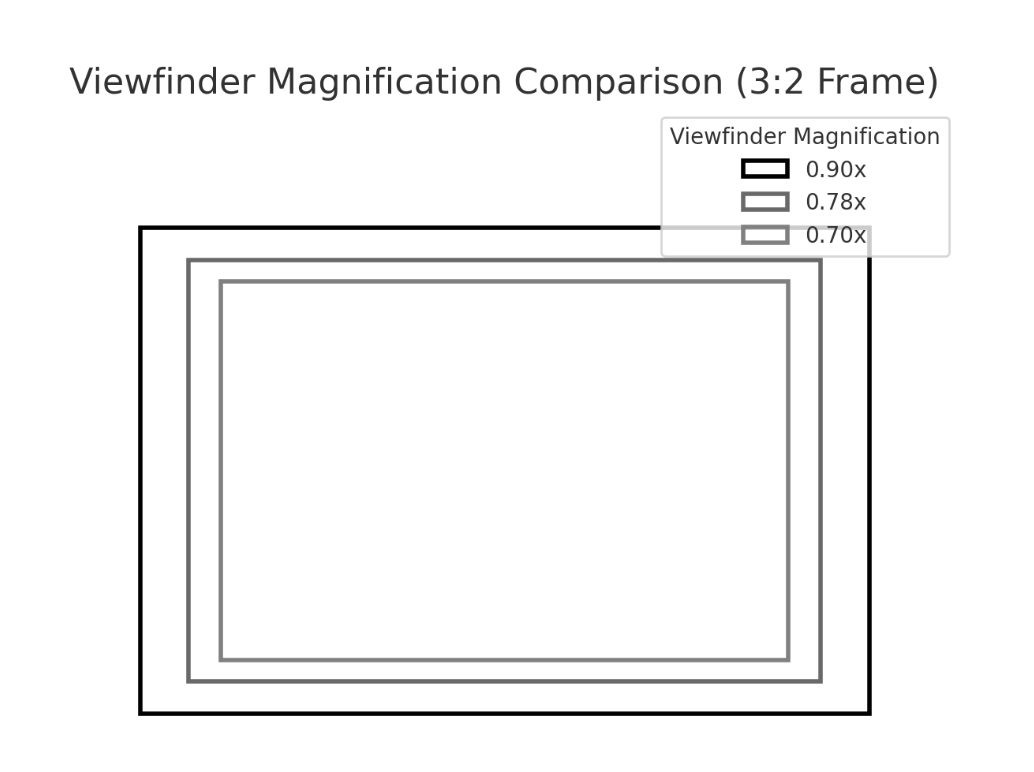
Here is an illustration showing how large the image appears when looking through the viewfinder of different cameras, using a 3:2 aspect ratio to represent the sensor frame:
• 0.90x – Best Sonys (largest viewing area)
• 0.78x – Best Leicas
• 0.70x – Sony A7CR (smallest viewing area)
zeitlos wrote:
I thought the EVF of the Sony is larger?
I just did a side by side comparison with a lower magnification..
Although the shapes are different in the surrounding hard material and rubber eye cups are different, the actual measurements of the EVF window are both about the same at 0.75" X 0,50". Both use glass optics in the EVF. The magnifications are very different with the Sony being 0.90 and the Leica 0.78. Both are OLED based. So a higher DPI with larger magnification, just doesn;'t seem as smooth to me as a lower DPI .
Side by side I do favor the Leica for shooting and focusing. Reviewing images I favor the Sony because of the magnification which allows for better enlargement and detail inspection. I think the differentiation in favor of the Leica is likely primarily the result of better glass and optics. Possibly, also focus peaking implementations are playing a part. Fore sure, both are at the top of the technology in this feature. I really enjoy shooting manual focus on the SL3, not as much with the A1.
Here is an illustration showing how large the image appears when looking through the viewfinder of different cameras, using a 3:2 aspect ratio to represent the sensor frame:
• 0.90x – Best Sonys (largest viewing area)
• 0.78x – Best Leicas
• 0.70x – Sony A7CR (smallest viewing area)
Theoretically one could also use the GFX 100II with its 1.0x EVF. Medium format camera of course, but it can be set to shoot cropped to 35mm. It would be a bit odd to do that though, instead of using native glass.
I was a bit surprised that Leica didn’t push the SL3 EVF to 1.0x magnification.
There we go with the Fuji GFX 100 II. That was the Fuji I was tinking about. Anyone can chime in if they own a ton of gear, i.e., A1, SL3 and GFX 100 II. Thanks.
Fred Miranda wrote:
I think it comes down to the EVF optics. The Leica definitely shows fewer aberrations, like distortion and other artifacts. Even the edges stay clear, which is impressive. That said, the EVF does feel smaller compared to the best Sony models, especially with 0.90x magnification versus 0.78x.
I think 0.78x is a solid magnification, though many have complained about the A7CR, which is not much lower at 0.70x. Still, I agree the optics make it look beautiful, even on the Q series.
There isn't much room for a high-end EVF on the M body. I'm curious to see what the compromise will be, but whatever they decide, you can bet there will be complaints. ...Show more →
Agree Fred, it will take some fine engineering, but wonder if the Q EVF could fit in an M, of course not using/needing AF algorithms.
stgrove wrote:
wonder if the Q EVF could fit in an M, of course not using/needing AF algorithms.
It looks from the prototype pictures that they have created lots of room over in the EVF area by removing the ISO dial and the big mechanical RF mechanisms. I think they will be able to get a nice quality EVF in the body. My biggest objection to the current M Visoflex is actually that is not stable. This is due to the M cameras not having any form of image stabilization. This is extremely bad when zoomed in for focusing. I'm not sure they can get to a stable zoomed image with just electronic stabilization. The best solution would be IBIS, but so far they say they cannot fit it in the M body. Is that possibly the reason for the complete lack of buttons on the prototype? Making room for IBIS?
1bwana1 wrote:
It looks from the prototype pictures that they have created lots of room over in the EVF area by removing the ISO dial and the big mechanical RF mechanisms. I think they will be able to get a nice quality EVF in the body. My biggest objection to the current M Visoflex is actually that is not stable. This is due to the M cameras not having any form of image stabilization. This is extremely bad when zoomed in for focusing. I'm not sure they can get to a stable zoomed image with just electronic stabilization. The best solution would be IBIS, but so far they say they cannot fit it in the M body. Is that possibly the reason for the complete lack of buttons on the prototype? Making room for IBIS?
stgrove wrote:
For me less Italian coffee each day is worth 3 stops while using an M. I prefer Illy personally.
I don't drink coffee but in many cases I can get better images when I shoot with a camera that has IBIS due to slower shutter speeds resulting in lower ISO
stgrove wrote:
There we go with the Fuji GFX 100 II. That was the Fuji I was tinking about. Anyone can chime in if they own a ton of gear, i.e., A1, SL3 and GFX 100 II. Thanks.
The GFX100ii EVF is astounding. It feels vast. It also has the optics sorted so there is absolutely nothing on the market close to it. By some margin the best overall EVF ever made. Using the GFX100ii EVF is an incredible immersive experience. The camera is big but handles really well except for the usual Fuji menu mess. And it’s already the best EVF you can then add the tilt adaptor. 10/10.
The Sony 9m dot evf on the A1ii and A7R5 vs the SL3 is a wash for me. The Sony has the resolution and magnification. The Leica has better optics. I prefer the Sony, slightly, for shooting but the Leica, by a margin, for playback. Moving from one to the other doesn’t matter much to me. But I do prefer reviewing images in the SL3. The Sony's seem to fall apart beyond a certain magnification and it’s harder to assess critical sharpness. Same for punching in to manual focus. Also the Sony has 1 billion setting potions so I’m not actually sure I have it set up right after 2 years of using it?? The actual shooting experience is excellent with fast refresh rates and good brightness. With both the Sony and Leica it’s actually pretty easy to see if you have nailed focus.
Honarable mention to the X2D. Resolution is lower than the Fuji 100ii but it’s still 1.0x and has excellent optics. Reviewing images is a great experience here. It has a *shimmer* when lenses are in critical focus so manual focus without focus aids is possible sometimes.
I have. no experience with Nikon’s latest except a play in my dealers store and a 1 day demo on a Z8, so I can’t comment on them. The R5ii is only slightly behind the Sony and Leica in real world use. By a tiny amount. It’s still very good. It’s a solid EVF for shooting and playback. It’s very responsive and Canons choice of blue focus boxes works really well.
To keep the size of the M11V the same as the M11-P I don’t see a great magnification unit going into it. Hopefully the optics are good, ike the SL3.
Yes, Sony A1/9 III/A7R5 & GFX100II evf's are 0.64". Biggest is X2D & original SL @ 0.66". Only X2D & GFX100II have 100% coverage. Other Leica / Canon / Nikon / Fuji EVF's are at biggest @ 0.5". Other common size is 0.45" (Olympus) & 0.39" (A7CR/X-E5). You can sort the evf sizes in below link:
serhan_ wrote:
Yes, Sony A1/9 III/A7R5 & GFX100II evf's are 0.64". Biggest is X2D & original SL @ 0.66". Only X2D & GFX100II have 100% coverage. Other Leica / Canon / Nikon / Fuji EVF's are at biggest @ 0.5". Other common size is 0.45" (Olympus) & 0.39" (A7CR/X-E5). You can sort the evf sizes in below link:
Older Nex-6 or CL had 0.5" evf's also... I checked it last month when I had lots of eye allergy and couldn't use the small 0.39" evf's...
IMO, the most important aspect of an EVF is magnification because it directly affects how "immersive" the experience feels. Second is resolution, which brings clarity to fine detail and helps with focus precision, which is crucial with manual lenses. Panel size matters the least on its own and only becomes meaningful when combined with good magnification and resolution..
Another important factor is the optical IQ of the EVF itself. Some brands, like Leica, are known for having well-corrected optics with minimal distortion, low aliasing, and reduced CA, which makes the viewing experience feel more natural with better contrast and fewer distractions.
I assume it’s unlikely, but an adjustable magnification would be interesting. Being able to switch from .73x for 35mm to 1x for 50mm, for example, would be very appealing.
I would be happy with this:
Viewfinder
Type
Electronic (OLED)
Resolution
5,760,000 Dot
Coverage
100%
Magnification
Approx. 0.79x
Diopter Adjustment
-4 to +2
In my opinion, the Q3(43) EVF is nothing special in practice. More like just okay. The SL2/3 models, on the other hand, are much, much better. But it’s unlikely to find much space in an M body.