This topic is in the 2025 archive. You can read it and like its posts here. It is read only.
Archive 2025A7R5 / A7IV difference -- color science differences?
p.3 #1A7R5 / A7IV difference -- color science differences?
mawz wrote:
bwcolor wrote
This thread has me confused. Multiple people have posted that the A7RV sensor has too much resolution and they would prefer less resolution. Do you mean that you believe that lower resolution cameras are more responsive and have better low light capability? If so, the use of the word ‘resolution’ is misleading. Do you mean that you have an old computer and limited drive space? If so, then I would suggest that spending money on an expensive camera might be putting the proverbial horse before the cart. If you are really talking resolution, then I think that you are not thinking things through. I rarely need the resolution of my high resolution cameras, but when I do require the full resolution, lower resolution files will never do. My move to 60-100Mpix cameras has changed how I process images. I always try to compose in the viewfinder, but here is an image where I didn’t have time to compose, move, or in anyway do anything but press the shutter. The look was standard older daughter, how dare you photograph me…. It was taken in the relative low light of the hotel room. The image is now a 24”x48” (after pretty severe cropping) hung on my wall and my oldest daughter loves it. That was only one image where I need that kind of crop and asked for that size of print, but I now do more cropping in post than ever before.1. I find the ~40-50MP bodies to be the sweet spot for resolution, DR and noise performance.
2. I find the file sizes for those bodies to again be a sweet spot for buffer and write performance in-camera with current cards
3. I do prefer the 61MP bodies for flexibility in crop, but find the 40-50MP bodies to be acceptably close
I currently shoot a 33MP body (A7iv) and a 45MP body (Z7). I don't think I'd go back to 20-24MP...Show more →
A7RV's one of best feature the 26MP mode, I use it 98% of time. Walk arounds 35GM is an 50mm f2 lens too, because apsc crop has exactly same resolution.
Mar 19, 2025 at 11:37 AM
p.3 #2A7R5 / A7IV difference -- color science differences?
Lukacs wrote:
A7RV's one of best feature the 26MP mode, I use it 98% of time. Walk arounds 35GM is an 50mm f2 lens too, because apsc crop has exactly same resolution.
The A7iv has that too (but at a less useful 14MP resolution). It's on all the newer bodies with lossless compression. I do use it for walkaround/street work.
It's a really killer idea, especially since the APS-C crop switch is seamless.
Mar 19, 2025 at 11:45 AM
p.3 #3A7R5 / A7IV difference -- color science differences?
Jonas B wrote:
Sony cameras apply gamma curves before the ADC. Not all cameras work this way, but Sony cameras do. You can easily see this effect yourself by shooting the same scene with varying gammas. The raw output histograms in Lightroom (of any other raw processor) are different.Like Daran I doubted this. Today I got a chance to try this IRL.
I placed a Calibrite Digital SG card on a white table pretty close to a window (to lazy to fix with light for this). Then I took an image for every possible Gamma setting available using an A1 fw 3.0. Like 16 images i think. To avoid any possible mistake i put a note below the SG card with the current Gamma setting written on it.
A quick move to ACR.
I applied my usual custom profile to all images and everything else to off. I applied the...Show more →
You provided your own evidence of the effect when you "equalized" and "shifted" exposure to get similar visual output shows that the underlying raw data is different. Lightroom is visually displaying colors mapped to your particular monitor output profile (or whatever soft profile you were using). Although you can look at the HDR histogram in Lightroom and see how the image brightness shifts from one gamma to another. Color mapping is purely a construct of your output profile. The raw data has no color, only brightness of each color channel.
Sony indirectly explains the gamma effect in the camera Help Guides:
If you develop RAW images with shooting settings, the following settings are not reflected:
Black Level
Black Gamma
Knee
Color Depth
If you change [Gamma], the available ISO value range changes.
There may be more noise in dark parts depending on the gamma settings. It may improve by setting the lens compensation to [Off].
Therefore, Gamma settings are reflected in RAW image. The relation to ISO and noise shows the gamma setting effects the data upstream of the A/D conversion.
It is easier to visualize using RawDigger which shows the actual raw channel histograms. You can see the varying brightness and dynamic range between some (but not all) of the gamma settings. Clearly some gammas use the same A/D pipeline while others have distinctly different processing.
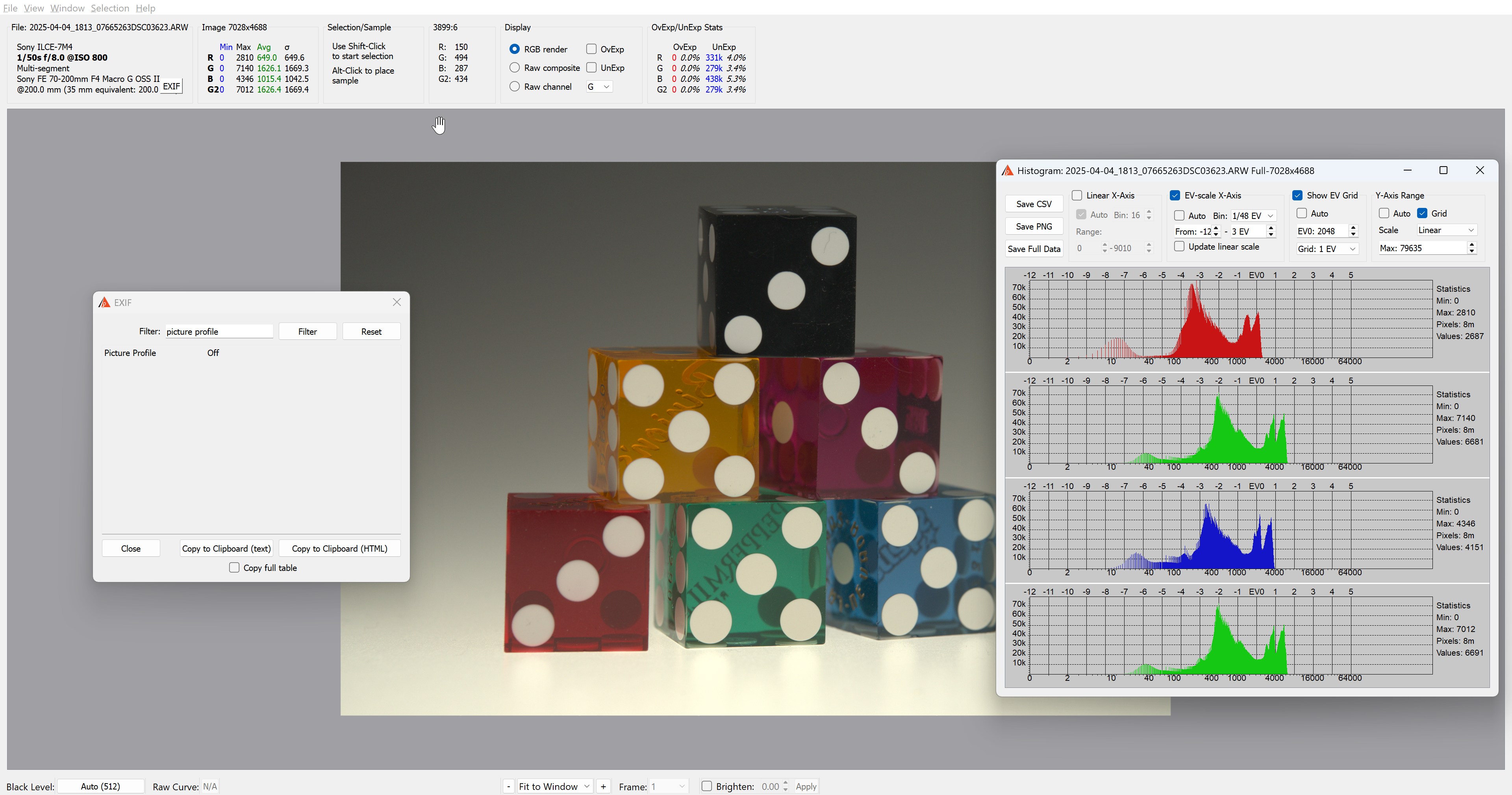
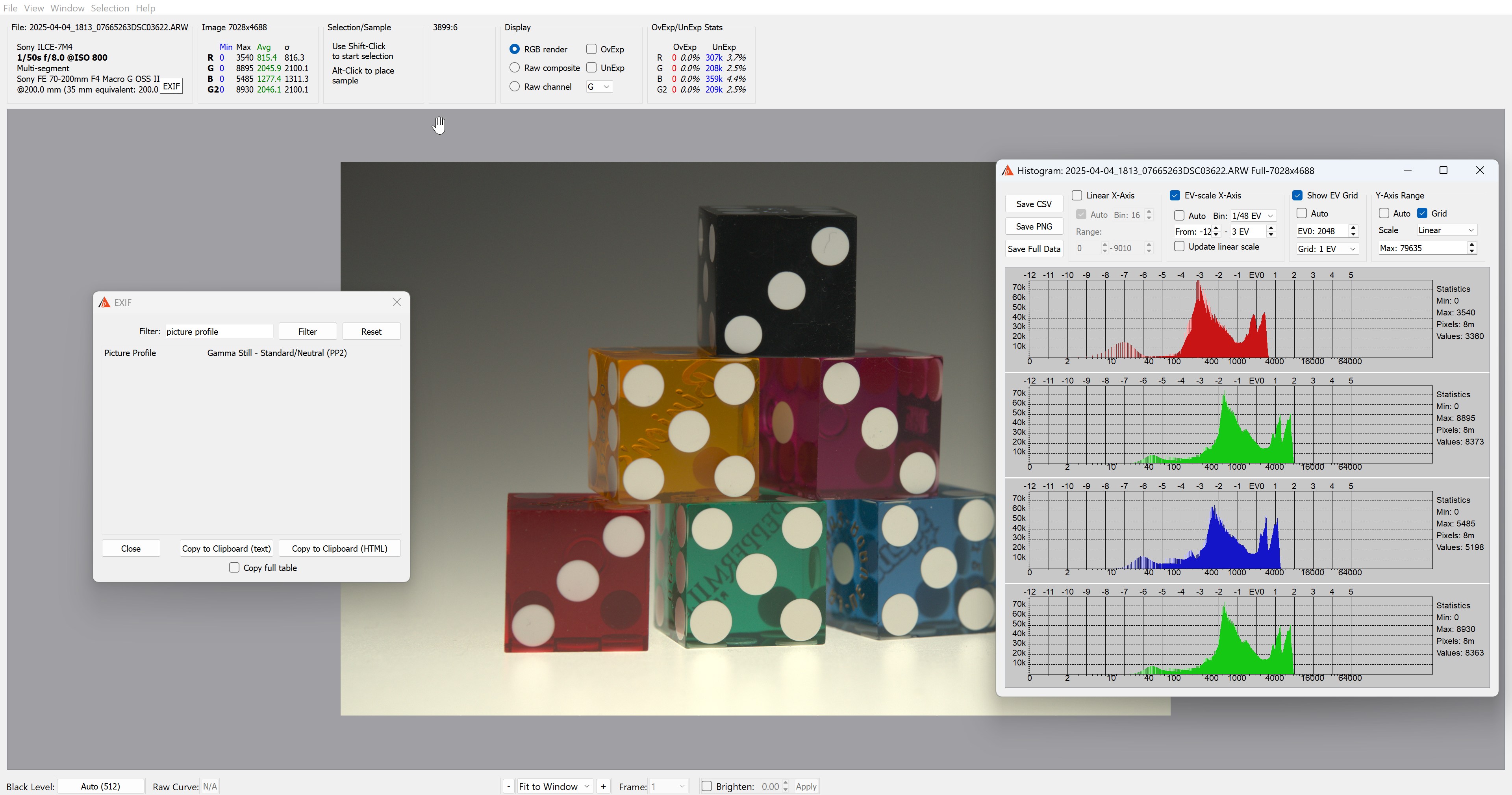
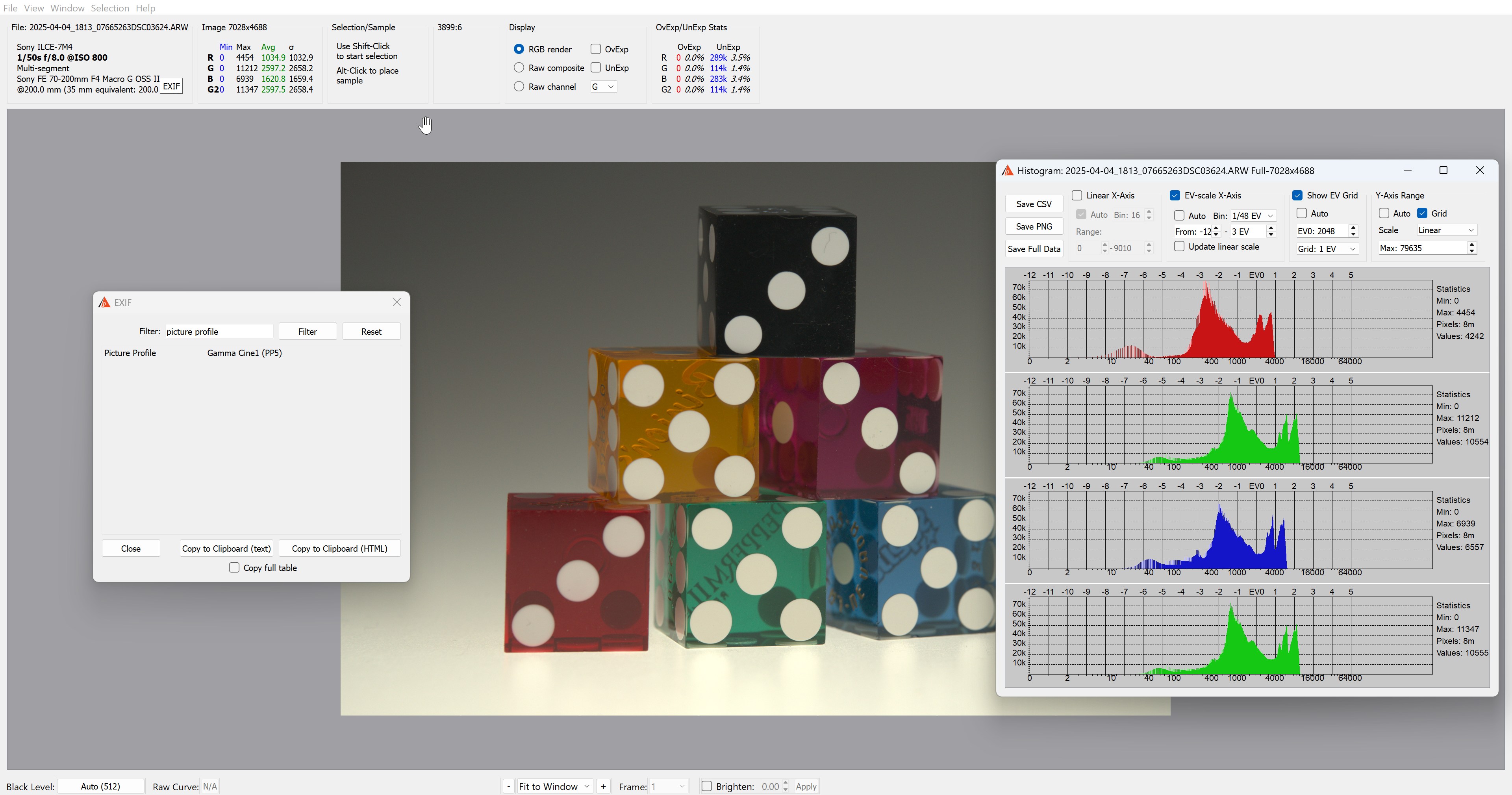
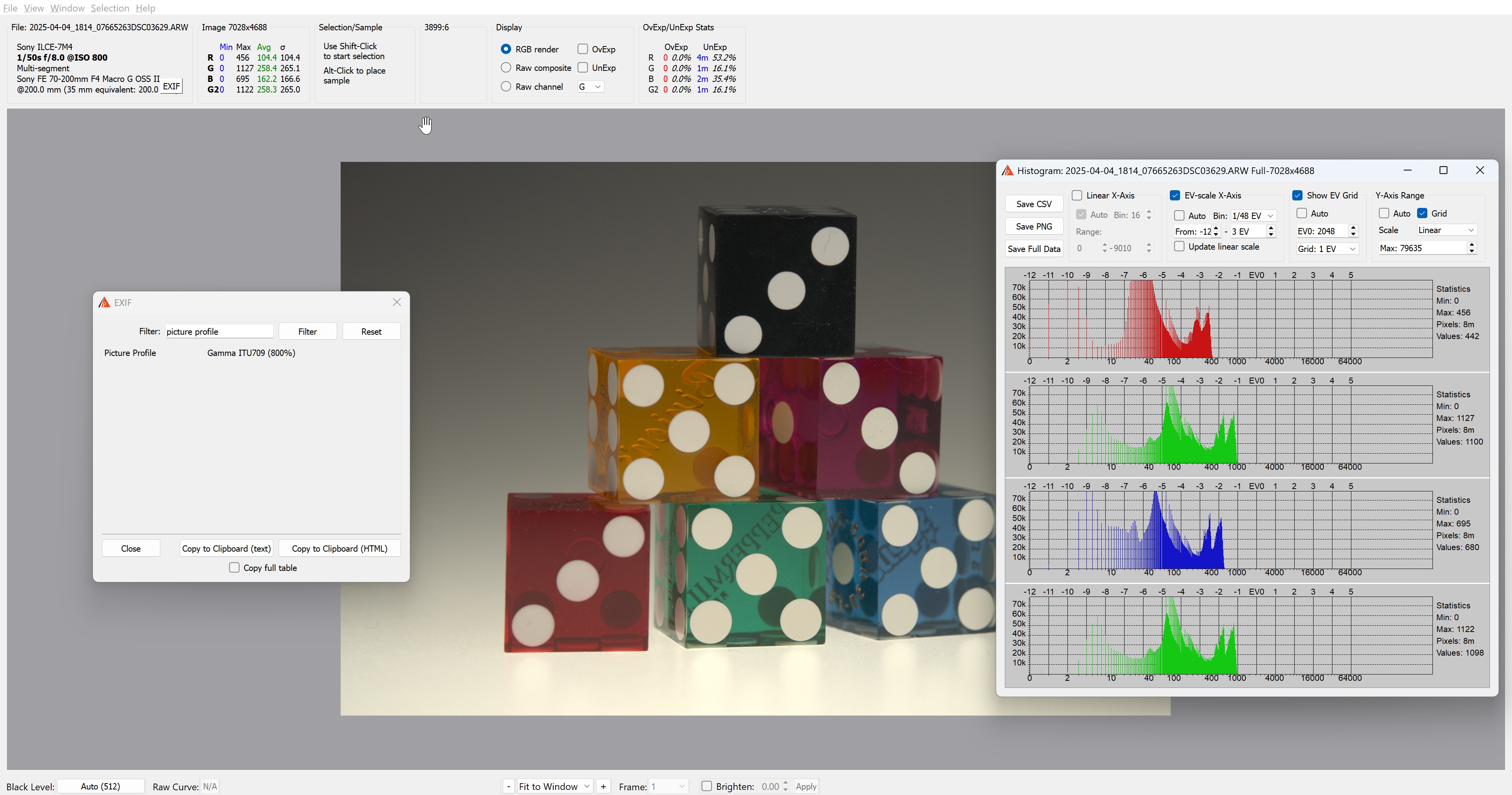
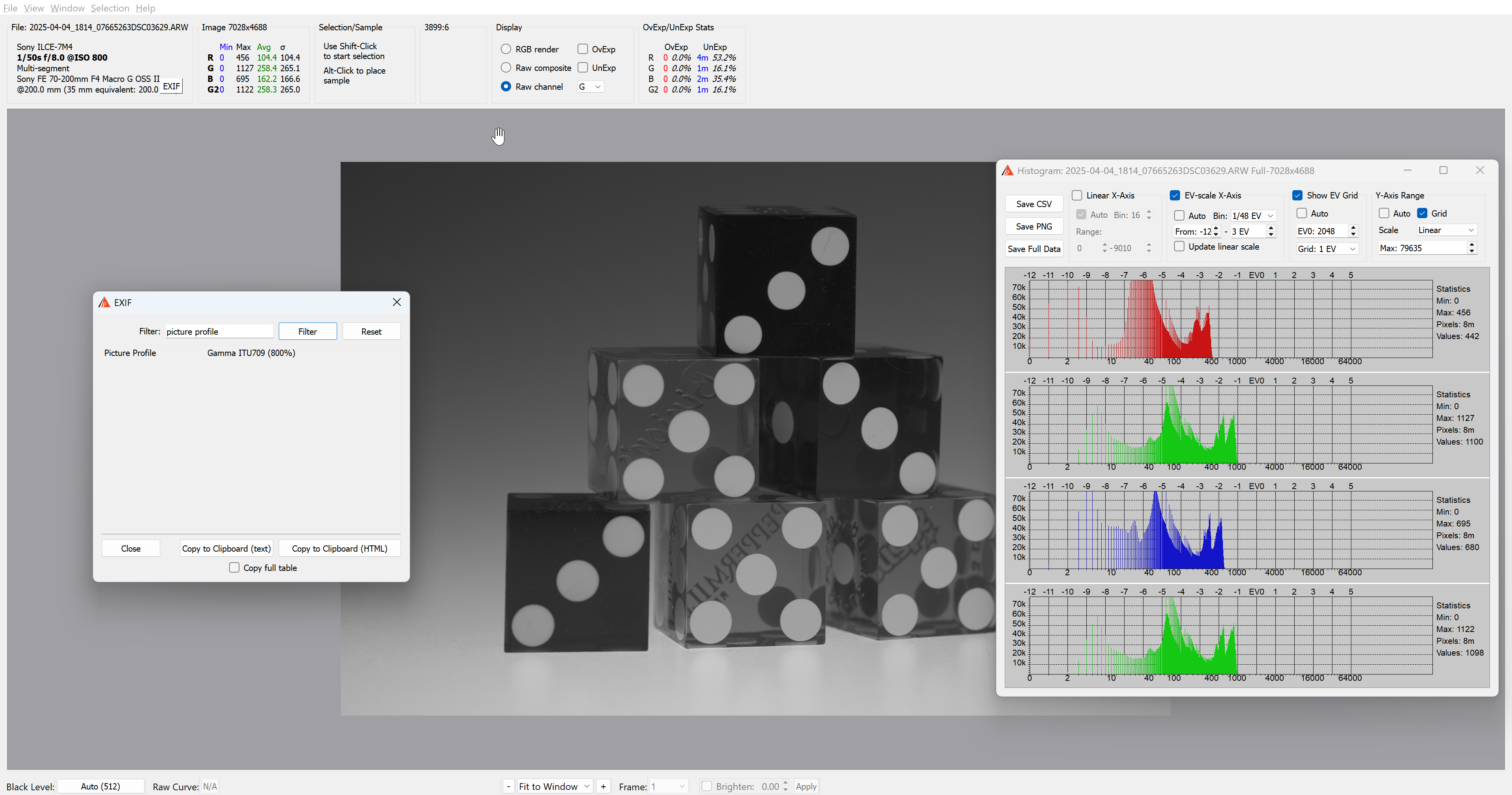
jeffbuzz wrote
[...]Sony cameras apply gamma curves before the ADC. Not all cameras work this way, but Sony cameras do. You can easily see this effect yourself by shooting the same scene with varying gammas. The raw output histograms in Lightroom (of any other raw processor) are different.
I placed a Calibrite Digital SG card on a white table pretty close to a window (to lazy to fix with light for this). Then I took an image for every possible Gamma setting available using an A1 fw 3.0. Like 16 images i think. To avoid any possible mistake i put a note below the SG card with the current Gamma setting written on it.
A quick move to ACR.
I applied my usual custom profile to all images and everything else to off. I applied the...Show more →
You provided your own evidence of the effect when you "equalized" and "shifted" exposure to get similar visual output shows that the underlying raw data is different. Lightroom is visually displaying colors mapped to your particular monitor output profile (or whatever soft profile you were using). Although you can look at the HDR histogram in Lightroom and see how the image brightness shifts from one gamma to another. Color mapping is purely a construct of your output profile. The raw data has no color, only brightness of each color channel.
Sony indirectly explains the gamma effect in the camera Help Guides:
If you develop RAW images with shooting settings, the following settings are not reflected:
Black Level
Black Gamma
Knee
Color Depth
If you change [Gamma], the available ISO value range changes.
There may be more noise in dark parts depending on the gamma settings. It may improve by setting the lens compensation to [Off].
Therefore, Gamma settings are reflected in RAW image. The relation to ISO and noise shows the gamma setting effects the data upstream of the A/D conversion.
It is easier to visualize using RawDigger which shows the actual raw channel histograms. You can see the varying brightness and dynamic range between some (but not all) of the gamma settings. Clearly some gammas use the same A/D pipeline while others have distinctly different processing.
Apr 05, 2025 at 01:00 PM
p.3 #4A7R5 / A7IV difference -- color science differences?
jeffbuzz wrote:
[...]
You provided your own evidence of the effect when you "equalized" and "shifted" exposure to get similar visual output shows [...]
Hi,
There was no equalization made in my experiment. All images got the same profile and the same white balance value. After that several of them were looking the same while some other needed an exposure compensation to look the same.
Changing the "exposure" only is to me a common linear adjustment. If I accidently have, let's say underexposed, an image a stop and then lift it a stop in ACR or Lightroom - I never think I changed the gamma. That was the only kind of adjustment needed to make the images match.
Are you saying this was altering their gamma values I have to take your word for it. Gamma has to me always been a non-linear physical quantity but I might be wrong about that.
Btw:
I took screenshots of the first three histograms from the images you posted. They fit fine as overlayes for each other if you just move them a bit to the left or right. Exposure adjustment, no gamma change. (I think)
/Jonas
Apr 05, 2025 at 01:33 PM
p.3 #5A7R5 / A7IV difference -- color science differences?
Jonas B wrote:
You provided your own evidence of the effect when you "equalized" and "shifted" exposure to get similar visual output shows [...]Hi,
There was no equalization made in my experiment. All images got the same profile and the same white balance value. After that several of them were looking the same while some other needed an exposure compensation to look the same.
Changing the "exposure" only is to me a common linear adjustment. If I accidently have, let's say underexposed, an image a stop and then lift it a stop in ACR or Lightroom - I never think I changed the gamma. That was the only kind of adjustment needed to make the images match.
Are you saying this was altering their gamma...Show more →
Gamma determine the tonal response curve when voltages from the sensor are mapped to grey tone brightness values in the raw data. When you adjust exposure in post (LR, C1, etc) you're shifting the raw data relative to that curve. The left / right shifting of the histogram between gamma settings shows how a different tone curve is applied.
jeffbuzz wrote
[...]You provided your own evidence of the effect when you "equalized" and "shifted" exposure to get similar visual output shows [...]
There was no equalization made in my experiment. All images got the same profile and the same white balance value. After that several of them were looking the same while some other needed an exposure compensation to look the same.
Changing the "exposure" only is to me a common linear adjustment. If I accidently have, let's say underexposed, an image a stop and then lift it a stop in ACR or Lightroom - I never think I changed the gamma. That was the only kind of adjustment needed to make the images match.
Are you saying this was altering their gamma...Show more →
Gamma determine the tonal response curve when voltages from the sensor are mapped to grey tone brightness values in the raw data. When you adjust exposure in post (LR, C1, etc) you're shifting the raw data relative to that curve. The left / right shifting of the histogram between gamma settings shows how a different tone curve is applied.
Apr 05, 2025 at 03:22 PM
p.3 #6A7R5 / A7IV difference -- color science differences?
jeffbuzz wrote:
Gamma determine the tonal response curve when voltages from the sensor are mapped to grey tone brightness values in the raw data. When you adjust exposure in post (LR, C1, etc) you're shifting the raw data relative to that curve. The left / right shifting of the histogram between gamma settings shows how a different tone curve is applied.
Yes. So far I get it and agree. I have always understood it as the gamma curve isn't linear. like this:
https://photos.imageevent.com/jonas_b/sellingstuff2023/gamma.jpg
So, when I took all those images of the color checker card I mentioned I changed the camera gamma setting as you did above. The thinking was to develop the images in ACR using the same settings for all the images. It turned out that all I had to adjust in ACR to make the images look the same with the Exposure slider. That seems as a linear change to me, not an adjustment of a curve.
Here are crops from row five of the images. The text in the images for explanation.
https://photos.imageevent.com/jonas_b/sellingstuff2023/comparing%20values_2.jpg
The white-grey-black patches work as control points and the RGB values where measured in Photoshop before converting the image to sRGB, measuring patch 11x11 pixels.
I see the same or very similar result in your screenshots where you can use the histograms as overlays and staple them just fine on top of each other.
I simply don't see any gamma curve adjustments being made to these images. The levels are however up or down a bit but that is a linear shift. I might be dense and guess I miss something?
EDIT: Fixed a problem with the image and the last two sentences.
Apr 06, 2025 at 02:58 AM
p.3 #7A7R5 / A7IV difference -- color science differences?
Jonas B wrote:
Yes. So far I get it and agree. I have always understood it as the gamma curve isn't linear. like this:
https://photos.imageevent.com/jonas_b/sellingstuff2023/gamma.jpg
So, when I took all those images of the color checker card I mentioned I changed the camera gamma setting as you did above. The thinking was to develop the images in ACR using the same settings for all the images. It turned out that all I had to adjust in ACR to make the images look the same with the Exposure slider. That seems as a linear change to me, not an adjustment of a curve.
Here are crops...Show more →
everyone convinces themselves that pixel dust is being added, good conclusive test that there isnt.
jeffbuzz wrote
Gamma determine the tonal response curve when voltages from the sensor are mapped to grey tone brightness values in the raw data. When you adjust exposure in post (LR, C1, etc) you're shifting the raw data relative to that curve. The left / right shifting of the histogram between gamma settings shows how a different tone curve is applied.https://photos.imageevent.com/jonas_b/sellingstuff2023/gamma.jpg
So, when I took all those images of the color checker card I mentioned I changed the camera gamma setting as you did above. The thinking was to develop the images in ACR using the same settings for all the images. It turned out that all I had to adjust in ACR to make the images look the same with the Exposure slider. That seems as a linear change to me, not an adjustment of a curve.
Here are crops...Show more →
everyone convinces themselves that pixel dust is being added, good conclusive test that there isnt.
Apr 06, 2025 at 03:29 PM
p.3 #8A7R5 / A7IV difference -- color science differences?
jeffbuzz wrote:
Gamma determine the tonal response curve when voltages from the sensor are mapped to grey tone brightness values in the raw data.
Nothing is applied to any voltages. Direct ADC to RAW. The RAW data is inherently linear, because sensor response to light is linear. This is trivial to see using gazillion RAW editing / inspection tools. Gamma is applied later, entirely in software.
In fact, the entire purpose of the RAW format is exactly what's in the name: to be raw. To move all "color science" into the software realm. The only hardware bit which remains as a potential contributor to color response differences between cameras is their color filter array, but even that can be wiped out in software. You can do everything in software, there is no need to mess with raw data in-camera. I built LUTs to mimic Nortisu scans of Portra 400 using Fujifilm RAW as a source. With this much software flexibility and power, it makes zero sense to touch ADC output. Basically, color science begins in a RAW converter, not earlier.
When people complain that some RAW files are easier to work with than others, what they are saying (without understanding) is that some RAW converters have better-fitting color profiles than others. My personal tragedy is that my favorite RAW converter (C1) requires a lot of effort to get my-taste-matching color from Sony files, while its Fuji profiles are much better. Another often forgotten variable is a monitor. Because what we see is two profiles applied sequentially: raw -> camera -> monitor. So it's the combination of a camera profile and a monitor profile that defines what we see. And neither of those is often made by your camera manufacturer! That's why there's no "Sony color".
That said, I do believe some manufacturers tried in the past to fuck with raw data, and were caught. Notably, Pentax and Canon had a habit on running noise reduction on it. But those were isolated crimes. They should have been (and were!) condemned.
And finally, in-camera light meters command different exposures based not just on the light intensity, but also on its temperature. And that is also why camera profiles have different LUTs for different temps. While this fact has little relevance to "color science", it fucks up a lot of homebrew experiments when people try to compare color between cameras.
TLDR: Digital cameras are just dumb light-tight enclosures for analog-to-digital converters. Talking about "Sony color science" in 2025 makes as much sense as talking about "Leica color science in 1985". Back then color was determined by film+paper combination, these days it's a camera profile + monitor profile combination.
Apr 06, 2025 at 05:16 PM
p.3 #9A7R5 / A7IV difference -- color science differences?
Lukacs wrote:
Sorry I don't understand the question. You have A7RV, the very best Sony camera body for general photography, portraits, landscape. You have excellent jpeg output, medium sized raw, full sized raw when need resolution, best EVF, best LCD scrren with foldable-tilting screen, latest AI eye tracking AF. You want saving money downgrading to A7IV? Because it has not other advantage, not a single one.
The ONLY thing I would want after having my A7RV is a smaller body like my A7CII with the 61mp sensor... oh, wait... never mind.
Apr 07, 2025 at 10:26 AM
p.3 #10A7R5 / A7IV difference -- color science differences?
Man there are a lot of charts and graphs in this thread... seems like they would totally get in the way of creating meaningful images.
But you know what, people rag on me all the time for the things I obsess about in photography, so I'm going to just cut you all some slack. If the charts and graphs are what turns you on, then go for it!
Personally I just like to try to make metaphysically meaningful compositions with whatever gear I have with me at the time.
Apr 07, 2025 at 10:30 AM
RoamingScott
Offline
Activity
[X]
Details
p.3 #11A7R5 / A7IV difference -- color science differences?
HS-LD wrote:
Man there are a lot of charts and graphs in this thread...
Some people are allergic to just creating. I can't fathom overthinking like this.
Man there are a lot of charts and graphs in this thread...
Some people are allergic to just creating. I can't fathom overthinking like this.
Apr 07, 2025 at 10:34 AM
p.3 #12A7R5 / A7IV difference -- color science differences?
old-gregg wrote
That said, I do believe some manufacturers tried in the past to fuck with raw data, and were caught. Notably, Pentax and Canon had a habit on running noise reduction on it. But those were isolated crimes. They should have been (and were!) condemned.
And yet nobody condemns Nikon for discarding all the 2:3 aspect ratio data from the raw files when shooting in a different aspect ratio like 1:1. Never understood why that's OK? Raw should include all the data from the sensor. But whatever.
Apr 07, 2025 at 10:34 AM
p.3 #13A7R5 / A7IV difference -- color science differences?
HS-LD wrote:
Man there are a lot of charts and graphs in this thread... seems like they would totally get in the way of creating meaningful images.
But you know what, people rag on me all the time for the things I obsess about in photography, so I'm going to just cut you all some slack. If the charts and graphs are what turns you on, then go for it!
Personally I just like to try to make metaphysically meaningful compositions with whatever gear I have with me at the time.
Edward,
I enjoyed your recent posts but more importantly, thanks for sharing the opportunity to see some of your work. I always have much more respect for posts, if I have a chance to see ones work.
Apr 07, 2025 at 11:27 AM
p.3 #14A7R5 / A7IV difference -- color science differences?
pjmsj21 wrote:
But you know what, people rag on me all the time for the things I obsess about in photography, so I'm going to just cut you all some slack. If the charts and graphs are what turns you on, then go for it!
Personally I just like to try to make metaphysically meaningful compositions with whatever gear I have with me at the time.Edward,
I enjoyed your recent posts but more importantly, thanks for sharing the opportunity to see some of your work. I always have much more respect for posts, if I have a chance to see ones work.
Yes, there are a lot of internet "experts" who like to tell everybody they are wrong, and yet you never ever see any photographs from them... funny how that is...
www.edwardmartins.com A lot of my work is there as well. Cheers! (and thanks!)
http://www.edwardmartins.com
HS-LD wrote
Man there are a lot of charts and graphs in this thread... seems like they would totally get in the way of creating meaningful images.But you know what, people rag on me all the time for the things I obsess about in photography, so I'm going to just cut you all some slack. If the charts and graphs are what turns you on, then go for it!
Personally I just like to try to make metaphysically meaningful compositions with whatever gear I have with me at the time.
I enjoyed your recent posts but more importantly, thanks for sharing the opportunity to see some of your work. I always have much more respect for posts, if I have a chance to see ones work.
Yes, there are a lot of internet "experts" who like to tell everybody they are wrong, and yet you never ever see any photographs from them... funny how that is...
www.edwardmartins.com A lot of my work is there as well. Cheers! (and thanks!)
http://www.edwardmartins.com
Apr 07, 2025 at 03:16 PM
p.3 #15A7R5 / A7IV difference -- color science differences?
Sony also had the star eater raw issues. I can't say for sure, but my guess is there is some processing going on in most cameras "raw" pipelines. For most photographers, it probably does not matter as the minor processing most likely produces better images, but if you want to get into scientific images, it probably does matter.
Apr 08, 2025 at 09:30 AM
p.3 #16A7R5 / A7IV difference -- color science differences?
RoamingScott wrote:
Some people are allergic to just creating. I can't fathom overthinking like this.
Have you tried working on your fathoming skills? There are many uses for digital cameras, including archival/reproduction. There's no art in these applications, yet graphs and charts are critical because color neutrality and gamut are important.
For me it's a film scanner. And I "can't fathom" how some people shoot weddings and ducks on film scanners!
Apr 08, 2025 at 10:11 AM
p.3 #17A7R5 / A7IV difference -- color science differences?
DWOfPaul wrote:
Sony also had the star eater raw issues. I can't say for sure, but my guess is there is some processing going on in most cameras "raw" pipelines. For most photographers, it probably does not matter as the minor processing most likely produces better images, but if you want to get into scientific images, it probably does matter.
One of the cases of RAW processing that can be particularly annoying even to "normal", non-OCD photographers" is "Shading Comp.". Folks unaware of the issue had that enabled when shooting mountains in clear weather and came home with colored gradients in what should have been deep blue skies.
Apr 08, 2025 at 02:47 PM
p.3 #18A7R5 / A7IV difference -- color science differences?
Daran wrote:
One of the cases of RAW processing that can be particularly annoying even to "normal", non-OCD photographers" is "Shading Comp.". Folks unaware of the issue had that enabled when shooting mountains in clear weather and came home with colored gradients in what should have been deep blue skies.
The Sony A7R V no longer exhibits the infamous "Star Eater" behavior seen in earlier models (such as the A7R II to IV). Even at exposure times longer than 4 seconds, there is no hidden noise reduction affecting the RAW files.
https://www.cloudynights.com/topic/902676-sony-a7r5-no-longer-has-sony-star-eater/
https://www.markshelley.co.uk/Astronomy/raw_data_filtering.html
DWOfPaul wrote
Sony also had the star eater raw issues. I can't say for sure, but my guess is there is some processing going on in most cameras "raw" pipelines. For most photographers, it probably does not matter as the minor processing most likely produces better images, but if you want to get into scientific images, it probably does matter.The Sony A7R V no longer exhibits the infamous "Star Eater" behavior seen in earlier models (such as the A7R II to IV). Even at exposure times longer than 4 seconds, there is no hidden noise reduction affecting the RAW files.
https://www.cloudynights.com/topic/902676-sony-a7r5-no-longer-has-sony-star-eater/
https://www.markshelley.co.uk/Astronomy/raw_data_filtering.html
Apr 08, 2025 at 04:00 PM
p.3 #19A7R5 / A7IV difference -- color science differences?
DWOfPaul wrote:
Sony also had the star eater raw issues. I can't say for sure, but my guess is there is some processing going on in most cameras "raw" pipelines. For most photographers, it probably does not matter as the minor processing most likely produces better images, but if you want to get into scientific images, it probably does matter.
The photos went from an analogue capture to a digital signal... you know there's some diggery pokery happening there.
Engineers just can't help themselves. RAW being RAW is a complete myth.
But it really doesn't matter anyway, nobody is looking at anyones photos for longer than 5 seconds and on a 6 inch screen too...
Apr 08, 2025 at 09:04 PM
p.3 #20A7R5 / A7IV difference -- color science differences?
Stefan Official wrote:
One of the cases of RAW processing that can be particularly annoying even to "normal", non-OCD photographers" is "Shading Comp.". Folks unaware of the issue had that enabled when shooting mountains in clear weather and came home with colored gradients in what should have been deep blue skies.The Sony A7R V no longer exhibits the infamous "Star Eater" behavior seen in earlier models (such as the A7R II to IV). Even at exposure times longer than 4 seconds, there is no hidden noise reduction affecting the RAW files.
https://www.cloudynights.com/topic/902676-sony-a7r5-no-longer-has-sony-star-eater/
https://www.markshelley.co.uk/Astronomy/raw_data_filtering.html
Yeah. That took years of petitions and moaning posts to be finally silently dropped from the firmware.
Daran wrote
DWOfPaul wrote
Sony also had the star eater raw issues. I can't say for sure, but my guess is there is some processing going on in most cameras "raw" pipelines. For most photographers, it probably does not matter as the minor processing most likely produces better images, but if you want to get into scientific images, it probably does matter.https://www.cloudynights.com/topic/902676-sony-a7r5-no-longer-has-sony-star-eater/
https://www.markshelley.co.uk/Astronomy/raw_data_filtering.html
Yeah. That took years of petitions and moaning posts to be finally silently dropped from the firmware.
Apr 09, 2025 at 02:30 AM