CP+ 2026 Voigtlander speculation thread!
p.23 #1CP+ 2026 Voigtlander speculation thread!
My digital high-res Bessa R ain’t gonna make itself.
Oct 14, 2026 at 05:44 AM
p.23 #2CP+ 2026 Voigtlander speculation thread!
There’s no significant price difference between Type I and Type II here. For the Fuji, I’d prefer to buy the lighter aluminium version, but I’ve just bought a Leica SL, so it can handle the heavier lens. Hopefully, I can too :-)
Oct 14, 2026 at 05:45 AM
p.23 #3CP+ 2026 Voigtlander speculation thread!
I love black paint versions on all previous lens they made, like VM 28/2, 21/3.5 etc
I wish they always made this version for all lens they release. Some like those silver version, some like matt - I LOVE thick glossy black paint.
I wish they always made this version for all lens they release. Some like those silver version, some like matt - I LOVE thick glossy black paint.
Oct 14, 2026 at 05:59 AM
p.23 #4CP+ 2026 Voigtlander speculation thread!
Something new is being announced just now, but it's not something I expected:
Oct 14, 2026 at 11:57 PM
p.23 #5CP+ 2026 Voigtlander speculation thread!
Juha Kannisto wrote:
Something new is being announced just now, but it's not something I expected…
I have the original version from 1999 so this might be a fun upgrade
Something new is being announced just now, but it's not something I expected…
I have the original version from 1999 so this might be a fun upgrade
Oct 15, 2026 at 01:24 AM
p.23 #6CP+ 2026 Voigtlander speculation thread!
joakim wrote:
I have the original version from 1999 so this might be a fun upgrade
I had one of the original LTM versions in the past as well. It seems that this new version is keeping the same original optics, it's mostly an appearance update as an anniversary model. I made a separate thread for this new release here: https://www.fredmiranda.com/forum/topic/1959597/.
Juha Kannisto wrote
Something new is being announced just now, but it's not something I expected…I had one of the original LTM versions in the past as well. It seems that this new version is keeping the same original optics, it's mostly an appearance update as an anniversary model. I made a separate thread for this new release here: https://www.fredmiranda.com/forum/topic/1959597/.
Oct 15, 2026 at 02:22 AM
p.23 #7CP+ 2026 Voigtlander speculation thread!
Juha Kannisto wrote:
Something new is being announced just now, but it's not something I expected:
That's exactly what I meant...Cosina is unpredictable, and the fact that they keep future developments rumor-free is really refreshing. Nobody could have predicted this new announcement!
Something new is being announced just now, but it's not something I expected:
That's exactly what I meant...Cosina is unpredictable, and the fact that they keep future developments rumor-free is really refreshing. Nobody could have predicted this new announcement!
Oct 15, 2026 at 09:37 AM
RoamingScott
Offline
Activity
[X]
Details
p.23 #8CP+ 2026 Voigtlander speculation thread!
Not me wanting a new Color-Skopar and the monkey paw curling 
Oct 15, 2026 at 10:26 AM
p.23 #9CP+ 2026 Voigtlander speculation thread!
why do they keep releasing those weird lens? 35mm f2.5, 35mm 3.5, 50mm 2.2, 50mm 3/5 apo...
Oct 16, 2026 at 07:41 PM
p.23 #10CP+ 2026 Voigtlander speculation thread!
phinix wrote:
why do they keep releasing those weird lens? 35mm f2.5, 35mm 3.5, 50mm 2.2, 50mm 3/5 apo...
What should they be releasing?
Everyone makes fast bokehlicious lenses yet there's a dearth of high quality moderate speed, very sharp lenses. Most other brands disappointingly equate slow with low budget and cheap, probably because the average photographic consumer has been repeatedly told to believe faster = better.
Oct 16, 2026 at 08:06 PM
|
p.23 #11CP+ 2026 Voigtlander speculation thread!
Juha Kannisto wrote:
joakim wrote
Juha Kannisto wrote
Something new is being announced just now, but it's not something I expected…I did as well, in the fetching matte silver. It was absolute mush in the corners due to the known cover glass field curvature issue, and never got acceptable. But in the center? It was fantastic, had a look that I just loved. Could've been the heavy vignette as well, really focused the eye on the subject.
Big fan of this lens and the matching 75/2.5 LTM. Still my dumbest sell.
https://www.fredmiranda.com/forum/topic/1688359/53#16374808
Oct 16, 2026 at 08:19 PM
p.23 #12CP+ 2026 Voigtlander speculation thread!
I rarely need a lens so small, but have found the Color Skopar 35mm f/2.5 PII to be like-able enough, when I want to be able to carry the camera/lens combo in a pocket or small pouch. Simple barrel distortion can be apparent, along the edges, if my subject is in front of something like a brick wall, but simple barrel distortion is rarely a problem.
Oct 17, 2026 at 08:56 AM
p.23 #13CP+ 2026 Voigtlander speculation thread!
phinix wrote:
why do they keep releasing those weird lens? 35mm f2.5, 35mm 3.5, 50mm 2.2, 50mm 3/5 apo...
Can it really get any weirder than a 28-35-50mm f/4 M-mount "zoom"?
Or what about vintage oddballs like the 73mm f/1.9 Hektor and the not so old ultra-wide 18mm f/3.8 and still current 21/3.4?...And let's not forget the newly revived 66mm f/2!
Honestly though, I'm not complaining, each of these wildcard lenses brings its own unique option to the table. Sure, if every lens in our camera bags had specs this bizarre, we'd all be scratching our heads. But when you look at the vast number of completely normal 35mm and 50mm options Voigtlander pumps out every day, a little quirkiness keeps things fun!
Oct 17, 2026 at 12:09 PM
p.23 #14CP+ 2026 Voigtlander speculation thread!
Actually I‘m looking forward to some of the former lenses or lenses that have come of age to be rereleased. I would be very interested in:
- 12mm new edition (e-mount)
- 15mm new edition (e-mount)
- 18mm (e-mount)
- 75 to 90mm Apo Lanthar (e-mount)
- 180mm f4 or f5,6 Apo Lanthar (e-mount)
For the wide angles I wouldn‘t mind f4 or even f5,6 (If they get performance high at the wide aperture, like with the 50/f3.5 and 90/f4 Apo Lanthars).
These apertures would allow very small and light lenses, a real bon!
Oct 18, 2026 at 04:15 AM
p.23 #15CP+ 2026 Voigtlander speculation thread!
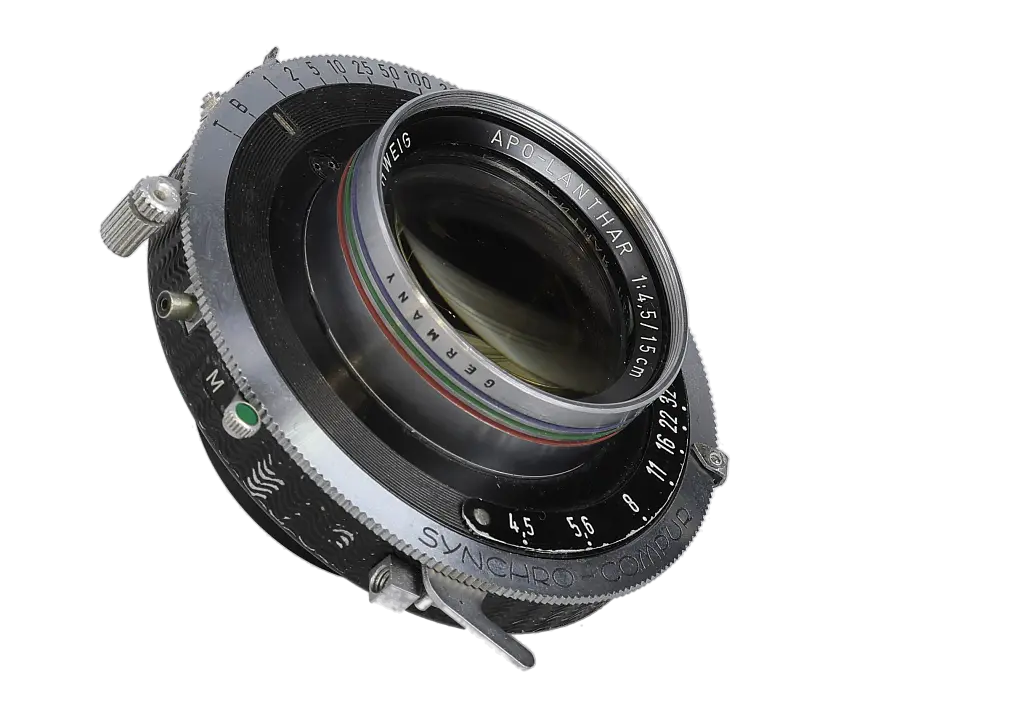
I was not aware that Voigtlander produced a 150mm (15cm) f/4.5 APO-Lanthar. It's a legendary large-format lens based on an asymmetric 5-element Heliar optical design, produced in the 1950s using high-refractive lanthanum glass.
Oct 18, 2026 at 01:37 PM
p.23 #16CP+ 2026 Voigtlander speculation thread!
Fred Miranda wrote:
I was not aware that Voigtlander produced a 150mm (15cm) f/4.5 APO-Lanthar. It's a legendary large-format lens based on an asymmetric 5-element Heliar optical design, produced in the 1950s using high-refractive lanthanum glass.
A true Apo LANTHAR!
😊
I was not aware that Voigtlander produced a 150mm (15cm) f/4.5 APO-Lanthar. It's a legendary large-format lens based on an asymmetric 5-element Heliar optical design, produced in the 1950s using high-refractive lanthanum glass.
A true Apo LANTHAR!
😊
Oct 18, 2026 at 01:43 PM
p.23 #17CP+ 2026 Voigtlander speculation thread!
Fred Miranda wrote:
Can it really get any weirder than a 28-35-50mm f/4 M-mount "zoom"?
Or what about vintage oddballs like the 73mm f/1.9 Hektor and the not so old ultra-wide 18mm f/3.8 and still current 21/3.4?...And let's not forget the newly revived 66mm f/2!
Honestly though, I'm not complaining, each of these wildcard lenses brings its own unique option to the table. Sure, if every lens in our camera bags had specs this bizarre, we'd all be scratching our heads. But when you look at the vast number of completely normal 35mm and 50mm options Voigtlander pumps out every day, a little...Show more →
I agree, but I would assume that first they should cover all main apertures in all mounts, at least I would do that.
We have all possible lens variation in VM, but E or Z - still lack of some of the best solutions.
I just wish Cosina would make every new release available for all mounts....
phinix wrote
why do they keep releasing those weird lens? 35mm f2.5, 35mm 3.5, 50mm 2.2, 50mm 3/5 apo...Or what about vintage oddballs like the 73mm f/1.9 Hektor and the not so old ultra-wide 18mm f/3.8 and still current 21/3.4?...And let's not forget the newly revived 66mm f/2!
Honestly though, I'm not complaining, each of these wildcard lenses brings its own unique option to the table. Sure, if every lens in our camera bags had specs this bizarre, we'd all be scratching our heads. But when you look at the vast number of completely normal 35mm and 50mm options Voigtlander pumps out every day, a little...Show more →
I agree, but I would assume that first they should cover all main apertures in all mounts, at least I would do that.
We have all possible lens variation in VM, but E or Z - still lack of some of the best solutions.
I just wish Cosina would make every new release available for all mounts....
Oct 19, 2026 at 01:07 AM
p.23 #18CP+ 2026 Voigtlander speculation thread!
Knut. wrote:
A true Apo LANTHAR!
😊
more like.. Lantern!
Fred Miranda wrote
I was not aware that Voigtlander produced a 150mm (15cm) f/4.5 APO-Lanthar. It's a legendary large-format lens based on an asymmetric 5-element Heliar optical design, produced in the 1950s using high-refractive lanthanum glass.😊
more like.. Lantern!
Oct 19, 2026 at 01:09 AM
p.23 #19CP+ 2026 Voigtlander speculation thread!
Fred Miranda wrote:
I was not aware that Voigtlander produced a 150mm (15cm) f/4.5 APO-Lanthar. It's a legendary large-format lens based on an asymmetric 5-element Heliar optical design, produced in the 1950s using high-refractive lanthanum glass.
There’s also a 105mm f/4.5 APO-Lanthar on a variant of the Bessa II from the 1950s.
Oct 19, 2026 at 03:31 AM
p.23 #20CP+ 2026 Voigtlander speculation thread!
Voigtländer was rightfully very proud of their Apo Lanthars in the fifties. It was one of the first attempts to use glas with anomalous dispersion to achieve true apochromatic correction, e.g. what at that time meant: correction for three instead of two colors.
These, at the time large format lenses, were extremely highly regarded and had an outstanding reputation. It was the best that was achievable resolutionwise at that time.
Obviously this (translated into our modern times) is what Cosina/Voigtländer wants to achieve with their present day Apo Lanthars.
Interestingly, they have carried quite a few design features from the lenses of lore on to their present day Apo Lanthars, one of them the three colored rings (red-green-blue) indicating apochromatic correction.
Quite obviously, only lenses with near perfect LOCA correction get the Apo Lanthar designation (This means, like in the fifties, lenses with a lot of special glass of anomalous dispersion).
Oct 19, 2026 at 10:01 AM