madNbad wrote:
Leica is more about tradition than innovation. Why else would a digital M camera have a removable baseplate?
They no longer do...
But I don't even use the removable base plate on my M10-P and M10-M. I use a half case with a flap for the battery/SDCard door. Good riddance to that PIA base plate.
flash wrote:
The Sony A7CR has IBIS and a flip screen and the same sensor as the M11.
And it’s smaller.
Gordon
Interesting option for some.
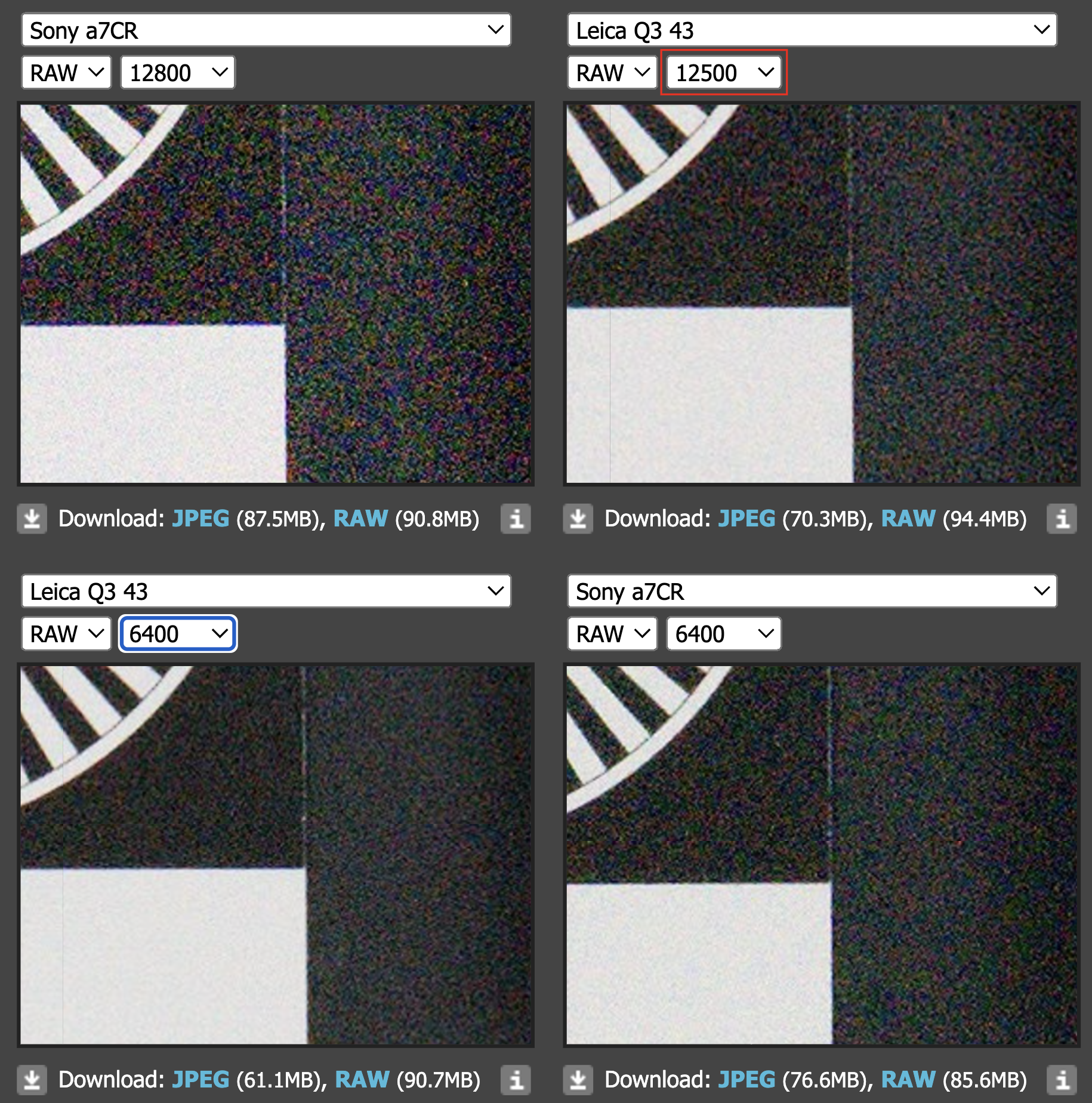
I know its not the best comparison, and only a single data point. But, it seems like the A7CR isn't bringing the same to the table as the Q3 43. Which makes me wonder what the # of measuring bands vs. readout speed, etc. is going on under the hood. I don't have any good data info, so if others do, I'd be curious to learn of any actual underlying diffs, even if it is the same sensor. Also, this isn't the M11 ... which may be better / diff from the Q3 43 under the hood.
I guess my perspective is that sometimes "no free lunch" is in play in ways that may not be obvious at first thought. Lots of moving parts, etc.
Now, to play along with things ... assuming that there is a 1 stop difference, it begs the question of whether someone would prefer 1-2 stops of IQ via ISO, or harness 2-3 stops of IBIS for ISO reduction. At that point, the question may not be if IBIS gives you the best IQ overall (if readout speeds / noise are impacted), but does it make for a reasonable arbitrage / trade on the diff's during "less than ideal" situations.
I think the conversation between Eng #1 and Eng #2 may shift a bit, when the question is reconstructed somewhat. Which could include things like programming / warnings that you may be incurring rolling shutter if below the readout speed. Again, not saying IBIS is a bad thing ... just saying Leica has a way of thinking about the ethos of the M ... that most folks don't fully understand their rationale behind the what / why they do what they do. I'm not pretending to understand / know what Leica is thinking ... but, I do give credence to the perspective that Leica is thinking about, but in Leica M terms ... not, everyone else terms.
Again, what Leica will do wrt readouts / bits / measurement bands ... relative to IQ ... and subsequently influenced by users harnessing IBIS (if / when) for sub-readout shutter speeds, etc. Anybody's guess.
Probably better to look at this comp at DPR, my screen shot is kinda but, hopefully you get the gist.
That said ... have a great evening, everyone and I'll see ya next year.
brick33308 wrote:
Sounds like it's a winner for you if you're not into manual control and rangefinder focus.
Me, I'll stick with my M11M, MP and M6, all of which take my really great Leica glass.
All I’m saying is if the A7CR can have IBIS and a screen and and and….. then the argument about the M11 not being able to do it is hard to argue.
Now the A7CR does some stuff to get al this in. It removes half the shutter mechanism. It also has more room behind the sensor than the M11. But it eventually will happen in an M and then everyone will go on about how awesome it is. Just like those that said the SL didn’t need IBIS and how great it was on the SL2.
And I actually do prefer my Q3’s and SL3’s to my M11’s. One of the big reasons is the lack of both IBIS in the latter.
---------------------------------------------
RustyBug wrote:
Interesting option for some.
I know its not the best comparison, and only a single data point. But, it seems like the A7CR isn't bringing the same to the table as the Q3 43. Which makes me wonder what the # of measuring bands vs. readout speed, etc. is going on under the hood. I don't have any good data info, so if others do, I'd be curious to learn of any actual underlying diffs, even if it is the same sensor. Also, this isn't the M11 ... which may be better / diff from the Q3 43 under the hood.
I guess my perspective is that sometimes "no free lunch" is in play in ways that may not be obvious at first thought. Lots of moving parts, etc.
Now, to play along with things ... assuming that there is a 1 stop difference, it begs the question of whether someone would prefer 1-2 stops of IQ via ISO, or harness 2-3 stops of IBIS for ISO reduction. At that point, the question may not be if IBIS gives you the best IQ overall (if readout speeds / noise are impacted), but does it make for a reasonable arbitrage / trade on the diff's during "less than ideal" situations.
I think the conversation between Eng #1 and Eng #2 may shift a bit, when the question is reconstructed somewhat. Which could include things like programming / warnings that you may be incurring rolling shutter if below the readout speed. Again, not saying IBIS is a bad thing ... just saying Leica has a way of thinking about the ethos of the M ... that most folks don't fully understand their rationale behind the what / why they do what they do. I'm not pretending to understand / know what Leica is thinking ... but, I do give credence to the perspective that Leica is thinking about, but in Leica M terms ... not, everyone else terms.
Again, what Leica will do wrt readouts / bits / measurement bands ... relative to IQ ... and subsequently influenced by users harnessing IBIS (if / when) for sub-readout shutter speeds, etc. Anybody's guess.
Probably better to look at this comp at DPR, my screen shot is kinda but, hopefully you get the gist.
That said ... have a great evening, everyone and I'll see ya next year.
New year done and dusted here already. Enjoy yours.
There’s 3 variants of the Sony 60MP 24x36mm sensor in place. The normal Af version (SL3, A7R5 A7CR etc). A monochrome version (M11M) and a non PDAF version (M11 etc). Each brand will then order their preferred bayer and micro filter needs and away you go.
I agree that Leica seems to eek a tiny bit more out of the sensor than even Sony does. Above 8000 ISO the Leica does seem to now have some mandatory noise reduction going on. It’s light but measured by P2P. In practice it makes as little difference to not matter. LR Enhance means there’ no functional difference. Generally I prefer Leica’s approach but I almost always choose IQ over speed. Sony has AF as a priority, generally. Load the same files into DXO and any difference disappear immediately. It’s a non issue.
I don’t see what IBIS has to to with the sensor read out speed. All these cameras have a mechanical shutter. And if Leica would finally add EFCS to the M and SL lines there’d be zero issues with readout speed going forward.
Every Leica body will go through sensor alignment test before passing through work bench (and will be the first thing to fix before everything else), so I can imagine it'll be a lot more complicated for the technician to work on one with moving sensor.
Moreover an M is a full manual focus camera so it has to have high degree of precision, and less potential for customers to complain about the focus accuracy due to moving sensor. With these in mind I'm not betting that Leica will come out with IBIS anytime soon, unless they're integrating IBIS with some new tech as well.
I for one am still appalled by the unnecessary features of the M-series. We should never have moved beyond the Barnack, the purest photographic tool ever made.
catacore wrote:
So the bottom line, for me, is that Leica can't only stay "traditionalists" on some fronts, and become "moderns" in others because those things are strongly linked between them.
+1
It's a fine line they try to walk ... that's part of what makes it so difficult to "guess" what Leica will do. At what pace will they "tiptoe" vs. "race" forward? That's the difficult thing to speculate on.
With Leica, it's not a matter of can they ... it is will they, and when?
Some say Leica chose to remain "traditionalists" wrt their camera bodies as to not depart too much from the "film camera" feeling of old days. And that this is what keeps their customers "trapped" to the brand. And I guess part of this is true, and it is what, actually, appeals to me as well. But I don't think it is actually 100% the case since they have engaged into the MPx race. And just for this reason alone I think that they need to address the IBIS issue. Maintaining the "film camera" user's experience means, alongside other things, maintaining the 1/FL shutter speed technique, which is no more possible with these new, high MPx sensors, without IBIS. For me, at least, this is the only reason I am still arguing about the IBIS necesity.
I was able to use and shot my (now sold) M240 at 1/FL shuter speeds and I have been happy with that. And I think the 24 MPx (on FF) is about the max resolution that would allow that. So that is why I am looking now into buying, again, a digital M with (max) 24 MPx sensor.
So the bottom line, for me, is that Leica can't only stay "traditionalists" on some fronts, and become "moderns" in others because those things are strongly linked between them....Show more →
The reality for me is that with street shooting subject movement is more often the limiting factor when setting shutter speed than focal length or sensor resolution. IBIS is not going to change that.
Still, IBIS will be very valuable when shooting static subjects, and long focal lengths when not on a tripod. It will also improve the EVF experience on the rare occasions I use that. This improved EVF experience is one reason I am optimistic that Leica will include it with the hybrid EVF that is coming in the next M.
Was there a rumor I missed about a hybrid EVF M coming out, or is that wishful thinking? I’d prefer two separate models: one rangefinder, one rangefinder-style EVF.
For me, IBIS is more useful for daily diary work. Documentary rather than street, roughly.
raizans wrote:
Was there a rumor I missed about a hybrid EVF M coming out, or is that wishful thinking? I’d prefer two separate models: one rangefinder, one rangefinder-style EVF.
For me, IBIS is more useful for daily diary work. Documentary rather than street, roughly.
I think the Hybrid EVF M mount has moved a bit beyond just rumor and is now expected in the next generation M cameras.
My question is why would they strat making the M like anything else I or anyone could buy that already exsists at a lower price point? Doesn't make a lot of sense to me.
They kept off auto focus off the M when the industry wnet that way with SLRs in the film days. DSLR in digital and mirrorless and yet Leica is one camera company doing pretty well financially while the others have struggled.
On reason I own Leica M because they don't have all that stuff on them. There are more out there like me thus their success with their flagship line M.
airfrogusmc wrote:
My question is why would they strat making the M like anything else I or anyone could buy that already exsists at a lower price point? Doesn't make a lot of sense to me.
They kept off auto focus off the M when the industry wnet that way with SLRs in the film days. DSLR in digital and mirrorless and yet Leica is one camera company doing pretty well financially while the others have struggled.
On reason I own Leica M because they don't have all that stuff on them. There are more out there like me thus their success with their flagship line M. ...Show more →
I think they are driven by customer request on this one. I took part in a Leica Company Survey, and this was the number one requested feature. Still, they will never abandon the rangefinder in the M line. That is why it is a Hybrid. From what I have heard is that the standard they are holding to ius that the Range Finder experience must not be diminished at all with a Hybrid View Finder, and this is the biggest challenge. Still, I would not be surprised if they offer a choice of pure Range Finder, or Hybrid View Finder.
Legacy is obviously an important thing for Leica to protect and profit from. They are still offering new film cameras, and legacy inspired lenses. Heck they even offer a digital M without a rear screen. They also trade in historical and used Leica gear as a regular pert of their business. Both buying and selling on the used market, as well as a Corporate owned auction house. I don't know of another camera manufacturing brand that does that. Leica knows they must manage the M line carefully in this regard. I trust they will do so successfully.
Another thing we must keep in mind is that a Hybrid View Finder is not just about focus in the way that a Range Finder is. The EVF part is just as much about exposure, and composition through the lens. These WYSIWYG features of mirrorless EVFs is to a great extent what drove the mirrorless cameras to the forefront of photography, and led to the abandonment of DSLRs in the industry. We should view this in the context that Leica was the first mirrorless camera in the market, and remained mirrorles during its entire digital lifetime. Another constant for the M cameras is that they have always been a Manual Focus camera. This has enabled them to keep the M form factor in both bodies and lenses. From that perspective in makes sense to me that Leica strives to provide the best Manual Focus experience available. I believe that on the optical side the Range Finder and lenses together do that. Leica now has the opportunity to also be the best EVF Manual Focus platform on the market. To do that they need top level EVF resolution, smoothness, and focusing aids in the new Hybrid View Finder. This will open the platform up to a large pool of potential new customers. They must do this without alienating Leica's existing customer base. This challenge is full of both risk, and opportunity. I wish leica the best in this pursuit.
airfrogusmc wrote:
My question is why would they strat making the M like anything else I or anyone could buy that already exsists at a lower price point? Doesn't make a lot of sense to me.
They kept off auto focus off the M when the industry wnet that way with SLRs in the film days. DSLR in digital and mirrorless and yet Leica is one camera company doing pretty well financially while the others have struggled.
On reason I own Leica M because they don't have all that stuff on them. There are more out there like me thus their success with their flagship line M. ...Show more →
I really have no clue what Leica is going to do and how they see the challenges, but keeping manual focus has the clear advantage of being able to offer great lenses at small sizes. It’s the reason I sought out Leica. In my case, I wasn’t sure about the rangefinder. I did and do appreciate the focus on core functions, though.


 but, hopefully you get the gist.