This topic is in the 2024 archive. You can read it and like its posts here. It is read only.
Archive 2024RF24 1.4
p.2 #1RF24 1.4
I just made a thread (my first here, long time reader, first time thread starter) about the 35 1.4L VCM which requires heavy lens profile correction. If you want to read that (and see an accompanying video, which I can't directly link to until 24 hours has passed but if you just put "watch?v=JzkSuG226V4" after yt dot com you can watch it before the forum robot allows me to post the full link tomorrow) please feel free, but the TL;DR is this: I too was scared off by all the lens profile criticism, but I ended up buying it thinking I'd get a kick booty video lens for my R5mk2 and a hobbled photo lens. Owning an RF 50 1.2L and the 24-70 2.8L IS USM I didn't mind, as I could always rely on those for great stills.
To my shock the 35 1.4L VCM is sharper and has better contrast (slightly better in the middle, significantly better in the corners) even when viewing the uncorrected RAW files. The correction is mostly fixing the barrel distortion and vignetting, but both improvements are visible pre-correction.
So to me, that eliminated my fear of lens profile correction given how great the corrected RAW files look. In fact, I'm now contemplating trading in my 24-70 2.8L and getting the 24 1.4 VCM, assuming it performs similarly at its focal length to the 35 1.4 VCM. Though I'll miss the ease of zooming of the 24-70, I'll have 24, 35 and 50 covered via the 1.4 VCMs and the 1.2, and have awesome video capability at 24mm and 35mm, as well as unlocking f/1.4-f/2.5 at those two focal lengths. The MTF chart does look better for the 24mm than the 35mm so I'm optimistic!
Dec 26, 2024 at 08:56 PM
p.2 #2RF24 1.4
"the unavoidable loss in resolution due to distortion correction" ?
(not pointed at the writer of the sentence at all, just a headline for some thoughts and rumble)
I have not drilled into the optics of this line of lenses. But if they work like e.g. the 24-105STM and 24-240 where both capture a slightly larger angle of view that is corrected to rectilinearity at the intended (24mm) final angle. If the data is there, why should the resolution be so much lower when the "pixels are put at their correct places". Depends partly on the intelligence of the software these day and they tend to be rather good and ever improving.
I remember my disgust when Hasselblad brought out lenses that should be corrected in post. Simply junk! Of course I would prefer a perfect lens, I have a few that are close. But the weight, the cost, they are manual focus. As I like AF in many cases, and as I´d rather own a lens than just dream about it, I can live with post correction these days. I suppose it is part of everyones journey if it is long enough, the part when we are purists and only accept the best of the best with the rest being puke. Life...
Edit: Carlo_M, I guess this should have been written in you thread.
Dec 27, 2024 at 07:50 AM
p.2 #3RF24 1.4
Z250SA wrote:
"the unavoidable loss in resolution due to distortion correction" ?
(not pointed at the writer of the sentence at all, just a headline for some thoughts and rumble)
I have not drilled into the optics of this line of lenses. But if they work like e.g. the 24-105STM and 24-240 where both capture a slightly larger angle of view that is corrected to rectilinearity at the intended (24mm) final angle. If the data is there, why should the resolution be so much lower when the "pixels are put at their correct places".
When you use software to correct for distortion, then you are not using all the pixels on the sensor for the final photo, and thus losing both resolution and loosing the amount of light that makes up the photo, thus making it more noisy. Of course, if, say, even 20% of the pixels on the sensor are not being used for the final photo, that's not a really big deal. For example, with regards to resolution, that's like going from 40 MP to 32 MP, where I'm sure we're aware that 32 MP with a sharper lens can easily outperform 40 MP with a less sharp lens. With regards to noise, not using 20% of the sensor for the final photo results in the loss of only a third of a stop of light, which is a pretty trivial difference.
Depends partly on the intelligence of the software these day and they tend to be rather good and ever improving.
That's simply the software extrapolating the missing information and/or replacing existing information with what the software thinks it "should" be. Again, using the example of loosing 20% of the pixels in the process, not a big deal, really. And, quite honestly, how many use AI software to improve their photos, anyway, which is doing a similar thing, and sometimes even far more extreme (e.g. face recovery).
I remember my disgust when Hasselblad brought out lenses that should be corrected in post. Simply junk! Of course I would prefer a perfect lens, I have a few that are close. But the weight, the cost, they are manual focus. As I like AF in many cases, and as I´d rather own a lens than just dream about it, I can live with post correction these days. I suppose it is part of everyones journey if it is long enough, the part when we are purists and only accept the best of the best with the rest being puke. Life......Show more →
I don't disagree. I, too, feel the tradeoff is worth it. But make no mistake -- it is a tradeoff, and I can understand those who are not keen on the tradeoff. It's like people who prefer APS-C over FF -- it's not right or wrong, it's a choice saying that the differences in size, weight, and price matter than the differences in IQ.
Dec 27, 2024 at 05:03 PM
p.2 #4RF24 1.4
takowasa wrote:
(not pointed at the writer of the sentence at all, just a headline for some thoughts and rumble)
I have not drilled into the optics of this line of lenses. But if they work like e.g. the 24-105STM and 24-240 where both capture a slightly larger angle of view that is corrected to rectilinearity at the intended (24mm) final angle. If the data is there, why should the resolution be so much lower when the "pixels are put at their correct places".When you use software to correct for distortion, then you are not using all the pixels on the sensor for the final photo, and thus losing both resolution and loosing the amount of light that makes up the photo, thus making it more noisy. Of course, if, say, even 20% of the pixels on the sensor are not being used for the final photo, that's not a really big deal. For example, with regards to resolution, that's like going from 40 MP to 32 MP, where I'm sure we're aware that 32 MP with a sharper lens can easily outperform...Show more →
It is well over a decade since I looked into the sensor tech. But IIRC they have RGGB Beyer filters on the e.g. 6000x4000 24Mp sensor. The end result is not a mix of red, green and blue dots, every pixel has its own correct colour and still 6000x4000. There is obviously a lot going on there which might be far more fundamental than distortion correction. Furthermore the distorted prime image is captured by the same 6000x4000, then corrected for distortion, and put out as a corrected 6000x4000. A lot going on there in so many ways. Which tradeoff is the worst? And who cares if the end result if fine? Obviously those who feel cheated by corrections. I´m not among those anymore.
Z250SA wrote
"the unavoidable loss in resolution due to distortion correction" ?(not pointed at the writer of the sentence at all, just a headline for some thoughts and rumble)
I have not drilled into the optics of this line of lenses. But if they work like e.g. the 24-105STM and 24-240 where both capture a slightly larger angle of view that is corrected to rectilinearity at the intended (24mm) final angle. If the data is there, why should the resolution be so much lower when the "pixels are put at their correct places".
Earlier quote
Depends partly on the intelligence of the software these day and they tend to be rather good and ever improving.Earlier quote
I remember my disgust when Hasselblad brought out lenses that should be corrected in post. Simply junk! Of course I would prefer a perfect lens, I have a few that are close. But the weight, the cost, they are manual focus. As I like AF in many cases, and as I´d rather own a lens than just dream about it, I can live with post correction these days. I suppose it is part of everyones journey if it is long enough, the part when we are purists and only accept the best of the best with the rest being puke. Life...It is well over a decade since I looked into the sensor tech. But IIRC they have RGGB Beyer filters on the e.g. 6000x4000 24Mp sensor. The end result is not a mix of red, green and blue dots, every pixel has its own correct colour and still 6000x4000. There is obviously a lot going on there which might be far more fundamental than distortion correction. Furthermore the distorted prime image is captured by the same 6000x4000, then corrected for distortion, and put out as a corrected 6000x4000. A lot going on there in so many ways. Which tradeoff is the worst? And who cares if the end result if fine? Obviously those who feel cheated by corrections. I´m not among those anymore.
Dec 28, 2024 at 07:49 AM

p.2 #5RF24 1.4
OK - I had to know how this lens works at night. I had a brief window between clouds to capture a few frames wide open. Nothing artistic here, just some data.
More details are available on my website at imageskylejones.com where I'll add more test shots once the weather improves.
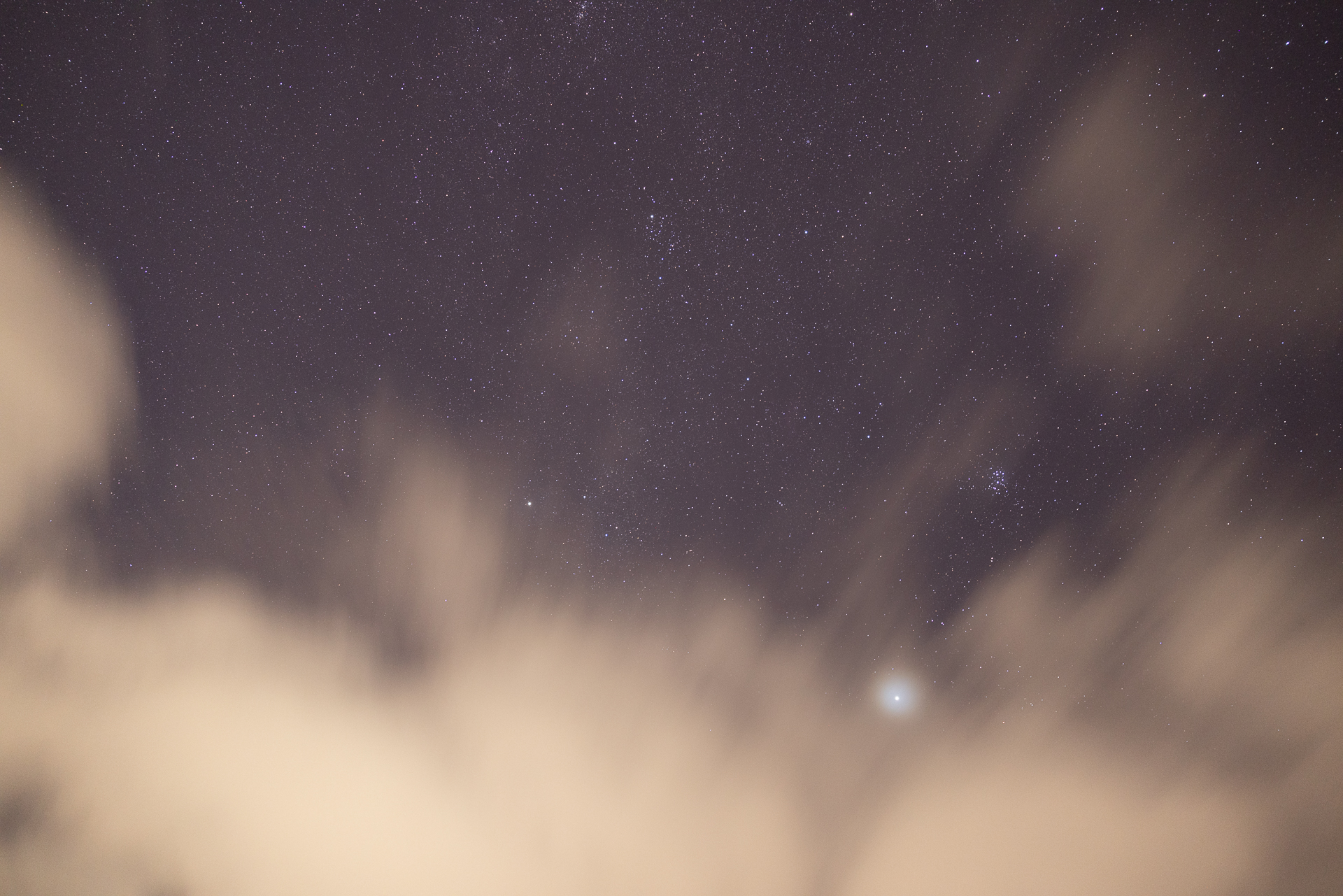
Canon R5 with RF 24mm f/1.4L VCM Unprocessed except digital profile
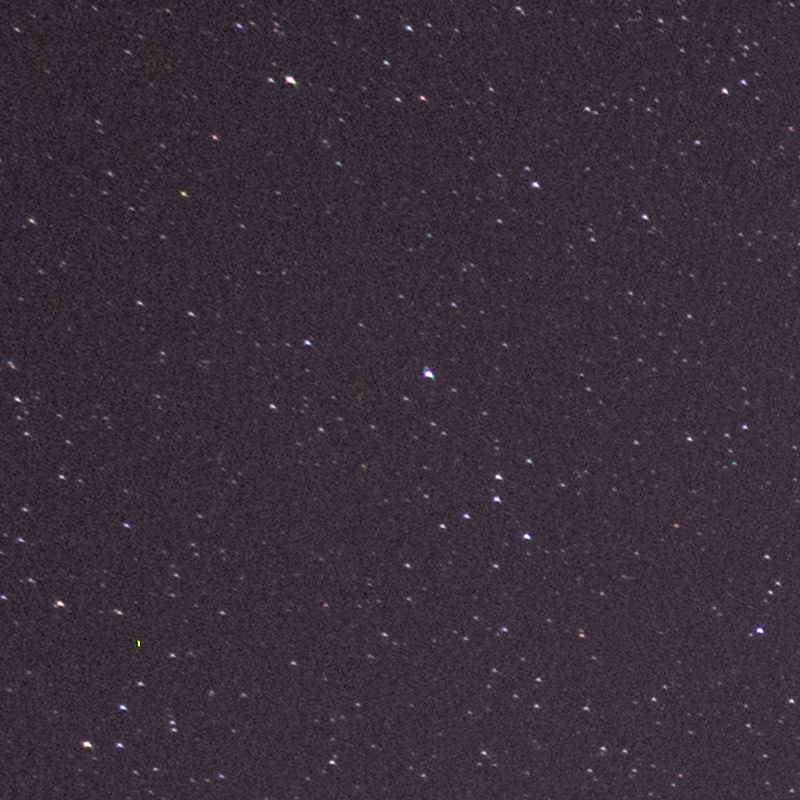
100% crop of the top left corner
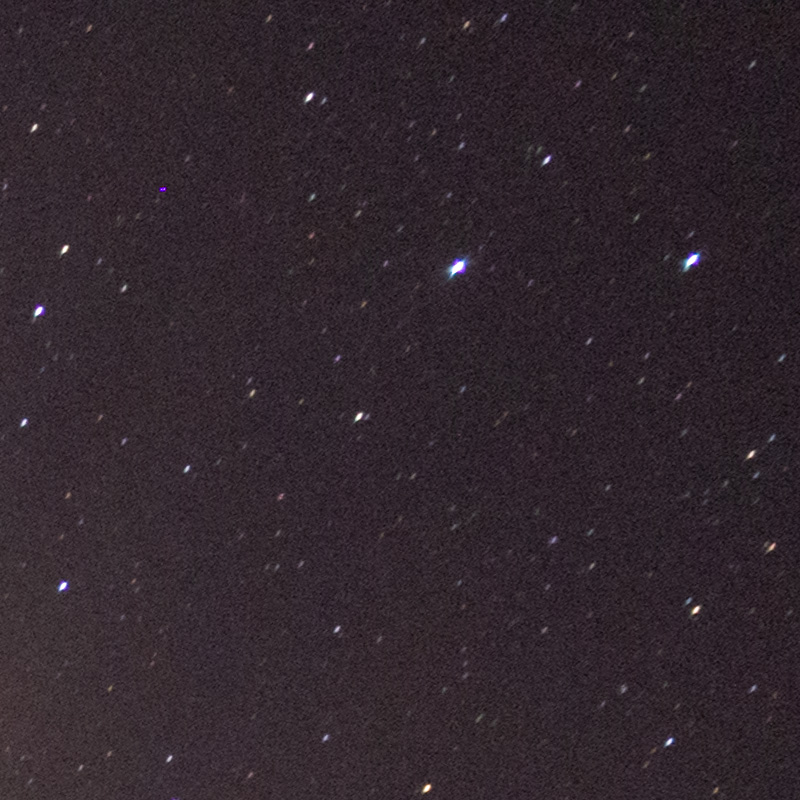
100% crop of the top right corner
More details are available on my website at imageskylejones.com where I'll add more test shots once the weather improves.
Canon R5 with RF 24mm f/1.4L VCM Unprocessed except digital profile
Canon EOS R5 RF24mm F1.4 L VCM lens 24mm f/1.4 10s 1600 ISO 0.0 EV
100% crop of the top left corner
100% crop of the top right corner
Dec 30, 2024 at 06:31 PM
p.2 #6RF24 1.4
I've had one clearish night to try it and your images are similar enough to what my copy was giving and what the TDP review found - it completely outclasses my Sigma 20mm f/1.4 in star sharpness across the field and lack of astigmatism/coma in the periphery and in those respects looked similar wide open to my EF 16-35mm f/2.8 III wide open at 16mm. This is the best reasonably wide FOV + large aperture area astro lens I have tried in terms of sharpness & astigmatism/coma (have had and returned Samyang 24mm f/1.4, Sigma 24m f/1.4). It's also been a light and fun general lens to use the last couple of weeks.
Dec 31, 2024 at 05:11 AM
p.2 #7RF24 1.4
kylebarendrick wrote:
OK - I had to know how this lens works at night. I had a brief window between clouds to capture a few frames wide open. Nothing artistic here, just some data.
More details are available on my website at imageskylejones.com where I'll add more test shots once the weather improves.
Darn it Kyle you're going to make me want to buy this. I just bought the 35 VCM and loving it, now I'm going to be tempted to get the wider FOV to add to the hybrid kit. Not sure if I''ll ever get the 50 VCM, my 50 1.2L works great for photos and now that I have the 35 VCM I've never used the 50 for video. But there have been a few times where I'd wished I had just a little bit wider FOV while using the 35.
Dec 31, 2024 at 11:47 AM
p.2 #8RF24 1.4
I received my copy of the 24/1.4 VCM last week and have run some tests. Below are my findings (without images)
- very good sharpness across the field from f/2. I’m not testing at f/1.4 as it’s not important to me.
- no noticeable coma in stars at f/2. F/2 is max aperture I would shoot Astro.
- a little fine grain corner noise from vigneting correction in Astro shots (tested at iso1600). Nothing bad though.
- excellent stars and sharpness at f/2
- the image circle uncorrected of the lens is larger than 24mm. I’d say maybe 20/21mm. The software correction then crops, distortion corrects and vignette corrects it to 24mm. Compared this to an EF 17-35mm lens that I have and the 24mm final image is accurate. It’s not a 25/26mm image stretched.
- the distortion correction, on my copy does cause a little resolution loss on the right side of the frame on a flat field image (a tree line at approximately 50m from the camera). In my copy I think it’s weak on that side (soft, possibly from focus misalignment or forward focus). I have another copy coming to compare and pick the best one.
- Capture one does a better job than Adobe on the lens profile and also has an “edge falloff focus” sharpening slider which can apply additional sharpening to the falloff areas that need extra sharpening. It works great, just don’t dial it up too high.
- Resolution with distortion correction turned off is spectacular right to the edge of the frame. So you could in theory apply your own cropping and distortion correction for non-critical scenes that don’t require perfectly straight lines, such as Astro and some landscape. I couldn’t get a manual distortion adjustment that looked as good as the profile for straight lines however.
Overall it’s a win. I did try some other shots at f/1.4 and f/2 with the background blurred and a centre and off-centre subject and at f/1.4 it is fantastic for detail and contrast, but that’s the only time I would use it personally at f/1.4.
I am shooting on a R5ii and find that I got visibly superior images from capture one over Lightroom especially for fine detail on branches in the distance. And blades of grass, anywhere that the detail is ultra-fine, capture one was superior and cleaner for base iso files.
Dec 31, 2024 at 02:08 PM
p.2 #9RF24 1.4
For anyone using Lightroom, does the correction profile result in the same final crop/image size as Canon's in-camera profile? For example, if you extract the embedded jpeg preview in the raw file and compare it against an uncropped Lightroom export with Lightroom's profile for this lens applied, are the two the same in respect to final framing and corrections?
When I had a chance to shoot with the 24-105/2.8 Z, I noticed that Canon's correction profile differed and was more conservative/stronger than Adobe's correction. The Adobe correction cropped less of the total image capture, with a slightly wider field of view.
Below is a gif of three conversions versions from the 24-105Z at 24mm to illustrate the above:

And here are the individual images for closer comparison purposes if the gif is too fast:
SOOC embedded jpeg with Canon's lens corrections applied:

With LRC's lens correction applied:

Lens correction disabled in LRC:

You can see that Canon's correction and final cropping results in a much narrower field of view than Adobe's. Canon appears to 'pin' the center of the image and flows all corrections out from the center. The center of the image also appears to be the same between Canon's corrected version and the image without a profile applied. Adobe's correction appears to pin the midfield which 'pulls' in the periphery, retaining more of that area, while also causing the center of the image to scale down slightly.
Just wondering if Adobe is applying the same correction strategy with the VCM... it would gain a slightly wider field of view and use more of the image capture but at the possible slight expenses of some central image scaling (down sizing) and a wider than expected (based on EVF framing/composition) field of view.
When I had a chance to shoot with the 24-105/2.8 Z, I noticed that Canon's correction profile differed and was more conservative/stronger than Adobe's correction. The Adobe correction cropped less of the total image capture, with a slightly wider field of view.
Below is a gif of three conversions versions from the 24-105Z at 24mm to illustrate the above:
And here are the individual images for closer comparison purposes if the gif is too fast:
SOOC embedded jpeg with Canon's lens corrections applied:
With LRC's lens correction applied:
Lens correction disabled in LRC:
You can see that Canon's correction and final cropping results in a much narrower field of view than Adobe's. Canon appears to 'pin' the center of the image and flows all corrections out from the center. The center of the image also appears to be the same between Canon's corrected version and the image without a profile applied. Adobe's correction appears to pin the midfield which 'pulls' in the periphery, retaining more of that area, while also causing the center of the image to scale down slightly.
Just wondering if Adobe is applying the same correction strategy with the VCM... it would gain a slightly wider field of view and use more of the image capture but at the possible slight expenses of some central image scaling (down sizing) and a wider than expected (based on EVF framing/composition) field of view.
Dec 31, 2024 at 03:48 PM
p.2 #10RF24 1.4
Z250SA wrote:
"the unavoidable loss in resolution due to distortion correction" ?
(not pointed at the writer of the sentence at all, just a headline for some thoughts and rumble)
I have not drilled into the optics of this line of lenses. But if they work like e.g. the 24-105STM and 24-240 where both capture a slightly larger angle of view that is corrected to rectilinearity at the intended (24mm) final angle. If the data is there, why should the resolution be so much lower when the "pixels are put at their correct places". Depends partly on the intelligence of the software these...Show more →
You don't need or want intelligent software for distortion correction. It is just a matter of resampling the image, using the known lens distortion curve as input. If, at a given position in the image, the 50 % MTF resolution is 50 lp/mm prior to the correction, and the image is locally stretched by 10 %, the 50 % MTF resolution will be at best 50 lp / 1.1 mm = 45.5 lp/mm in the corrected image. Hence we speak of a loss in resolution.
takowasa wrote:
That's simply the software extrapolating the missing information and/or replacing existing information with what the software thinks it "should" be. Again, using the example of loosing 20% of the pixels in the process, not a big deal, really. And, quite honestly, how many use AI software to improve their photos, anyway, which is doing a similar thing, and sometimes even far more extreme (e.g. face recovery).
Software for distortion correction does not replace existing information with what it thinks it should be. It just performs deterministic resampling and that is it. There is no thinking or guessing involved.
Using AI for something as simple as distortion correction would be a death sentence to photography. Software tools that invent stuff should always be optional.
Jan 06, 2025 at 01:38 PM
p.2 #11RF24 1.4
Toothwalker wrote:
(not pointed at the writer of the sentence at all, just a headline for some thoughts and rumble)
I have not drilled into the optics of this line of lenses. But if they work like e.g. the 24-105STM and 24-240 where both capture a slightly larger angle of view that is corrected to rectilinearity at the intended (24mm) final angle. If the data is there, why should the resolution be so much lower when the "pixels are put at their correct places". Depends partly on the intelligence of the software these day and they tend to be rather good and ever improving.You don't need or want intelligent software for distortion correction. It is just a matter of resampling the image, using the known lens distortion curve as input. If, at a given position in the image, the 50 % MTF resolution is 50 lp/mm prior to the correction, and the image is locally stretched by 10 %, the 50 % MTF resolution will be at best 50 lp / 1.1 mm = 45.5 lp/mm in the corrected image. Hence we speak of a loss in resolution.
Yes, you might be right. My thoughts were along those lines too. But... It feels a bit too simplistic. You have more data than just the individual pixels. There are the differences to the surrounding pixels in both colour and intensity, lines, dots, even faces, wings, twigs, arms, wheels, windows, roofs. By applying some nice AI there is much more than might be done to get a better correction than by just mathematically push contrast around.
I´m not particularly fond of AI. My test of chatgpt found it provided a mixture of advertises and reviews, with the "I" part lacking to the extreme. A "nice and likable guy" though...
I use the ZE 100/2 Makro Planar for mission critical work. Wonderful for panos or photogrammetry. After working with the MP you get that "what the heck?"-feeling with other lenses.
Z250SA wrote
"the unavoidable loss in resolution due to distortion correction" ?(not pointed at the writer of the sentence at all, just a headline for some thoughts and rumble)
I have not drilled into the optics of this line of lenses. But if they work like e.g. the 24-105STM and 24-240 where both capture a slightly larger angle of view that is corrected to rectilinearity at the intended (24mm) final angle. If the data is there, why should the resolution be so much lower when the "pixels are put at their correct places". Depends partly on the intelligence of the software these day and they tend to be rather good and ever improving.
Yes, you might be right. My thoughts were along those lines too. But... It feels a bit too simplistic. You have more data than just the individual pixels. There are the differences to the surrounding pixels in both colour and intensity, lines, dots, even faces, wings, twigs, arms, wheels, windows, roofs. By applying some nice AI there is much more than might be done to get a better correction than by just mathematically push contrast around.
I´m not particularly fond of AI. My test of chatgpt found it provided a mixture of advertises and reviews, with the "I" part lacking to the extreme. A "nice and likable guy" though...
I use the ZE 100/2 Makro Planar for mission critical work. Wonderful for panos or photogrammetry. After working with the MP you get that "what the heck?"-feeling with other lenses.
Jan 07, 2025 at 05:40 AM
p.2 #12RF24 1.4
Z250SA wrote:
Yes, you might be right. My thoughts were along those lines too. But... It feels a bit too simplistic. You have more data than just the individual pixels. There are the differences to the surrounding pixels in both colour and intensity, lines, dots, even faces, wings, twigs, arms, wheels, windows, roofs. By applying some nice AI there is much more than might be done to get a better correction than by just mathematically push contrast around.
If by "better correction" you mean a result that is visually more pleasing to some people, then yes. AI can do that. What it cannot do is give you something that is closer to the ground truth.
I use the ZE 100/2 Makro Planar for mission critical work. Wonderful for panos or photogrammetry. After working with the MP you get that "what the heck?"-feeling with other lenses.
One of my all time favorites.
Jan 07, 2025 at 12:35 PM
p.2 #13RF24 1.4
My rental house got a copy which I picked up for a trial yesterday. I was going to shoot it back-to-back with my trusty old EF 24L II to see how much of an improvement it is (or isn't)...but after a morning of shooting the kids frankly I don't think that's required, the ~15 years have clearly been well spent. I usually use the 28-70 f/2 so the extra 4mm is handy in tight spaces.
I wasn't seriously planning on picking one of these up but reconsidering now - for my use (people, environmental portrait) I am fine to trade off weight and bulk for distortion.
I have it for a few more days so will do a real comparison with the EF for old times sake but I can see it will be a bit ugly for the 24L II.
Jan 07, 2025 at 07:43 PM
p.2 #14RF24 1.4
Very interested in your findings. I really wanted a 20mm ish 1.2 to match the 1.2 lineup, but we got this thing. I am left feeling that I will not be happy with this lens as I am not a video shooter. I was thinking about grabbing the EF version to scratch the itch for a while until a proper lens is released.
_Refraction wrote:
My rental house got a copy which I picked up for a trial yesterday. I was going to shoot it back-to-back with my trusty old EF 24L II to see how much of an improvement it is (or isn't)...but after a morning of shooting the kids frankly I don't think that's required, the ~15 years have clearly been well spent. I usually use the 28-70 f/2 so the extra 4mm is handy in tight spaces.
I wasn't seriously planning on picking one of these up but reconsidering now - for my use (people, environmental portrait) I am fine to trade...Show more →
Jan 09, 2025 at 07:38 AM
p.2 #15RF24 1.4
I ran a 24mm test against a building wall yesterday with the 24/1.4 VCM, the 15-35/2.8, the 24-105/4, and the Samyang 24/1.4 (my previous astro lens). I have had a chance to pull together 100% crops yet, but my initial conclusion is that I would take the 24 VCM over any of them for sharpness and contrast across the frame. At f/1.4 the results are comparable to the 15-35 at f/2.8. At f/2.8 the results are superior to the other lenses at f/4. The Samyang is left in the dust.
Jan 09, 2025 at 11:15 AM
p.2 #16RF24 1.4
This is what I keep hearing. I just struggle with the software correction. A little here and there is whatever, but this is just nuts. It is also possible that I just need to forget it all if the lens is really performing this well with the correction and technical resolution loss.
kylebarendrick wrote:
I ran a 24mm test against a building wall yesterday with the 24/1.4 VCM, the 15-35/2.8, the 24-105/4, and the Samyang 24/1.4 (my previous astro lens). I have had a chance to pull together 100% crops yet, but my initial conclusion is that I would take the 24 VCM over any of them for sharpness and contrast across the frame. At f/1.4 the results are comparable to the 15-35 at f/2.8. At f/2.8 the results are superior to the other lenses at f/4. The Samyang is left in the dust.
Jan 09, 2025 at 11:48 AM
p.2 #17RF24 1.4
I was struggling with the SW correction of newer lenses also. And then I broke down and bought the 14-35 f/4L because the wide range and small size made it an attractive hiking lens. I was really surprised at the quality of the images, including the corners at 14mm. I've always supported the idea that if you start with higher quality inputs (glass and sensors) then you have a higher chance of a higher quality output (all other things being equal). While I'd argue that this is still true, the outputs of these newer Canon lenses are strong enough that I am getting better at ignoring what it takes to get there.
Heck, my default Lightroom import preset applies lens distortion corrections automatically so I never even see the uncorrected version.
Heck, my default Lightroom import preset applies lens distortion corrections automatically so I never even see the uncorrected version.
Jan 09, 2025 at 12:14 PM
p.2 #18RF24 1.4
Attaching some photos for reference comparing the 24 VCM against the 15-35 f/2.8 zoom at 24mm. I also tested against the Samyang 14/1.4 but that lens is definitely weaker (although it cleans up nice when stopped down) and I wanted to show the comparison between the VCM and its need for distortion corrections against the more traditional zoom.
The first 3 images show the overall image. You can see in the 2nd image that the uncorrected VCM is wider than advertised to provide the data for the distortion corrections. For reference the 3rd image is the zoom without distortion corrections (because I manually zoomed, 24mm on this is kind of a guess).
I also provide 100% crops at the center and the top left corner with Lightroom's distortion corrections applied. No vignetting corrections were applied. Comparisons provided include:
I tried to be reasonably rigorous with gathering these but this isn't a scientific experiment. Hopefully this info is helpful.
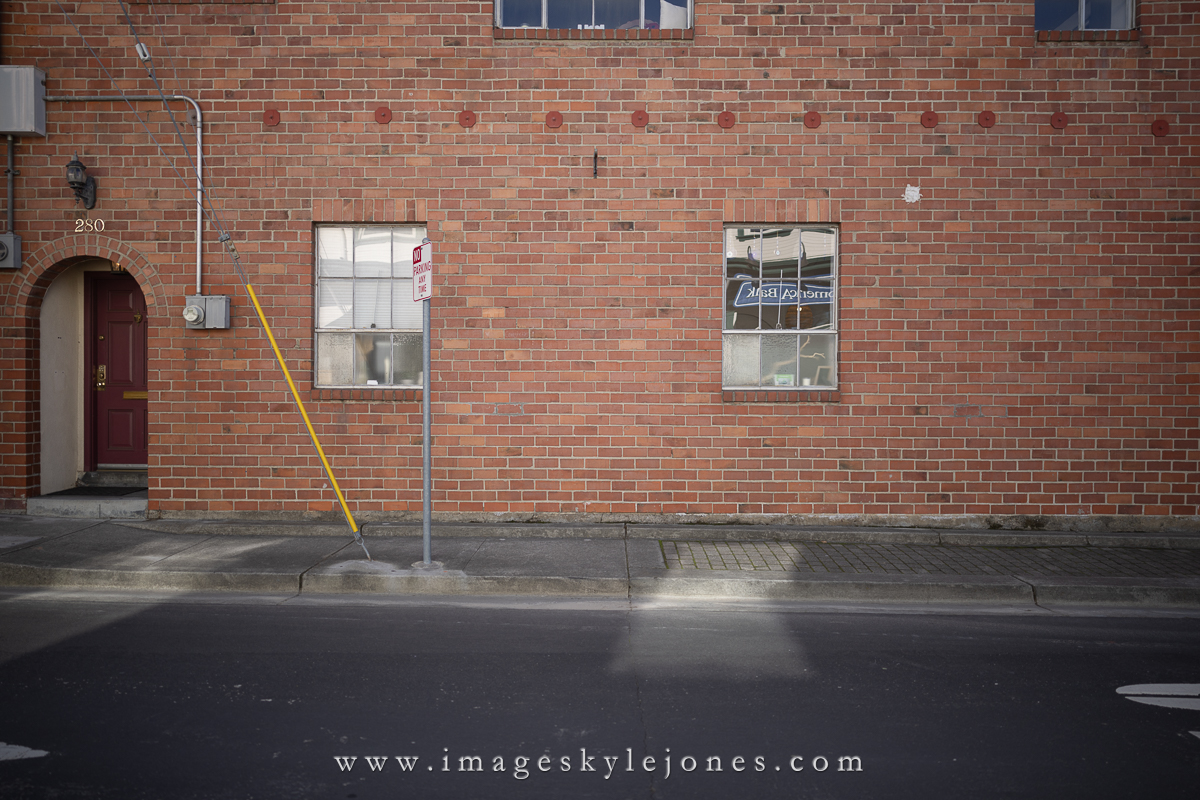
24mm VCM at f/1.4 and LR distortion corrections applied
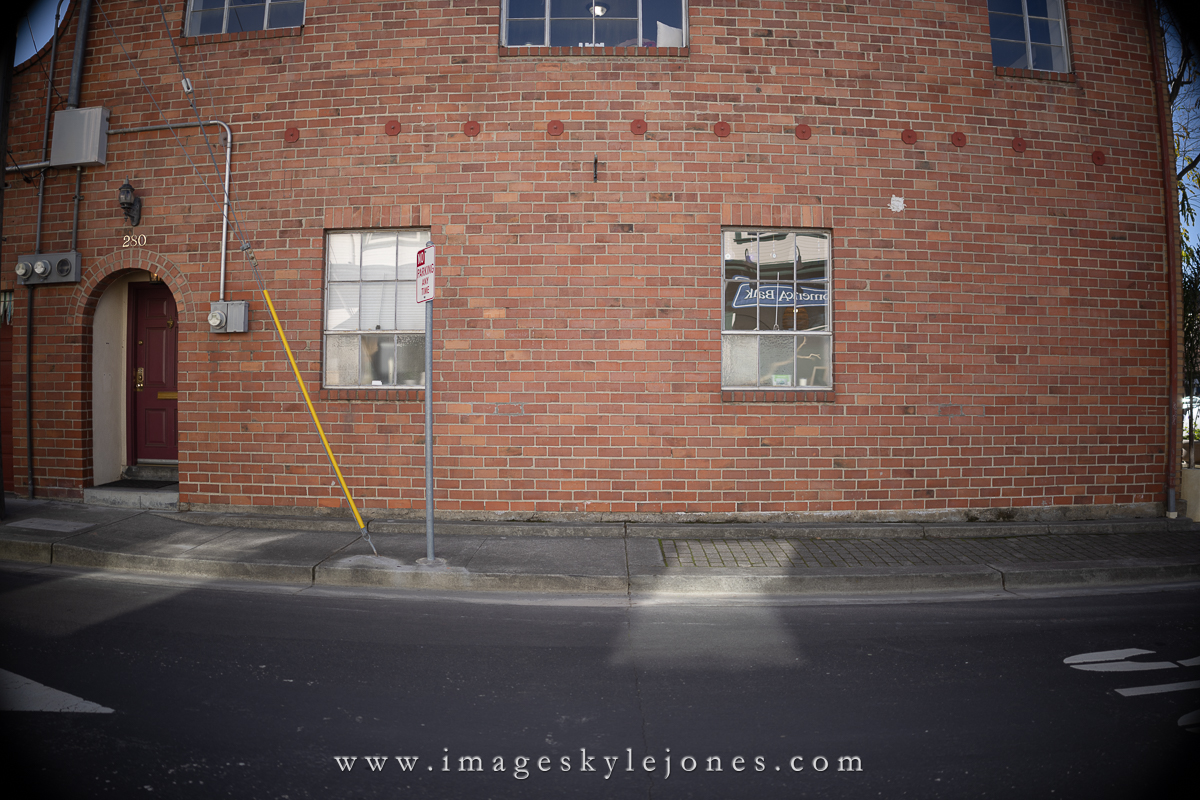
24mm VCM at f/1.4 with no corrections applied
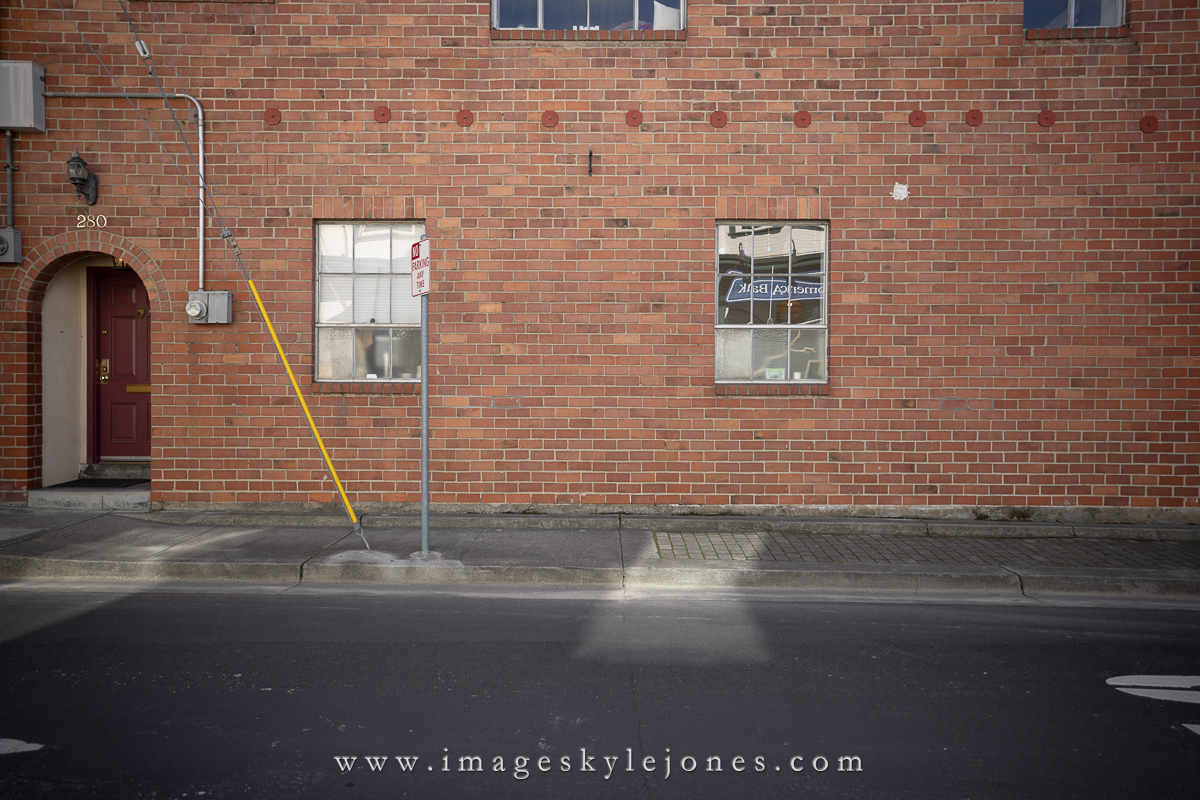
15-35 Zoom at 24mm and f/2.8 with no corrections applied (for reference)
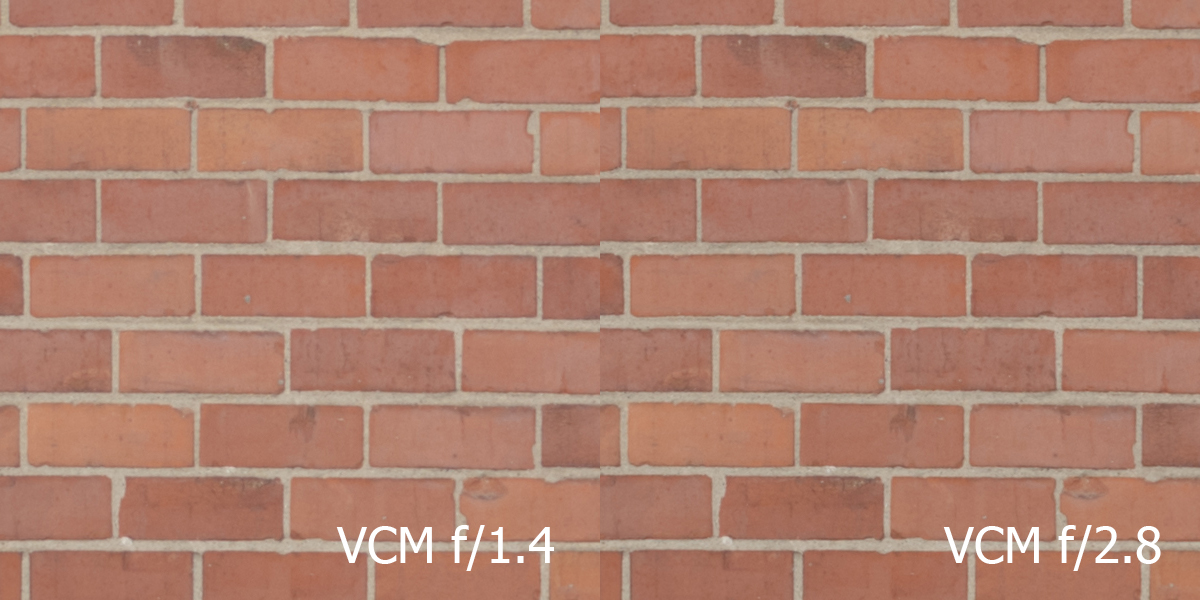
24mm VCM Comparison between f/1.4 and f/2.8 at Center
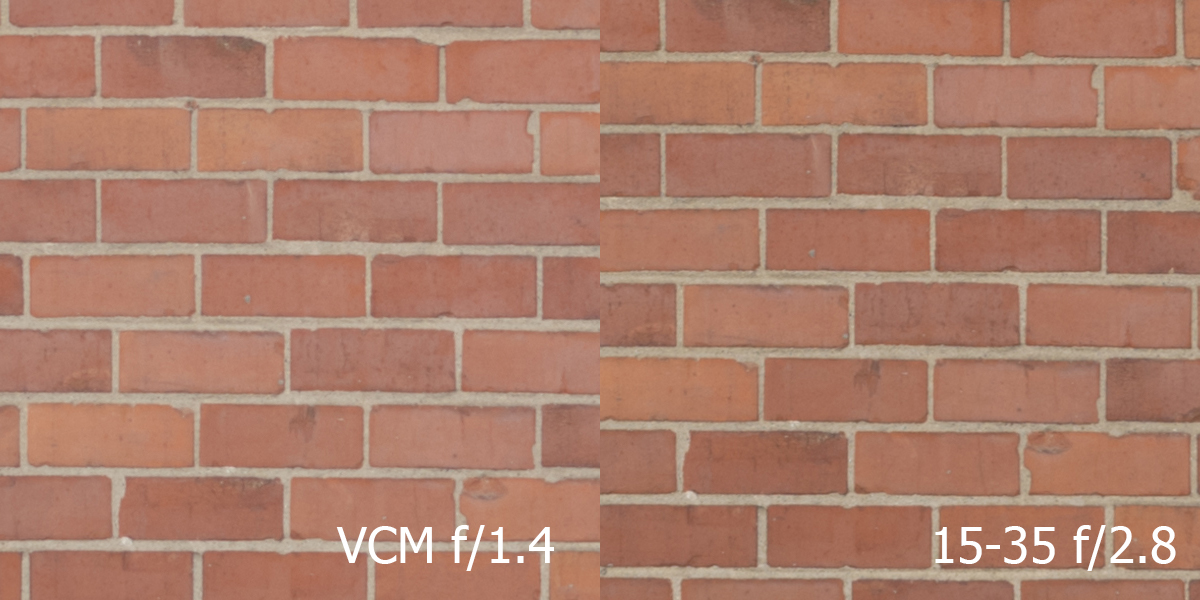
24 VCM at f/1.4 vs. 15-35 at f/2.8 in center
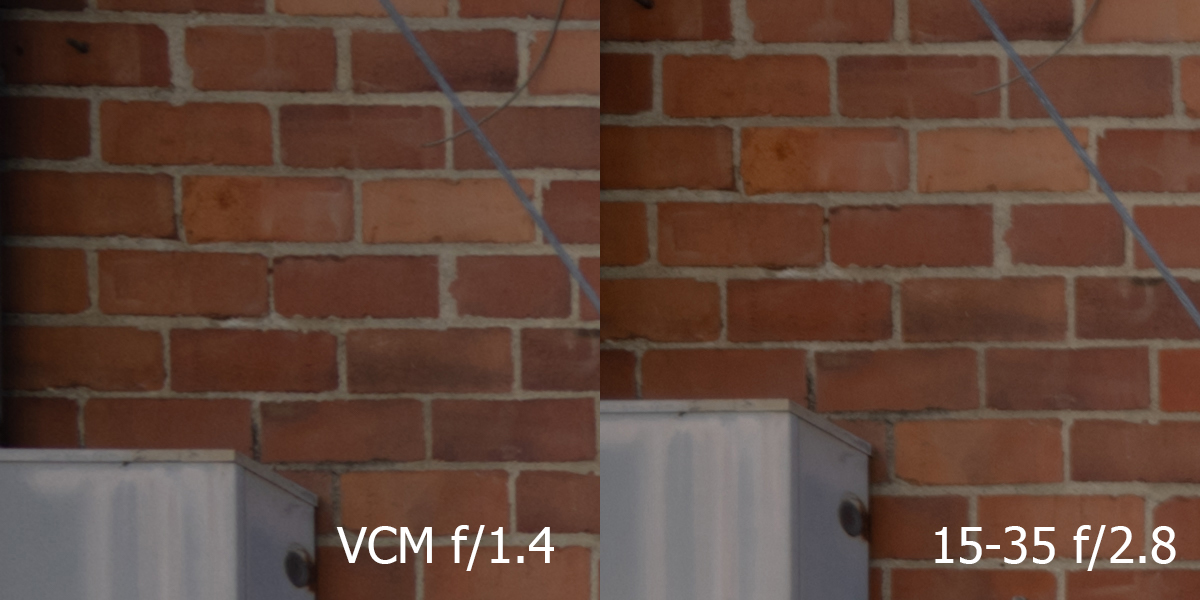
24 VCM at f/1.4 vs. 15-35 at f/2.8 at top left corner
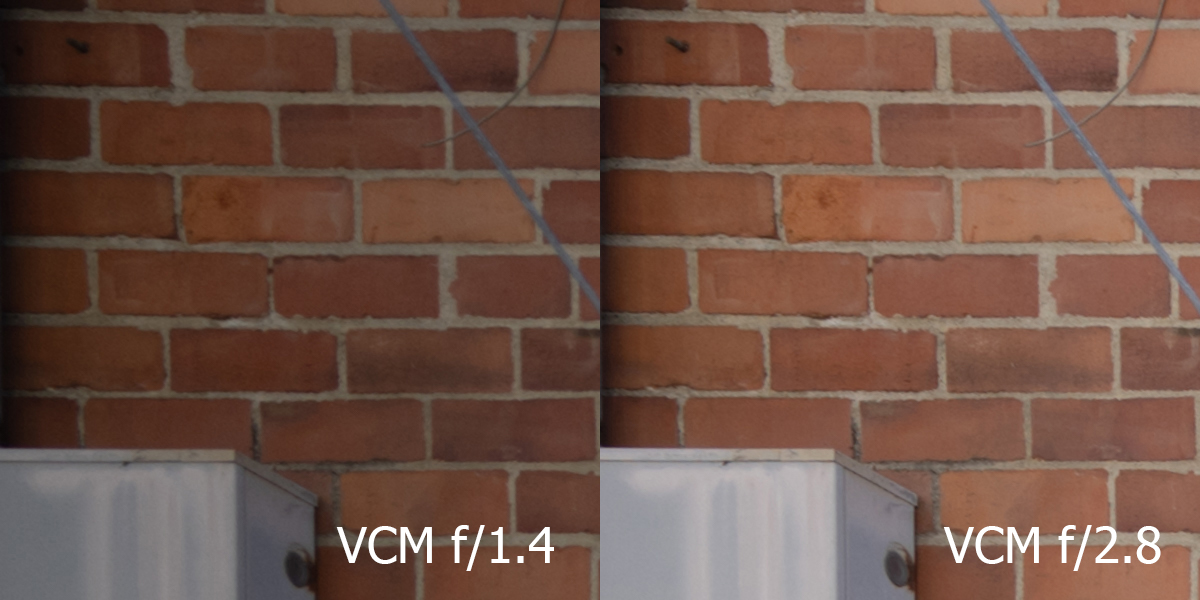
24mm VCM Comparison between f/1.4 and f/2.8 at top left corner
The first 3 images show the overall image. You can see in the 2nd image that the uncorrected VCM is wider than advertised to provide the data for the distortion corrections. For reference the 3rd image is the zoom without distortion corrections (because I manually zoomed, 24mm on this is kind of a guess).
I also provide 100% crops at the center and the top left corner with Lightroom's distortion corrections applied. No vignetting corrections were applied. Comparisons provided include:
- VCM stopping down from f/1.4 to f/2.8
- VCM at f/1.4 vs. 15-35 at f/2.8
- VCM at f/2.8 vs. 15-35 at f/2.8
I tried to be reasonably rigorous with gathering these but this isn't a scientific experiment. Hopefully this info is helpful.
24mm VCM at f/1.4 and LR distortion corrections applied
Canon EOS R5 RF24mm F1.4 L VCM lens 24mm f/1.4 1/1600s 100 ISO 0.0 EV
24mm VCM at f/1.4 with no corrections applied
Canon EOS R5 RF24mm F1.4 L VCM lens 24mm f/1.4 1/1600s 100 ISO 0.0 EV
15-35 Zoom at 24mm and f/2.8 with no corrections applied (for reference)
Canon EOS R5 RF15-35mm F2.8 L IS USM lens 24mm f/2.8 1/400s 100 ISO 0.0 EV
24mm VCM Comparison between f/1.4 and f/2.8 at Center
24 VCM at f/1.4 vs. 15-35 at f/2.8 in center
24 VCM at f/1.4 vs. 15-35 at f/2.8 at top left corner
24mm VCM Comparison between f/1.4 and f/2.8 at top left corner
Jan 11, 2025 at 12:22 PM
p.2 #19RF24 1.4
Final image showing comparison between the VCM and the zoom with both at f/2.8 in the top left corner
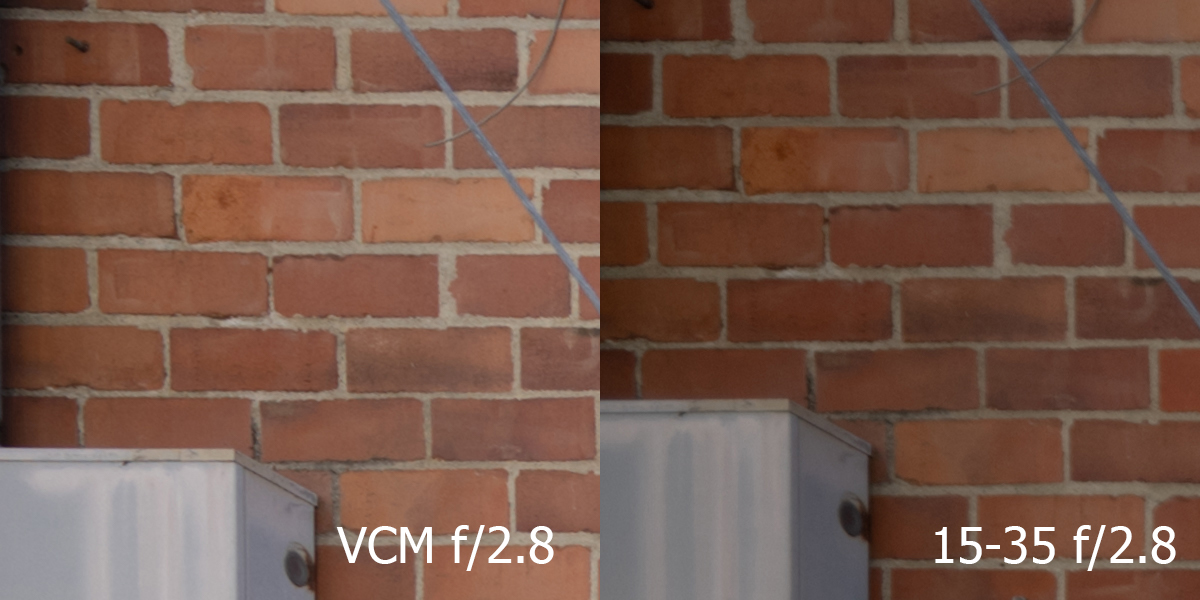
24mm VCM vs. 15-35 at top left corner and both at f/2.8
24mm VCM vs. 15-35 at top left corner and both at f/2.8
Jan 11, 2025 at 12:25 PM
p.2 #20RF24 1.4
kylebarendrick wrote:
(because I manually zoomed, 24mm on this is kind of a guess).
For future reference, many R cameras can display focal length in the viewfinder. It's an option somewhere in the menus... I've found it handy when doing these kinds of comparisons.
(because I manually zoomed, 24mm on this is kind of a guess).
For future reference, many R cameras can display focal length in the viewfinder. It's an option somewhere in the menus... I've found it handy when doing these kinds of comparisons.
Jan 11, 2025 at 01:50 PM