JohnDizzo15 wrote:
@kf86174@ -
To expound further as a proponent on the whole issue of the 1.2, it should be noted that at least for me, I don't necessarily care about something simply being faster for the sake of being faster. If that were the case, I would've never gotten rid of the EF 50/1.0.
Some of the 1.2 lenses on the market just also happen to have a look that they produce, that many of us fancy. Such was the case when I tried out the Sony GM 35/1.4 for a week, when I was hoping to like it enough to dump the Sigma 35/1.2. While an amazing piece of glass, the Sony GM just wasn't giving me the look I was accustomed to with the slightly faster Sigma.
With regard to clients never asking why something wasn't shot on a faster piece of glass, I tend to agree. However, while most consumers are perfectly content with well-executed shots at 1.8, or even f/8, I don't think that is a very useful point around these parts, as we are gear heads and image connoisseurs. Playing devils advocate to your point, I'm fairly certain one doesn't need 1.8 for most clients either. But such is a logical slope that is rather slippery.
I suppose what I'm trying to say is, whether capturing moments for yourself or clients, one can always make do with something as minimalist as their phones. I'm fairly confident I could produce work for people with my current phone that they would be perfectly content with (especially if care is taken with lighting and composition). But that's not what we are all here for.
Personally, I was hoping Canon would use the RF 35L as their opportunity for yet another statement lens. Especially considering the rumor mill had it as a 1.2. The only other way for you to get a high performing AF 35/1.2 is with a third party lens on Sony or Leica. As such, I was hoping Canon would really metaphorically slap their wieners on the table with the release of their own groundbreaking 35. As it stands, it appears to just be another good enough lens at an FL they needed to check off the to do list....Show more →
That's quite a statement from someone who's never seen the lens never mind using it.
CelesteForza wrote:
That's quite a statement from someone who's never seen the lens never mind using it.
Valid enough point. However, I will say that my opining in this way is derived from deduction, based on what we have already seen thus far.
If you look at the marketing materials (and what is being pushed by all the ambassadors) thus far, it's hybrid mania, and not a touting of the IQ at the forefront. It's not the 1.2 that was rumored, there is no IS, and no new spiffy blue spectrum refractive lens type addition (a la EF MK II version) to buzz about. Coincidentally, this release reminds me a lot of how lackluster the announcement for the Sony version was. lol.
So yes, I have never seen or used this particular lens. But I have seen and used countless lenses before it, that I highly anticipated. And based on those prior data points, this quacks like a duck. My apologies if that comes off as overly assumptive.
SNJOps wrote:
Sony haven’t made a 35mm f1.2, Nikon doesn’t have one either and there are rumours theirs might end up an f1.4 as well. Perhaps 35mm f1.2 is popular on forums but maybe the market research suggests that a 35mm f1.4 is favoured by most users.
Sony hasn't, but Sigma has.
And that line of logic doesn't fly, as Canon has made plenty of statement lenses that were never expected to sell in high volume. Did the market research suggest that a 5.2mm dual fisheye, 8-15, 85/1.2 DS, 200/1.8/2.0, 50/1.0, 200-400, 800/11, etc etc etc would be "favoured by most users?"
Point is, this was an opportunity to make a gem at a very commonly used FL, something that they could tout as yet another reason Canon is king. None of this is to say that I think it won't be a great lens. Because I believe it will be. But will it be the gem that makes the overwhelming majority of shooters turn their heads to look at Canon and say "whoa" when they previously weren't? I don't think so.
JohnDizzo15 wrote:
@kf86174@ -
To expound further as a proponent on the whole issue of the 1.2, it should be noted that at least for me, I don't necessarily care about something simply being faster for the sake of being faster. If that were the case, I would've never gotten rid of the EF 50/1.0.
Some of the 1.2 lenses on the market just also happen to have a look that they produce, that many of us fancy. Such was the case when I tried out the Sony GM 35/1.4 for a week, when I was hoping to like it enough to dump the Sigma 35/1.2. While an amazing piece of glass, the Sony GM just wasn't giving me the look I was accustomed to with the slightly faster Sigma.
With regard to clients never asking why something wasn't shot on a faster piece of glass, I tend to agree. However, while most consumers are perfectly content with well-executed shots at 1.8, or even f/8, I don't think that is a very useful point around these parts, as we are gear heads and image connoisseurs. Playing devils advocate to your point, I'm fairly certain one doesn't need 1.8 for most clients either. But such is a logical slope that is rather slippery.
I suppose what I'm trying to say is, whether capturing moments for yourself or clients, one can always make do with something as minimalist as their phones. I'm fairly confident I could produce work for people with my current phone that they would be perfectly content with (especially if care is taken with lighting and composition). But that's not what we are all here for.
Personally, I was hoping Canon would use the RF 35L as their opportunity for yet another statement lens. Especially considering the rumor mill had it as a 1.2. The only other way for you to get a high performing AF 35/1.2 is with a third party lens on Sony or Leica. As such, I was hoping Canon would really metaphorically slap their wieners on the table with the release of their own groundbreaking 35. As it stands, it appears to just be another good enough lens at an FL they needed to check off the to do list....Show more →
I guess it is a question of how many lens lines the market can support.
Ideally we would have:
1.) Ultra premium L primes (50mm 1.2, 135 1.8) $2000+
2.) Hybrid L primes f/1.4 sub $2000
3.) Mid-range primes e.g. 35mm f/1.8 ~$500
4.) Ultra budget e.g 50mm f/1.8 ~$250
But less and less people are buying cameras and lenses so maybe canon did the numbers and 35mm f/1.2 is not profitable for Canon.
Even at touristy spots (e.g. Florence) the number of people carrying cameras is pretty small (my estimate ~5%). Modern phones are just too good.
For me the lighter f/1.4 is much better choice, but I would love to have 4 options at each focal length.
JohnDizzo15 wrote:
Valid enough point. However, I will say that my opining in this way is derived from deduction, based on what we have already seen thus far.
If you look at the marketing materials (and what is being pushed by all the ambassadors) thus far, it's hybrid mania, and not a touting of the IQ at the forefront. It's not the 1.2 that was rumored, there is no IS, and no new spiffy blue spectrum refractive lens type addition (a la EF MK II version) to buzz about. Coincidentally, this release reminds me a lot of how lackluster the announcement for the Sony version was. lol.
So yes, I have never seen or used this particular lens. But I have seen and used countless lenses before it, that I highly anticipated. And based on those prior data points, this quacks like a duck. My apologies if that comes off as overly assumptive.
Sony hasn't, but Sigma has.
And that line of logic doesn't fly, as Canon has made plenty of statement lenses that were never expected to sell in high volume. Did the market research suggest that a 5.2mm dual fisheye, 8-15, 85/1.2 DS, 200/1.8/2.0, 50/1.0, 200-400, 800/11, etc etc etc would be "favoured by most users?"
Point is, this was an opportunity to make a gem at a very commonly used FL, something that they could tout as yet another reason Canon is king. None of this is to say that I think it won't be a great lens. Because I believe it will be. But will it be the gem that makes the overwhelming majority of shooters turn their heads to look at Canon and say "whoa" when they previously weren't? I don't think so....Show more →
Its true Sigma has a 35mm f1.2 and while its a great lens not one of the big 3 has released their own equivalent, bear in mind the Sigma came out in 2019. I’d happily buy a 35mm f1.2 GM from Sony but I’m probably in the minority. In the case of Canon the 35mm f1.2 L was rumoured for so long I suspect that was the original plan but they instead decided to release an f1.4 instead probably because it would appeal to a lot more users.
With this RF 35/1.4 now released, Canon should forget about doing a 35/1.2 and just go a full stop to 35/1.0, though they would not be the first to market with this specification. Surprisingly, Zenit in Russia released a 35/1.0 in Leica M mount with full frame coverage 4-5 years ago...
I think Canon cannibalised its own market for a fast 35mm with the 28–70mm f/2. Be grateful you got one at all, because this 35mm was probably not commercially viable without the video shooters.
rscheffler wrote:
With this RF 35/1.4 now released, Canon should forget about doing a 35/1.2 and just go a full stop to 35/1.0, though they would not be the first to market with this specification. Surprisingly, Zenit in Russia released a 35/1.0 in Leica M mount with full frame coverage 4-5 years ago...
I am very intrigued by this lens and may end up with one. But I think I'm keeping my RF 35mm 1.8 for use on the R8.
I can't say that I love the STM focusing, but do I appreciate its compact size and weight, good rendering wide open, and having IS for use with Canon's killer full frame travel camera.
Canon allowed me to put the new 35mm f/1.4L VCM up on my R5 today while I was at Cine Gear on the Warner Brothers lot. Did some extremely rough tests while I could.
Extremely quick thoughts, expanding on my previous thoughts earlier in this thread.
Canon went with the small, compact, and more affordable approach in this case. Which likely is going to satisfy a good portion of people. The lens itself actually has a very nice bokeh rendering at all f/stops, which is a plus. Close focus performance is very good. Autofocus is pretty snappy. Much like the 24-105mm f/2.8, the iris on the lens only engages when in video mode on say an R5, so for stills, it does nothing. I've provided some feedback on that.
Chromatic Aberrations are there, but not overly oppressive and of course clean up as stopped down. I suspected the size and design of the lenses would yield some distortion, and yes, barrel distortion is there. A more corrected 35mm f/1.4 would likely be a larger lenses and also more expensive to make. For some, that is okay, for others, a worthy tradeoff. I didn't side by side them, but the 35mm f/1.8 Macro I feel has less distortion, but I'll know at the end of the month. For ACR users, it's around a +25-30 correction. Adobe currently doesn't have a profile for this lens.
RoamingScott wrote:
There is a ton of "swirly bokeh" with subjects well away from MFD which you don't see a whole lot in modern, highly corrected lenses. There is also cat's eye bokeh very near the middle of the frame.
Swirly bokeh and cat's eye bokeh are the same thing. It is also the same as optical vignetting. All normal lenses have this to some degree. In this case you can already tell from the look of the lens. An elongated design without an oversized front element is a warning sign of optical vignetting.
nhanzero wrote:
From my own observations:
The 35mmL is sharp wide open from corner to corner with no in-camera sharpening, it hurts my eyes.
Bokeh is beautifully melt away.
There are fringings at wide open, and won't go away till F2.8.
Chromatic aberration affects resolution, so the lens would be sharper from corner to corner without the fringing.
That said, it does look attractive - despite the compromises made to keep this lens compact. I still have the magnificent Milvus 35/1.4. It will be interesting to see how they compare. The weight is definitely in favor of the RF lens.
Toothwalker wrote:
Chromatic aberration affects resolution, so the lens would be sharper from corner to corner without the fringing.
I've read / heard and understood that lateral chromatic aberration can be corrected 'non-destructively', given that a mathematically-describable transform can be applied to each color channel to align them. I've felt that this implied that there was little to no cost to resolution for LaCA correction, am I incorrect here?
(either way, how would we prove the conclusion?)
Toothwalker wrote:
That said, it does look attractive - despite the compromises made to keep this lens compact.
Compactness is a big deal here, as is everything Canon has done to make the RF 35L a 'hybrid' lens, making the lens gimbalable as well increases the attractiveness significantly in my opinion. A R6 II / R5(c) combination is pretty compact and can produce excellent results.
Also making the lens this capable and still this affordable, whatever quirks remain, will almost certainly make it extremely popular.
PhilH wrote:
Canon allowed me to put the new 35mm f/1.4L VCM up on my R5 today while I was at Cine Gear on the Warner Brothers lot. Did some extremely rough tests while I could.
Extremely quick thoughts, expanding on my previous thoughts earlier in this thread.
Canon went with the small, compact, and more affordable approach in this case. Which likely is going to satisfy a good portion of people. The lens itself actually has a very nice bokeh rendering at all f/stops, which is a plus. Close focus performance is very good. Autofocus is pretty snappy. Much like the 24-105mm f/2.8, the iris on the lens only engages when in video mode on say an R5, so for stills, it does nothing. I've provided some feedback on that.
Chromatic Aberrations are there, but not overly oppressive and of course clean up as stopped down. I suspected the size and design of the lenses would yield some distortion, and yes, barrel distortion is there. A more corrected 35mm f/1.4 would likely be a larger lenses and also more expensive to make. For some, that is okay, for others, a worthy tradeoff. I didn't side by side them, but the 35mm f/1.8 Macro I feel has less distortion, but I'll know at the end of the month. For ACR users, it's around a +25-30 correction. Adobe currently doesn't have a profile for this lens.
Some quick samples in front of 1989 Batmobile. ...Show more →
The hand bokeh examples are uncorrected distortion? If so, it would indeed seem to be fairly strong. I seem to have the impression that simple barrel/pincushion type distortion is 'better' than complex, wavy, mustache-type distortion to fix in software but not sure if that is true.
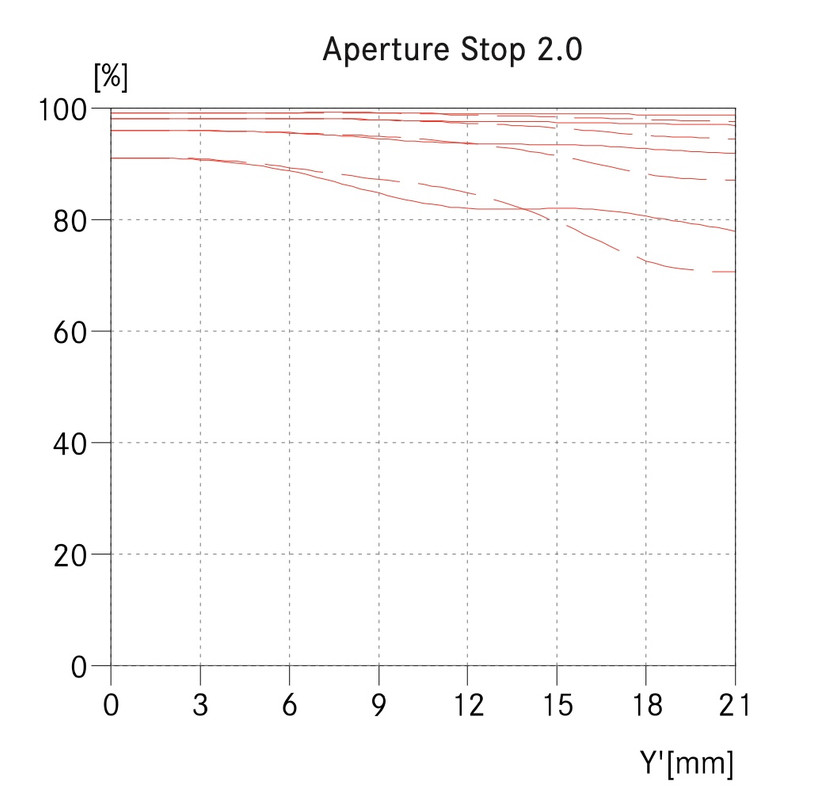
It would be interesting to see bokeh/rendering with a subject in the 3-5 feet range (1-1.5m) with and without significant background separation. Perhaps with time such examples will become available. My concern WRT the MTF graph is you can see significant sagittal and tangential divergence in the outer 1/3 of the image, which to me suggests greater astigmatism-like nervousness in out of focus rendering.
Just for sake of comparison, the Leica 35/2 APO-Summicron-SL:
johnctharp wrote:
I've read / heard and understood that lateral chromatic aberration can be corrected 'non-destructively', given that a mathematically-describable transform can be applied to each color channel to align them. I've felt that this implied that there was little to no cost to resolution for LaCA correction, am I incorrect here?
My understanding is that LaCA is the result of each color channel image being a slightly different size. To 'realign' each color channel would require interpolation of at least one or two of the channels. Such interpolation likely slightly degrades fine detail sharpness and contrast, therefore there would be some slight loss of absolute image quality. Whether it makes a 'real world' difference may be another matter.
RoamingScott wrote:
There is a ton of "swirly bokeh" with subjects well away from MFD which you don't see a whole lot in modern, highly corrected lenses. There is also cat's eye bokeh very near the middle of the frame.
OH, wait, the above photo is from the Sigma 35/1.2. A huge lens like that and still cat's eye bokeh towards the center of the frame...
It would be nice not to have much cat's eye wide open, but I think I'd take the Canon RF 35/1.4 simply for its sane size.
To be fair to the Sigma, there are plenty of image examples online that show how effectively it can melt away the background. But of course, it helps to have ideal scenarios, such as near subjects, distant backgrounds, avoiding specular light sources, etc. It would seem this will also be the case for the RF 35/1.4. For example Phil's samples above.
johnctharp wrote:
I've read / heard and understood that lateral chromatic aberration can be corrected 'non-destructively', given that a mathematically-describable transform can be applied to each color channel to align them. I've felt that this implied that there was little to no cost to resolution for LaCA correction, am I incorrect here?
(either way, how would we prove the conclusion?)
Yes, resampling/interpolation can be applied to each color channel to align them. This works well when there is a small amount of LaCA, but excessive LaCA blurs the individual color channels. That is much harder to correct.
Compactness is a big deal here, as is everything Canon has done to make the RF 35L a 'hybrid' lens, making the lens gimbalable as well increases the attractiveness significantly in my opinion. A R6 II / R5(c) combination is pretty compact and can produce excellent results.
Also making the lens this capable and still this affordable, whatever quirks remain, will almost certainly make it extremely popular.
Affordability is a question mark on my side of the Atlantic, but I have no doubt it will become a popular lens. It is the first in an upcoming series of hybrid, fast fixed focal length lenses with a hybrid design.
rscheffler wrote:
My concern WRT the MTF graph is you can see significant sagittal and tangential divergence in the outer 1/3 of the image, which to me suggests greater astigmatism-like nervousness in out of focus rendering.
The separation between the sagittal and tangential MTF just confirms that this lens has some lateral chromatic aberration. There is no evidence of astigmatism.
Looks like a nice lens. IMO a 35 f/1.2 doesn't make a ton of sense when they already have the 50mm if you want a ton of separation. I'm glad to see them go towards a more modest size/price point with this one.
People tend to use the term astigmatism to indicate high spatial frequency line separation, but it might be better described as residual colour aberration. Designers are targeting LoCA rather than worrying overly about the last percentage elements of LaCA, which (if minor) is close to effectively cleaned up in post.
I have read you cannot entirely eliminate lateral chromatic aberration, and that Arri actually designed in the least visible colour residue for its lenses' lateral CA! It's personal, but I have never been satisfied with obvious lateral CA fixes unless it is very minor. Often it won't clean up well, leaving grey outlines in its wake, or not disappearing at all.
All the high end APO lenses are very 'crisp' so Peter Karbe seems to be right in asserting that APO 'is very important', in this respect at least. It certainly shows up in MTF.
Many of the best lenses trail off in outer frames, Dr Nasse asserted this was not particularly a worry for the highest spatial frequencies, at least. Zeiss however tried to have the sag/tan lines meet at exactly 21mm image height, when possible.
The makers that rely on post for distortion fixes favour a linear barrel form, it makes sense that it is easier to eradicate than complex forms.
johnctharp wrote:
I've read / heard and understood that lateral chromatic aberration can be corrected 'non-destructively', given that a mathematically-describable transform can be applied to each color channel to align them. I've felt that this implied that there was little to no cost to resolution for LaCA correction, am I incorrect here?
(either way, how would we prove the conclusion?)
Prove? One way is to write image-processing software like mine.
Linear scaling is a first approximation and often sufficient. For some lenses like the infamous gull-wing CZ D21 C/Y and successors, a higher-order polynomial is required. Each channel is scaled according to its aberration from the intended projection (usually rectilinear), then recombined into the final image. Besides TCA, this transformation also corrects distortion.
Versus an optically correct lens, there are two problems with post correction. First, most images are oversampled and the transformation will reveal artifacts at the pixel scale—and possibly on the large scale with moire. Second, common image areas with visible TCA are blown out (think tree branches under an overcast sky). Since image R/G/B channels are actually synthesized from the camera R'/G'/B' sensels with their overlapping spectral responses, there is often no way to extract non-clipped values from the area to be corrected. The result is a different but obvious color aberration. Now, this second problem can be solved by underexposing to avoid channel blowout, but then there will be complaints about loss of dynamic range, just as there are complaints about AA filters trying to do their job!
garyvot wrote:
This feels like reviewers needing to find something to criticize.
To quote Jobs: "You're holding it wrong"
It's not a question of 'why allow it', but rather, why go out of their way to ensure that the feature can't be used for stills? And since it's a soft control, the current functionality could be toggled rather than being forced?