AlphaPhotography wrote:
Can any owners confirm if the 35mm VCM makes noise when walking with it in a backpack? Does it's orientation in the bag effect this? I saw a review mention that the VCM elements make a notable "thud" when the lens is shaken and that it can even be heard when walking with it in a backpack.
If you shake it yes- you can here it- its more you can feel it that anything loud. For comparison, my Leica Q3 is a little louder when shaken but just because its higher pitched.
If its in my backpack, I have no idea how on earth anyone could here it. In a quite room, where no other ambient noise is present and you are listening for it, maybe in the quietest room on earth you could hear.
No way under any less than normal circumstance you here it. I have my Leica Q3 or my 35 RF with me on trips weekly. Never once have I ever heard either of them. Absolutely ridiculous claims. I travel 150K miles a year and have one or the other (more recently the RF) almost always with me. Not once have I heard either of them in my Nomatic Camera bag.
JohnDizzo15 wrote:
For starters, I'm not one of those guys that just strokes lenses all day and oogles over stuff on the web. Anyone who knows me around these parts knows that I've made and shared countless images using numerous 35ish mm lenses. So I do get out and shoot. I'll just continue to use the multitude of lenses I have in that FL until I'm compelled to pick up the Canon version. So far, not compelled.
Secondly, I already stated earlier in the thread what amount of resolution needs to be cut from the edges on the RF 35 via the profile correction, which is not a negligible amount. It's fine that you and some other folks are fine with this, but there's hundreds of millions more folks that think the portrait mode on their new phones is perfectly fine too. Different strokes for different folks.
Make no mistake though, this is not the lens people were anxiously awaiting for in the premium 35mm from Canon after 6 years of RF. I'm happy that you're happy with your choice. Seems like a great lens for those who accept the value proposition. Not knocking you, so no need to be so triggered.
---------------------------------------------
I don't inherently have a problem with software corrections, if you would take the statement into context. I have a problem with them in a lens that is supposed to be the premium lens in that particular FL where it has a corresponding price tag, but seemingly leans more heavily into the profiles than other comparable lenses. Virtually every lens from every manufacturer has an accompanying profile, I get it.
And let's not make assumptions about what I've said. I've never stated that this was a bad lens or that people couldn't make beautiful images with it (as evidenced by people like @96whiteknight@). I believe you can make beautiful images with any lens, premium or not. But just like I told the other guy, this is clearly not the lens many people in the market were waiting 6 years for....Show more →
I agree it’s not the sister to the 50 and 85 1.2’s but that’s not what everyone wants. It’s a lightweight compact version that fits the mold for a lot of people with the compromise being the distortion. It doesn’t bother me much because it corrects well and I think this little lens has some good character, it’s sharp too. I've had the lens since day one and I think most people would be happy to pay around $900 for this lens. I think $1500 is a little steep but I paid the early adopter premium because I love the 35 focal length and I use Iit a lot.
AlphaPhotography wrote:
Can any owners confirm if the 35mm VCM makes noise when walking with it in a backpack? Does it's orientation in the bag effect this? I saw a review mention that the VCM elements make a notable "thud" when the lens is shaken and that it can even be heard when walking with it in a backpack.
The clunking noise is way overblown. You will not hear it unless you are handling it while changing lenses.
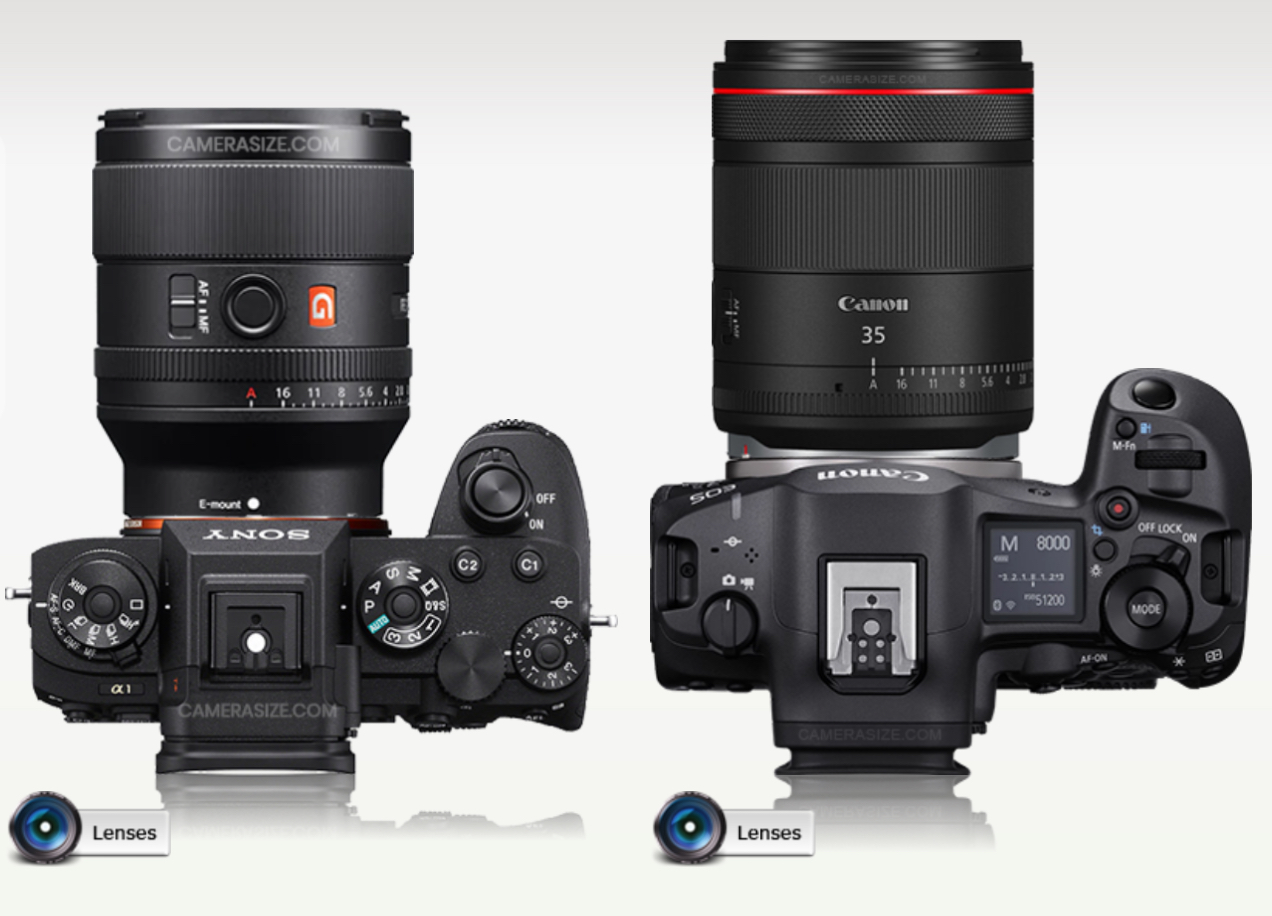
That's great to hear. That'd probably be a deal breaker if it were that audible so this makes me much more likely to give it a shot. I also didn't realize just how small this lens was until I saw a side-by-side with the Sony 35mm f1.4 GM. It's not quite as tiny as the GM but it's shorter than I thought.
RustyRus wrote:
If you shake it yes- you can here it- its more you can feel it that anything loud. For comparison, my Leica Q3 is a little louder when shaken but just because its higher pitched.
If its in my backpack, I have no idea how on earth anyone could here it. In a quite room, where no other ambient noise is present and you are listening for it, maybe in the quietest room on earth you could hear.
No way under any less than normal circumstance you here it. I have my Leica Q3 or my 35 RF with me on trips weekly. Never once have I ever heard either of them. Absolutely ridiculous claims. I travel 150K miles a year and have one or the other (more recently the RF) almost always with me. Not once have I heard either of them in my Nomatic Camera bag.
RustyRus wrote:
So your concern is loss of resolution?
Since we didn't design the lens or the camera, is it possible that the extra pixels outside of the effictive area of the sensor was used for this (its used for IBIS etc). Could this be the portion that is cropped so you might not loose any resolution? Are you just making assumptions you loose resolution based on the uncorrected image?
Your theory/inquiry regarding IBIS, etc. being the potential culprit doesn't change the issue of the trimmed resolution off the edges. The only way this logically isn't an issue is if the sensor itself is actually larger and of higher resolution than is stated on the spec sheet of the body you're using. Otherwise, any trimming off the edges of the raw file will inherently result in resolution loss. There is no way around it.
There have been well-respected people on the web that have tested it. Canon is actually doing something a bit disingenuous (at least in LR Classic) with the profile corrections. They've baked in the native resolution into the EXIF data if you use the profile correction. But if you turn off the profile correction and manually correct to match the manufacturer profile, the resulting loss is 396x262 which shows up once you constrain crop. The thought is that the lens itself is actually closer to about 32mm without corrections, so the final image is actually a 35mm FOV at least.
Again, none of this is to say it makes it a bad lens. The final images look plenty good, so no dispute there. The issue I have remains though, this is not optically the 35mm L lens that many of us were waiting 6 years for. Personally, I still think Canon will put out a much more photo-centric version of this lens that will be more akin to the 50L and 85L.
---------------------------------------------
AlphaPhotography wrote:
Can any owners confirm if the 35mm VCM makes noise when walking with it in a backpack? Does it's orientation in the bag effect this? I saw a review mention that the VCM elements make a notable "thud" when the lens is shaken and that it can even be heard when walking with it in a backpack.
artsupreme wrote:
The clunking noise is way overblown. You will not hear it unless you are handling it while changing lenses.
Have to agree. The worst offenders I've had with regard to clunking while not in use are the Fuji GF 120mm and the XF 90mm. While certainly alarming when you handle them at first, the clunking was definitely a non-issue through ample use/handling of both lenses. Also, the clunking was only prominent when you flipped the lenses around vertically or intentionally shook them. I never noticed it on either lens during transport. I suspect the same here.
Again, none of this is to say it makes it a bad lens. The final images look plenty good, so no dispute there. The issue I have remains though, this is not optically the 35mm L lens that many of us were waiting 6 years for. Personally, I still think Canon will put out a much more photo-centric version of this lens that will be more akin to the 50L and 85L.
-----------
I do think Canon will eventually produce a 35 f/1.2 or a more proper f/1.4 but right now they are focused on the video market considering its much hotter than the stills market
For me, this concept begs a significant question though. Where does the line get drawn for what is still considered an acceptable threshold for the amount of baked-in computing in an image? It isn’t unfathomable that we can reach a point in the (not so distant) future where things like bokeh will also be automatically improved/correctable with a “profile correction.” Would that still be considered acceptable by most of us? I tend to believe many would find it off putting to pay a premium price tag for a lens that in and of itself, has terrible bokeh that is redrawn in software to look more pleasant.
I don’t inherently have a problem with lenses relying on profile corrections. I just think that it is a slippery slope for manufacturers to eventually profiteer even more off the software end, versus hardware. What we are really saying when we accept a value proposition like the RF 35/1.4 is, we are willing to pay for a required software pairing for a lens to be what it’s supposed to be via ones and zeros in code. The only way this works for me is if the lenses correspondingly come down in price.
For general photography purposes (whether professional or hobbyist), the digital correction issue is an interesting question, but I think one that is a matter of personal preference, as long as the image quality is satisfactory. Still, it's a fair position to expect cost to come down if lens design is increasingly a software issue.
Additionally, the software correction issue is opening a huge can of worms for situations where image fidelity is required. Generally speaking, I'm thinking of any case where photographic evidence is required to prove something. If camera/lens manufacturers go too far in the software correction side, they're going to find themselves subpoenaed all the time in court and before government in general to testify as to the extent that images from their products may have been silently manipulated or altered when compared to the original real life scene.
It may also prove a serious issue for news media, where accuracy is also important to preserve credibility.
As a result of this, I think camera/lens manufacturers need to publicly document all aspects of their digital corrections starting now. Otherwise, they're setting up for a real trust issue sometime in the future. Real life is full of surprises and that digitally "corrected" corner may have critical evidence for a legal matter.
(Side note: I think for the same reason RAW files probably need complete documentation of any modifications from the actual raw sensor data. One can foresee now that some camera may be designed for always-on digital "corrections" where said modifications from the actual sensor data may be important to some future matter.)
I shoot RAW; do I need to turn on a setting in my cameras so that they correct my RF35 1.4L images, or is that done in Lightroom or DPP by applying a lens profile?
ardvorak wrote:
This is going to be a luddite-ish question...
I shoot RAW; do I need to turn on a setting in my cameras so that they correct my RF35 1.4L images, or is that done in Lightroom or DPP by applying a lens profile?
It’s usually on by default on both your camera and in LR.
I prefer to shoot with them off in-camera, and that setting normally translates directly into LR upon import also.
JohnDizzo15 wrote:
Nice work! Any chance you have some more candid and/or walk-around/street stuff? More curious to see the types of stuff that doesn't involve crafted/controlled lighting scenarios. TIA
Here are a few street captures with the lens, most of them at f/2.
fraibert wrote:
Additionally, the software correction issue is opening a huge can of worms for situations where image fidelity is required. Generally speaking, I'm thinking of any case where photographic evidence is required to prove something. If camera/lens manufacturers go too far in the software correction side, they're going to find themselves subpoenaed all the time in court and before government in general to testify as to the extent that images from their products may have been silently manipulated or altered when compared to the original real life scene.
It may also prove a serious issue for news media, where accuracy is also important to preserve credibility. ...Show more →
Corrections like those for distortion, vignetting, and lateral chromatic aberration are deterministic. They bring the end result closer to the real life scene, so the court should be happy about those. AI noise reduction and the moiré brush on the other hand do not. They remove distractions and may make the image look better, but not by bringing the photograph closer to the ground truth. These algorithms don't have a clue as to what the real life scene looked like.
I don't know what the future has in store for us, but a lot depends on the type of correction and whether it is done in camera or in post processing.
(Side note: I think for the same reason RAW files probably need complete documentation of any modifications from the actual raw sensor data. One can foresee now that some camera may be designed for always-on digital "corrections" where said modifications from the actual sensor data may be important to some future matter.)
I haven't read every comment but I see that a lot of lenses or software do corrections for distortion and other things which means the lenses aren't as costly to make but cost just as much if not more. I am waiting for a camera with AI that I can tell it Hey Siri or Hey Google, to adjust in camera, give me bokeh of an f1.2, sharpen the eyes, lighten shadows, crop for portrait, etc, etc, etc. Then have it post it on FM and watch how many likes I can get. This way I won't need artistic talent, which is the only thing I am missing, I have the gear.
But the RF 35/1.4L is less expensive than the latest version EF 35/1.4L and apparently at least as good optically (sharpness) based on comments here and the MTF charts published by Canon, while also being smaller and lighter. I doubt though that Canon reduced its price point because it was less expensive to make; the optical complexity of the two is very similar with each having 14 elements, two of which are aspherical. The RF tops the EF with two UD elements vs. one, while the EF has the BR feature to reduce LoCA. Rather, the RF's lower price is likely because of the price range the competition (Sony) is selling similar products. Then Nikon decided to really shake things up with their 'cheap' 35/1.4, though it's not part of their premium line like an L lens is for Canon and apparently performs accordingly...
Rather than seeing it as a cost saving, corner cutting decision by Canon to maximize profits, I consider the stronger reliance on software distortion correction with this lens as a tradeoff for other potential benefits that might be desirable, such as better pre-correction across-frame sharpness, smaller size, lighter weight, faster focusing.
At least with software distortion correction, there is the option to turn it off, or only apply partial correction (depending on the software you use). I have found this very useful in some situations with the RF 16/2.8. If it's a natural scene where distortion isn't obvious, I can turn off or reduce correction and gain a wider field of view. In some instances, I have adjusted distortion correction in Lightroom to around 50-60%, particularly for large group photos, so that the people at the edges are not as 'stretched' as when the lens is fully corrected.
Maybe this is an opportunity for Canon to diversify the L line into L 'lite' and L 'halo' types of products? Rather than release yet another f/1.2, as I've previously suggested, they should go to f/1.0 and really set it apart from their other 35mm offerings for all the deep-pocketed bokeh aficionados for whom there is no such thing as too large or too heavy.
Was recently presented with an opportunity for a decent deal on one of these, so figured I'd just try it out and see for myself.
Some thoughts:
The thud was actually worse on both the Fuji GF 120 and XF 90. On the Canon 35, it's actually pretty mild, and really a non-issue.
Look and feel of the lens itself pretty much falls in line with the rest of the RF lineup. No issues there.
I'm no optical scientist or subject matter expert, but the front glass element on this thing is unusually tiny for a fast full frame prime relative to the countless other lenses I've used. Would love to understand how this affects the IQ and why that decision was made.
Mounted on the R8 with firmware updated on both lens and body, this thing appears to focus very quickly, but misses a surprising amount when least expected (one point and spot in servo). Will have to play with it some more.
The decision with the aperture ring not being enabled for stills is really odd, as I'm used to relying on it for my Sony and Fuji rigs. Not a huge deal though, as I've just programmed the control ring to aperture control.
Not a fan of the total package size with hood installed. Trying out a square metal 67mm hood that saves me about an inch of length and some girth in the front. Vignetting seems to be about the same. So far, so good.
Distortion and vignetting are really bad uncorrected. But this was well-known already. Other than this, the lens is very sharp and has an interesting look uncorrected. Some samples from today (distortion uncorrected).
I'm no optical scientist or subject matter expert, but the front glass element on this thing is unusually tiny for a fast full frame prime relative to the countless other lenses I've used. Would love to understand how this affects the IQ and why that decision was made.
Front element/entrance pupil only needs to be 25mm for a 35/1.4 lens. Consider the many 35/1.4 lenses available for the Leica M rangefinder system and they're all much smaller than mainstream mirrorless/DSLR 35/1.4s. For example the Leica 35/1.4-M is 46mm filter size.
A reason for the huge optics of modern fast lenses (both in diameter and in groups/elements count) is to more easily improve image quality/sharpness. Look at Zeiss Otus, Sigma Art (particularly their massive 35/1.2 for mirrorless), Canon's EF 35/1.4 v2... The smaller the elements and the fewer there are, the more 'work' each element has to do to form the desired image. And the shape of each element, the spacing, the assembly all need to be much more precise.
With the short mirrorless flange distance, an important consideration is that light rays reach the entire sensor area as perpendicular to the sensor surface as possible. Hence the reason many mirrorless lenses have large rear elements to minimize the strongly oblique light rays typically projected from small diameter rear elements that sit near the sensor surface. Strongly angled light travels farther through the glass sandwich that covers the sensor itself, resulting in additional image refraction that can degrade image quality if it is not accounted for in the lens design. Such light rays also require more help from customized microlens arrays above the sensor's pixel wells to redirect the light as optimally as possible down into the pixel wells to the actual light sensitive photosite.