bjhurley wrote:
I have an amazing app on my phone called Pinhole Assist that has a large database of cameras (including mine) and a large database of films and their reciprocity failures. It has a light meter (even a selectable spot meter) and it takes your pinhole's size and the film's reciprocity curve into account, plus any filters you have added (ND, red filter, etc.) to give you the proper exposure. It has great reviews and a lot of pinhole photographers use it.
The camera does come with a nice little wooden exposure chart to use with any light meter (take a reading for f22, and then use that to get the exposure on the little wooden chart). But then you have to calculate the additional exposure needed to account for reciprocity failure, which varies greatly by film, and most exposures with a pinhole camera are much longer than 1 second, sometimes 45 minutes or more (not counting the pinhole cameras that are used for photo paper, which can have exposures lasting months or even years). Fuji Acros is always a good choice due to its low reciprocity failure, but it's not my favorite film. A lot of people use Fomapan 100 because it has extreme reciprocity failure, giving you long exposure times even in relatively bright conditions, which is one of the features of pinhole photography: you aren't just capturing a moment in time, you're capturing a collection of moments....Show more →
"pinhole photographers" - I don't doubt it - I just am amazed it exists. As kids we made pinhole cameras out of cardboard and tape. Maybe I should look and see if crystal radio operators is a thing now.
James Markus wrote: "pinhole photographers" - I don't doubt it - I just am amazed it exists. As kids we made pinhole cameras out of cardboard and tape. Maybe I should look and see if crystal radio operators is a thing now.
Hah, I bet it is. :-)
But pinhole photography really is a thing, especially among fine art photographers. I've been aware of it since I was a kid but never paid much attention until I saw the work of Zeb Andrews, a photographer in Oregon (and a manager of Blue Moon Camera). Check out this album for example: https://flic.kr/s/aHsiDP65vr
No pinhole cameras produce sharp images, but to get them this sharp you need very small, precise laser-drilled pinholes in thin foil.
But pinhole photography really is a thing, especially among fine art photographers. I've been aware of it since I was a kid but never paid much attention until I saw the work of Zeb Andrews, a photographer in Oregon (and a manager of Blue Moon Camera). Check out this album for example: https://flic.kr/s/aHsiDP65vr
No pinhole cameras produce sharp images, but to get them this sharp you need very small, precise laser-drilled pinholes in thin foil.
Wow! I can guarantee I did not expect them to look so good. He seems to have picked the perfect topic for long exposures.
As much as I like all my analog cameras, I would have to say My Nikon FM2n. I've had it since I was sixteen, and while loads of other cameras passed by, The FM2a size, viefinder information and handling allways been my benchmark.
Secong place at the would be my Leica IIIG, third Rollei 35. This autum I've been using my Nikon FA more, it needs exercise and my newly bougt Yashica-Mat 124 which is tons of fun.
As much as I like all my analog cameras, I would have to say My Nikon FM2n. I've had it since I was sixteen, and while loads of other cameras passed by, The FM2a size, viefinder information and handling allways been my benchmark.
Secong place at the would be my Leica IIIG, third Rollei 35. This autum I've been using my Nikon FA more, it needs exercise and my newly bougt Yashica-Mat 124 which is tons of fun.
If you like an F3 but don't always need a body that compact, it's worth trying an F4. The F4 has a bigger, brighter, and clearer viewfinder with a center AF/confirmation point and a diopter adjustment. It has built-in motor drive and a buttery smooth shutter that lets you get away with very marginal handheld shutter speeds. A particularly big point for me is that it has matrix metering with all lenses (including pre-Ai). Unlike the F3, you get a normal hot shoe mount on the viewfinder and a more generous 1/250s sync speed. But like the F3, it's modular. If you want a grip, add one. Want a waist-level finder or the big action finder? Add one.
I'll also say that the F4 has a surprisingly good autofocus implementation. It's certainly better than I expected, being both snappy and accurate. It's best with AF/AF-D or manual glass, but it'll host AF-S lenses as well. You just have to shoot in S or P and you won't get VR. This works fine, and I've actually enjoyed shooting the 35 f/1.4G on this camera quite a bit, but I wouldn't seek out the F4 if you only use AF-S lenses.
At $250 or so, I think the F4 is a steal. I can't say enough good things about the shutter smoothness or the viewfinder quality, and the lens flexibility does make it a real contender against the F5 and F6 depending on the lenses you prefer to use. Just be sure to buy a comfy strap, because it's nearly a pound heavier than the F3, even with a four-cell grip and lithiums.
until this afternoon the Nikon F3 was my favorite (with Holga running in second place).
I just received this from a super nice guy here on FM, and now it's top position, my favorite film camera, and likely/hopefully, my last film camera in this and the next 3 lifetimes.
Sleek and kind of modern. Crazy, but talk about getting back to basics and not caring if someone swipes it. It made me think about exposure before the shot and pay attention more to lighting. I won’t be shooting color slide film on it, but for street photography, especially at night when you are near wide open and as slow as you can hold it- and pray. It makes you realize that exposure isn’t some crazy combo that the camera comes up with out of no where. Just like having to MF puts you more in touch with the pic than AF.
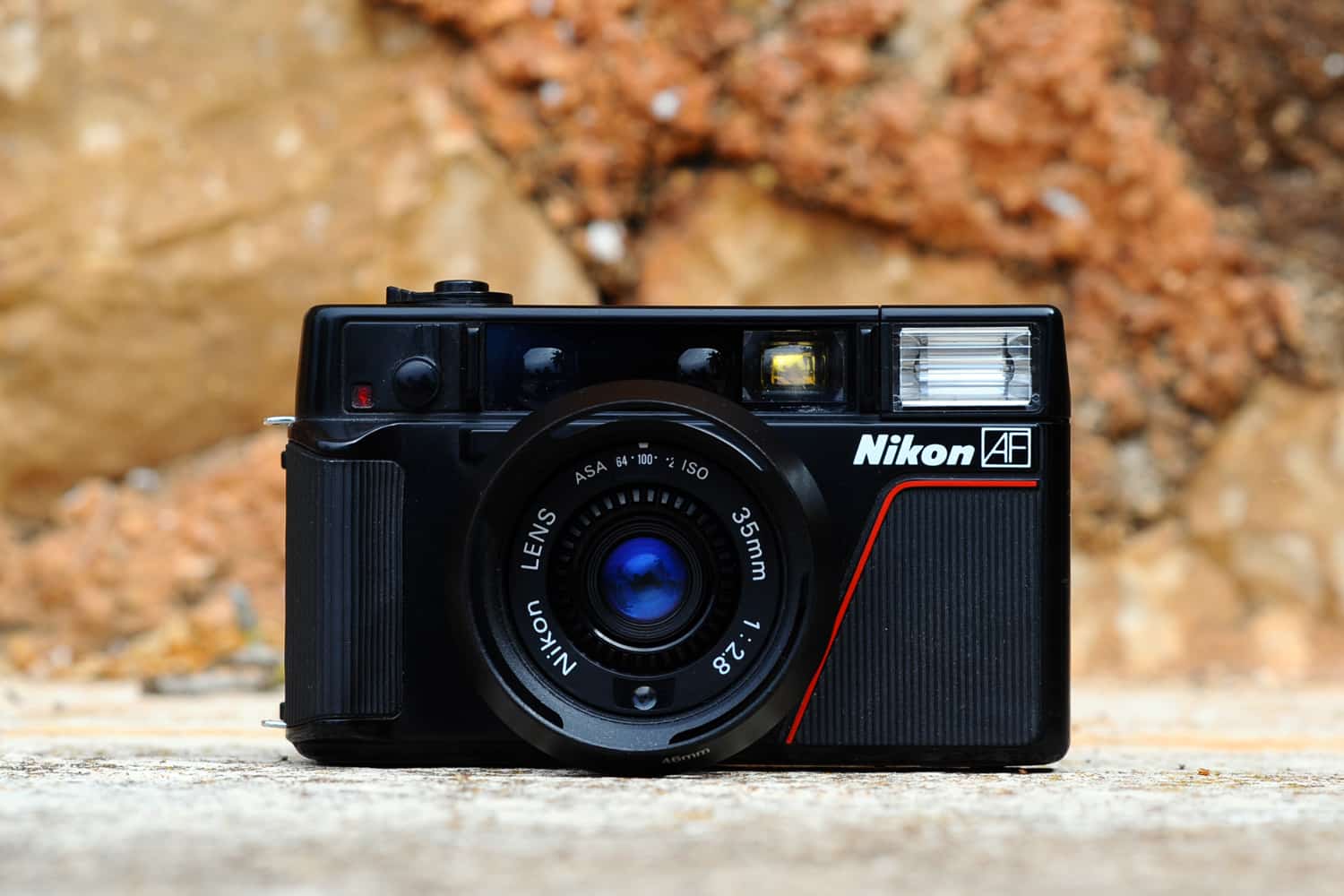
..couldn't really make my mind up which of the SLR's I shot with is my favourite one (probably Pentax ME, but also really loved my Nikon FG as well as a couple other Nikon's) so decided to share my favourite compact of all time, the L35AF:
Although, while explaining the Hasselblad system to a friend of mine the other day, I realized that there probably never was camera that I enjoyed using more than the 503cx. Just never got used to the square format, frankly, which is why I also gave away the Rolleicord, despite really enjoying that one as well..
brick33308 wrote:
just received this from a super nice guy here on FM, and now it's top position, my favorite film camera, and likely/hopefully, my last film camera in this and the next 3 lifetimes.
I had a Leica MP BP, M4, M3, IIIG and currently holding onto a Nikon F3 and FE2 (love these two)...but the M-A just has the magic for me in its simplicity.
I had a Leica MP BP, M4, M3, IIIG and currently holding onto a Nikon F3 and FE2 (love these two)...but the M-A just has the magic for me in its simplicity.
Ahem, the title of this thread has the word “show” in it.
All are perfect working order...including the light meters. Amazing that the F3 meter still works...I think the original F3 manual stated that it had about a 5 year life expectancy before it had to be replaced. And this F3 is not a later model...serial # has it made in 1985.
Asking which one of these is my favorite is like asking a parent, "Of your 3 children, which one is your favorite?" The one I use the most is probably the FM3A, as I keep the AI-S 35mm f/2 on it. My sentimental favorite is the F3 (AI-S 50mm f1.8 perma-mounted for the most part), which was my first serious camera (that I had to spend almost 2 months of my Army salary at the time to acquire it and a lens, at the time). Metering...TBH, I still like the LED -o+ of the FM2N, even though it isn't quite as accurate as the needle meter in the FM3A. That's why I keep the AI-S 28mm f/2.8 on the FM2N...the meter is easy to see in low light, and 28mm is such a great focal length for nighttime street photography.
The only other film body I keep and maintain is a Zenit TTL Moscow Olympics edition with that unique Helios-44 58mm f/2. The exposure meter on that conked out a few years ago. Before I put an external on the hotshoe, I found a couple of sites in Russian suggesting how to bring it back to life...and... whaddya know, now it works after a couple of tries. Also a marvelous camera, built like a T-34/85.
All are perfect working order...including the light meters. Amazing that the F3 meter still works...I think the original F3 manual stated that it had about a 5 year life expectancy before it had to be replaced. And this F3 is not a later model...serial # has it made in 1985.
Asking which one of these is my favorite is like asking a parent, "Of your 3 children, which one is your favorite?" The one I use the most is probably the FM3A, as I keep the AI-S 35mm f/2 on it. My sentimental favorite is the F3 (AI-S 50mm f1.8 perma-mounted for the most part), which was my first serious camera (that I had to spend almost 2 months of my Army salary at the time to acquire it and a lens, at the time). Metering...TBH, I still like the LED -o+ of the FM2N, even though it isn't quite as accurate as the needle meter in the FM3A. That's why I keep the AI-S 28mm f/2.8 on the FM2N...the meter is easy to see in low light, and 28mm is such a great focal length for nighttime street photography.
The only other film body I keep and maintain is a Zenit TTL Moscow Olympics edition with that unique Helios-44 58mm f/2. The exposure meter on that conked out a few years ago. Before I put an external on the hotshoe, I found a couple of sights in Russian suggesting how to bring it back to life...and... whaddya know, now it works after a couple of tries. Also a marvelous camera, built like a T-34/85.
I have a few. The Nikon is usually my go to camera for nearly all my film photography needs. The next is the GW690II with that beast I take a tripod along, a remote shutter cable and a meter. The GW690II and Nikon FM2 are both all mechanical. The FM2 has a metering system but I don't use it so to me its all mechanical as well. The other cameras need a battery or two to function.
Fujifilm GW690II Medium Format
Nikon FM2
Canon Sure Shot Supreme
Canon EOS 1
Canon EOS 1N HS
Canon EOS 1V HS


 "pinhole photographers" - I don't doubt it - I just am amazed it exists. As kids we made pinhole cameras out of cardboard and tape. Maybe I should look and see if crystal radio operators is a thing now.