p.1 #1 · How do old Zeiss/Contax/Yashica lenses compare to modern designs?
Just wondering,
I have a bunch of Contax/Yashica prime lenses, 25-35-50-85-100-135-200 and wondering how do they perform compared to modern design?
For instance I am a prime snobbish, I prefer primes over zooms but I understand that sometimes a zoom allows flexibility especially when it's about landscape or casual shooting, when I know what I wanna take home I think at which of my primes can achieve it and go for it but since I make no use of my Contax glass I was wondering if anybody has personal experience especially on the Distagon 35/1.4 as I have no 35mm primes on Nikon mount and I can adapt it on a Nikon Z (not on a D D-SLR) and either thinking to sell to fund a native 35mm or to keep and use it adapted.
I know once stopped down in the f8 range realm they should perform pretty well but wondering about somebody's opinion based on personal experience.
p.1 #2 · How do old Zeiss/Contax/Yashica lenses compare to modern designs?
It really depends on the modern design. If you were to compare them to the Z line, you'd find them overall more in line with the 28/2.8 and 40/2 than their more expensive S series lenses so far as objectively measurable attributes. And that's especially true for the teles. Objectively, the 70-200/2.8s makes your 85-100-135-200 look like they're not really trying.
But lenses are not simply collections of their objective performance. Those aspects make them easier to discuss in gear forums, but you can list all the ways in which a lens is objectively worse than others without ever touching upon why you'd want to use it in the first place. And you can do that just as easily with every modern lens, because none of them are flawless. Personally, great objective performance only matters to me in specific focal lengths. Most of my primes were picked because they have aspects that I love for the way I use them, and nothing that drives me insane.
One thing I can tell you- there is no other lens quite like the CY Distagon 35/1.4. Even as the Zeiss designs grew in size and got objectively better, there's still an argument to be made that they lost a bit of that lens' magic in the process. If you love it, keep it. If there are aspects of it driving you crazy, start looking for a replacement.
p.1 #3 · How do old Zeiss/Contax/Yashica lenses compare to modern designs?
They are much less sharp wide open than their more modern Zeiss descendants, have all kinds of optical flaws wide open like coma, CA, etc. Nevertheless I mourn the loss of my AEG 35 and 85 1.4's every day, such special lenses Wish I still had them to try shooting with a speedbooster and cropping.
p.1 #4 · How do old Zeiss/Contax/Yashica lenses compare to modern designs?
As I've gotten older and (somewhat) wiser, I've really started to appreciate faults and design inefficiencies in glass.
Modern glass is chasing perfection far, far too much, which in turn produces really sterile images. Sure, there's no aberrations, no faults, corner-to-corner sharpness wide-open, but it feels like I'm looking at a GenAI-created image half the time. At least the HDR over-saturation isn't as prevalent now. But, I digress.
Older glass has a certain charm, in that there's a balance between aberrations and artistic character (at least if the lens was pricey back then and of good quality), that creates results which are still hard to replicate via software. Some are almost impossible (thinking bokeh from an old Biotar as an example) to replicate now. I'll also note that said imperfections also more closely mirror human memory, so they match more, which evokes emotion.
On a more practical side, I find modern ASPH-everything™ to be frustrating to work with, because of the onion-ring bokeh, and other cost-absed limitations of modern optical manufacturing techniques (read: savings via moulded glass, no manual aspherical glass grinding, etc.) make for some jarring or less pleasing images. Really depends on the manufacturer.
Interestingly, some high-end cine manufacturers have launched lens lines deliberately eschewing from the use of aspherics, like the Leitz THALIA line, in order to create "classic" images like those made by the R line and the C/Y generation.
p.1 #5 · How do old Zeiss/Contax/Yashica lenses compare to modern designs?
I am shooting a lot with C/Y lenses, though not with the 35mm 1.4. Like MKRhodes says, they are not as sharp as modern lenses, have optical flaws but that gives them a certain character. For shooting landscapes stopped down, I don't see much use for them (but I don't shoot a lot of landscapes and could be entirely wrong).
As far as zooms are concerned. I used to have the 35-70, sold it in an act of madness, and will re-buy it.
p.1 #6 · How do old Zeiss/Contax/Yashica lenses compare to modern designs?
I will add that if you go down the path of picking up some more modern glass, hold on to your vintage glass, because getting it back will take time, money, and there is no guarantee that your "new" copy will be as good as the old one.
p.1 #7 · How do old Zeiss/Contax/Yashica lenses compare to modern designs?
Hello,
I am not much of a landscape shooter, I mean, I do but I find it boring and I don't see myself that good at it nonetheless for that kind of stuff I either have a native 20/1.8 on D-SLR or a 14-24/2.8 on ML so on the wide end I am covered.
As much as I try and use 35mm (the Distagon adapted onto a ML body) I can't really seem to find a spot for that focal in my shooting not to mention that I own the kit 24-70/4S onto ML body and it does very well if not looking for a particular rendering, it actually is very good in its "flatness".
My favorite focal lengths are from 50 to 85 and maybe a little longer as I love portraits and mostly in a semi-candid fashion and that's why I do need AF, I have the beautiful Planar 85/1.4 and 100/2 but manual focus doesn't do it not to mention that I also own AF 85s like the old but wonderful f1.4D and the fancy new 1.2S along with a cheapo but good f1.8G, actually I would trade them for a 135/1.8 just to complete the portrait lineup as all of those MF Contax lenses, as good as they might be, don't see any usage but I appreciate some distinctive renderings, actually the lenses I love the most among those I own are the Nikon 58G and the old 85/1.4D, I got the 50/1.8S which is amazingly sharp corner to corner even wide open but, to my taste, totally tasteless.
p.1 #8 · How do old Zeiss/Contax/Yashica lenses compare to modern designs?
I think you answered your own rhetorical question. Maybe that was done to seek validation of the choices you've already made. In the portrait range you already own the Planar 85/1.4 and the 85/1.4D and you've compared them to the 50/1.8S and made your decision. I'm not quite sure what you can expect us to offer, as you seem to already know what you like. Personally, I agree with your choices.
As much as I love the Planar 85/1.4 for it's unique rendering characteristics I find it difficult to use for semi-candid portraits, or what I would call quick indoor portraits in ambient light, because it is very difficult to quickly nail wide open focus manually and because of it's focus shift at wider apertures. I pair my Planar with the Nikon 85/1.4G for those times when I need to have fast AF. The 1.4G is great for instant AF indoor portraits in ambient light. I prefer the 1.4G over more recent designs because I agree with Sam's previous comments about ASPH-everything lenses. Lenses that produce onion rings in the OOF highlights are a no-go for me and the 1.4G produces beautiful smooth OOF highlights. The 85/1.4G is a recent lens design, and freak's comments that it all depends on the design of the recent lens is spot-on, as the lens seems intended to avoid the modern ASPH-everything characteristics that a subset of users don't like.
To adapt CY mounts to Nikon I've modified lenses using Leitax F-mount converters which becomes expensive if you're adapting a large number of lenses. I expect that the process would be much simpler on the Z mount if all that you need to do is to mount the lens on an adapter ring. (No experience there)
I would not consider selling of your lenses as it's obvious that you like the way that they render.
p.1 #9 · How do old Zeiss/Contax/Yashica lenses compare to modern designs?
I have to admit from the beginning that I am a grumpy old man about this and the related debate about 'old cameras' that are likely to be barely 'run in' with all but a few truly 'professionals'.
I believe that many 'old' lenses have real virtues, as do many of the newest, and that neither a particular lens nor any specific camera - ancient or launched tomorrow - do a good photographer make.
I also believe that almost all cameras and lenses currently available offer capacity that is beyond the reach of most of us to be able to fully utilise that capacity ( perhaps that accounts for the surge of interest in artificial intelligence assistance ?).
I still adore the results from my 'old' Contax G lenses and even a Zeiss 75 Biotar from about 1938 (spoiler alert - incidentally the year that I too was born !) alongside my more modern glass.
I also believe that it is more productive to concentrate on improving how I use my existing resources rather than chase the newest moonbeam that might, hopefully, improve results for me .... but then as I pointed out before I am 85 and still working quite hard to learn and improve as I am far from what I would like to be.
p.1 #10 · How do old Zeiss/Contax/Yashica lenses compare to modern designs?
GiovanniAprea wrote:
Just wondering,
I have a bunch of Contax/Yashica prime lenses, 25-35-50-85-100-135-200 and wondering how do they perform compared to modern design?
For instance I am a prime snobbish, I prefer primes over zooms but I understand that sometimes a zoom allows flexibility especially when it's about landscape or casual shooting, when I know what I wanna take home I think at which of my primes can achieve it and go for it but since I make no use of my Contax glass I was wondering if anybody has personal experience especially on the Distagon 35/1.4 as I have no 35mm primes on Nikon mount and I can adapt it on a Nikon Z (not on a D D-SLR) and either thinking to sell to fund a native 35mm or to keep and use it adapted.
I know once stopped down in the f8 range realm they should perform pretty well but wondering about somebody's opinion based on personal experience.
I had ... past tense ... several different C/Y lenses that I adapted onto my Canon EF mounts. Read this as "I kept spending money to buy them, because I liked them, a lot."
That ^ should be 'nuff said (imo).
The only reason I don't have them anymore is I changed platforms, and my M glass is to my liking, but I'll always have a good regard for them.
However, that doesn't exactly answer you question wrt "modern" design.
I'd recommend you take the word "modern" out of the equation ... and recognize that optical designs can be as varied as mixing cocktails at the local pub. With the advent of new computational speed, the variety of optical designs that can be brought to market are increased. The most significant aspect is probably the advent of the Aspherical lens designs, and then what I'd call the hybrid approach of mixing biogon with distagon with double gauss, etc. and the possibilities of different designs can grow significantly.
I think if you take a look at "modern" Voigtlander lenses, you can see that they have their "Vintage" line vs. their Ultron line, etc. Both lines are indeed "modern", but they are different optical formulations intended to yield different rendering styles. An oversimplification would be ASPH vs. non-ASPH ... and the levels of SA (or other corrections) involved.
My point is that the age of the lens glass doesn't mean that much ... it is the design choices that are being made, whether those choices were made 5 days ago, or 50 years ago (my 40 Cron, for example).
Excellent glass from days gone by ... is still excellent glass. It may have different characteristics, because it has different design. If you like those characteristics, there are plenty of C/Y lenses that indeed excellent. Can we spend a whole lot more $$$ on newer production and achieve higher levels of resolution, and improved levels of correction ... you bet.
I could go longer, and others can explain better ... but, simply this:
Personally, I'd get an adapter and use them. You have wonderful glass, never mind what else is out there ... use them, enjoy them, learn them. You'll find your fav's. As to the C/Y 35/1.4 specifically, I've got no experience with it (I had the 35-70/3.4 Vario and 50/1.4), but for the price of an adapter ... get the adapter and shoot it.
p.1 #11 · How do old Zeiss/Contax/Yashica lenses compare to modern designs?
RustyBug wrote:
I think if you take a look at "modern" Voigtlander lenses, you can see that they have their "Vintage" line vs. their Ultron line, etc. Both lines are indeed "modern", but they are different optical formulations intended to yield different rendering styles. An oversimplification would be ASPH vs. non-ASPH ... and the levels of SA (or other corrections) involved.
Just one minor correction to this: the "Vintage" line at Cosina Voigtländer refers to the lens's physical appearance, not its optical formula. The lenses that aim to mimic the optical qualities of older film-era lenses are in the "Classic" line. It's confusing, and I kind of think they should have reversed those designations, but there you go.
p.1 #12 · How do old Zeiss/Contax/Yashica lenses compare to modern designs?
Some of the ZF/ZE Classic Zeiss lenses share optical formulas with the C/Y lenses, so optical performance for those is pretty much the same outside of newer coatings. You can check the Zeiss spec sheets and compare to see if a lens's optical formula was updated or not. The updated lenses will perform better.
For the Milvus line the 50mm f/1.4 and 85mm f/1.4 were redesigned (both were C/Y formulas in the Classic line) but the rest were kept the same from the Classic line. The 50 and 85 are the only Classic line lenses not discontinued, because they are the only optical formulas distinct from the Milvus line. Otus lenses are all new formulas.
One nice thing about the C/Y Zeiss line is that the lenses are smaller than their Classic line counterparts. There's also the option of the f/2.8 lenses for most focal lengths which are very small and don't have newer counterparts.
p.1 #13 · How do old Zeiss/Contax/Yashica lenses compare to modern designs?
Actually, the Z* lenses were all recomputed, because several glass types were no longer available due to RoHS restrictions coming into place. There's ample comparisons available on the web; some aspects have remained the same, but often things like bokeh and CA/LoCA profiles were impacted. It's not just the coatings making things sharper or adding microcontrast.
Just because a lens diagram looks similar, it doesn't mean it'll perform the same, especially when it comes to character. Even similar MTF charts don't mean similar drawing style, since there's a ton of nuance to it. (The PDFs Zeiss publishes on interpreting MTF charts are a good read!)
p.1 #14 · How do old Zeiss/Contax/Yashica lenses compare to modern designs?
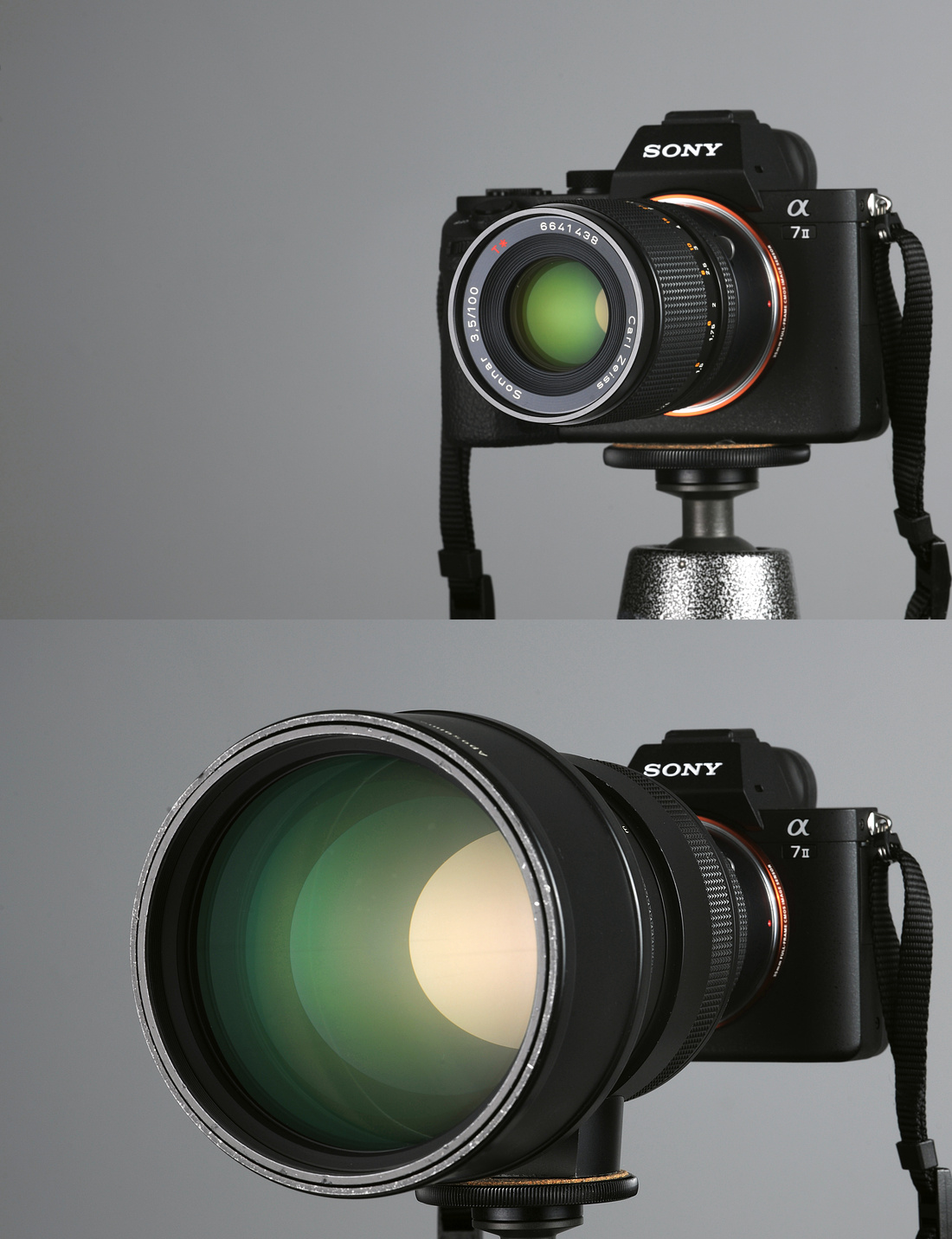
Most CZ C/Y lenses are sharp enough for me. The ones that aren't, I don't buy. To paraphrase Sam, too much perfection is boring. I do own lenses that are state of the art—perhaps even perfect —which I will use when the need arises. In other situations, small, cheap and flawed has an attraction all its own. Two CZ C/Y primes that aren't perfect but pretty damn excellent in different ways:
These are both replaceable by the Nikkor 70-200/2.8E if image quality, stabilization, and AF are the only factors. I intend to keep them all, however.
That comparison should give you an idea. The Planar is a Contax/Yashica optical formula still in production today.
To simplify it, as time went by lenses improved by correcting aberrations at wider apertures and in the corners. Many old designs do very well at f/2.8 and beyond and are comparable to modern optical formulas although the modern optics will have better correction in more situations. The more you stop down older designs the less difference you will see compared to modern optics.
Aspherical elements helped the complex problem of spherical aberrations, which old lenses have. Leica shooters call those spherical aberrations the "Leica glow".
Floating elements helped with the problem of being able to optimize a lens for only a single distance: either close or infinity.
If you are looking at a lens for landscape use and want the best corner to corner performance, then you are better off with a modern optical formula.
If you are looking for a lens for portraits, then you might like how the aberrations affect the image of an older optical formula. They call this the lens rendering or character. For example, I really love how a Helios/Biotar renders when shooting people and I am not referring to the swirly bokeh it is famous for.
Some defects of older lenses like strong curvature can be an asset if you can take advantage of them.
The faster the lens the more residual aberrations even when you stop down. That means a f/2 lens will be better corrected than a f/1.4 lens even when you stop down to f/4 or f/5.6. This is still true today of modern optical formulas. A summicron will have better corners and they will clean up faster at wider apertures than a summulix. Whether the difference is enough to matter to you is a personal decision.
p.1 #16 · How do old Zeiss/Contax/Yashica lenses compare to modern designs?
Cinematographers are collecting, sometimes rehousing, these lenses for a reason.
The coatings were pretty advanced at the time but still render a classic spherical look. So it's a nice blend that gives good tonal gradation and contrast.
Aspherical lenses are wonderful. Some are pretty dull though. I like having a little bit of both. I also think the Nikon Z as a platform is an excellent choice.
p.1 #18 · How do old Zeiss/Contax/Yashica lenses compare to modern designs?
It's one lens I regret not buying, the (6/5) CY 100/2. Despite being a Planar, it features the same flat MTF lines the one I did buy also has, the Sonnar 100/3.5 (5/4). Both are very faithful to their designs.
Zeiss had this magical approach from Contarex days, where they were prepared to trade off out and out resolution wide open for detail content for total control of field curvature at the focal plane. It was thought be a factor in excellent out of focus (the word 'bokeh' not having been part of the lexicon yet) backgrounds. It certainly makes for extremely engaging portraits. 'Makes', not 'made', since this elegant look from the old firm is timeless.
p.1 #19 · How do old Zeiss/Contax/Yashica lenses compare to modern designs?
'Aspherical lenses are wonderful. Some are pretty dull though.'
There are very, very few APO lenses with no aspherical elements, because you need fabulous glass and top tier expertise to achieve this. I only know of the Voigtlander 110/2.5 and the new 50/3.5 APO-Lanthars. Zeiss resisted using aspherics seemingly for an eternity, and many of their character lenses appeared in those times.
PMO (‘precision molded’) aspherics are the very epitome of computation in optics. People tend to think of aspherics as similar to spherical lenses, with a slight alteration to the regular round element shapes we see in data sheets. And some are in fact made that way.
But aspheres are increasingly fuelling the race to the bottom that we see in lens design in the major companies - the Canon RF 28mm f/2.8 STM is a fine example. It's half full of weirdly shaped PMO aspherics. A year ago, cameralabs was permitted to film a teardown of this lens. It’s almost half composed of weirdly shaped high tech plastic pieces:
YT title, I would not want to sully the thread with even the face image:
‘Canon lens TEARDOWN! What's INSIDE a new lens?’
And Canon is also using this technique in all manner of RF lenses - eight at that time of publishing, including their only regular price 50mm, the 50/1.8 STM.
Sony is a heavy user of aspherics, as shown by their glossary:
This morning, I looked through the ($1100) Sony 20-70/4 G image thread and the rendering struck me as being very different, almost alien from what you might expect:
p.1 #20 · How do old Zeiss/Contax/Yashica lenses compare to modern designs?
Why does it matter?
To many it won't matter at all, they like what they get and fair enough. But as times passes by, modern image rendering is displacing what we had just a decade ago, as the *dominant form* against which all else is judged.
If we believe the phone-led asph revolution is going to stop there, think again about how business works. The direction is reversed now, and we will have a 'phone-up' revolution in photographic optics.
For some, the contribution of all aspherics is not all positive, once a certain, carefully chosen level of aberration control is attained. We are arguably learning how to see images better as we move along in the digital era, and this aspherics trend can be expected to accelerate that perception shift.
We may (and should) see a move away from aspherics purely for rendering preferences, apart from (in some cases) very judicious and traditional usage - as seen in Otus and some CV lenses that use just one element of them. You can almost sense Cosina's reluctance to use them.
There seems to be two very different paths being followed in aspheric manufacture. But even the high-end production path may see a move away from aspherics in the more traditional heartland of the optical industries:
'Beauty First
The use of modern photography lenses for beautiful cinematography is rare, mostly because many modern photo lenses lack a distinct and artistic character, instead prioritizing sharp images that can feel devoid of life.
The Leitz THALIA lenses...are an exception to the rule. The S lenses are designed to capture people above all else and the way THALIA lenses render faces evokes the iconic portraiture that medium format is known for.'
'Many cinematographers have pulled away from modern cinematography lenses in order to introduce aberrations that take the edge off digital sensors.'
It sounds a lot like Zeiss's 'rounded sharpness'. Bravo, we need both kinds of lenses. What might have appeared to be a cost-cutting measure by Cosina (to avoid expensive asph production) in its latest lenses could in fact be the company reasserting its new direction regarding glass types to be used in its high-end lenses. Good for them.


 Wish I still had them to try shooting with a speedbooster and cropping.
 —which I will use when the need arises. In other situations, small, cheap and flawed has an attraction all its own. Two CZ C/Y primes that aren't perfect but pretty damn excellent in different ways: