p.3 #1 · How do old Zeiss/Contax/Yashica lenses compare to modern designs?
Along with Leica, Sony is probably the most enthusiastic maker regarding aspherical surfacing, that is the background. Sony only mention the four asph elements in that 24-50 zoom. My somewhat educated guess is they use no PMO or PMC processing, but an extension of their very sophisticated glass molding processes.
The PMO/PMC process is most associated with Canon (and phones):
'Canon has been at the forefront of developing PMo lenses. For example, the RF28mm F2.8 STM lens features 3 large-diameter PMo aspherical lenses, contributing to high image quality while maintaining a compact and lightweight design.
Similarly, the RF 16mm F2.8 STM lens incorporates a single PMo aspherical lens to achieve excellent color rendition and crisp, contrasty images. The manufacturing process of PMo lenses involves injecting resin into a mold, which is then coated to finish the lens. This process is *more cost-effective*..'
Sony, however, devoted vast sums to developing and refining glass aspherical elements:
To my knowledge, only the 35/1.4 in the CY range uses just one asph lens. The CY 21/2.8 has none either among its 15 elements.
Jan 11, 2025 at 07:42 PM
Steve Spencer Offline • • • • • • • Upload & Sell: On
p.3 #2 · How do old Zeiss/Contax/Yashica lenses compare to modern designs?
philip_pj wrote:
Along with Leica, Sony is probably the most enthusiastic maker regarding aspherical surfacing, that is the background. Sony only mention the four asph elements in that 24-50 zoom. My somewhat educated guess is they use no PMO or PMC processing, but an extension of their very sophisticated glass molding processes.
The PMO/PMC process is most associated with Canon (and phones):
'Canon has been at the forefront of developing PMo lenses. For example, the RF28mm F2.8 STM lens features 3 large-diameter PMo aspherical lenses, contributing to high image quality while maintaining a compact and lightweight design.
Similarly, the RF 16mm F2.8 STM lens incorporates a single PMo aspherical lens to achieve excellent color rendition and crisp, contrasty images. The manufacturing process of PMo lenses involves injecting resin into a mold, which is then coated to finish the lens. This process is *more cost-effective*..'
Sony, however, devoted vast sums to developing and refining glass aspherical elements:
These are some of the top performing Zeiss C/Y lenses. It seems Zeiss didn't shy away from using Asph elements when they pulled out all the stops and they certainly used them later on their Otus lenses, several of their ZE/ZF/Milvus lenses and two of their best ZM lenses (35 f/1.4 and 15 f/2.8).
p.3 #5 · How do old Zeiss/Contax/Yashica lenses compare to modern designs?
rico wrote:
I never saw a CZ C/Y datasheet or brochure with mention of asphere elements.
Hi Rico,
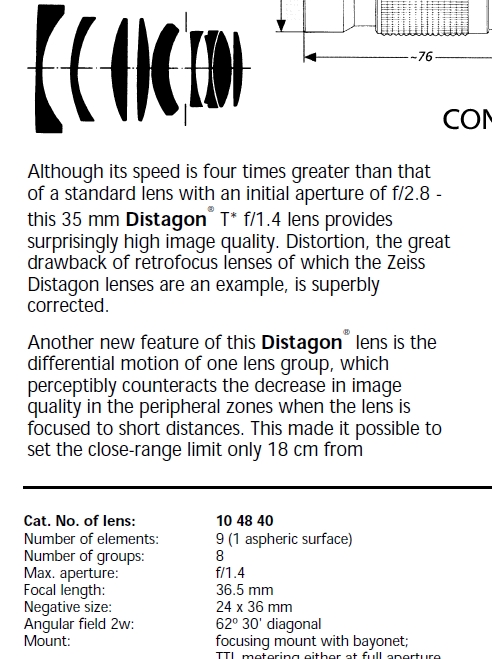
I just checked my copies of the Zeiss datasheets. The CZ datasheet for the Distagon 35/1.4 CY says:
"Number of elements: 9 (1 aspheric surface)".
None of the datasheets for the other lenses listed above by @Steve Spencer say anything much about shape, but they do talk a lot about special ingredients ("extreme anomalous partial dispersion", "high-index glass", "fluophosphate glass", and etc.).
Screen shot of Zeiss datasheet for Distagon® T* f/1.4 - 35 mm
p.3 #6 · How do old Zeiss/Contax/Yashica lenses compare to modern designs?
jcolwell wrote:
"Number of elements: 9 (1 aspheric surface)".
Thanks for the correction, Jim. I don't own any 35mm CZ C/Y, and likely never perused the D35/1.4 spec sheet. For film, I had that FL covered by the T3. As you say, the D21 and AS200 spec sheets say nothing about aspheres, respite that Spencer listing.
Jan 12, 2025 at 02:35 PM
Steve Spencer Offline • • • • • • • Upload & Sell: On
p.3 #7 · How do old Zeiss/Contax/Yashica lenses compare to modern designs?
rico wrote:
Thanks for the correction, Jim. I don't own any 35mm CZ C/Y, and likely never perused the D35/1.4 spec sheet. For film, I had that FL covered by the T3. As you say, the D21 and AS200 spec sheets say nothing about aspheres, respite that Spencer listing.
I was just reporting what is in the pebbleplace database. It isn't my listing. I have no idea where they got the information for that site, but I do know that database was really useful once upon a time when I had a Canon 5D and 5D II and adapted Zeiss C/Y mount lenses. I always found the information to be both accurate and helpful, but maybe they got it wrong. I believe FM member John Black put the database together. I don't know if he ever logs into FM any more, but perhaps he will and let us know where he got the information.
p.3 #8 · How do old Zeiss/Contax/Yashica lenses compare to modern designs?
rico wrote:
Thanks for the correction, Jim.
More of an unpdate, IMO. Anyway, I'll be using my Contax CY lenses on Canon film cameras, in the near future. I just received the first of two, matching EOS 7 cameras that I recently bought. They'll be Port and Starboard.
I'm getting itchy to replace my old Contax 139Q camera (that I sold 15+ years ago), but I have to let the dust settle on my new EOS film setup.
p.3 #9 · How do old Zeiss/Contax/Yashica lenses compare to modern designs?
'..the Distagon 2.8/21 for the Contax SLR, a relatively complex lens with 15 elements in 13 groups. However, it had no aspherical surfaces. Its performance, particularly the perfect correction of lateral chromatic aberration, was achieved solely by the combination of very special (and expensive) high-index glass types with glass types displaying extremely high anomalous partial dispersion.'
Hubert Nasse, Carl Zeiss (Distagon white paper)
So Zeiss pushed hard on each of HRI and APD glass - 'very special (and expensive)', 'extremely high anomalous partial dispersion'. You don't hear much about HRI glass usage in lens specs these days, but the older Leica APOs (and now DZO/Thypoch) do list them separately from APD glass. From what Dr Nasse had to say above, it might be a factor in the 'modern vintage' 90s' look, for top tier optics at least, and may contribute to why these lenses have aged so well. The expense may have led to its properties being displaced by ever more sophisticated asph shaping (and PMO) and more affordable APD glass, to cover sensor outers effectively and eradicate LoCA.
'What is “partial dispersion”? This mysterious-sounding technical term is appearing with increasing frequency in brochures. If, for example, a negative and positive lens are combined to correct chromatic aberration, then the element with the lower refractive power must have the higher dispersion so that the color dispersing effects of both lenses compensate for each other without also canceling the refractive powers of both elements.'
'Glass types with anomalous partial dispersion deviate from the normal relationship between dispersion and the curvature of the dispersion curve. For them, the ratio of the change in refractive index between blue and green to the change between green and red differs from that of normal glass, allowing better chromatic correction with these glass types.'
p.3 #10 · How do old Zeiss/Contax/Yashica lenses compare to modern designs?
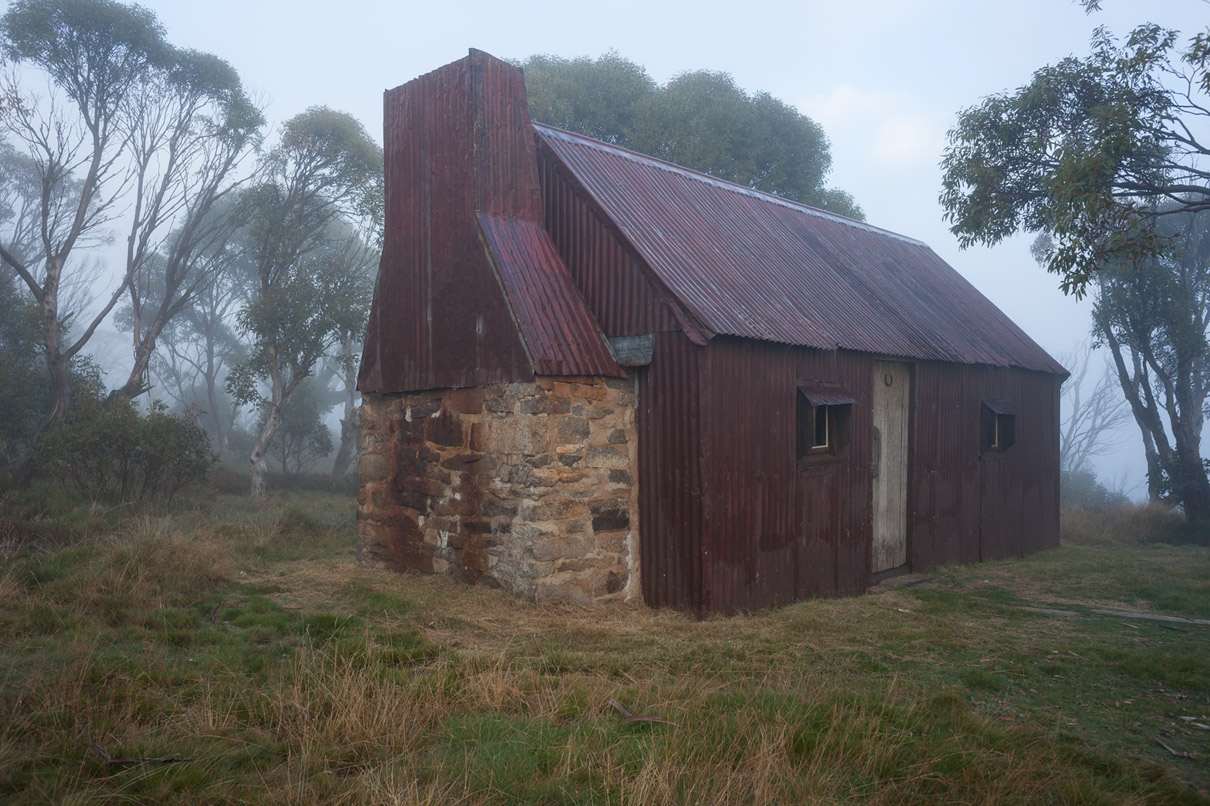
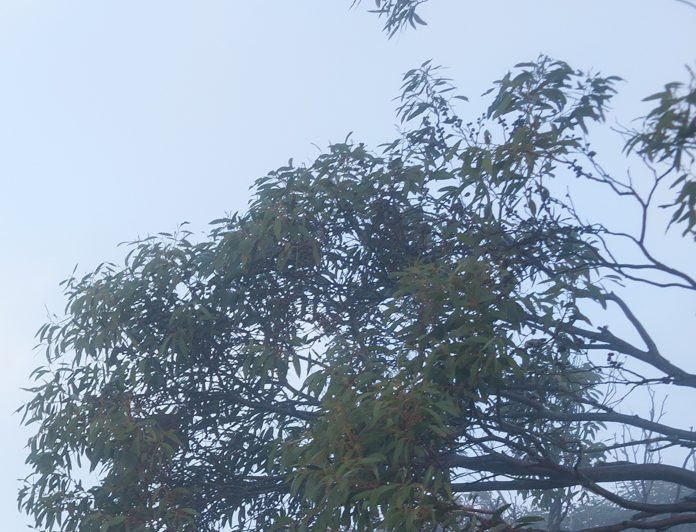
I get lazy looking after lenses. I just had a solid inspection of two of my 30-40 year old specimens, CY 35-70/3.4 and CY 100/3.5. Both are exceptionally clean, despite the proposed potential of the zoom to suck in air, it being a push-pull single ring design. They are as clean inside as my new CV and Thypoch lenses. Speaking of which, below a couple from 2009 or so, out of the Sony a900, shot through the (Leitaxed) CY 28/2.8, a simply lovely little lens. The current lot just don't seem to be able to do it so well. A modern one of this design would win many hearts, Carl Zeiss film lenses work great on digital.
..
corner crop - some thought we'd see a lot of smearing; check the CA, always a strong feature of CZ lenses
I believe there is a demon domiciled around this hut.
p.3 #12 · How do old Zeiss/Contax/Yashica lenses compare to modern designs?
What made them so special? And why did this happen and why are they relevant today? From an fdtimes article on the Zeiss Aatma cine lenses:
'We had a lot of discussions about the character of vintage lenses and why so many people desire them for cinematography. But instead of simply replicating the optical design of those old lenses, we were inspired by the way they rendered skin textures and bokeh.'
'(Over)correction is rarely seen in modern lenses, but with a balanced recipe it can deliver unique characteristics like softer skin rendition, bubble bokeh, extended depth of field, smoother focus transition during pulling, or even resolution roll-off.'
How do you achieve that greater depth of field?
With a combination of aberrations. It’s related to focus roll-off rendering. Focus doesn’t become sharp
abruptly. There is a larger depth range where the object is in focus because of this very special combination of aberrations.'
'How would you describe subjective look of vintage versus modern lenses, as well as the technical differences?
For example, if you take a fast, T1.4 modern lens, you probably have a very sharp image when you are in focus, with nice bokeh and very shallow depth of field. Focus is super sharp. Skin tones are rendered in a way that you can see every detail and you can count every hair that is in focus.
But if we look at a fast T1.4 vintage lens, skin tones are rendered in a different way. You cannot see a specific focus plane where the skin is completely sharp; instead, you notice that the face appears smoother, in a more comfortable way. There’s no unnatural “pop” of the very fine skin details. I think skin texture rendition is the most significant difference between modern and vintage glass.'
'Some still photographers are looking at the artistic qualities of the lens. But for the majority, I think the trend continues towards more and more perfection, with the image appearing as close to reality as possible. Pixel peeping seems prevalent in still photography—for example, zooming in 800% and checking how the edges look.
Above all, it was about softer, smoother skin tones. Aatmas take inspiration from vintage ZEISS Contax lenses.'
'ZEISS Aatma is our new series of Full Frame cine lenses with lots of character. You may not have expected this from ZEISS. Their look is inspired by earlier times, for example Super Speeds or Contax ZEISS lenses.'
'Two years ago we wondered how we could surprise people even more and asked why old ZEISS Super Speeds are so admired. The answer is that they share qualities that you can also recognize
in the old ZEISS Contax lenses. They are not dirty or soft; they have a very strong and special character.'
'Why didn't you just rehouse old ZEISS/Contax lenses?
The character was nice..the optical elements were made with lead and we are not allowed to use them anymore.'
So that is the tragedy of the piece - no more lead. So there can never be a replacement for what has so foolishly been jettisoned. Well, maybe never say never.
p.3 #13 · How do old Zeiss/Contax/Yashica lenses compare to modern designs?
re aspherics:
'Very few lenses in the Contax/Yashica (C/Y) manual focus system used aspherical elements. The iconic Carl Zeiss lineup from that era primarily relied on advanced, classic optical glass rather than aspherical designs.'
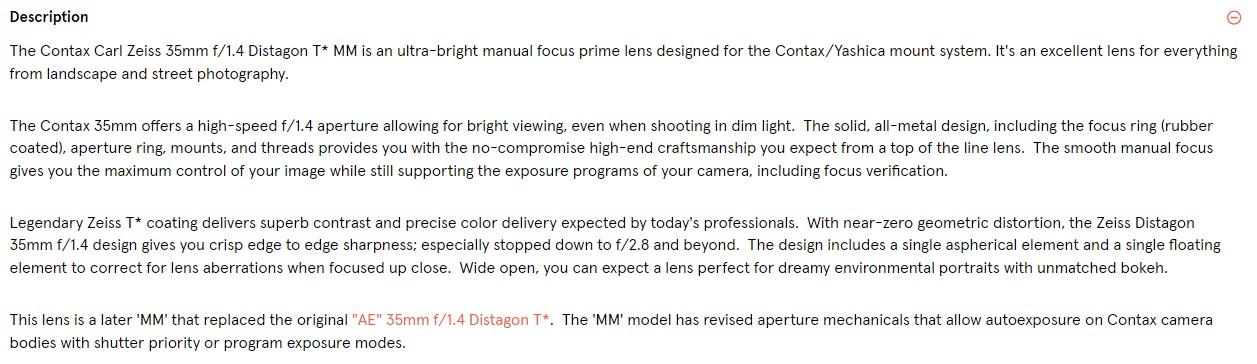
The only one most observers point to in regular FLs: 'Distagon T 35mm f/1.4:* Widely known in the C/Y lineup for having a single, massive hand-polished glass aspherical element.' It used just one surface of aspheric design.
And how important were the contemporaneous Zeiss Super Speed cine lenses that shared glass and designs and coatings with the CY range?
'The Mk I lenses were released in the mid 80’s. It was at this point that the Zeiss primes began to shape the motion picture prime lens design for decades to come.'
Nor did Super Speeds or CY lenses use APD glass, with the exception (among primes) of the CY 21/2.8.
'the original vintage ARRI/Zeiss Super Speeds did not use anomalous partial dispersion glass. Instead, these iconic cinema lenses (which debuted in 1975) relied heavily on classic high-refractive index glass and complex spherical designs to achieve their speed. Because they lack modern chromatic aberration correction technologies, vintage Super Speeds are well known for their distinctive character'.
(Lead is known as the secret ingredient for high refractive index, high clarity glass, and for rich colour saturation.)
'Lead played a major role in the evolution of vintage camera optics by allowing manufacturers to create glass that was denser and optically superior. By adding lead oxide to molten glass, optical engineers were able to achieve two primary breakthroughs:
Higher Refractive Index: Lead significantly increases the glass's refractive index, meaning it bends light more sharply. This allowed lens designers to make lenses thinner while achieving the same optical power.
Lower Chromatic Dispersion: It helped reduce color fringing (chromatic aberration), producing sharper, high-contrast images with better color reproduction.
Rounding off this look at these lenses from 50 years ago, the Super Speeds were also remarkable for their low element counts. The 18mm, 25mm and 35mm lenses are reported as 9/7 designs, and the 50mm and 85mm were 7/5 or 7/6 designs. How things have changed!
An extraordinary 133 titles are listed at Shot-On-What as being shot on Zeiss Super Speeds.