Andrew CD
Offline
• •
Upload & Sell: On
|
highdesertmesa wrote:
I've shot both and currently only have the M11M. When speaking about "tones", I find the way the M11 color sensor renders black and white conversions to be more appealing than the M11M (and the SL2-S b&w conversions even more appealing than the M11). The M11 b&w converted images feel alive to me because I can pull out much more varied and interesting contrasts by using the color sliders over a b&w filter at the time of capture.
Images I make with the M11M feel too somber to me, sometimes to the point of feeling morbid. It takes too much more work in post to make the M11M images feel like M11 b&w converted images. I'm sure some enjoy that challenge, and perhaps there is a sense of accomplishment in having processed the M11M files into something wonderful, which the images posted from the M11M here illustrate.
Strangely, I felt the opposite way when comparing the Q2 to the Q2M, because I much preferred the Q2M. The Q2M's tones right out of the gate in Capture One seemed to really jump out at me, and they responded so easily to post processing. ...Show more →
It seems obvious to me that the monochrome sensors have superior high ISO performance and yield greater definition (it’s almost common sense that they should, given the absence of the Bayer CFA). So in the right hands, and for work that lends itself to B&W, the M11M and earlier Monochroms are great tools. The striking examples in several earlier posts (from @RustyRus, @Kasper6188 and @brick33308) and the impressive work by @airfrogusmc in the Leica blog piece (post #2 on this page) illustrate this well.
Having said that, I agree with @highdesertmesa (above), that colour conversions can sometimes be equally, if not more, appealing. Similar points were made in several other posts. One can debate whether greater flexibility in colour conversion is an advantage but, although I dislike doing more than the bare minimum of post-processing, I do think that there are times when adjusting colour channels can be useful. (Whereas, with a B&W sensor, it obviously isn’t possible to retrospectively apply a coloured filter.) It’s almost like being able to choose the film’s characteristics after it has been developed!
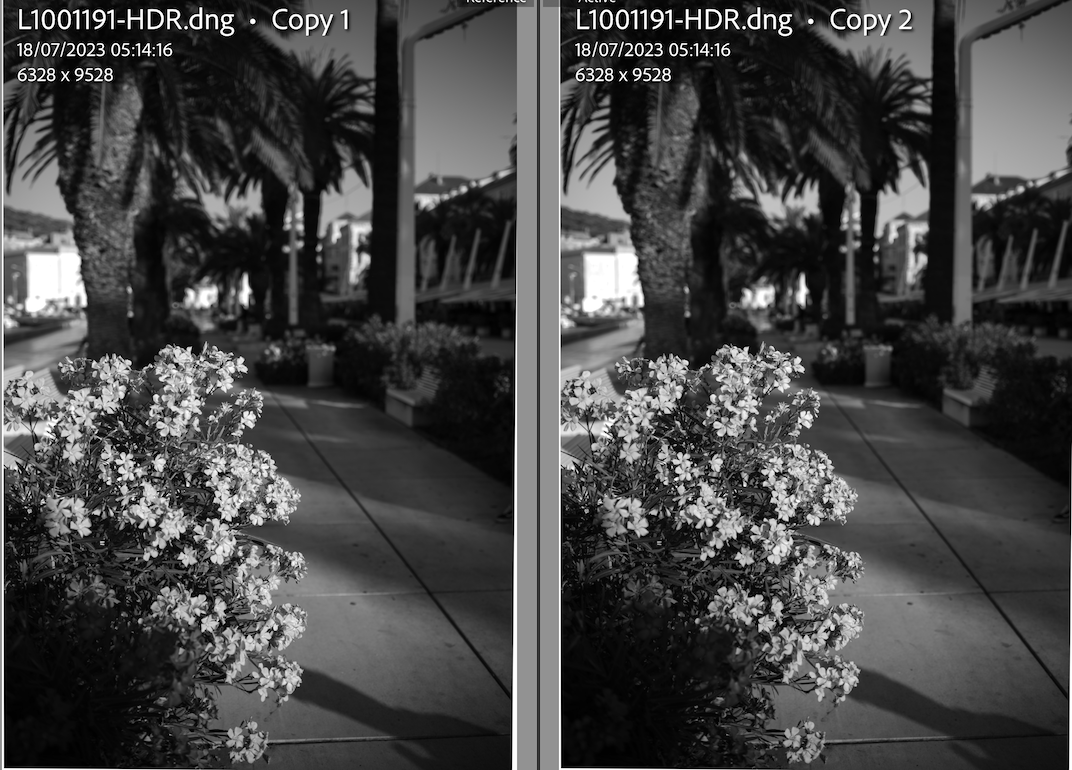
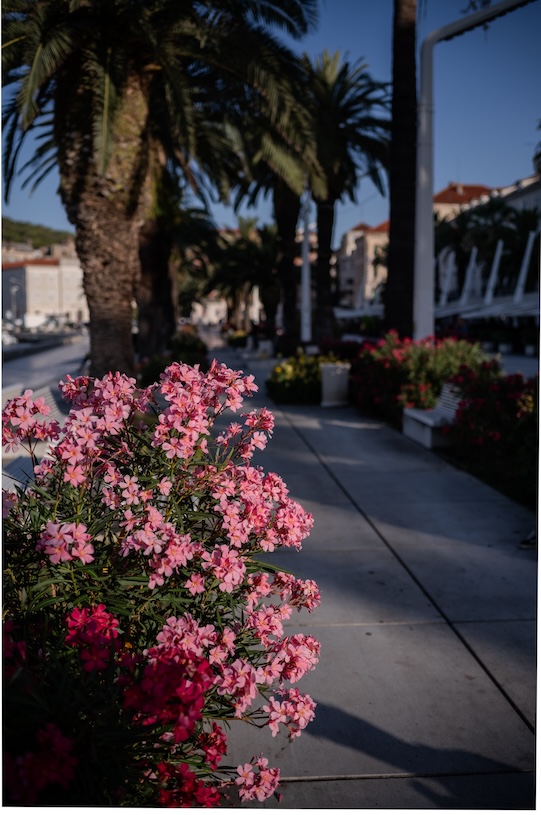
Here is a rather rudimentary example, using a not particularly interesting (but quite colourful) image. On the left, Lightroom’s default B&W conversion. The image on the right has the blue / violet end of the spectrum boosted and the red end reduced (which may be somewhat akin to what an M11M would produce). Colour original below. Not a huge difference, for sure, and I’m certainly not saying that one is better than the other. But I can see that not being tied to a particular spectral response (potentially modified by coloured filters) could be an advantage.
I must confess that I have toyed with the idea of getting an M11M, possibly even exchanging my M11 for one. I have probably spent too much time thinking about it! But, at this point in time, I am now more or less convinced that it is not the right option for me (although I’m equally convinced that it is a good choice, albeit a fairly niche one, for some). For the time being, much as I admire some of the outstanding Monochrom images that others have posted, I am sticking with conversions from colour (and B&W film, of course ….  ). ).
Left - LR basic B&W conversion / Right - colour channel adjustments
LEICA M11 Zeiss Distagon T* 1.4/35 ZM lens 35mm f/1.2 1/10000s 64 ISO -2.7 EV
|