fredmiranda.com
Login

Moderated by: Fred Miranda
  New fredmiranda.com Mobile Site
  New Feature: SMS Notification alert
  New Feature: Buy & Sell Watchlist
  

FM Forums | Leica & Alternative Gear | Join Upload & Sell

1              3       end
  

Archive 2024 · M11 and M11M


brick33308
Offline
• • •
Upload & Sell: On
p.2 #1 · M11 and M11M


if money is no object, then get both the 11 and 11M. If money is an object but you NEVER want to shoot color, then get the 11M. If money is an object and you occasionally want to shoot color, then get the 11.

In my case: much of what I shoot with my M10 I convert to black/white, but I still enjoy shooting and processing color now and then, lately going for a vintage vibe. Although I could stretch and afford both the M10 and M10M, and this is purely a personal observation, as someone said in an earlier post, the images from the M monochrome seem moody. And to me the seem flat and lack punch. I suppose that could be corrected in post, but then you don't have the option of using colored filters during the conversion of color image to b/w.

Yes for sure the M monochrome has greater dynamic range, but how important is that when lighting is enough to keep ISO at or below 12,000? I often exceed that with my M10 (which doesn't even have the supposedly improved sensor of the M11 that deals better with high ISO), and my images clean up perfectly either with Adobe AI denoise or DXO RawPrime.

Here are some high ISO images from my M10 that seem fine in terms of noise.

https://photos.smugmug.com/Photography/2024-3-9-Key-West-night-shots/i-53VDxZ7/0/c3C2M3g585jr7VLC3rt9GvJg4nz5JBNJk3Pwzk92/O/L1001191.jpg


https://photos.smugmug.com/Photography/2024-3-9-Key-West-night-shots/i-pRVb6Bd/0/CJ8SbntwjhK8TTtcPCCkkTBVndpfhnDGQtT2gjrpR/O/L1001189.jpg


https://photos.smugmug.com/Photography/2024-3-9-Key-West-night-shots/i-LnHsXGX/0/fCk5gfLB4Jz2kV4NN7rw3RQXccSW8k8rRTVM2K6m/O/L1001169.jpg


Mar 23, 2024 at 07:43 AM
airfrogusmc
Offline
• • • • • •
Upload & Sell: Off
p.2 #2 · M11 and M11M


For me and the way I see and work there is really nothing better than the M 10 Mono. And it is for as much of what it doesn't have as what it does have. The way it feels in my hand and how it functions makes me enjoy picking it up and using it. I don't get that from a lot of the other options out there. When I finally fully retire (fill time pro) I will probably sell the two M 10s and most of my lenses. I will keep the M 10 mono and my 35 Lu FLE v1 and my 24 2.8 Elmarit. With Leica digital M, especially the Monochrom, it is truly a real alternative to other digital cameras out there today.

When in college I had two semesters of the zone system. And yes I did all the tests with large format. For several decades I was a darkroom rat. Early in my career, not long after graduating college, I did some custom B&W and color printing for a photographer I worked for.

Leica did this piece on my work a few years back. It explains my thoughts on using a digital B&W only camera. This was when I still had the M 9 Mono but appropriate.
https://leica-camera.blog/2016/12/15/spontaneous-relationships/

As I and others have mentioned if you are a B&W photographer and want to work with a digital rangefinder then it is a no brainer.There is not a better tool for that than the Leica M Monochrom.


Mar 23, 2024 at 10:00 AM
airfrogusmc
Offline
• • • • • •
Upload & Sell: Off
p.2 #3 · M11 and M11M


Wanted to add the look from the M 10 Mono at high ISO
12,500 ISO

Crop


50,000 ISO


Crop and notice the film grain like quality to the noise.


Mar 23, 2024 at 01:05 PM
1bwana1
Offline
• • • • • •
Upload & Sell: On
p.2 #4 · M11 and M11M


airfrogusmc wrote:
For me and the way I see and work there is really nothing better than the M 10 Mono. And it is for as much of what it doesn't have as what it does have. The way it feels in my hand and how it functions makes me enjoy picking it up and using it. I don't get that from a lot of the other options out there. When I finally fully retire (fill time pro) I will probably sell the two M 10s and most of my lenses. I will keep the M 10 mono and my 35 Lu
...Show more

Nice article, and work Allen. Congratulations. Thanks for posting.


Mar 23, 2024 at 01:06 PM
airfrogusmc
Offline
• • • • • •
Upload & Sell: Off
p.2 #5 · M11 and M11M


Thanks Steve. A local piece on an exhibit I had in Hamburg Germany a few years back. All but one image in the exhibit was shot with a Leica M Mono
https://www.oakpark.com/2019/05/28/streets-alleys-and-other-captured-moments/

Edited on Mar 28, 2024 at 01:46 PM · View previous versions


Mar 23, 2024 at 01:11 PM
brick33308
Offline
• • •
Upload & Sell: On
p.2 #6 · M11 and M11M


airfrogusmc wrote:
Wanted to add the look from the M 10 Mono at high ISO
12,500 ISO
https://pbase.com/airfrogusmc/image/172227990.jpg
Crop
https://pbase.com/airfrogusmc/image/172334908.jpg

50,000 ISO
https://pbase.com/airfrogusmc/image/172118501.jpg

Crop and notice the film grain like quality to the noise.
https://pbase.com/airfrogusmc/image/172334913.jpg

Well of course I recognize some of those pics 🤓

https://brick.smugmug.com/Photography/Key-West-collection/i-TVVmDTw


Mar 23, 2024 at 01:45 PM
highdesertmesa
Offline
• • • • •
Upload & Sell: On
p.2 #7 · M11 and M11M


robsonj wrote:
It’s the same principle as why you’re better editing from a (14 or 16bit) raw file than a (8bit) jpeg file. My display can’t display the 16bit color raw’s from the gfx for example, but the improved color tonal transitions are visible.

So I’d have to disagree with your last statement based on my own experience.


There's a lot that goes into how pliable a RAW file is in post besides bit depth, but lower bit depth can cause image-ruining banding and/or posterization when making heavy edits to images with large continuous tone gradients, such as a clear blue sky. How much added bit depth makes how much difference with which types of images and how much editing, though? I suspect those that see little difference are making more reasonable edits to their files

Edits that can break images with lower bit depths:

Extreme darkening of Blue and Cyan color channels in the b&w conversion panel in order to make near-black skies
Adding Vignette, which often causes banding even in 16-bit files if too much is applied
Adding Dehaze
Adding Clarity
Levels adjustments that compress dynamic range to increase contrast
Adding Contrast

The GFX 100S 16-bit files were the most impervious to destructive edits of any files I've ever used. But it's more than just the bit depth, it's the physical sensor size, dynamic range, and the Fujifilm GF lenses that discriminate and transfer a wide range of tones to the sensor.


Mar 23, 2024 at 03:59 PM
thrice
Offline
• • • •
Upload & Sell: Off
p.2 #8 · M11 and M11M


I would posit that the edits which lead to posterisation have less to do with bit depth and more to do with software limitations/imprecision (Lightroom is terrible at managing colour profiles) and metameric error.

Funnily enough I have found my GFX to have quite a lot of metameric error, combining greens particularly. It's still a great camera but in terms of colour precision I think CFA/processing in the camera are not as good as they should be.
Everyone deserves to edit a file from a phase one trichromatic back at some point in their lives.

highdesertmesa wrote:
There's a lot that goes into how pliable a RAW file is in post besides bit depth, but lower bit depth can cause image-ruining banding and/or posterization when making heavy edits to images with large continuous tone gradients, such as a clear blue sky. How much added bit depth makes how much difference with which types of images and how much editing, though? I suspect those that see little difference are making more reasonable edits to their files

Edits that can break images with lower bit depths:

Extreme darkening of Blue and Cyan color channels in the b&w conversion panel in
...Show more


Mar 23, 2024 at 04:12 PM
highdesertmesa
Offline
• • • • •
Upload & Sell: On
p.2 #9 · M11 and M11M


thrice wrote:
I would posit that the edits which lead to posterisation have less to do with bit depth and more to do with software limitations/imprecision (Lightroom is terrible at managing colour profiles) and metameric error.

Funnily enough I have found my GFX to have quite a lot of metameric error, combining greens particularly. It's still a great camera but in terms of colour precision I think CFA/processing in the camera are not as good as they should be.
Everyone deserves to edit a file from a phase one trichromatic back at some point in their lives.


I no longer have the 100S, and I regret never testing the same scene side-by-side as 14 vs 16-bit to see if there’s a difference with regard to extreme post processing. Why did I never test it? I guess because I was using 16-bit and couldn’t break the files, so I never got around to it.

I’m afraid to test a Phase One trichromatic file now that you’ve said that


Mar 23, 2024 at 06:40 PM
flash
Offline
• • • • •
Upload & Sell: On
p.2 #10 · M11 and M11M


thrice wrote:
It really doesn't.
In fact after interpolation you have each pixel represented by 3*14 bits coming from a Bayer sensor. You throw away *some* of that data converting to monochrome but arguably have more DR from bit-depth for post processing than you would with the monochrom.

The monochrom benefits from having much lower noise which gives you a more usable DR but that benefit is due to the lack of CFA and higher quantum efficiency, not due to 14 bits.


The Monochrome sensors also produce. a 3 x 14 bit file. But the data is all real. There's no interpolation like a Bayer array.

Have you used a Monochrome for any period of time?

Gordon


Mar 23, 2024 at 09:47 PM
thrice
Offline
• • • •
Upload & Sell: Off
p.2 #11 · M11 and M11M


I must admit I only used the original monochrom at length, during my time at Leica.

It doesn't have 3*14 bit, there is no interpolation to give you the benefit of averaging noise. Furthermore, all 3 channels would be identical if you converted it to a colour file. All the DR gains are from quantum efficiency vs the same sensor with a CFA. Please read Jim Kasson's blog to learn more about the myth of bit depth for DR in editing. It's real, but only really visible when you're comparing 14-bit and above to 11-bit and below.

flash wrote:
The Monochrome sensors also produce. a 3 x 14 bit file. But the data is all real. There's no interpolation like a Bayer array.

Have you used a Monochrome for any period of time?

Gordon


Mar 24, 2024 at 03:47 AM
2613pch
Offline
• •
Upload & Sell: Off
p.2 #12 · M11 and M11M


I would. Prefer to start with a rib image and not converting to monochrome therefore not throwing away 2/3 of the data.THEN Cooking the colors in the file to get to a B&W image that cannot be produced from a B&W negative with out significant darkroom tricks and then printing skills. Works well for me and eliminates filters and guesswork.


Mar 24, 2024 at 09:46 AM
wolfloid
Offline
• • •
Upload & Sell: Off
p.2 #13 · M11 and M11M


“ I would. Prefer to start with a rib image and not converting to monochrome therefore not throwing away 2/3 of the data.THEN Cooking the colors in the file to get to a B&W image that cannot be produced from a B&W negative with out significant darkroom tricks and then printing skills. Works well for me and eliminates filters and guesswork.”

I’m not sure what you are saying here without some guesswork.


Mar 24, 2024 at 01:08 PM
thrice
Offline
• • • •
Upload & Sell: Off
p.2 #14 · M11 and M11M


I think they're saying they prefer the flexibility to apply colour filters in post which you get with a colour camera when converting to b&w.

If I primarily shot b&w I'd have the monochrom in an instant. I rarely do though.

wolfloid wrote:
“ I would. Prefer to start with a rib image and not converting to monochrome therefore not throwing away 2/3 of the data.THEN Cooking the colors in the file to get to a B&W image that cannot be produced from a B&W negative with out significant darkroom tricks and then printing skills. Works well for me and eliminates filters and guesswork.”

I’m not sure what you are saying here without some guesswork.


Mar 24, 2024 at 02:39 PM
Andrew CD
Offline
• •
Upload & Sell: On
p.2 #15 · M11 and M11M


wolfloid wrote:
“ I would. Prefer to start with a rib image and not converting to monochrome therefore not throwing away 2/3 of the data.THEN Cooking the colors in the file to get to a B&W image that cannot be produced from a B&W negative with out significant darkroom tricks and then printing skills. Works well for me and eliminates filters and guesswork.”

I’m not sure what you are saying here without some guesswork.


It seems to me there’s a non-zero probability that it’s an iDevice or similar mucking up the text (adding a gratuitous full stop after ‘would’, maliciously capitalising the ‘P’ and mangling ‘rgb’ to ‘rib’) ….


Mar 24, 2024 at 04:06 PM
stevejack2
Offline

Upload & Sell: On
p.2 #16 · M11 and M11M


highdesertmesa wrote:
I've shot both and currently only have the M11M. When speaking about "tones", I find the way the M11 color sensor renders black and white conversions to be more appealing than the M11M (and the SL2-S b&w conversions even more appealing than the M11). The M11 b&w converted images feel alive to me because I can pull out much more varied and interesting contrasts by using the color sliders over a b&w filter at the time of capture.

Images I make with the M11M feel too somber to me, sometimes to the point of feeling morbid. It takes too much more
...Show more

I noticed this as well, the M11 colour converted files are 'crunchier' whereas the mono files are smoother, flatter, and need more work to bring them back to the somewhat harsher colour converted files. I don't tend to play with the colour sliders at all and even then, it's like the clarity and texture sliders are already cranked up on the colour converted files when you first open the RAW.

When you pixel peep the mono files are just so much better, and it makes some difference in very large prints. The smoothness of those files is something else, and you can push / pull the mono files far more before the image starts to break down. This is noticeable at all ISO levels. It's definitely like shooting with a higher megapixel camera.

I think the M11 converted files are some of the best black and white images I've seen, so much so that I tended to use the M11 over my M10M due to the quality of life improvements that the M11 series brought to the table. The difference in image quality wasn't the deciding factor anymore.

I have the M11M now and will be selling the M11, but the colour converted files are no slouch and I can definitely see why some would prefer them. If the M11M didn't exist, I would still be very happy with just the colour converted M11 files.


Mar 24, 2024 at 07:39 PM
Andrew CD
Offline
• •
Upload & Sell: On
p.2 #17 · M11 and M11M


highdesertmesa wrote:
I've shot both and currently only have the M11M. When speaking about "tones", I find the way the M11 color sensor renders black and white conversions to be more appealing than the M11M (and the SL2-S b&w conversions even more appealing than the M11). The M11 b&w converted images feel alive to me because I can pull out much more varied and interesting contrasts by using the color sliders over a b&w filter at the time of capture.

Images I make with the M11M feel too somber to me, sometimes to the point of feeling morbid. It takes too much more
...Show more

It seems obvious to me that the monochrome sensors have superior high ISO performance and yield greater definition (it’s almost common sense that they should, given the absence of the Bayer CFA). So in the right hands, and for work that lends itself to B&W, the M11M and earlier Monochroms are great tools. The striking examples in several earlier posts (from @RustyRus, @Kasper6188 and @brick33308) and the impressive work by @airfrogusmc in the Leica blog piece (post #2 on this page) illustrate this well.

Having said that, I agree with @highdesertmesa (above), that colour conversions can sometimes be equally, if not more, appealing. Similar points were made in several other posts. One can debate whether greater flexibility in colour conversion is an advantage but, although I dislike doing more than the bare minimum of post-processing, I do think that there are times when adjusting colour channels can be useful. (Whereas, with a B&W sensor, it obviously isn’t possible to retrospectively apply a coloured filter.) It’s almost like being able to choose the film’s characteristics after it has been developed!

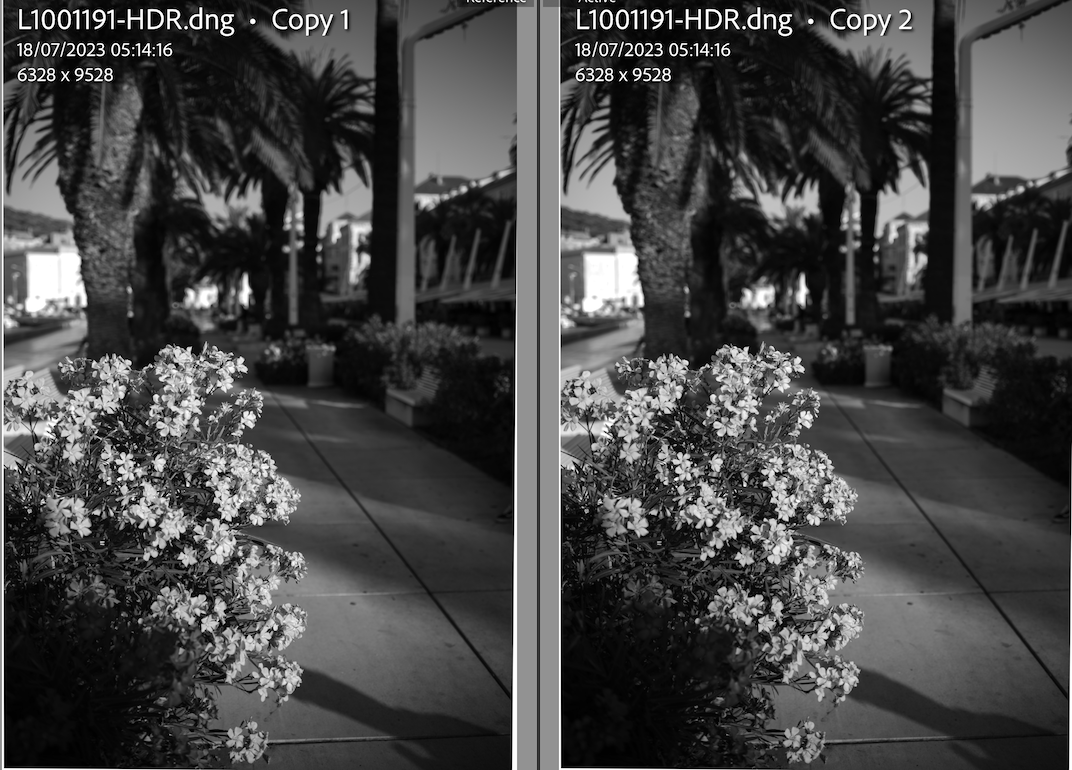
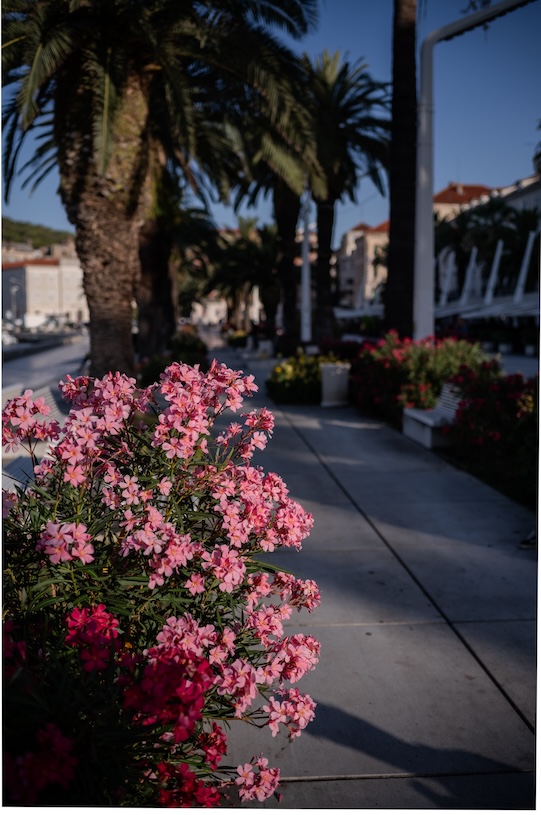
Here is a rather rudimentary example, using a not particularly interesting (but quite colourful) image. On the left, Lightroom’s default B&W conversion. The image on the right has the blue / violet end of the spectrum boosted and the red end reduced (which may be somewhat akin to what an M11M would produce). Colour original below. Not a huge difference, for sure, and I’m certainly not saying that one is better than the other. But I can see that not being tied to a particular spectral response (potentially modified by coloured filters) could be an advantage.

I must confess that I have toyed with the idea of getting an M11M, possibly even exchanging my M11 for one. I have probably spent too much time thinking about it! But, at this point in time, I am now more or less convinced that it is not the right option for me (although I’m equally convinced that it is a good choice, albeit a fairly niche one, for some). For the time being, much as I admire some of the outstanding Monochrom images that others have posted, I am sticking with conversions from colour (and B&W film, of course …. ).


Left - LR basic B&W conversion / Right - colour channel adjustments


  LEICA M11    Zeiss Distagon T* 1.4/35 ZM lens    35mm    f/1.2    1/10000s    64 ISO    -2.7 EV  


Mar 26, 2024 at 04:10 PM
Andrew CD
Offline
• •
Upload & Sell: On
p.2 #18 · M11 and M11M


robsonj wrote:
That first image is exquisite!

One thing not mentioned with regard to post processing and contrast. The monochrom images are generally quite flat to start with, just like a good negative, you can use a on lens filter to address some of that at the time of shoot, but in Lightroom, just like you would do in a traditional darkroom, the dodge and burn tools are an excellent companion to the on lens filters, as are the masking tools.

My journey to the M11m was to own a Q2m, to sell it after not getting to grips with the post processing aspect,
...Show more

Thank you.

What you say about monochrom images is exactly right, IMHO.


Mar 26, 2024 at 04:14 PM
highdesertmesa
Offline
• • • • •
Upload & Sell: On
p.2 #19 · M11 and M11M


Something else to consider regarding the Leica M11M: it is more sensitive to blue light than traditional b&w film. This makes achieving near-black skies with the M11M more difficult compared to film like TMAX100. If you remember what a deep blue sky with a red filter looked like on TMAX printed to high contrast Illford gloss paper, then you may need to use a deep red filter that crosses over into IR territory for the same effect (B+W 695/092 IR Dark Red for example) or use a CPL or linear polarizer instead.

I've read that pre-M10M cameras were not this sensitive to blue light. I have a feeling the current M11M spectral sensitivity to blue light is due to the pursuit of high ISO/low light performance without regard for how color tones map out in daylight. Not that there is anything wrong with how the M11M renders daylight tones, but it's something to be aware of.


Mar 26, 2024 at 04:32 PM
thrice
Offline
• • • •
Upload & Sell: Off
p.2 #20 · M11 and M11M


This does seem to be the case but I'm not sure of the explanation. BSI sensors get more of a bump to quantum efficiency around 400nm (~20%) than around 700nm (~10%). I think that Leica could have countered this phenomenon with a custom hot mirror.

One explanation could be the depth of the photoreceptor in BSI vs FSI but I'm not familiar with the scatter depths in silicon. I would assume red penetrates deeper (think foveon sensors) so having the photoreceptor shallower in the sensor could mean it is getting more blue light.

highdesertmesa wrote:
Something else to consider regarding the Leica M11M: it is more sensitive to blue light than traditional b&w film. This makes achieving near-black skies with the M11M more difficult compared to film like TMAX100. If you remember what a deep blue sky with a red filter looked like on TMAX printed to high contrast Illford gloss paper, then you may need to use a deep red filter that crosses over into IR territory for the same effect (B+W 695/092 IR Dark Red for example) or use a CPL or linear polarizer instead.

I've read that pre-M10M cameras were not this sensitive
...Show more


Mar 27, 2024 at 02:27 AM
1              3       end


FM Forums | Leica & Alternative Gear | Join Upload & Sell

1              3       end


Welcome back
Log in to your account