This topic is in the 2024 archive. You can read it and like its posts here. It is read only.
Archive 2024Nikon Z8 firmware 2.0
p.3 #1Nikon Z8 firmware 2.0
I respectfully disagree. It is not because the processor is shared that buyers of this much lower priced camera take for granted that their camera can get the goodies from more expensive set models. Sure, technically is that all possible, perhaps with relative small resources but marketing wise a lousy move to bring bodies with such a big price gap close to each other.
ilkka_nissila wrote:
Z8/Z9 will always distinguish themselves from Zf by virtue of stacked sensor.
However, it would be nice if Zf can detect and find a bird the way Z8/Z9 can.
Zf already have the same CPU so hopefully all the software features can be shared among
all the bodies on the same platform.Since they have to focus on value for the respective typical users of each camera, I would argue that bird photography is a niche usage among Zf user and therefore should be a low priority for Nikon.
The ergonomics of the camera are a poor match for long glass.
I'd personally prefer them to focus on more value added enhancements.Why would they need to focus on value for typical users? The cameras share the same processor and most code would probably work by simply copying and pasting. Granted, bird AF might need some changes because the cameras have different sensors and resolutions, but a lot of the features probably have identical implementations in code. Spreading firmware features across cameras with the same processor has very low effort for relatively high gains in usability. Of course, they might not want to give cheaper cameras all the features of the more expensive models because they want people to buy the more...Show more →
ilkka_nissila wrote:
bernardl wrote
suteetat wrote
It would be nice if Zf gets all the software bell and whistle from Z8.Z8/Z9 will always distinguish themselves from Zf by virtue of stacked sensor.
However, it would be nice if Zf can detect and find a bird the way Z8/Z9 can.
Zf already have the same CPU so hopefully all the software features can be shared among
all the bodies on the same platform.
The ergonomics of the camera are a poor match for long glass.
I'd personally prefer them to focus on more value added enhancements.
Feb 07, 2024 at 05:14 AM

p.3 #2Nikon Z8 firmware 2.0
I would not expect the Zf to get the vast majority of updates contained here, but I do hope it gets two: the improved Non-CPU lens function, and the ability to cancel magnification with a half shutter press. Given the Zf’s style and use as a base for manual lenses, this would be very handy.
Feb 07, 2024 at 05:54 AM
p.3 #3Nikon Z8 firmware 2.0
suteetat wrote:
Aren’t there plenty of Zf threads?People also talk about Z9 on this thread, why just pick on Zf?
If you don't want to see it, feel free to block me. I will do the same as I dont need to see any internet police either.
I don't see that it is against rule to take about any camera or any brand in any thread.
First of all, take a chill pill and back off.
The only reason I mention it is often what happens is threads often devolve into being unrelated to its original title, in this case “Z8 Firmware 2.0”
George Welch wrote
Not sure what the Zf has to do with Firmware 2.0 on the Z8.Aren’t there plenty of Zf threads?
If you don't want to see it, feel free to block me. I will do the same as I dont need to see any internet police either.
I don't see that it is against rule to take about any camera or any brand in any thread.
First of all, take a chill pill and back off.
The only reason I mention it is often what happens is threads often devolve into being unrelated to its original title, in this case “Z8 Firmware 2.0”
Feb 07, 2024 at 06:07 AM
p.3 #4Nikon Z8 firmware 2.0
The Z8 and Z9 separate themselves from the Zf by hardware features such as
- larger grips
- vertical grip (option)
- better heat management
- better memory cards
- GPS in the Z9
- Ethernet port of the Z9
- faster sensor (=> more reliable AF on fast-moving subjects)
- higher-resolution sensor
- in the case of Z9, larger battery
- owing to the better heat management and faster cards, higher quality video modes without cropping
- silent photography
- sensor shield
- greater number of custom function buttons
- support for radio triggering of flash and remote photography via WR-R10 etc.
- full-size HDMI port
There is really no need to artificially boost the the Z8 and Z9 as they're easily among the best value cameras on the high-performance camera market as they are. Nikon is doing very well in that market, but not so well in the more consumer/lower end enthusiast category where most of the camera sales volume is generated. If Nikon can do anything to improve the market standing of their mid-level cameras (with small expense on R&D), they should do it as it would have a large and direct impact on their market share (and lead to subsequent increases in lens and accessory sales). Since the code has already been developed for the Z9 and Z8, if they can easily make the Zf support it they should do that, as well as other future cameras such as the Z6 III and Z7 III. By being competitive on subject-recognition AF in the 1500-2500€ price class and making the cameras as configurable and as pleasant to use as possible (via appropriate firmware choices), Nikon could significantly increase their overall market share (in volume). By crippling lower-end cameras they will not sell any more Z8s or Z9s. People are annoyed at such marketing tactics and vote with their feet (wallets), the one that gives the best value and performance in the 1500-2500€ class cameras probably eventually becomes the market leader. Nikon may have chosen otherwise, to focus on the high end but that places them vulnerable and dependent on their ability to compete for the very best performance over the long run, whereas in the middle sector, I believe the greatest usability wins high points without having to necessarily have the very best performance. The majority of photographers want cameras that are fairly priced and good enough for what they do, and do not get in the way of getting the photos. A relatively small number of photographers really care if their camera happens to be the very best of the best (it's a windy spot). A lot of fredmiranda.com users might fall into the latter camp but then in the normal real-world outside of camera geek forums, it's a different situation and value and ease of use play a big part. I happen to think the Zf is an excellent camera and excellent value for my needs, but it has a few flaws: no cabled remote control, no support of SB-5000 radio triggering, and a few usability quirks that they could easily fix, such as allowing either the self-timer to function without the obnoxiously bright light in the front of the camera, or implement exposure delay mode (which has been a standard feature in DSLRs and earlier mirrorless cameras in this price class and even some lower-priced models).
As for auto capture, good luck finding people who are willing to sacrifice 4500-6200€ cameras (not including the price of the lens) as remotes in the wilderness. It's great that they could do such a useful and in some way cutting-edge feature at all, but there is no way I would leave my expensive camera out there without close supervision (and having to be there and watch that no one takes the camera kind of defeats the purpose of having the auto capture in the first place, as it would alert the animal to human presence). This feature will be really useful when they put it into cheaper cameras. Until then, I'll probably not even try if it works since I can't afford to use it in that way.
In my opinion, features that are purely software and enhance the usability of less expensive cameras would be a huge benefit for Nikon's perception in the eyes of the market and also their sales, much more than niche cameras such as the Z9 that only relatively small number of people can afford. Once the code has been developed for the high end the porting would be minimal cost in most cases, yet it might have a large impact on market share and goodwill.
Vinnie_VdB wrote:
I respectfully disagree. It is not because the processor is shared that buyers of this much lower priced camera take for granted that their camera can get the goodies from more expensive set models. Sure, technically is that all possible, perhaps with relative small resources but marketing wise a lousy move to bring bodies with such a big price gap close to each other.
Z8/Z9 will always distinguish themselves from Zf by virtue of stacked sensor.
However, it would be nice if Zf can detect and find a bird the way Z8/Z9 can.
Zf already have the same CPU so hopefully all the software features can be shared among
all the bodies on the same platform.Since they have to focus on value for the respective typical users of each camera, I would argue that bird photography is a niche usage among Zf user and therefore should be a low priority for Nikon.
The ergonomics of the camera are a poor match for long glass.
I'd personally prefer them to focus on more value added enhancements.Why would they need to focus on value for typical users? The cameras share the same processor and most code would probably work by simply copying and pasting. Granted, bird AF might need some changes because the cameras have different sensors and resolutions, but a lot of the features probably have identical implementations in code. Spreading firmware features across cameras with the same processor has very low effort for relatively high gains in usability. Of course, they might not want to give cheaper cameras all the features of the more expensive models because they want people to buy the more expensive ones, but in practice for a lot of people the cost dictates or at least greatly influences which products they can buy; lot of people who might want a Z9 or Z8 can not justify its cost.
One reason why I have a Zf as a second camera is because it's thinner than most other Z camera bodies (49 mm for Zf vs. 69.5 mm for the Z6 II) and so it takes less space in the bag and is thus a good backup camera when I have limited space for travel. I might ordinarily shoot different subjects with the two cameras (Z8 for birds & landscape & architecture & close-ups; Zf for people, low-light, indoor events) but if one of the cameras fails (that is why one has a backup camera) then the second camera would become primary and it would need to handle all the subjects of the Z8. Thus there is benefit in sharing firmware features across cameras where it is possible, such as the bird subject mode for autofocus.
I don't notice any ergonomic disadvantage to the Zf - for a camera that is so small, it is excellent in my opinion. A larger camera can have a bigger grip which can be helpful but then it also takes more space in the bag and disadvantages the user with the increased weight and bag size required.
For auto capture and other types of remote photography there are also advantages to using a smaller camera; it is easier to mount on a pole for remote photography, and it introduces less financial risk if stolen or broken while doing this (maybe leaving the camera ready to shoot automatically for extended periods of time (on auxiliary USB-C battery). And for remote photography one definitely wants the best code for subject-detection that is available.
- larger grips
- vertical grip (option)
- better heat management
- better memory cards
- GPS in the Z9
- Ethernet port of the Z9
- faster sensor (=> more reliable AF on fast-moving subjects)
- higher-resolution sensor
- in the case of Z9, larger battery
- owing to the better heat management and faster cards, higher quality video modes without cropping
- silent photography
- sensor shield
- greater number of custom function buttons
- support for radio triggering of flash and remote photography via WR-R10 etc.
- full-size HDMI port
There is really no need to artificially boost the the Z8 and Z9 as they're easily among the best value cameras on the high-performance camera market as they are. Nikon is doing very well in that market, but not so well in the more consumer/lower end enthusiast category where most of the camera sales volume is generated. If Nikon can do anything to improve the market standing of their mid-level cameras (with small expense on R&D), they should do it as it would have a large and direct impact on their market share (and lead to subsequent increases in lens and accessory sales). Since the code has already been developed for the Z9 and Z8, if they can easily make the Zf support it they should do that, as well as other future cameras such as the Z6 III and Z7 III. By being competitive on subject-recognition AF in the 1500-2500€ price class and making the cameras as configurable and as pleasant to use as possible (via appropriate firmware choices), Nikon could significantly increase their overall market share (in volume). By crippling lower-end cameras they will not sell any more Z8s or Z9s. People are annoyed at such marketing tactics and vote with their feet (wallets), the one that gives the best value and performance in the 1500-2500€ class cameras probably eventually becomes the market leader. Nikon may have chosen otherwise, to focus on the high end but that places them vulnerable and dependent on their ability to compete for the very best performance over the long run, whereas in the middle sector, I believe the greatest usability wins high points without having to necessarily have the very best performance. The majority of photographers want cameras that are fairly priced and good enough for what they do, and do not get in the way of getting the photos. A relatively small number of photographers really care if their camera happens to be the very best of the best (it's a windy spot). A lot of fredmiranda.com users might fall into the latter camp but then in the normal real-world outside of camera geek forums, it's a different situation and value and ease of use play a big part. I happen to think the Zf is an excellent camera and excellent value for my needs, but it has a few flaws: no cabled remote control, no support of SB-5000 radio triggering, and a few usability quirks that they could easily fix, such as allowing either the self-timer to function without the obnoxiously bright light in the front of the camera, or implement exposure delay mode (which has been a standard feature in DSLRs and earlier mirrorless cameras in this price class and even some lower-priced models).
As for auto capture, good luck finding people who are willing to sacrifice 4500-6200€ cameras (not including the price of the lens) as remotes in the wilderness. It's great that they could do such a useful and in some way cutting-edge feature at all, but there is no way I would leave my expensive camera out there without close supervision (and having to be there and watch that no one takes the camera kind of defeats the purpose of having the auto capture in the first place, as it would alert the animal to human presence). This feature will be really useful when they put it into cheaper cameras. Until then, I'll probably not even try if it works since I can't afford to use it in that way.
In my opinion, features that are purely software and enhance the usability of less expensive cameras would be a huge benefit for Nikon's perception in the eyes of the market and also their sales, much more than niche cameras such as the Z9 that only relatively small number of people can afford. Once the code has been developed for the high end the porting would be minimal cost in most cases, yet it might have a large impact on market share and goodwill.
Vinnie_VdB wrote:
I respectfully disagree. It is not because the processor is shared that buyers of this much lower priced camera take for granted that their camera can get the goodies from more expensive set models. Sure, technically is that all possible, perhaps with relative small resources but marketing wise a lousy move to bring bodies with such a big price gap close to each other.
ilkka_nissila wrote
bernardl wrote
suteetat wrote
It would be nice if Zf gets all the software bell and whistle from Z8.Z8/Z9 will always distinguish themselves from Zf by virtue of stacked sensor.
However, it would be nice if Zf can detect and find a bird the way Z8/Z9 can.
Zf already have the same CPU so hopefully all the software features can be shared among
all the bodies on the same platform.
The ergonomics of the camera are a poor match for long glass.
I'd personally prefer them to focus on more value added enhancements.
One reason why I have a Zf as a second camera is because it's thinner than most other Z camera bodies (49 mm for Zf vs. 69.5 mm for the Z6 II) and so it takes less space in the bag and is thus a good backup camera when I have limited space for travel. I might ordinarily shoot different subjects with the two cameras (Z8 for birds & landscape & architecture & close-ups; Zf for people, low-light, indoor events) but if one of the cameras fails (that is why one has a backup camera) then the second camera would become primary and it would need to handle all the subjects of the Z8. Thus there is benefit in sharing firmware features across cameras where it is possible, such as the bird subject mode for autofocus.
I don't notice any ergonomic disadvantage to the Zf - for a camera that is so small, it is excellent in my opinion. A larger camera can have a bigger grip which can be helpful but then it also takes more space in the bag and disadvantages the user with the increased weight and bag size required.
For auto capture and other types of remote photography there are also advantages to using a smaller camera; it is easier to mount on a pole for remote photography, and it introduces less financial risk if stolen or broken while doing this (maybe leaving the camera ready to shoot automatically for extended periods of time (on auxiliary USB-C battery). And for remote photography one definitely wants the best code for subject-detection that is available.
Feb 07, 2024 at 06:28 AM
p.3 #5Nikon Z8 firmware 2.0
Annnnddd in true FM fashion the thread is de-railed into arguments within 2-3 pages 
Just be glad the Zf is as good as it is- Fuji users got used to Kaizen then it slowed down, heck the older cameras can't even get any update with newer film sim, which takes like 0.2% processing power.
Edited on Feb 07, 2024 at 07:24 AM · View previous versions
Just be glad the Zf is as good as it is- Fuji users got used to Kaizen then it slowed down, heck the older cameras can't even get any update with newer film sim, which takes like 0.2% processing power.
Edited on Feb 07, 2024 at 07:24 AM · View previous versions
Feb 07, 2024 at 06:36 AM
p.3 #6Nikon Z8 firmware 2.0
I am just surprised that Nikon finally gives ability to cancel magnification with half shutter press, something that other brands have for a long time and give many features from Zf but from my quick testing, it does not get Zf eye focus in manual focus mode. Or at least I cannot find in the menu option for using subject detection in manual mode/area selection in MF mode like in Zf yet.
While I use Z8/Z9 in the field a lot. Sometimes I do use Zf as a back up also as size is sometimes an issue. Or back 2 weeks ago, I was shooting Z9. My Z8 was out of commission in -19C because body cap
got stuck and I could not take it off to mount a lens (reported to Nikon already, body cap finally came off in warmer temp when I got back to my homestay) Luckily I still had my Zf as a third body.
I don't see any down side to having all the software feature across the 3 bodies. That make it easier to move from one to another. Stacked sensor is always going to be the reason why Z8/Z9 are more expensive than Zf or upcoming Z6 iii.
Feb 07, 2024 at 06:37 AM
RoamingScott
Offline
Activity
[X]
Details
p.3 #7Nikon Z8 firmware 2.0
I’m not surprised that the Z8/Z9 don’t have EyeAF in MF yet. The ZF needs at least one unique feature to sell it now that it lost pixel shift
Feb 07, 2024 at 06:58 AM
p.3 #8Nikon Z8 firmware 2.0
Wait, the Z8 just got the Exposure Delay Mode that the D850 has always had? That's kinda weird. They thought eliminating the shutter got rid of the only potential vibration source you might want to isolate without going to a full-on multi-second timed release?
Feb 07, 2024 at 07:02 AM
p.3 #9Nikon Z8 firmware 2.0
lukemeup wrote:
One of the new custom controls is 'cycle af-area mode'. You can switch between focus modes of your choice with a simple press of a button. I'll have to rethink my setup now .
Some new shutter sounds have also been added (no cat's meow though ).
It only took them 10 years to add one of Sony's best features....bravo Nikon, bravo "golf clap"....too bad they don't have enough buttons on the damn camera to use these Sony features they slowly keep adding....maybe Z9II/Z8II will address that...or maybe in 10 years with Z9IV??
Joking aside, now that Z8 has 2.0 I'll try to pick up one of the Amazon renewed ones that keep popping up every couple weeks or so. Swallows are returning early it seems...timing couldn't be better.
One of the new custom controls is 'cycle af-area mode'. You can switch between focus modes of your choice with a simple press of a button. I'll have to rethink my setup now
.Some new shutter sounds have also been added (no cat's meow though
). It only took them 10 years to add one of Sony's best features....bravo Nikon, bravo "golf clap"....too bad they don't have enough buttons on the damn camera to use these Sony features they slowly keep adding....maybe Z9II/Z8II will address that...or maybe in 10 years with Z9IV??
Joking aside, now that Z8 has 2.0 I'll try to pick up one of the Amazon renewed ones that keep popping up every couple weeks or so. Swallows are returning early it seems...timing couldn't be better.
Feb 07, 2024 at 07:04 AM
p.3 #10Nikon Z8 firmware 2.0
Laslo Varadi wrote:
Adding focus distance display is a great get for the MF crowd!I’m in both camps. Great for all these additions to the Z8. The A1 is overdue but still does everything I need. Hopefully this will force Sony to come out with something.
Me too in both camps. So far the rumors about A1 FW just talked about video features. That worries me. We will find out in a week I guess.
RoamingScott wrote
I’d be raging if I shot a certain brand that never gets FW updates. Nikon is KILLING it.Adding focus distance display is a great get for the MF crowd!
Me too in both camps. So far the rumors about A1 FW just talked about video features. That worries me. We will find out in a week I guess.
Feb 07, 2024 at 07:21 AM
p.3 #11Nikon Z8 firmware 2.0
arbitrage wrote:
.
Some new shutter sounds have also been added (no cat's meow though).It only took them 10 years to add one of Sony's best features....bravo Nikon, bravo "golf clap"....too bad they don't have enough buttons on the damn camera to use these Sony features they slowly keep adding....maybe Z9II/Z8II will address that...or maybe in 10 years with Z9IV??
Joking aside, now that Z8 has 2.0 I'll try to pick up one of the Amazon renewed ones that keep popping up every couple weeks or so. Swallows are returning early it seems...timing couldn't be better.
You also should pickup 800 PF and start shooting at 1/25 seconds hand held @800mm
lukemeup wrote
One of the new custom controls is 'cycle af-area mode'. You can switch between focus modes of your choice with a simple press of a button. I'll have to rethink my setup now.Some new shutter sounds have also been added (no cat's meow though
).Joking aside, now that Z8 has 2.0 I'll try to pick up one of the Amazon renewed ones that keep popping up every couple weeks or so. Swallows are returning early it seems...timing couldn't be better.
You also should pickup 800 PF and start shooting at 1/25 seconds hand held @800mm
Feb 07, 2024 at 07:23 AM
p.3 #12Nikon Z8 firmware 2.0
arbitrage wrote:
.
Some new shutter sounds have also been added (no cat's meow though).It only took them 10 years to add one of Sony's best features....bravo Nikon, bravo "golf clap"....too bad they don't have enough buttons on the damn camera to use these Sony features they slowly keep adding....maybe Z9II/Z8II will address that...or maybe in 10 years with Z9IV??
Joking aside, now that Z8 has 2.0 I'll try to pick up one of the Amazon renewed ones that keep popping up every couple weeks or so. Swallows are returning early it seems...timing couldn't be better.
If you factor in lens buttons there are plenty.
Cheers,
Bernard
lukemeup wrote
One of the new custom controls is 'cycle af-area mode'. You can switch between focus modes of your choice with a simple press of a button. I'll have to rethink my setup now.Some new shutter sounds have also been added (no cat's meow though
).Joking aside, now that Z8 has 2.0 I'll try to pick up one of the Amazon renewed ones that keep popping up every couple weeks or so. Swallows are returning early it seems...timing couldn't be better.
If you factor in lens buttons there are plenty.
Cheers,
Bernard
Feb 07, 2024 at 07:26 AM
p.3 #13Nikon Z8 firmware 2.0
Did anyone try BIF with new Bird yet? I know Z9 already had this for a while. For some it's a game changer and for some not. I'd like to hear more comments. I will try it this weekend.
Feb 07, 2024 at 07:30 AM
RoamingScott
Offline
Activity
[X]
Details
p.3 #14Nikon Z8 firmware 2.0
The Z8 has less physical controls than the Z9 you didn’t like so not sure what the appeal of the Z8 is here for you.
arbitrage wrote:
.
Some new shutter sounds have also been added (no cat's meow though).It only took them 10 years to add one of Sony's best features....bravo Nikon, bravo "golf clap"....too bad they don't have enough buttons on the damn camera to use these Sony features they slowly keep adding....maybe Z9II/Z8II will address that...or maybe in 10 years with Z9IV??
Joking aside, now that Z8 has 2.0 I'll try to pick up one of the Amazon renewed ones that keep popping up every couple weeks or so. Swallows are returning early it seems...timing couldn't be better.
arbitrage wrote:
lukemeup wrote
One of the new custom controls is 'cycle af-area mode'. You can switch between focus modes of your choice with a simple press of a button. I'll have to rethink my setup now.Some new shutter sounds have also been added (no cat's meow though
).Joking aside, now that Z8 has 2.0 I'll try to pick up one of the Amazon renewed ones that keep popping up every couple weeks or so. Swallows are returning early it seems...timing couldn't be better.
Feb 07, 2024 at 07:39 AM
p.3 #15Nikon Z8 firmware 2.0
Nikon has posted a supplemental User Manual for firmware 2.0 on their support page, here's the direct link to the downloadable PDF for those of us here in "the States"...
Z8_FU_addendum_(En)01.pdf
https://download.nikonimglib.com/archive6/nIWtz00J1UcF06oIdd637B0QVy44/Z8_FU_addendum_(En)01.pdf
Link
Edited on Feb 07, 2024 at 07:58 AM · View previous versions
Z8_FU_addendum_(En)01.pdf
https://download.nikonimglib.com/archive6/nIWtz00J1UcF06oIdd637B0QVy44/Z8_FU_addendum_(En)01.pdf
Link
Edited on Feb 07, 2024 at 07:58 AM · View previous versions
Feb 07, 2024 at 07:48 AM
p.3 #16Nikon Z8 firmware 2.0
Fantastic update looking forward to trying it out but too busy today!
Feb 07, 2024 at 07:50 AM
RoamingScott
Offline
Activity
[X]
Details
p.3 #17Nikon Z8 firmware 2.0
jimmy462 wrote:
Nikon has posted a supplemental User Manual for firmware 2.0 on their support page, here's the direct link to the downloadable PDF for those of us here in "the States"...
Z8_FU_addendum_(En)01.pdf
https://download.nikonimglib.com/archive6/nIWtz00J1UcF06oIdd637B0QVy44/Z8_FU_addendum_(En)01.pdf
Link
Thanks for linking, I had a few questions that none of the videos had answered yet.
Feb 07, 2024 at 08:04 AM
p.3 #18Nikon Z8 firmware 2.0
ilkka_nissila wrote:
Since the code has already been developed for the Z9 and Z8, if they can easily make the Zf support it they should do that, as well as other future cameras such as the Z6 III and Z7 III.
It's far from being that simple. The hardware being different the adaption of Z8/Z9 code to the Zf is most probably not a trivial task.
I don't believe that Nikon is crippling the Zf, they are just prioritizing engineering tasks, focusing on those that serve best the users of each camera.
ilkka_nissila wrote:
As for auto capture, good luck finding people who are willing to sacrifice 4500-6200€ cameras (not including the price of the lens) as remotes in the wilderness. It's great that they could do such a useful and in some way cutting-edge feature at all, but there is no way I would leave my expensive camera out there without close supervision (and having to be there and watch that no one takes the camera kind of defeats the purpose of having the auto capture in the first place, as it would alert the animal to human presence).
I have used auto-capture myself for video in the wild, not a problem at all. It's a lot less risky than in an urban environment. It's a game changer feature IMHO and am glad not to have to carry my Z9 around anymore to benefit from it.
I have also used it in a venue btw.
Cheers,
Bernard
Feb 07, 2024 at 08:07 AM
p.3 #19Nikon Z8 firmware 2.0
Having used the new Non-CPU lens feature - I hope this comes to all Nikon bodies. First, Nikon was one of the only companies to have something like this in the first place, and now this fixes all the gripes I had about it. - You can now input any focal length and any aperture (even very oddball ones...could even specify an f/0.88 lens if you wanted. This is much needed, as being limited to what Nikon had in AI-S lenses was bizarre.
But awesomely, you can now input the lens name to write in EXIF. This is just fantastic.
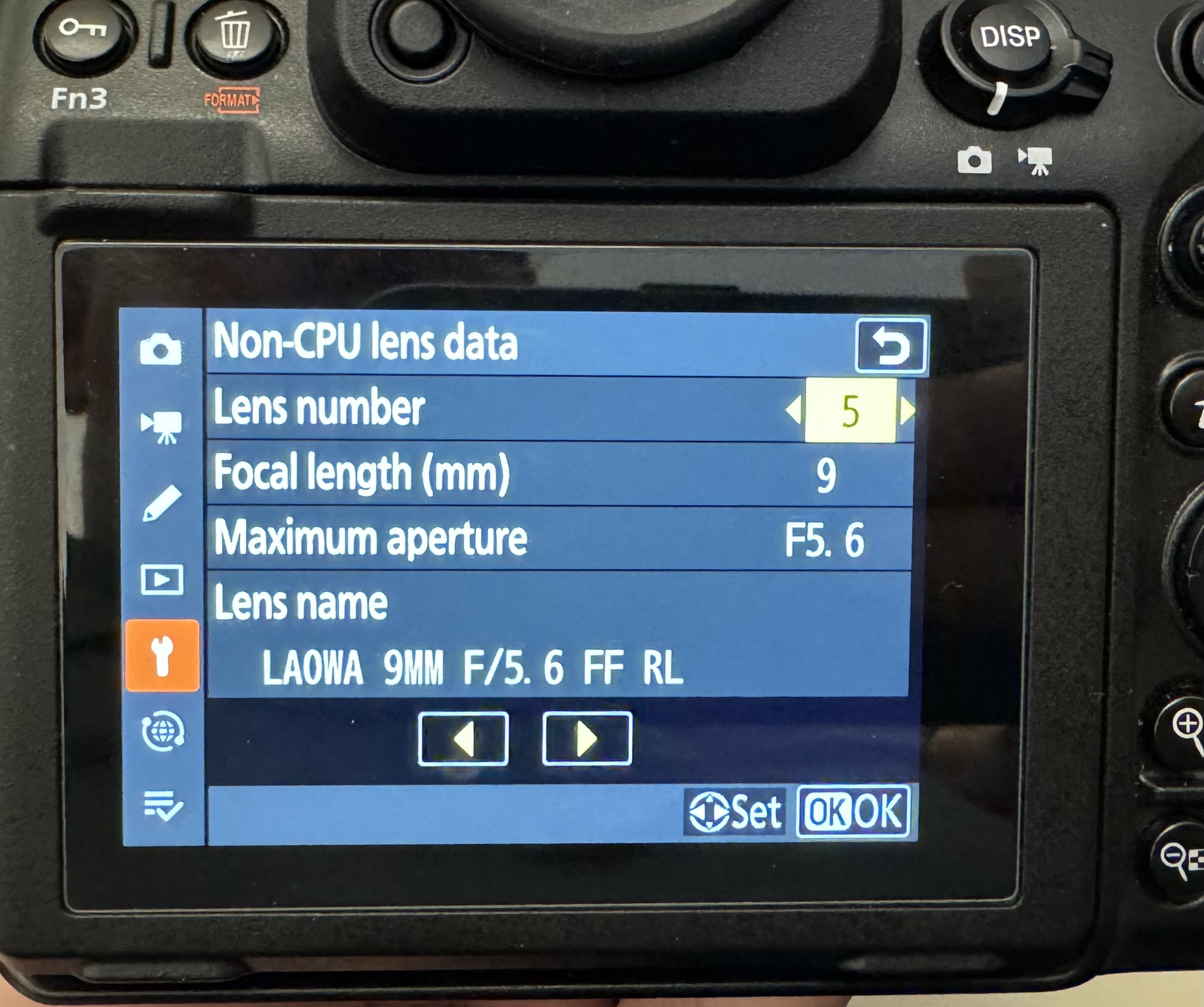
But awesomely, you can now input the lens name to write in EXIF. This is just fantastic.
Feb 07, 2024 at 08:09 AM
p.3 #20Nikon Z8 firmware 2.0
It's nice that you can finally punch in the real focal length/aperture, thought I'm not sure it matters all that much in practice. The EXIF element of it is definitely welcome since I'm forever forgetting to change which non-cpu lens I have selected (because numbers are hard) so now a bunch of my photos are mislabeled
I've never done extensive tests to see if the IBIS behavior shifts around all that much if you had a lens programed at its correct FL vs something way off. Supposedly the camera takes the FL value into consideration when applying IBIS with that lens selected.
I've never done extensive tests to see if the IBIS behavior shifts around all that much if you had a lens programed at its correct FL vs something way off. Supposedly the camera takes the FL value into consideration when applying IBIS with that lens selected.
Feb 07, 2024 at 08:15 AM