dieterson wrote:
What I apriciate with Bastians reviews are his strictly unbiased attitude towards companies whom produce gear! This truly impresses me not to follow personal preferences, thank you for following this road Bastian!
Except for his strong bias against Leica.
I just think that in Bastian's effort to be fair to all, and not hold a pre-bias toward Leica ... his pendulum has swung too far, and he hasn't realized that he has interjected an anti-Leica sentiment (i.e. not objective) into his objective efforts. This to the point that he makes snarky remarks regarding members who ask honest questions (from their desired perspectives) using the Lux as their baseline.
Just sayin' ... sometimes the pendulum swings past its target, and having Bastian complain about members who use the Lux as a baseline, seems to be inclusive of his personal bias.
It goes without saying that besides the objective tests for resolution, contrast, and other technical stuff like field curvature and color errors, I also share my personal preferences for what I enjoy in images from a lens. So, it's just my take, and many might have a different opinion. Personally, I think the Leica 28mm f/1.4 stands out as one of the best 28mm lenses out there. I love all the characteristics of this lens, including its imperfections, which add a unique touch to the rendering.
The Voigtlander 28mm f/1.5 follows a similar path, being a high-contrast lens with excellent resolution and a distinctive character. It's not about a technical competition but rather about choosing a lens that aligns with your vision for capturing images.
RustyBug wrote:
Except for his strong bias against Leica.
Love it when people think they know something about me without knowing anything.
I like my 90mm 2.0 pre Asph and I also kinda like my M6 (RF flares too easily though).
My wife also bought me a tote bag with a Leica logo which is actually my go-to bag when going to work.
Among the modern Leica lenses I tried there were a lof of disappointments though.
The 35mm 1.4 FLE, the 50mm 1.4 FLE, the 16-18-21mm 4.0 and also the 50mm 0.95. And that is regardless of price.
I guess some of the slower ones might be better performers. The 28mm 2.8 looked good in Fred's comparison to the VM 28mm 2.8.
For myself, I don’t even know why other people care about other peoples opinions about lenses. I know for instance, that some people that shoot pretty regularly have similar preferences to my own, so if they recommend a lens, I’m more likely to try it.
As far as Bastian or Fred, or really anybody’s reviews, they’re just providing a ton of objective free information to do with it as we will (because they are excellent reviewers). What to do with the technical presentation of data (i.e. how you weigh them) is the subjective part. some people have a lot of money, some don’t. Some people don’t mind heavy lenses, some due. Some people hate optical vignetting, some don’t. Some people want a highly corrected draw, some want personality, some want a lot of personality. And what those factors mean and are worth to different people is personal. So just do your thing and enjoy.
I personally have a different idea about colors and contrast and size than Bastian has had in the past. In this review, for instance, I was much more concerned with the mid frame performance of the 28/1.5 than Fred was because I often shoot it in that area wide open. If reviewers, or other photographers, have strong opinions, about which thing they prefer, good for them. The labor intensive free objective content is a gift.
Everybody’s different, a diversity of opinions is healthy. If people are disagreeing on objective, or verifiable data, that’s another issue.
BastianK wrote:
Love it when people think they know something about me without knowing anything.
I like my 90mm 2.0 pre Asph and I also kinda like my M6 (RF flares too easily though).
My wife also bought me a tote bag with a Leica logo which is actually my go-to bag when going to work.
Among the modern Leica lenses I tried there were a lof of disappointments though.
The 35mm 1.4 FLE, the 50mm 1.4 FLE, the 16-18-21mm 4.0 and also the 50mm 0.95. And that is regardless of price.
I guess some of the slower ones might be better performers. The 28mm 2.8 looked good in Fred's comparison to the VM 28mm 2.8....Show more →
I can only go by what I read, of what your write. That is all I can know. And you projected your bias, when called me out for asking about vignetting as looking for an excuse (vs. looking for comparative understanding) ... so, it cuts both ways.
I was simply asking for something more in line with what Lars provided as a testing method. Instead, it was met with a snarky reply to impugn that I was looking to make excuses for Leica, etc.
That said, I'll consider the pendulum re-centered ... and would still like to see the vignetting comps (similar to Lars blank image) between the various 28's in discussion, if you'd be so inclined to present it objectively without the introduction of scene variation(s).
RustyBug wrote:
and would still like to see the vignetting comps (similar to Lars blank image) between the various 28's in discussion, if you'd be so inclined to present it objectively without the introduction of scene variation(s).
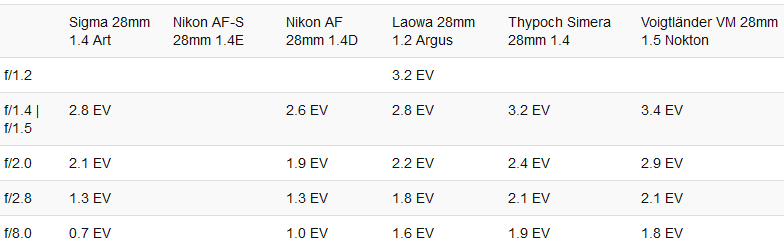
Not sure this helps, but happy to share:
Fred Miranda wrote:
It goes without saying that besides the objective tests for resolution, contrast, and other technical stuff like field curvature and color errors, I also share my personal preferences for what I enjoy in images from a lens. So, it's just my take, and many might have a different opinion. Personally, I think the Leica 28mm f/1.4 stands out as one of the best 28mm lenses out there. I love all the characteristics of this lens, including its imperfections, which add a unique touch to the rendering.
The Voigtlander 28mm f/1.5 follows a similar path, being a high-contrast lens with excellent resolution and a distinctive character. It's not about a technical competition but rather about choosing a lens that aligns with your vision for capturing images....Show more →
First of all I want to thank you as well for all the time spending on testing and to upload your reviews here!
And of course it is okay to descripe a lens according to your preferences as every reviewer does in the end. Usually I feel your reviews are quite balanced as well. But with the CV 28 1.5 I was missing in your Cons-list the field curvature and the reduced sharpness in the outer midfield (1/3) with open aperature at 1-3m (you only mentioned the corners). So somebody could easily get the impression you wont emphasize this technical facts because you are so impressed by the positive characteristics of this lens. I think it is allways a hard thing for a reviewer to write down very detailed the negatives of a lens he is mainly exited about, I can imagine.
dieterson wrote:
First of all I want to thank you as well for all the time spending on testing and to upload your reviews here!
And of course it is okay to descripe a lens according to your preferences as every reviewer does in the end. Usually I feel your reviews are quite balanced as well. But with the CV 28 1.5 I was missing in your Cons-list the field curvature and the reduced sharpness in the outer midfield (1/3) with open aperature at 1-3m (you only mentioned the corners). So somebody could easily get the impression you wont emphasize this technical facts because you are so impressed by the positive characteristics of this lens. I think it is allways a hard thing for a reviewer to write down very detailed the negatives of a lens he is mainly exited about, I can imagine....Show more →
Honestly though testing with a Rangefinder camera and shooting RF-
Midfield at close distance and wide open is pretty much pointless to cover- Unless shooting on converted mirrorless body- Its next to impossible to get focus and recompose at 1.5 and keep your subject in focus unless using an EVF where you can move the focus point during composure.
I shoot RF only so I really don't care about that test-
I get that others might but for RF shooters, its not a big deal. So the fact its not included is fair for most RF users I would assume although we all have what we care about.
This thread is crossposted to the Sony forum and Fred does some tests on a stock Sony sensor camera.
I guess what I'm trying to say is that I don't know if everything here is directed at RF shooters only....since this thread has been near the top of the Sony forum for quite a while.
Not saying that this concern was specifically related to non-RF shooters....but if this thread is intended for only RF shooters, then there seems to be a disconnect.
RustyRus wrote:
Honestly though testing with a Rangefinder camera and shooting RF-
Midfield at close distance and wide open is pretty much pointless to cover- Unless shooting on converted mirrorless body- Its next to impossible to get focus and recompose at 1.5 and keep your subject in focus unless using an EVF where you can move the focus point during composure.
I shoot RF only so I really don't care about that test-
I get that others might but for RF shooters, its not a big deal. So the fact its not included is fair for most RF users I would assume although we all have what we care about.
RustyRus wrote:
Honestly though testing with a Rangefinder camera and shooting RF-
Midfield at close distance and wide open is pretty much pointless to cover- Unless shooting on converted mirrorless body- Its next to impossible to get focus and recompose at 1.5 and keep your subject in focus unless using an EVF where you can move the focus point during composure.
I shoot RF only so I really don't care about that test-
I get that others might but for RF shooters, its not a big deal. So the fact its not included is fair for most RF users I would assume although we all have what we care about.
Interesting. On both film and digital RF’s, when I know the 1/3rd is decent, I use the RF patch to focus and recompose. For a 28mm, I wouldn’t consider within 3 meters overly close.
nehemiahphoto wrote:
Interesting. On both film and digital RF’s, when I know the 1/3rd is decent, I use the RF patch to focus and recompose. For a 28mm, I wouldn’t consider within 3 meters overly close.
So at the extreme of 3m, its easier of course but this was about 1-3 meters-
So depth of field is roughly .11m at 1m and .99m at 3m- Thats a pretty small variance. Its not something I would want to rely on consistently to get critical shots in focus- The closer to the midpoint the more luck you would have but even at 3m- Its not something I would want to do all the time. Thats me though-
I am actually gonna test this though later- curious to see how much the focus will need to change when I do shift to EVF on the M.
Feb 05, 2024 at 04:27 PM
Steve Spencer Offline • • • • • • • Upload & Sell: On
tsdevine wrote:
This thread is crossposted to the Sony forum and Fred does some tests on a stock Sony sensor camera.
I guess what I'm trying to say is that I don't know if everything here is directed at RF shooters only....since this thread has been near the top of the Sony forum for quite a while.
Not saying that this concern was specifically related to non-RF shooters....but if this thread is intended for only RF shooters, then there seems to be a disconnect.
This specific issue (whether you can focus well where the vertical and horizontal rule of thirds meet) is fairly complicated by the specific camera that is used. If you use a rangefinder as Rusty suggest this probably isn't a very important criteria as you won't be focussing at that spot (or at least I don't) with such a short focus distance because focus and recompose is just too hard.
If you shoot with a stock mirrorless camera then focussing at this spot could well be compromised by the sensor cover glass thickness and have nothing to do with the lens.
If you shoot with an ultra-thin modified cover glass mirrorless camera (or a Leica M camera with the EVF, or maybe a Leica L-mount camera), however, then focussing at this spot is likely to be important to you. How important may depend on the mirrorless camera involved, however, as some cameras (some Leica L-mount cameras for example and maybe even the Sony A7r V) might work fine in the spot because of the EVF is so good, and other cameras (Nikon Z and Canon RF for example) might work fine in that spot if you use focus confirmation. Fred did test with one sensor modified camera (a Sony A7r II) but that might not be representative of what you would get with other mirrorless cameras as it has a rather poor EVF and no focus confirmation.
That level of complexity, in my view, makes it hard to address this issue in a summary for the lens. So, I don't see leaving it out as a con in the summary, as Fred did, as a major omission. It is there in comparisons if you look into the details.
Honestly, the style of shooting I do and the fact that I shoot a stock Sony sensor, the test Fred posted on his Sony was enough for me to kind of lose interest. I've been sort of reading the thread at times along the way though.
I wasn't trying to pick on, or nit-pick Fred. I was just trying to remind everyone that the audience for this thread is pretty broad. Given that non-RF shooters don't do EVERYTHING exactly the same, I was thinking RF shooters might not either.
In any case, don't want to add to the noise. I don't have much to contribute here.
Steve Spencer wrote:
This specific issue (whether you can focus well where the vertical and horizontal rule of thirds meet) is fairly complicated by the specific camera that is used. If you use a rangefinder as Rusty suggest this probably isn't a very important criteria as you won't be focussing at that spot (or at least I don't) with such a short focus distance because focus and recompose is just too hard.
If you shoot with a stock mirrorless camera then focussing at this spot could well be compromised by the sensor cover glass thickness and have nothing to do with the lens.
If you shoot with an ultra-thin modified cover glass mirrorless camera (or a Leica M camera with the EVF, or maybe a Leica L-mount camera), however, then focussing at this spot is likely to be important to you. How important may depend on the mirrorless camera involved, however, as some cameras (some Leica L-mount cameras for example and maybe even the Sony A7r V) might work fine in the spot because of the EVF is so good, and other cameras (Nikon Z and Canon RF for example) might work fine in that spot if you use focus confirmation. Fred did test with one sensor modified camera (a Sony A7r II) but that might not be representative of what you would get with other mirrorless cameras as it has a rather poor EVF and no focus confirmation.
That level of complexity, in my view, makes it hard to address this issue in a summary for the lens. So, I don't see leaving it out as a con in the summary, as Fred did, as a major omission. It is there in comparisons if you look into the details. ...Show more →
tsdevine wrote:
Honestly, the style of shooting I do and the fact that I shoot a stock Sony sensor, the test Fred posted on his Sony was enough for me to kind of lose interest. I've been sort of reading the thread at times along the way though.
I wasn't trying to pick on, or nit-pick Fred. I was just trying to remind everyone that the audience for this thread is pretty broad. Given that non-RF shooters don't do EVERYTHING exactly the same, I was thinking RF shooters might not either.
In any case, don't want to add to the noise. I don't have much to contribute here.
And that is an important point, I mainly shoot these lenses on Leica RF's, occasionally on my Sony and Olympus. My criteria for buying though, focuses on how it performs with my Leica.
'Fred did test with one *sensor modified camera (a Sony A7r II)* '
'The Voigtlander 28mm f/1.5 Nokton is designed for the slim Leica M sensor, making its performance less optimal on sensors of other mirrorless bodies. However, many photographers successfully adapt M lenses to their mirrorless cameras. In this test, I *adapted the CV 28/1.5 to the Sony A7R II, a camera known for its thicker sensor stack* compared to Leica.'
The implication appears to be clear regarding the unaltered Sony a7R II sensor in the test body. Fred did not do a close focus series (incl. mid-field) on the a7r II but based on infinity tests I'd be confident in being able to focus mid-field accurately at closer distances - very comfortably in fact.
EVF directly delivers the sensor feed, focus box is moveable, IBIS. Sensor cover degradation would have to be extreme to preclude this, even for small motifs. Included here for reasons Tim pointed out.
philip_pj wrote:
'Fred did test with one *sensor modified camera (a Sony A7r II)* '
'The Voigtlander 28mm f/1.5 Nokton is designed for the slim Leica M sensor, making its performance less optimal on sensors of other mirrorless bodies. However, many photographers successfully adapt M lenses to their mirrorless cameras. In this test, I *adapted the CV 28/1.5 to the Sony A7R II, a camera known for its thicker sensor stack* compared to Leica.'
The implication appears to be clear regarding the unaltered Sony a7R II sensor in the test body. Fred did not do a close focus series (incl. mid-field) on the a7r II but based on infinity tests I'd be confident in being able to focus mid-field accurately at closer distances - very comfortably in fact.
EVF directly delivers the sensor feed, focus box is moveable, IBIS. Sensor cover degradation would have to be extreme to preclude this, even for small motifs. Included here for reasons Tim pointed out....Show more →
As Philip pointed out, I tested with it on a regular 42MP A7R II. I purchased this camera specifically to assess how effectively the Voigtlander 28/1.5 ASPH would perform on an unaltered Sony sensor.
By the way, excluding the samples from the Sony, all the images captured in this review were focused using the rangefinder. I was pleased to see the perfect rangefinder alignment of the production copies I tested.
I said that too above. Thanks for doing that Fred.
Fred Miranda wrote:
As Philip pointed out, I tested with it on a regular 42MP A7R II. I purchased this camera specifically to assess how effectively the Voigtlander 28/1.5 ASPH would perform on an unaltered Sony sensor.
Feb 05, 2024 at 07:10 PM
Steve Spencer Offline • • • • • • • Upload & Sell: On
philip_pj wrote:
'Fred did test with one *sensor modified camera (a Sony A7r II)* '
'The Voigtlander 28mm f/1.5 Nokton is designed for the slim Leica M sensor, making its performance less optimal on sensors of other mirrorless bodies. However, many photographers successfully adapt M lenses to their mirrorless cameras. In this test, I *adapted the CV 28/1.5 to the Sony A7R II, a camera known for its thicker sensor stack* compared to Leica.'
The implication appears to be clear regarding the unaltered Sony a7R II sensor in the test body. Fred did not do a close focus series (incl. mid-field) on the a7r II but based on infinity tests I'd be confident in being able to focus mid-field accurately at closer distances - very comfortably in fact.
EVF directly delivers the sensor feed, focus box is moveable, IBIS. Sensor cover degradation would have to be extreme to preclude this, even for small motifs. Included here for reasons Tim pointed out....Show more →
Thanks for the correction Phillip. I had it wrong.
BruceRH wrote:
For me, the bokeh of the Voigtlander is fine. This lens will be more of a night/low light lens and the 28/2.8 Skopar would be used for daytime. Bokeh for a 28 is not as important for me. I like the size of the VM 28/1.5 and I am sure that I will be happy with the sunstars which is why it would mainly be a low light lens. The Thypoch is certainly an interesting lens as well, and I will probably try it someday. As always, it is great to have choices. I am still conflicted as to what to do with my VM 28/2 Ultron because it is such a nice, sharp lens and is also very compact. I do appreciate your reviews Bastian, they are one of my go to's for lens reviews. ...Show more →
I'm in a similar predicament with my VM/2 Ultron II. I really don't need both the 1.5 and the f2 but the ultron is such a nice little package it's hard to give up. I might just keep it as a portable alternative to the 1.5