bernardl wrote:
Before leaving this exchange, probably 99% of the range finder cameras built (themselves representing a tiny volume compared to SLRs) were film cameras so the shutter had to stay closed. Digital M bodies sold what, perhaps a few hundred thousands total at most? So un-representative enough to be left out of the discussion IMHO.
Besides, as I already wrote, much deeper mounts than mirrorless ones so the shutter was/is a lot less exposed to accidendal hits.
Having used the Z8/Z9 for 2+ years now, I can testify that the shield is robust enough to take the kind of light accidental hits that can happen during lens change. I would not want to try these with a functional shutter.
And back to the topic of this thread, the specs listed in the latest rumors are IMHO not very appealing.
Here is a link to a video regarding a broken Z9 sensor shield. Yes the camera was dropped to cause the problem. But it shows that it is no built as robustly as some think.
What is up with it having been melted prior to being dropped? Is it just made out of some sort of soft plastic? How can that happen? Very strange...
Anyway, still better to have it than not in my opinion.
1bwana1 wrote:
Here is a link to a video regarding a broken Z9 sensor shield. Yes the camera was dropped to cause the problem. But it shows that it is no built as robustly as some think.
What is up with it having been melted prior to being dropped? Is it just made out of some sort of soft plastic? How can that happen? Very strange...
Anyway, still better to have it than not in my opinion.
He dropped it with no lens attached , and by the looks of the cover , it hit something.
This is not Nikon's problem , this is a stupid mistake by the photographer.
Matt Granger has so far I think wrecked an 85 1.4, D810 and a D5 if I'm not mistaken. At least David Yarrow has the excuse of "my camera got kicked by an elephant" whenever he sends something to NPS.
JustShootMe wrote:
He dropped it with no lens attached , and by the looks of the cover , it hit something.
This is not Nikon's problem , this is a stupid mistake by the photographer.
I don't think it is Nikon's problem either. Cranger caused the damage by abuse. I agree, that is not my point. This is just a continuation of a conversation I was having with Bernard regarding the durability of sensor shields and functional shutters being used as shields. No one is criticizing Nikon in any way here.
According to Matt Granger the melted (not scuffed) marks on the shutter shield were not caused by the drop. They pre-existed that. He believes that they are melted marks caused by light being focused on the shield by lenses pointed into the sun. That makes me question what material they are made of. Still better too mark the shield than to burn the sensor though. We should all keep such things in mind when handling our cameras.
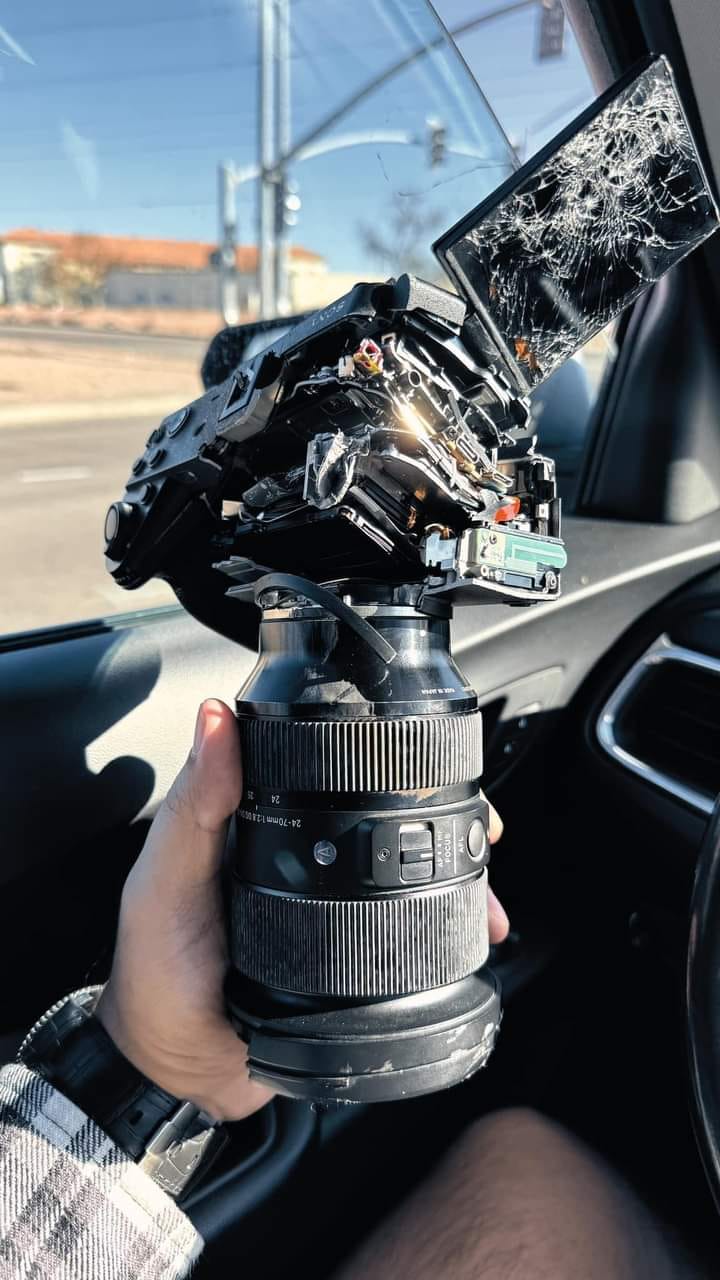
By the way, below is a picture of what happened to the Sony camera that he dropped the Z9 on to. Yes, the Z9 is that big and heavy but in comparison it held up very well.
Look at this Humvee…granted it was involved in a massive rollover accident and then caught on fire, but definitely not built as tough as you fanboys think!
I would like to see Nikon release the Z7III as the second camera. It would make sense since the Z6's and Z7's have been released together so far. I am really curious if Nikon are going to make the Z7III a timed down Z8 and keep it at 45mp, or go higher MP to compete with Sony's r line.
That was a pretty big drop and the sensor shield did its job. It protected the sensor and Matt was able to continue shooting the rest of his event. Without a shield the sensor would have been damaged or coated with dirt, knocking the camera out of commission.
A mechnical shutter is not as robust and damage may cause the camera to be inoperable. It may have been possible to continue using the electronic shutter at the risk of banding or rolling shutter but that would have been a challenge at an archery shoot.
For general protection, I'd take a shutter shield over no protection or the mechanical shutter every time. Compared to a shutter, the shield is more robust, less likely to need repair, and not essential to taking an exposure.
Jawnathin wrote:
That was a pretty big drop and the sensor shield did its job. It protected the sensor and Matt was able to continue shooting the rest of his event. Without a shield the sensor would have been damaged or coated with dirt, knocking the camera out of commission.
A mechnical shutter is not as robust and damage may cause the camera to be inoperable. It may have been possible to continue using the electronic shutter at the risk of banding or rolling shutter but that would have been a challenge at an archery shoot.
For general protection, I'd take a shutter shield over no protection or the mechanical shutter every time. Compared to a shutter, the shield is more robust, less likely to need repair, and not essential to taking an exposure....Show more →
We are in agreement. For protecting the sensor the shutter shield is best, the mechanical shutter used as a shield next best, and no shield the least protective.
But as an aside, the problem tha Matt Granger had with the shield after dropping is not unheard of. Here is another one that looks to be the exact same failure but the camera had not been dropped or abused. I have heard of more as well. More that other cameras that use their mechanical shutter as a shield. I doubt it. Shutter failures are one of the most common problems in cameras.
I think there is room for a Z7III in the product line but the pricing between the Z6III and Z8 will be tricky. The Z7III could have all of the rumored Z6III updates but higher resolution and lower frame rates.
The main difference from the Z8 would be a non-stacked sensor, lower frame rates, and a smaller/lighter body. The benefit over the Z6III is the higher resolution sensor. For landscape or portrait photographers where weight and resolution is more important than speed, it would be a solid alternative from either the Z8 or Z6III.
Jawnathin wrote:
I think there is room for a Z7III in the product line but the pricing between the Z6III and Z8 will be tricky. The Z7III could have all of the rumored Z6III updates but higher resolution and lower frame rates.
The main difference from the Z8 would be a non-stacked sensor, lower frame rates, and a smaller/lighter body. The benefit over the Z6III is the higher resolution sensor. For landscape or portrait photographers where weight and resolution is more important than speed, it would be a solid alternative from either the Z8 or Z6III.
Let’s not forget that Nikon ambitions to deliver the highest performing mirrorless cameras.
One key reason why they would want to release a 80+ mp Z7III is simply to continue their legacy of leading for landscape focused bodies following the ground breaking D800 for example.
This is what those guys wake up for everyday when they get to work.
If there were a Z6III addressing all the focusing limitations of the Z7II, improving the UI consistency with the Z8, featuring a newly designed physical shutter with 1/500s sync speed then such a Z6III would be the perfect base for a Z7III also.
I believe that such a camera would probably be introduced with a 10-20mm f4 S lens continuing the legacy of Nikon as the leading provider of ultra wide glass they started with the 14-24mm f2.8. It had taken Canon 8 years to come up with an answer.
They may also take the opportunity for a development announcement of their next portrait focused super télé that I think is likely to be a 100-200mm f2.0 TC.
I personally still feel that a Z90 is more likely but we will see. It should only take a few days.
JadedWriter wrote:
I'm going to be that guy and say anybody begging for 80mp on a full frame body for landscape work should just pony up for medium format already.
Well as a GFX-100s/GFX-100II/Xf IQ4-150/Arca owner… I am not sure to agree.
- The equation for DoF has always been in favor of smaller sensors that are only penalized by lower resolution,
- Lighter and smaller is more relevant for landscape than for any other discipline in photography,
- for those traditionalists who don’t do DoF stacking the T/S lenses Fuji released are too large/heavy for landscape usage, the Nikon 19mm T/S or it’s expected Z successor is a much better option,
- Nikon is not willing to hand over the landscape domain to Fuji. They are uniquely positioned for wildlife from a lens point of view, many wildlife shooters want to do landscape also on location instead of having to carry a Fuji G also
- Besides there is no reason why the evolution should stop at 60mp. It’s as arbitrary as 40 or 80.
bernardl wrote:
Let’s not forget that Nikon ambitions to deliver the highest performing mirrorless cameras.
One key reason why they would want to release a 80+ mp Z7III is simply to continue their legacy of leading for landscape focused bodies following the ground breaking D800 for example.
Highly doubt Sony would sell Nikon an 80MP sensor that they have not used on one of their own cameras first.
ingekj wrote:
Highly doubt Sony would sell Nikon an 80MP sensor that they have not used on one of their own cameras first.
Sony semi-conductor did it with the D800 though, didn’t they?
Recently Fuji released an APS-C camera with a stacked sensor before Sony imaging did.
Sony Semi-conductors is a separate business entity with their own objectives. Besides Sony imaging has been rumored to go small MF for years. Even if they had their say in what sensors Nikon can use, which I think they don’t, their strategy may not compete with a 80mp Z7III.
The reasons why Sony Semi will not want to slow down Nikon’s progress are the following btw:
1. They need to make money
2. They don’t want Nikon to fund the sensor development of a competitor
3. They are Japanese and folllow the directions “proposed” by the gov in terms of preserving a diverse photographic industry which implies a thriving Nikon.
akul wrote:
10-20 f4 S! 100-200 F2TC ! Did you have too much sake last night ? Sounds so good but.
Luka
It’s only logical:
- 10-24mm: Nikon lacks ultra-wide coverage. A zoom makes more sense than a prime, 12mm is too close to 14, f2.8 isn’t required, a zoom ratio of 2 is pretty standard, they have mostly released long glass in 2022/2023, one of their upcoming cameras will be landscape oriented,
- 100-200mm f2.0 TC: they replaced their 300mm f2.8 by a 120-300mm f2.8 and now Canon has a 100-300mm f2.8, but they never did the corresponding move for the 200mm f2.0, this is a legendary lens that will have a Z mount version, they 2 fast super télé and their F mount 180-400 f4 have a built-in TC and this has motivated many switchers. All in all it points to a 100-200mm f2.0 TC that would rule indoor sports. I think it’s going to weight 2.4 kg.
I honestly think any camera with the specs that you want just turns into an outdoors/studio camera. Also becomes heat and buffer management. I don't even like the 60mp sensor. I had it for probably a year and a half actually it's why I think full frame shouldn't be more than the current 45. bernardl wrote:
Well as a GFX-100s/GFX-100II/Xf IQ4-150/Arca owner… I am not sure to agree.
- The equation for DoF has always been in favor of smaller sensors that are only penalized by lower resolution,
- Lighter and smaller is more relevant for landscape than for any other discipline in photography,
- for those traditionalists who don’t do DoF stacking the T/S lenses Fuji released are too large/heavy for landscape usage, the Nikon 19mm T/S or it’s expected Z successor is a much better option,
- Nikon is not willing to hand over the landscape domain to Fuji. They are uniquely positioned for wildlife from a lens point of view, many wildlife shooters want to do landscape also on location instead of having to carry a Fuji G also
- Besides there is no reason why the evolution should stop at 60mp. It’s as arbitrary as 40 or 80.
I see no reason Sony wouldn't sell Nikon such a sensor. Below is a link to Sony Semi's current open to order sensor list. You will recognize many of the sensors available on the cameras used by the different brands.
Noticeably absent are the 50mp BI Stacked sensor from the A1, and the BI Stacked GS sensor from the A9III
Also missing is the 45.7mp BI Stacked sensor used in the Z8/9 (although many think it is an A1 variant modified to Nikon specifications.
Also interestingly there are available approx 24mp fBI Stacked sensors suitable for the rumored high speed Z6III sensor. So that is a likely thing for Nikon to have used.
There is no 80mp FF sensor in the available list. But Sony may have such a sensor not on the open list that they would sell Nikon. However, if Nikon has done their own design 80mp sensor I believe Sony would absolutely fab it for Nikon. Nikon is a very good Sony Semi customer, and would likely be serviced in such a way. If the Z7III does have such a sensor it would go a long way towards giving great credibility to Sony's sensor design capabilities, and relationship with Sony Semi independent of Sony's own camera division.
JadedWriter wrote:
I honestly think any camera with the specs that you want just turns into an outdoors/studio camera. Also becomes heat and buffer management. I don't even like the 60mp sensor. I had it for probably a year and a half actually it's why I think full frame shouldn't be more than the current 45.
I had a 7rIV and didn’t like what Sony imaging made of that sensor either but I like the way Fuji and Hasselblad used the exact same sensor tech in their cameras so this says nothing about how good a 80mp Nikon may be.
Sure it would be limited to 10+ fps but sports cameras used at the Olympics didn’t do much more 15 years ago…