rscheffler wrote:
From the DPR article: "Canon claims that this lens will deliver better image quality with teleconverters than its RF 100-500mm lens."
Also from DPR: "Although the lens has a maximum aperture of 800mm of F9, you'll need to zoom in all the way (or close to it) before the lens stops down that far. From 300-400mm, the lens stops down to F7.1, and from 500-600mm, it stops down to F8."
So, it's 1/3 stop slower than the 100-500 at the long end and 2/3 stop slower than the Nikon and Sony options at 600mm. Is this a significant point of difference, pro or con? I guess it's the compromise of reaching 800mm and keeping a 95mm filter size....Show more →
Zenon Char wrote:
That is accurate. 4.5 lbs. The RF 100-500 is 3 lbs and the TC does not add much. Another 1.5 adds up at the end of the day.
To be fair, the TC does not weigh nothing. It is exactly 0.5 lbs. So the weight difference is 1 lbs not 1.5
The 200-800 comes in at the higher end of my expectation window. It is better than the 800/11 in the periphery while it could have been worse. In the center it is almost a perfect diffraction limited MTF.
In Australia Canon are asking 40% more for this than Sony are for their popular 200–600mm. The Sony lens is a true internal zoom, and I personally wouldn’t even consider an extending lens as heavy as this Canon. The Canon is not an L, and the Sony is not a GM, just a G (so has weather sealing), so both lenses sit below their brands’ premium range but above the cheapest lenses. The Canon is really only offering a longer focal length. I think this lens will not sell well here.
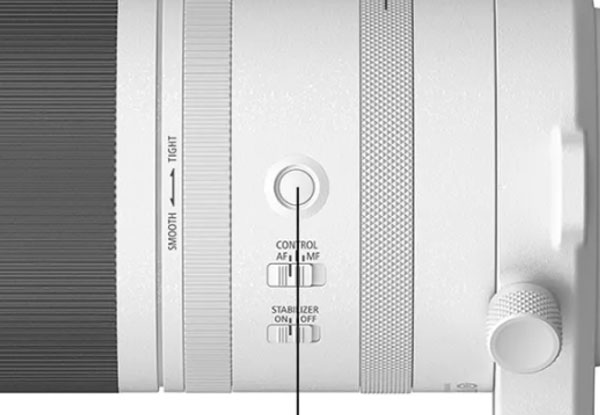
BTW, some sources are saying there is no IS switch, which would be a serious omission. As shown in Laing’s video, it does have one; it’s the IS mode switch which is missing.
EDIT – removed incorrect assertion that there is any difference in AF mechanism between the Canon and Sony. Both use high frequency piezoelectronic motors, under different marketing names.
melcat wrote:
In Australia Canon are asking 40% more for this than Sony are for their popular 200–600mm. The Sony lens is a true internal zoom, and I personally wouldn’t even consider an extending lens as heavy as this Canon. I think few people will pick up on the Canon having nano-USM but the Sony only STM...
Sony 200-600 has STM ? Mine certainly doesn't, you must have one of the early versions
melcat wrote:
In Australia Canon are asking 40% more for this than Sony are for their popular 200–600mm. The Sony lens is a true internal zoom, and I personally wouldn’t even consider an extending lens as heavy as this Canon. I think few people will pick up on the Canon having nano-USM but the Sony only STM. The Canon is not an L, and the Sony is not a GM, just a G (so has weather sealing), so both lenses sit below their brands’ premium range but above the cheapest lenses. The Canon is really only offering a longer focal length. I think this lens will not sell well here.
BTW, some sources are saying there is no IS switch, which would be a serious omission. As shown in Laing’s video, it does have one; it’s the IS mode switch which is missing....Show more →
I watched that part of the video a few times and I missed the word "unlike".
'unlike the 100-500 there's no focus distance limiter switch, nor any panning image stabilization modes to choose from'.
Looks like an IS switch but no mode switch. No Limiter either. From the Canon USA site.
I shoot with old glass and still a DSLR. But, Looking back over the last 12 years. if I would of been shooting at F/8-9 I would not of been able to have at least 50-75% of the photos I have now.
Interesting. I'm 3 years into using Sony 200-600, so comparing to that is obvious.
Biggest attraction is right there in the name, 200-800.
Lighter weight, excellent.
Fixed tripod foot / ring, not so great.
No focus limiter, not so great, although now I will be paying more attention to how advantageous that is.
1 stabilizer mode? I suppose have to wait for user reports for that.
For me, I could not give up the killer feature of the Sony 200-600: The very light, very short 62° zoom ring throw.
Choderboy wrote:
Interesting. I'm 3 years into using Sony 200-600, so comparing to that is obvious.
Biggest attraction is right there in the name, 200-800.
Lighter weight, excellent.
Fixed tripod foot / ring, not so great.
No focus limiter, not so great, although now I will be paying more attention to how advantageous that is.
1 stabilizer mode? I suppose have to wait for user reports for that.
For me, I could not give up the killer feature of the Sony 200-600: The very light, very short 62° zoom ring throw.
I found the limiter switch pretty important. Hunts less when shooting at distance and it is set to the longer distance.
Maybe the system will auto adjust for stills and panning but somehow I doubt it. It always was a bit of a pain. You forget to switch modes in heat of the moment. Sure would be nice to control it via the menus. Still can't figure out why Canon has not added IS mode to the EXIF data. You have to install Phil Harvey's exiftool for that info.
lighthound wrote:
MFD is 8.6ft which is great and it does have weather sealing.
I haven't found the answer yet but does it retract fully with a TC mounted?
gkinard1952 wrote:
I shoot with old glass and still a DSLR. But, Looking back over the last 12 years. if I would of been shooting at F/8-9 I would not of been able to have at least 50-75% of the photos I have now.
Yes, and that shows how fast the development has been since the step to mirrorless, and specifically the step to R5 and R6.
Zenon Char wrote:
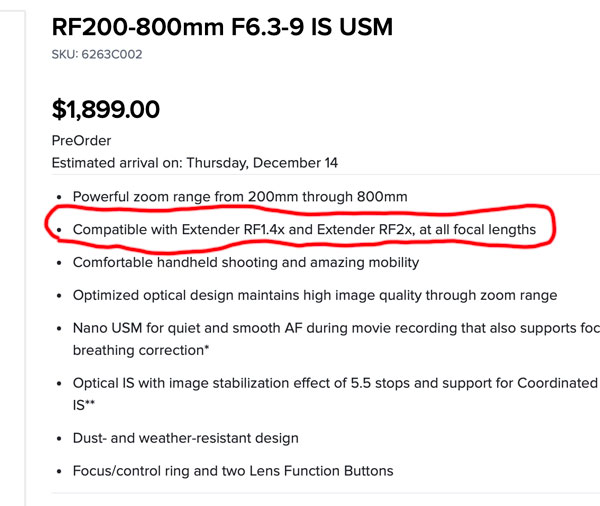
I'm assuming "at all focal lengths" means fully retractable.
That's great news. Obviously they learned from the 100-500 that that was a mistake. I would put good money on the likelihood of the 100-500II also eliminating that restriction.
To be honest though, I wonder how many people would actually need to use a TC on this lens. I know if I ever pick this lens up that I'd probably never need more reach than 800mm in 98% of the situations I get myself into. Hell, even at 800 you're going to need perfect conditions to reduce atmospheric distortions. Not so much for BIF in the sky but for land critters or perched birds it's a known problem.
As great as this lens seems to be so far, I must say I'm a little disappointed that Canon has still left a huge void in the "Mid tier" range of super tele lenses. I feel they have done a great job filling out the low end RF line up and the "non-mortal" high end RF line up, but not a damn thing in the mid range.
There is nothing between the $2600 (100-500) all the way to $12,000 (400/2.8) range. And no the 100-300 doesn't fall into this wildlife lens category as far as I'm concerned. That's a huge gap that could easily be filled with a couple of f/4.5 or maybe even f/5.6 primes. I'd love to see what Canon could do with a target priced prime lens in the $5-$6K range.
I don't mean to be an F/4 snob but there is a saying in the motorcycle world that definitely also applies here.
"There's no replacement for displacement."
Magic happens with fast glass and there is no way around it. Fake BG blur (bokeh) using software doesn't and never will cut it.
Looks like my beloved 500II is safe for a while longer at least.
Zenon Char wrote:
Maybe the system will auto adjust for stills and panning but somehow I doubt it.
AvianScott wrote:
I will have to find the video, but there was a video I watched last night that claimed it auto detects whether it is on a tripod or panning.
DPR's article also states that the 200-800 auto-detects panning.