jwolfe wrote:
I’m no fanboy of anyone. I think all three manufacturers have bad designs. But for its intended purpose this lens is a bad design. Canons RF long glass is a mess. And I’m certainly not the only one with that opinion. Scroll up. And I hear a lot in the field.
That said the R3 is a great camera. I know a lot of sports shooters that love it. And their shorter glass is very very good whereas I think Nikon has less to offer. No company is perfect. They are all tools. But to me in this case I think there’s a lot of missed opportunity....Show more →
I think if you corrected your statements to read 'objectively bad from my perspective' people would agree. As it is, you're ignoring all the reasons other's, with a different perspective than yours, think the design is 'objectively good'. That should clue you in to the fact that your observations and conclusions aren't, indeed, objective. Many like yourself have pronounced several lenses and bodies DOA for their poor design for their intended use, and yet somehow they continue to sell extremely well and post excellent quality images all over the internet. What could explain the disparity in proclamation and results?
Assuming the same sensor tech (and for arguments sake the same MP count).
1. Exposure remains constant regardless of sensor size. Exposure is not a function of the size of the sensor. Exposure is expressed as a point measurement or average of a set of point measurements.
2. Aperture is the relationship between focal length and the light gathering area of a lens. At f1 on a 50mm lens a disk of 50mm wide is gathering light. At f1.4 it's half that surface area (1.4x the diameter). This function is independent of the size of the sensor.
3. *Image Circle* is the part of the lens that projects light over a larger or smaller surface area but this doesn't affect exposure either. Because you get more points of light and not more light at each point. So, while a 24x36mm sensor get approximately 4x more light (2x factor linear) than a m43 sensor, exposure remains unchanged. It does lower the noise floor as the wells will be bigger (wider).
So, if in your example, you use f4 on your Canon and f2 on your m4/3 you'll either have to halve the ISO (same shutter speed) or double the shutter speed (same ISO) to maintain the same *exposure*. Exposure remains constant regardless of imager (sensor) size. If you halve the ISO to maintain a constant exposure, then you see less *apparent* (because noise is always present just not always visible) noise in the m43 image. Therefore, the noise levels at the same output size will appear similar, assuming the m4/3 lens is two stops faster than the 24x36mm equivalent. If both lenses were shot at the exact same exposure then the larger sensor would have a noise advantage (less enlargement) and an apparently shallow DoF.
Grab any two cameras and set them up side by side. Exposure should be the same as long as they measure exposure the same way (no bodged ISO's, etc). Sensor size is irrelevant.
Where the advantage of larger sensors comes in is where exposure parameters are the same. If there's no faster aperture alternative for the smaller sensor. For example the 1.2 primes available for 24x36mm sensors would need an f0.9 (approx.) lens for APSC to get similar noise performance. This is also why current miniMF cameras don't have shallower DoF than 24x36mm cameras. Not as many fast lenses at equivalent focal lengths. Physics....
In the case of the Canon 200-800mm f9 there are faster alternatives for the smaller formats. Some a little and some a lot. There's no way for smaller formats to match the Canon super tele primes or the 200-400 f4. But there is for the 200-800. In the Case of the Olympus 150-400 f4.5 it is twice as fast (two stops) so noise and apparent DoF would be the very similar. Of course the Olympus is 2.5x as expensive, so there's that. The consumer 100-400 f6.3 is one stop faster than the Cano and the sensor has a two stop advantage so the Olympus would be around a stop behind the Canon here.... A Sony a6700 would be around the same as the Canon.....
I say this as someone who currently uses m43 and 24x36 and medium format and APSC systems in most brands currently available. I have been a working photographer and photographic instructor for 35 years. But what would I know......
As I said, I have lots of experience with all formats. And I'm shocked you spent so much time making a point that is irrelevant. I don't care about perfectly matching settings between two formats. I care about matching pictures so I get the picture I want.
1/1000 shutter speed, f9, ISO 12800 on FF vs 1/1000 shutter speed f4.5 ISO 3200 on m4/3. Both have same light exposure, DOF, subject freezing shutter speed, and noise. What is left? How is the m4/3 shot better for having f4.5 vs f9? They are the same picture, so that why they are equivalent. m4/3 only has faster exposure if I ignore the free high ISO range I can use on a large sensor before the noise becomes an issue.
I thought we already had all these arguments 10 years ago on photo forums. And anyone who has used more than one format has seen it in action after 10 minutes of comparing results.
I don’t think there’s any way at to quantify that. Canon doesn’t post sales numbers on lenses and the market has contracted so much that if you’re a Canon user what other options do you have?
So you’re telling me you’re ok with a non removable tripod mount for no reason and a poor aperture spread? How are you gonna mount it on a tripod in a stable way? Internal zooming is neither here nor there. But I mean common the Nikon 180-600 and Sony 200-600 both have removable feet. So does pretty much any other long lens these days.
jedibrain wrote:
I think if you corrected your statements to read 'objectively bad from my perspective' people would agree. As it is, you're ignoring all the reasons other's, with a different perspective than yours, think the design is 'objectively good'. That should clue you in to the fact that your observations and conclusions aren't, indeed, objective. Many like yourself have pronounced several lenses and bodies DOA for their poor design for their intended use, and yet somehow they continue to sell extremely well and post excellent quality images all over the internet. What could explain the disparity in proclamation and results?
Zenon Char wrote:
That has never bothered me and I like how compact the 100-500 is without it. In 3 years I bet I don't have a single shot with less than 400mm. Most are between 600-700mm. I like it.
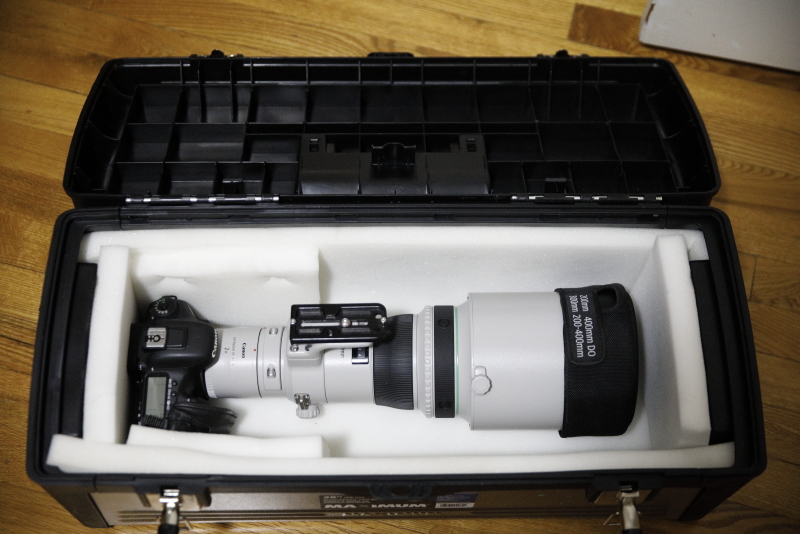
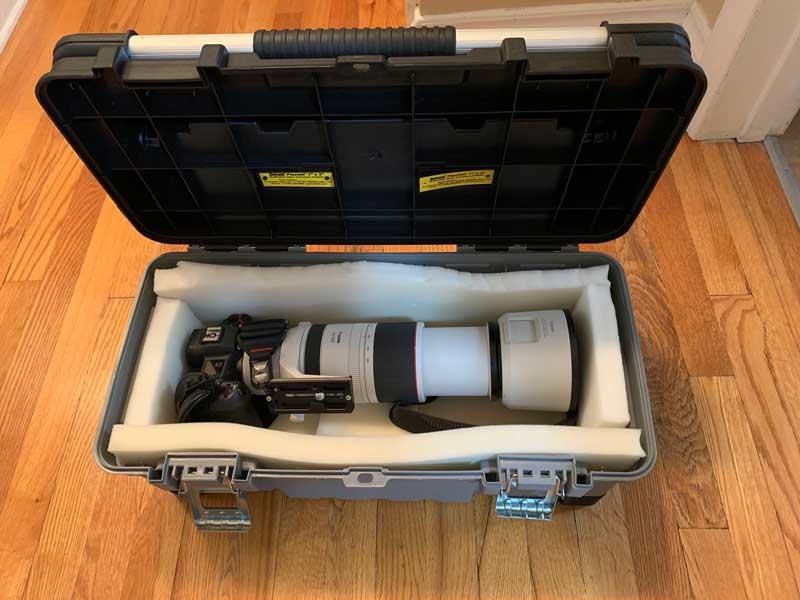
I have shown this before for local transportation. It started out for my DO 400 II so I didn't keep having to remove the lens hood and it ed to the 100-500. At location I use my PD shoulder strap and have a small lens pouch attached to the my belt for the TC.
I later came across this. Drop in so no zippers to worry about forgetting to do up. Once a brand new lens went flying out of a backpack style bag. I even took it to Europe as a checked but had clothes in it.
jwolfe wrote:
I don’t think there’s any way at to quantify that. Canon doesn’t post sales numbers on lenses and the market has contracted so much that if you’re a Canon user what other options do you have?
So you’re telling me you’re ok with a non removable tripod mount for no reason and a poor aperture spread? How are you gonna mount it on a tripod in a stable way? Internal zooming is neither here nor there. But I mean common the Nikon 180-600 and Sony 200-600 both have removable feet. So does pretty much any other long lens these days.
While sales numbers are not available per lens or per body, you can find aggregated numbers for the various manufacturers. And if Canon kept 'stacking Ls (losses)' as the kids like to say, you'd see it in the numbers. Instead they continue to be strong.
Non removable tripod foot is less than ideal, but its the bathwater to the baby. As an engineer you should know there is no free lunch, so to get a wider aperture anywhere along the zoom range, the front element has to get bigger, heavier, and more expensive. Because YOU wanted $3-6k lens that's faster with a removable foot does not mean this more budget friendly slower lens is 'objectively bad'. That's all I'm saying.
jwolfe wrote:
I don’t think there’s any way at to quantify that. Canon doesn’t post sales numbers on lenses and the market has contracted so much that if you’re a Canon user what other options do you have?
So you’re telling me you’re ok with a non removable tripod mount for no reason and a poor aperture spread? How are you gonna mount it on a tripod in a stable way? Internal zooming is neither here nor there. But I mean common the Nikon 180-600 and Sony 200-600 both have removable feet. So does pretty much any other long lens these days.
I'd be mostly using the lens hh if I got one, at this point. So a removable tripod foot isn't a particularly big concern. I just rotated the one on my 180 for years, out of the way, not a big deal
I already use 7.1 a lot on aps, f/9 is only 2/3 stop different. Any IS improvements over the 55-250 STM could cover that 2/3 stop pretty easily. 800/11 is apparently pretty easily usable to 1/30, if I got that at 800 on this lens, there's the 2/3 stop, right the there, at 800mm vs 250mm
Poor aperture spread? Come on. Anything else you'd like to complain about?
There would have been numerous ways to make the design better without increasing the price. The 100-500 has an equally bad design yet somehow Sony and Nikon managed to make better lenses for the same money. I’ve had numerous friends drop their 100-500’s because of the poor tripod collar design. Can you honestly tell me that lens has as good of design as the EF 100-400? I mean common. You see it all across the range of current Canon products. Another example - I can turn on and turn off a Nikon or a Sony body without moving my hand or my eye away from the camera. Canon has no cohesive button layout after decades of having great button design. And when you’re wearing gloves in the field and sparing your battery those details matter.
jedibrain wrote:
While sales numbers are not available per lens or per body, you can find aggregated numbers for the various manufacturers. And if Canon kept 'stacking Ls (losses)' as the kids like to say, you'd see it in the numbers. Instead they continue to be strong.
Non removable tripod foot is less than ideal, but its the bathwater to the baby. As an engineer you should know there is no free lunch, so to get a wider aperture anywhere along the zoom range, the front element has to get bigger, heavier, and more expensive. Because YOU wanted $3-6k lens that's faster with a removable foot does not mean this more budget friendly slower lens is 'objectively bad'. That's all I'm saying.
Yes, Canon has made some stupid design choices on telephoto lenses, regardless of the prices, such as
no lens hood, no focus-limiter, stupid lens collar, etc.
I think for a company that charges a premium over their competitors we should expect a bit better.
Are details like having to add an arca swiss plate a deal breaker? No, but If I spend 2+ grands on a telephoto lens I would expect not have to add one or at least be able to replace the foot.
Is the asymmetric design of the lens mount a deal breaker? No, but it’s super annoying fiddling with lens caps in the field
Is the lack of a lightweight 600mm 6.3 and 800 6.3 a deal breaker? No I can do with a 100-400, 500 f4 and teleconverter but I have to cope with a really heavy backpack.
Is it a deal breaker that the 400 and 600, 800 and 1200 primes are a recycled ef design? No but i would have preferred that they prioritised new designs, the 800 and 1200 are almost a joke and just released for marketing purposes.
Is the lack of an affordable stacked sensor camera like the z8 a deal breaker? No my r5 is good enough but if I had to switch to mirrorless now instead of 2 years ago I would choose nikon over canon and I have been with canon since the first 300d.
Now is great that we have a zoom that as some people here say can shoot at 800mm f9 1/30 of a sec, but honestly I don’t think I would be able to say that that would be the 80% of the situations I want to be in.
If you are canon wildlife shooter you either spend 2k for a slow zoom, 5k for a second hand, heavy and soon unserviceable prime or 10k+ plus for a prime without integrated converter.
I think canon did a great job with the 100-300 but then just a few months later sony shows that you can shave a kg from a 300 2.8, and you can get it for 6k instead of 10k.
So I hope canon catches up and starts filling the gaps in the 2-10k range or if you want in the 1.3-3kg or f4-f7.1 ranges
Canon is capable of making lenses for various price points, and targeted market.
In the case of the 200-800 & it's specks, it is geared at a price point & target market.
Can it be frustrating for some, sure. Especially when they are deep in $$$ to the system
It's not so easy to sell the system at a loss, and move to a system that best addresses there needs.
For others they eagerly await the release to pick one up.
All coming in weight wise, real close to one another
Canon 200-800 f/6.3-9 IS USM apprx $1900 External Zoom
Nikon 180-600mm f/5.6-6.3 apprx $1700 Internal Zoom
Sony 200-600mm f/5.6-6.3 apprx $1900 Internal Zoom
Here's the breakdown of Fstop and Zoom range of Canon 100-500 & 200-800
IMHO, Nikon and Sony gets the needs of Recreational & Amateur sports & wildlife shooters better than Canon
I think there is a lot of over thinking here. This Canon 200-800 is designed with 3 aims. First is cost to be attractive to impoverished wildlife photographers like me. Second is to extend the range out to 800mm so I can get a picture of that bird I can't get near to. Third is to give it an image quality that is competitive with cropped xxx-600 lenses. It looks like it satisfies all these. I will buy one. I don't give two hoots about the foot, I still have it attached to all the other lenses I own, and f9 on my R6 at high ISO is no worry, I get great shots now at 10,000. It's a lens built to a price, get over it.
I too don’t understand complaints about the tripod foot not coming off. The lens is heavy enough that I would always want to use it as a handle for carrying the lens. This is not the case with my 100–500, whose tripod collar and foot is currently off the lens in a cupboard.
By the way, I’ve seen at least one claim that the tripod ring does come off, the same way as some older L lenses like the 180mm f/2.5 macro and 300mm f/4 IS: with the lens not mounted on a camera, you rotate the ring to a marked position and slide it off backwards towards the mount. This method has the advantage the if the lens is mounted to a camera, the tripod ring can become loose but will still act as a halter around the base of the lens; it has the disadvantage that there are small metal pips on the lens barrel with the tripod collar removed.
I can see why Canon used the hinged mechanism on the RF 100–500mm: for those not using a quick-release system on their tripod head, you can quickly release the lens from the tripod without dismounting the lens and risking getting crud on the sensor. It is indeed fiddly, but my observation was that it was assembled with too little grease on the prong tip, and I added some more. I prefer this to the tripod foot on my EF 100–400mm f/4.5–5.6 IS II, which I replaced with the Kirk foot, which improves the fastening but not the carrying. I actually think Canon did put some thought into the tripod feet on the new lenses and came up with designs suited to each use case. Arca-Swiss would have been nice, but the dovetails do tend to bite into one’s hand, and some people do use other systems.
I don't have a 100-500 to compare to my 100-400. So I can't answer that question. The only one that remains then is why you are not chief of R&D at Canon or another brand? They are so obviously clueless you could walk right in to the job.
jwolfe wrote:
There would have been numerous ways to make the design better without increasing the price. The 100-500 has an equally bad design yet somehow Sony and Nikon managed to make better lenses for the same money. I’ve had numerous friends drop their 100-500’s because of the poor tripod collar design. Can you honestly tell me that lens has as good of design as the EF 100-400? I mean common. You see it all across the range of current Canon products. Another example - I can turn on and turn off a Nikon or a Sony body without moving my hand or my eye away from the camera. Canon has no cohesive button layout after decades of having great button design. And when you’re wearing gloves in the field and sparing your battery those details matter.
Ferrophot wrote:
It's a lens built to a price, get over it.
Yes, but it’s then sold at a premium in some countries (actually most places except the US). Canon’s costs are mostly in yen, yet the RF lenses are priced internationally in USD. This lens is overpriced by 50% or more here in Australia.
Preorder price at Ted’s $3499.95 AUD (this includes GST, our value added tax).
Price from B&H New York, converted at 1 AUD = 0.63 USD and with 10% added for GST: $3315.11 AUD. (Not that they will ship it here, Canon forbids it.)
OK, $184 AUD to cover the better statutory warranty here and Canon’s 5 year warranty in Australia is fair, right? Well, not really:
1 AUD = 96.59 YEN, historical average around 80¥ to 90¥
1 USD = 151.52 YEN, historically around 100¥
Lenses from Japan should have got cheaper in Australia because the yen is weak.
In times of war like this the USD rises against all other currencies, especially trade-dependent ones like YEN and AUD. Canon is just profiteering here.
For someone like me sitting on a pile of EF lenses bought when the AUD was stronger against the USD (in some cases, when it was $1.20) this lens does not look cheap.
Regarding the collar being removable in a certain position like some older lenses, and the EF70-200 2.8L IS II, those lenses didn't have the carrying strap fixtures on the collar. Those fixtures make that kind of solution less than ideal on this lens. In this case a removable foot, that you could be replaced with an AS type, would be preferrable. But I guess that is considered a luxury, just above the "hood included" on the luxury ladder.
The hood did make it through with the bean counters, but not the foot and the focus limiter switch.
Nobody cares to look at the RAWs that show how good the lens is at 800mm F9. But everybody seems to care that this lens does not have a removable tripod collar that btw no other Canon big withe tele has a removable one neither (100-300, 400, 500, 600, 800, 1200). Strange what people priorities are.
This lens is probably the sharpest 800mm below 6k USD (and even handholdable) across the market and people complain about the collar.
alundeb wrote:
The hood did make it through with the bean counters, but not the foot and the focus limiter switch.
It uses the same hood as the 800/11. Perhaps that hood has not been the best selling item, so they are happy to find a way to free up some space for the 200-500 f/4. Should be about 1:1, the space.
I got the ET-101 for my 800/11 and will shorten it for the 200-800 depending on how the new lens works, like the short versions of the big white´s hoods. Perhaps I will paint it white!
action99 wrote:
Nobody cares to look at the RAWs that show how good the lens is at 800mm F9. But everybody seems to care that this lens does not have a removable tripod collar that btw no other Canon big withe tele has a removable one neither (100-300, 400, 500, 600, 800, 1200). Strange what people priorities are.
This lens is probably the sharpest 800mm below 6k USD (and even handholdable) across the market and people complain about the collar.
Totally agree, the collar is just a minor detail. Since people disagree about what is good collar and foot design, it might be worth clarifying exactly that through discussion.
IMO the 200-800 is a better option than the 200-600 varietes from the competition if you are after an 800 mm lens. Lots of people using the 200-600 are exactly that without admitting it, you see it on how many shots that are taken at 600 mm or with a TC attached.